

How Schalke Academy Can Offset Financial Concerns at Bundesliga Club
Tuesday evening may have marked a turning point in Schalke's history under Roberto Di Matteo.
The Gelsenkirchen side became the first team ever to score four goals at the Santiago Bernabeu in a Champions League knockout-round fixture, overcoming hosts Real Madrid 4-3.
The match ended in heartbreak as Schalke, who'd lost the home leg 2-0, were eliminated on aggregate despite coming within inches of scoring a fifth goal that would have put them through on away goals. Yet it also was the first time in several years that Die Knappen exited Europe's most elite club competition with heads held high.
TOP NEWS
Live Highlights and Viral Moments 🍿

Final Men's Ballon d'Or Rankings 📊
Most to Blame at Man Utd? 😡
A year ago, Schalke were also eliminated by Real in the round of 16, but by a 9-2 aggregate score. The previous year, they were defeated by modest Galatasaray at the same stage.
"19-year old Leroy Sané scored this on his champions league debut at the Santiago Bernabeu! What a goal! https://t.co/RQUCcIH254
— Kyle (@AFCKyle5297) March 12, 2015"
The team that featured on Tuesday in many ways resembled the side that hammered then-champions Inter 5-2 in Milan in the spring of 2011 and reached the semifinals.
The 2011 team was anchored by the veteran leadership of Raul and featured rising talents in Kyriakos Papadopoulos and Joel Matip. On Tuesday, Klaas-Jan Huntelaar played the leader's role, while 19-year-olds Leroy Sane, Max Meyer and Timon Wellenreuther and 20-year-old Leon Goretzka came of age.
The match proved to be a glowing endorsement of Schalke's academy, perhaps the biggest in a growing list of accolades.
Last season, the Royal Blues' under-19 side reached the semi-finals of the UEFA Youth League before being defeated by eventual champions Barcelona, despite being without their two best eligible stars in Meyer and Goretzka.
Their graduates include such superstars as Manuel Neuer, Mesut Ozil and Julian Draxler as well as other international players like Joel Matip and Benedikt Howedes. Indeed, graduates of Schalke's academy played more minutes for Germany at the World Cup than those of any other academy.

Since Di Matteo's signing last October, Schalke have changed substantially. Their typical attacking flare has been replaced with a gritty, defensive style. The trainer's 5-3-2 formation has limited the number of forward-minded players he can use, thus inhibiting the use of the club's best young assets.
And until recently, his conservative tactics meant sacrificing the young and promising Meyer for the more physically robust Kevin-Prince Boateng.
The Italian trainer may have to revise his plans either by necessity or on-pitch performance, however.
On Thursday, Bild columnist Alfred Draxler wrote (in German) that Boateng's contract includes a clause that will extend his contract with €7 million annual wages automatically if he appears in 70 percent of Schalke's games this season.
The Ghana international was benched last weekend, and it appears that the club are unwilling to let him reach the 70 percent mark in order to ensure his costly wages are removed from their books sooner than later.
Boateng was signed in August of 2013 in order to bring some much-needed depth to the Schalke attack and add some established quality to supplement the academy's graduates. This season, though, he's been simply woeful, and his benching was a long time coming.
And as against Real, his presence was not missed in Schalke's win against Hoffenheim last weekend, in which the brilliant Meyer stood in for him and netted a brace.
Schalke may have substantial revenue (their earnings were €213.9 million in 2013-14, the 14th-highest in Europe, per Deloitte), but their sizable debt has been a concern in recent years.
Adding to the club's financial concerns is that their main sponsor is Gazprom, the state-owned Russian fuel company that has been rocked by the country's financial woes in recent months. Bild reported in December that Schalke could lose their sponsorship, a blow that would cost the club €15-25 million per year depending on performance.
Because of uncertain finances, Schalke have had to be careful with spending and have had limited resources to tap. They confirmed the full transfer of Matija Nastasic on Saturday but in all likelihood will have a rather quiet summer transfer window.
They could use a good holding midfielder like Sami Khedira (who'd be available on a free transfer) or Johannes Geis (who is under contract at Mainz through June 2017), but otherwise probably won't do very much in the transfer market. And in fairness, they won't have to.
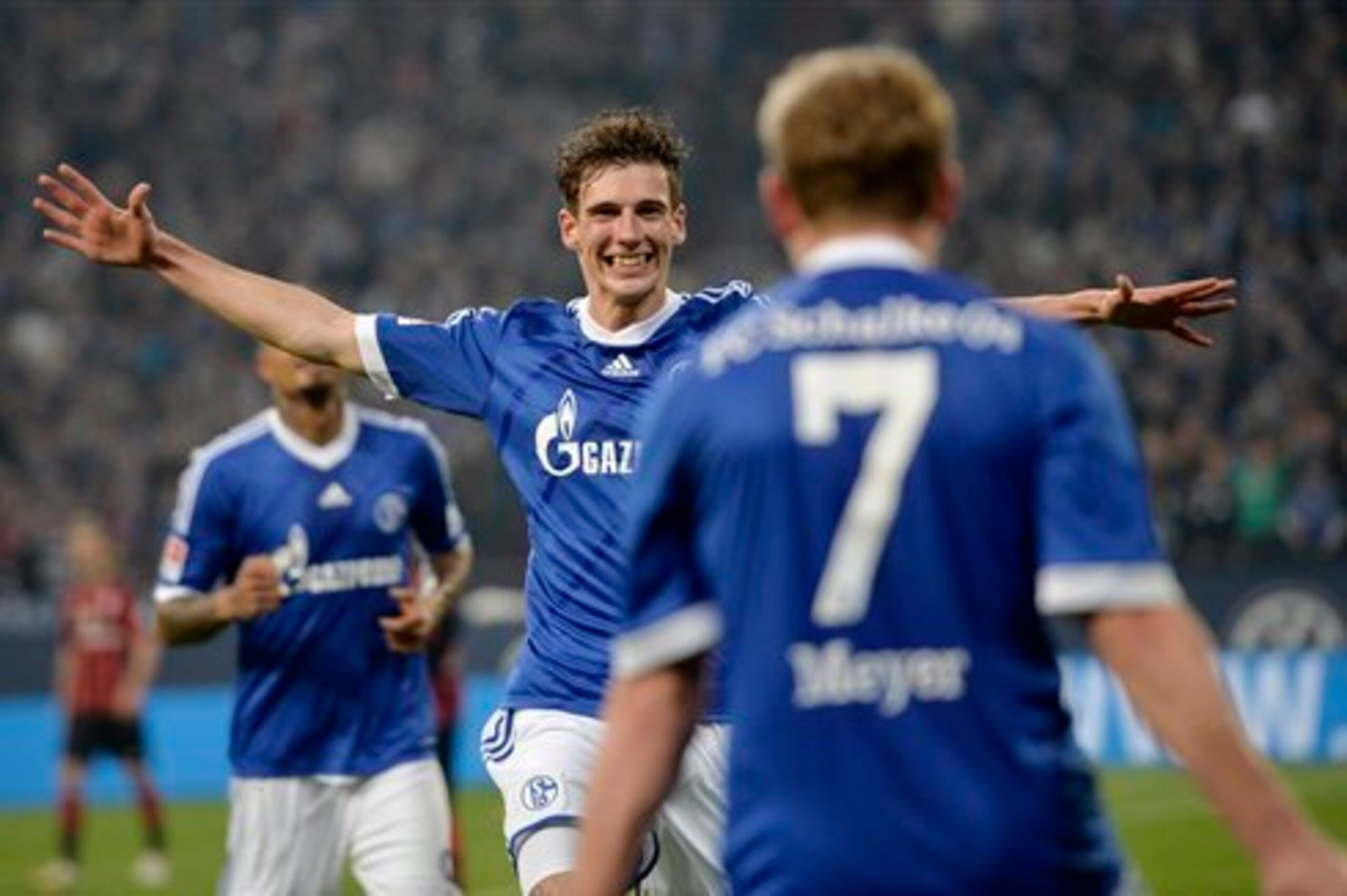
With each passing year, Schalke can expect their youngsters to mature and improve. Draxler has missed most of the season and will be like a new signing when he returns. Still 21, he has enormous potential. The same can be said of Goretzka, who only made his first appearances of the season over the last week.
Meyer has made enormous strides in the last week, as has Sane, and both may be superstars in the next couple of years. Felix Platte also looks to be a real talent at center forward, having hit the woodwork with a stunning strike in the first leg against Real.
Beyond the most obvious talents, Donis Avdijaj will be one to watch during his loan spell at Sturm Graz. The 18-year-old's record stands at 76 goals and 18 assists in 69 under-17 and under-19 Bundesliga matches, which explains why Schalke slapped (per SportBild) a €49 million release clause on his first professional contract.
In defense, 20-year-old Kaan Ayhan is Turkey's biggest prospect at center-back, while 19-year-old Marvin Friedrich was (along with Sane) one of two Schalke players named to last season's Youth League Team of the Year.
All in all, Schalke's financial woes are very well masked by their magnificent academy. The Royal Blues continue to churn out quality players every year and as such don't have to worry so much about bringing in expensive players on high wages like Boateng. And if need be, they can always sell their young talents at high value.
Tuesday's match was abundant proof that having a veteran (i.e. Huntelaar) to provide leadership and take the youngsters under his wing may be good, but the youngsters Schalke produce are ready to deliver, often even in their teens.
And it seems their academy is only getting better. Never before have they had so many young players ready to deliver at the highest level.
As dark as their financial situation may be, the future indeed looks very bright for Schalke.

.jpg?w=2560 "Chiefs Giants Football")
.jpg?w=2560 "5 Teams Eyeing Jonathan Taylor")
.jpg?w=2560 "Jonathan Taylor Landing Spots 📍")
.jpg?w=2560 "Baker Gets Glove From Rays 🧤")
.jpg?w=2560 "NFL investigating Eagles")

