

Packers, Mike McCarthy Know Team Must Address ILB Position in 2015 Draft
It was nearly a year ago that Green Bay Packers head coach Mike McCarthy stood at the combine podium in Indianapolis and listened to a barrage of questions about his failing safety position.
General manager Ted Thompson eventually provided him with an answer, using the 21st pick in the first round on Alabama safety Ha Ha Clinton-Dix. Problem solved.
Fast forward to 2015, and McCarthy is back in Indianapolis facing an almost identical question mark—which may require an identical solution—at inside linebacker.
TOP NEWS
.jpg?w=2560 "Rams Raiders Football")
Raiders Could Start Mendoza

Geno Explains Wilson Exchange
Contenders starting to separate themselves after Week 7
"I think the inside linebacker position could probably be compared to where we were last year at the safety position," McCarthy told reporters at the combine Thursday. "Obviously, we had a number of moving parts there. We’ll see what this process that we go through as far as player acquisition, how that affects it."
The first step is admitting you have a problem. And the Packers clearly have issues at a position of growing importance.
A.J. Hawk and Brad Jones began the season in Seattle as the team's starting inside linebackers. The pair each played all 70 snaps in the 36-16 loss. But by the time the Packers returned to the Pacific Northwest for the NFC Championship Game, neither veteran was playing more than 20 defensive snaps per game. In fact, Jones didn't even see the field on defense.
| A. Hawk | 852 | -11.6 | 52nd |
| S. Barrington | 366 | -4.6 | 34th |
| B. Jones | 211 | -11.4 | 51st |
| J. Lattimore | 285 | -2.1 | 30th |
Both players may become cap casualties this spring.
The Packers could gain $3.5 million in cap room by releasing Hawk and another $3.75 million by cutting ties with Jones. A move looks almost certain for Jones, a defensive liability who eventually became an overpaid special teams player. In no scenario is Jones worth his $3.25 million base salary or $4.75 million cap hit in 2015. The Packers will likely wash their hands of the bad contract and move on, taking the $1 million dead money hit to clear the $3.5 million.
UPDATE: The Packers announced Friday afternoon that Jones had been released.
Hawk's situation is a little more complicated.
According to Rob Demovsky of ESPN, Hawk had bone spurs removed from his ankle after the season. The injury limited Hawk's mobility and forced the veteran to compensate by cutting weight. Per Demovsky's source, which is almost certainly Hawk's agent, the former No. 5 overall pick played last season at 235 pounds.
The injury and weight loss do help partially explain why Hawk played so small—both literally and figuratively—for most of 2015. By the time the Packers arrived in Seattle in January, Hawk was nothing more than a shell of his former self.

On Marshawn Lynch's go-ahead touchdown run in the fourth quarter, Hawk found himself blocked and in the wrong gap—potentially due to his lack of horizontal agility. Lynch burst through the unattended opening for a 24-yard score. It was one of many moments that had some questioning if Hawk was done.
Bob McGinn of the Milwaukee Journal Sentinel might have put it best in his final defensive grades for the 2014 season.
"It was sad, really," McGinn wrote. "Hawk, a durable, contributing part of this defense for eight years, hit the wall. Hawk had been slipping but it was never this bad."
His lingering injury certainly played a part in the regression. And it's possible the Packers will monitor Hawk's recovery instead of cutting him, with hopes he can regain mobility and weight and come back as a veteran presence at the position.
But in no rational world can the Packers bank on Hawk returning from injury to save the inside linebacker group.
Remember, McCarthy once hit a point so low on viable options that he needed to move Clay Matthews—his best edge player—inside. While a risk, McCarthy basically had no other alternative. The Packers were getting gashed inside, with Green Bay ranked 32nd against the run after eight games. Drastic measures were needed.
Matthews and second-year linebacker Sam Barrington held their own over the second half. The Packers may still give Matthews snaps at inside linebacker in 2015, and McCarthy was complimentary of Barrington's progression.
"I like the step Sam Barrington made," McCarthy said. "I thought he made a huge step, and that's what you look for."
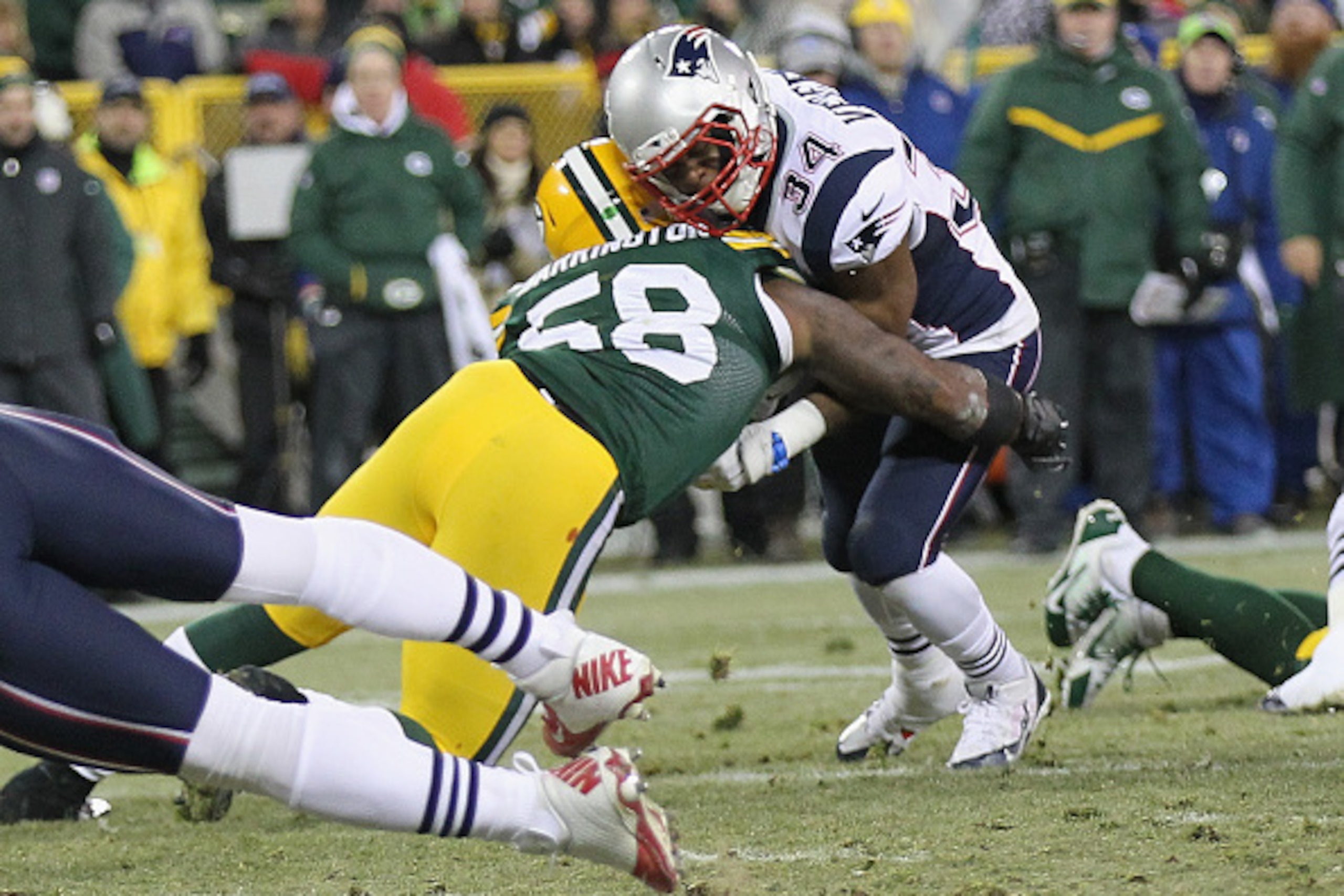
However, Matthews is probably best utilized as an every-down edge player, and an inside pairing of Barrington and Hawk has as much appeal as watching Seattle's onside kick bounce off the head of Brandon Bostick on a continuous loop.
The parallel with Green Bay's pre-Clinton-Dix safety position is certainly there. The Packers went into the 2013 season overvaluing the likes of M.D. Jennings and Jerron McMillian and paid the price when the two were huge flops in featured roles. Jennings and McMillian were eventually exiled, and a first-round pick was needed to patch the remaining hole.
In 2014, the Packers put far too much trust in a group consisting of Hawk, Jones, Barrington and Jamari Lattimore. Three of the four (Lattimore is a free agent) could be jettisoned this spring, once again leaving the potential for Thompson to use another first rounder to stop the leak.
The options at inside linebacker appear to have more depth this year than the last, when Alabama's C.J. Mosley came off the board before Green Bay's first pick. The next best player was Wisconsin's Chris Borland, and he was selected by the San Francisco 49ers before the Packers' pick in the third round.
Five different inside linebackers have been mocked in the first round by various sites and publications in 2015: UCLA's Eric Kendricks, TCU's Paul Dawson, Miss. State's Benardrick McKinney, Miami's Denzel Perryman and Clemson's Stephone Anthony.
Ramik Wilson of Georgia is another intriguing mid-round prospect.
Bottom line: There's really no excuse for the Packers to once again overlook the position in the draft.
Thompson's board and the values associated with it will always rule draft decisions, but need has undoubtedly played a role in Green Bay's recent first-round picks.
In 2009, the Packers were transitioning to the 3-4 defense and needed building blocks. Hello, B.J. Raji and Clay Matthews.
| 2012 | OLB Nick Perry |
| 2013 | DE Datone Jones |
| 2014 | S Ha Ha Clinton-Dix |
In 2010 and 2011, offensive tackles Mark Tauscher and Chad Clifton were nearing the end. Hello, Bryan Bulaga and Derek Sherrod.
In 2012, the defense needed to find a viable edge player opposite Matthews. Hello, Nick Perry.
In 2013, the Packers were thin on the defensive line and in need of a starting 5-technique. Hello, Datone Jones.
And finally, in 2014, the dumpster fire at safety was in need of extinguishing. Hello, Ha Ha Clinton-Dix.
Thompson has, for better or worse, been a predictable drafter in the first round. On some level, need has influenced the team's decisions early in the draft.
How the Packers fare in bringing back their own free agents will set some of the team's drafting needs. Losing either Randall Cobb or Bryan Bulaga could shift priorities. But it's hard to imagine any one position becoming a bigger priority than inside linebacker, especially if Hawk or Jones is sent packing.
The Packers are typically tight-lipped about draft plans, especially this time of year. But McCarthy said it all when he compared his team's current inside linebackers to last year's safeties.
The message was loud and clear. The position is a problem he wants his general manager to address.
Once again, expect the draft—and potentially the No. 30 overall pick—to be the tool Thompson uses to fix the issue.
Zach Kruse covers the NFC North for Bleacher Report.
.jpg?w=2560 "Steelers Saints Football")



.jpg?w=2560 "🚨 Week 8 AP Top 25 Poll")
