
New York Giants Mock Draft: 7-Round Predictions, Post Combine
The measurements are in the books, the interviews are done (for now), and the draft picture for the New York Giants is no doubt starting to become a lot clearer following the annual NFL Scouting Combine.
While the final draft board is far from being set—scouts will be dispatched to the various pro days for a final look at players of interest, while some players will be invited to the Giants’ East Rutherford headquarters—here is an updated, post-combine Giants mock draft.
Round 1: OL Brandon Scherff, Iowa
1 of 8The late George Young, in his role as general manager of the Giants, had a soft spot in his heart for what he affectionately referred to as dancing elephants, according to an archived article by Buster Olney, then of The New York Times.
Young’s theory was that teams fared better with big, powerful offensive linemen who imposed their will in the trenches, whereas smaller guys didn’t hold up as well.
Given how hard the Giants have been hit by injuries across the board, maybe Young was onto something, and maybe Jerry Reese, who started his Giants career as a scout under Young’s regime, finally understands that it is shortsighted to skim on the offensive line talent.
To that end, Reese has drafted two starting offensive linemen in the first and second round of the last two years, Justin Pugh and Weston Richburg, respectively.
This year could very well be the third straight draft that Reese and the Giants go offensive line early in the draft, and if they do, the choice has to be Iowa’s Brandon Scherff (6’5”, 319 lbs).
A college left tackle, there are numerous draft scouts who believe that Scherff is best suited for guard. Dane Brugler of NFLDraftScout.com offered that if Scherff's arms measured under 33", that would likely seal the deal as far as him being a guard at the NFL level.
According to the NFL.com combine results tracker, Scherrf’s arm length came in at 33.375".
However, a similar concern was expressed about Pugh when he entered the draft. Despite short arms, Pugh was effective as a rookie at right tackle, though he did struggle last season with his consistency.
Getting back to Scherff, he is the safe choice at No. 9 if he’s there.
The Giants need a powerful road grader on that offensive line to help the running game. That just so happens to be one of Scherff’s strengths, according to NFL.com’s Lance Zierlein, who praises Scherff as a “powerful run-blocker with exceptional power in hips and legs [who] moves well laterally and rarely allows defensive ends to set edge against him.”
Want another reason to be sold on Scherff? According to ESPN’s scouting profile, Scherff plays with a nasty disposition without playing dirty, and finishes his blocks.
The Giants offensive line desperately needs a road grader who can impose his will on the opponent. Whether he plays guard or tackle, Scherff looks to be just what they need in that regard assuming that Scherff, who injured his right hamstring during combine workouts, checks out medically a the draft draws closer.
Round 2: ILB Denzel Perryman, Miami
2 of 8Last year, the Giants took a step in the right direction regarding the rebuilding of their linebacker unit when they snared Devon Kennard in the fifth round.
Kennard played well enough as a rookie and likely enters 2015 as the starting strong-side linebacker in Steve Spagnuolo’s defense.
This year, the Giants need to continue to rebuild that unit via the draft, and next up on the priority list should be middle linebacker.
General manager Jerry Reese avoided giving a direct response when asked if incumbent starting middle linebacker, Jon Beason, would continue in that role in 2015.
“Jon is under contract,” Reese said. “We will see where that goes, but he is under contract."
There are two ways to interpret Reese’s response.
One, obviously, is that the Giants are trying to get Beason, who only played in four games last year due to a toe injury, to lower his $6.691 million cap figure.
If a new cap figure can’t be reached, the Giants may end up terminating Beason’s contract before March 15, the date on which, per Over the Cap, he’s due a $1 million roster bonus.
The other way to interpret that is that maybe the Giants are looking at potentially bringing in the successor to Beason via the draft, a long-term prospect that can be had for a fraction of the cost of a veteran, but who also has more upside.
Given Beason’s unfortunate injury history, that candidate will probably have to be ready to step in at a moment’s notice.
A candidate who fits that role is Denzel Perryman of Miami. Besides sharing an alma mater with Beason and having sported Beason’s No. 52 while in college, Perryman has been compared to Beason by NFL Network’s Mike Mayock.
It’s easy to see why. Both Beason and Perryman were considered undersized coming out of college—Beason at 6’0”, 232 lbs, and Perryman at 5’11”, 236 lbs.
Perryman, like Beason, is a thumper whom Derek Stephens and Rob Rang of NFLDraftScout.com describe as “a compact, instinctive defender whose open-field tackling and awareness could result in a long and distinguished pro career.”
Also like Beason, Lance Zierlein of NFL.com notes that Perryman is stouter in run defense than if isolated in coverage.
If it is Perryman, a top performer among inside linebackers in the 40-yard dash (4.78 seconds), bench press (27 reps) and broad jump (113 inches), the Giants will likely have to get him in the second round, if he’s there, which is where the former Hurricane is projected to go according to Stephens and Rang.
".@MiamiHurricanes' Denzel Perryman is Mike Mayock's #3 LB. And he just ran a 4.78 40. WATCH: http://t.co/DYNjuy9hS9 pic.twitter.com/hap9RitUNE
— NFL (@nfl) February 22, 2015"
Round 3: DT Joey Mbu, Houston
3 of 8Switching to the defensive line, the Giants need some fresh blood at defensive tackle to complement Johnathan Hankins and Jay Bromley.
Houston’s Joey Mbu (6’3”, 313 lbs) is a big-bodied prospect and team leader who, while not excelling in any one particular area, plays to the whistle.
According to NFL.com’s Lance Zierlein, Mbu is particularly adept at sniffing out screen passes and reacting accordingly.
Rob Rang of NFL Draft Scout, who projects Mbu as a third-round prospect, touts him as having the prototypical frame for a run-stuffer who can hold up well at the point of attack.
While not as effective just yet in the pass rush, Mbu, who has eight career pass breakups, will get his hands up to try to bat balls down at the line of scrimmage.
At this point, Mbu is a raw prospect whose overall game needs some refinement.
Given that he possesses the football IQ and the desire to get better at his craft, a year or two in a pro-level program could help him round into a more complete defender who is able to contribute down the line.

.jpg?w=2560 "Falcons Saints Football")
.jpg?w=2560 "Rams Eagles Football")
Round 4: FS Kurtis Drummond, Michigan State
4 of 8In news that should surprise absolutely no one, the Giants need help at the safety position, where barring anything changing between now and the start of free agency, they’ll have two inexperienced young players—Nat Berhe and Cooper Taylor—under contract.
General Manager Jerry Reese told reporters at the combine that Taylor, who has spent all or part of his first two seasons in the NFL on injured reserve, and Berhe would get a chance to compete. The problem, though, is that Berhe and Taylor both appear to be better suited for playing the strong safety spot.
So what do they do at free safety, a staple in a defensive secondary?
Ideally, a veteran free agent like Devin McCourty of the New England Patriots would be the top choice if he’s not franchised.
However, Shalise Manza Young of the The Boston Globe believes the franchise tag for McCourty could be the case.
In the draft, Kurtis Drummond of Michigan State might make sense in the fourth round.
Standing 6'1" and weighing in at 200 lbs, Drummond was part of the Spartans’ “No Fly Zone” defense.
Lance Zierlein of NFL.com notes that Drummond has NFL-caliber speed and can line up against slot receivers with success.
Another reason to like Drummond, whose tackling technique can probably be fixed with coaching, is that he is versatile enough to move down into the box in run support and contribute on special teams.
A primary knock against Drummond is his tackling, which Zierlein described as “catch-and-drag.” That is something that can be corrected through coaching and technique work.
Round 5: OG Ali Marpet, Hobart
5 of 8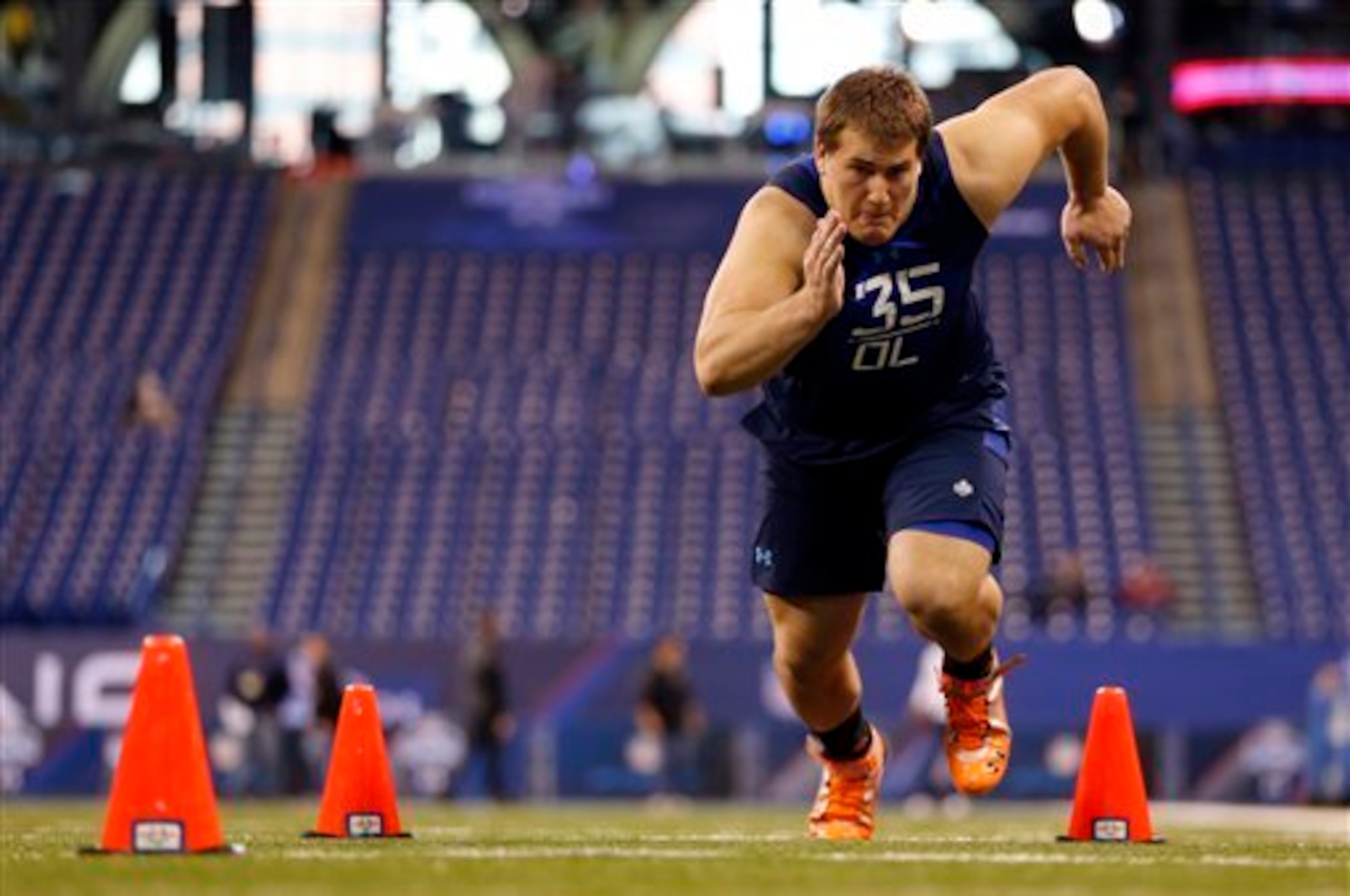
One player who has seen his draft stock rise since the start of the new year is offensive lineman Ali Marpet, a college tackle who projects to guard at the NFL level.
According to Eric Edholm of Yahoo Sports, the 6’4”, 307-pound Marpet was the fastest of the offensive linemen who ran at the combine.
Marpet clocked in at 4.98 seconds in the 40-yard dash, but more importantly, logged in at 1.74 seconds in the 10-yard split, the more telling stat for an offensive lineman given that they rarely have to run more than 10 yards down field to get to the second level.
Edholm also noted that Marpet, from tiny Hobart College in upstate New York, held his own against prospective top-10 prospect Washington defensive tackle Danny Shelton during Senior Bowl week.
That’s good news for Marpet’s draft stock considering he played against a lower level of competition in his collegiate career which might give some teams pause in their analysis of his skill set.
Initially regarded as a seventh-round prospect by NFL Draft Scout, Marpet, whom Charlie Campbell of Walter Football reported drew the Giants’ attention during the Senior Bowl, has been quietly raising his draft stock to where he might not last until the seventh round.
Round 6: WR Kenny Bell, Nebraska
6 of 8General manager Jerry Reese has been consistent in his public reports about receiver Victor Cruz, who is recovering from a torn patellar tendon suffered in October.
While Reese has repeatedly expressed confidence that Cruz will work himself back into playing shape—most recently he did so at his combine press briefing—he also cautions people that until Cruz actually gets on the field, it’s hard to say if he’ll be the same explosive and quick receiver he was prior to his injury.
As such, Reese admitted that the Giants are going to prepare just in case Cruz isn’t all the way back this year. The team has already re-signed veteran Kevin Ogletree, who will compete with Corey Washington and Marcus Harris for a spot in the receiver corps.
The Giants might also look to add another receiver from the outside once free agency begins, though it remains to be seen if they pluck down money for a top-notch free agent such as Green Bay’s Randall Cobb.
Then there is the draft, where a prospect such as Nebraska’s Kenny Bell (6’1”, 197 lbs) might be available in the sixth round.
Bell, who was a top performer among receivers at the combine in the vertical jump (41.5 inches), broad jump (129.0 inches) and 3-cone drill (6.66 seconds) has good size and deceptive speed which, per Dane Brugler of NFLDraftScout.com, he likes to suddenly turn on after he’s lulled cornerbacks to sleep.
Brugler also writes that Bell has enough traits to be a potential No. 2 receiver, among them reliable hands, a downfield ability to make plays, good blocking skills and an ability to find the soft spots in the coverage.
Round 7: RB John Crockett, North Dakota State
7 of 8Last year the Giants hoped to field a three-headed rushing attack featuring Rashad Jennings and Andre Williams as their between-the-tackles backs and David Wilson as their outside scatback.
It was not meant to be, as Wilson never made it back from spinal fusion surgery.
General manager Jerry Reese, however, has not given up on the vision of adding a speedy scatback who can catch the ball out of the backfield and perhaps even return kickoffs, as Wilson did in his short time in New York.
“David was a fast, quick guy who could catch the ball out of the backfield and return kicks,” Reese told reporters.
“When you lose that dynamic type player, it stings a little bit, but it is football and we will try to replace that position.”
An intriguing prospect who could add some competition for Orleans Darkwa and, if he returns from his broken leg, Michael Cox, is North Dakota State’s John Crockett (6’0”, 217 lbs).
Nicknamed “Taz” after the Tasmanian Devil because of his nonstop movements, Crockett was a top performer among running backs at the combine in the vertical jump (40 inches) and the broad jump (125 inches).
Per Lance Zierlein of NFL.com, Crockett is a creative runner who can make something out of nothing, and he has decent enough hands to be a receiving threat out of the backfield.
While not in the same neighborhood as Wilson as far as speed—Crockett was clocked at 4.62 in the 40-yard dash while Wilson clocked in at 4.49 seconds—Crockett, who carried the ball 398 times in 16 starts last season has better size to shed would-be tacklers.
Round 7B: OLB Aaron Davis, Colorado State
8 of 8
With the second of their two seventh-round picks, the Giants might want to look into adding another outside linebacker/special teamer to the mix.
One such prospect who could fill that role is Colorado State’s Aaron Davis (6’0”, 220 lbs), a college inside linebacker who, although not of ideal size or athleticism according to Lance Zierlein of NFL.com, overcomes his limitations by using his football intelligence to make plays.
Chosen as a team captain in four of the Rams’ games last season, Davis is in need of work as an outside linebacker candidate both in terms of technique and in terms of adding some bulk.
However, Zierlein opines that the young man’s special-teams potential is something that might just draw the attention of teams considering him late on Day 3.
Patricia Traina covers the Giants for Inside Football, the Journal Inquirer and Sports Xchange. All quotes and information obtained firsthand unless otherwise sourced. Follow me on Twitter @Patricia_Traina.
.jpg?w=2560 "Texans-Mixon Released Football")

.jpg?w=2560 "Grading WWE Raw 🔠")


.jpg?w=2560 "2 NFL Officials Suspended")
