

Arsenal vs. Leicester: Tactical Review of Premier League Game
Arsenal moved back into the Premier League top four on Tuesday night with a 2-1 home victory over Leicester City. Laurent Koscielny and Theo Walcott netted before Andrej Kramaric scored a consolatory strike.
Formations and XIs



.jpg?w=2560)
Arsenal played a free-flowing formation that's difficult to describe in numeric format. They started with Alexis Sanchez up front in a 4-3-3-esque look but quickly moved away from it, and we'll delve into how it changed further on.
Leicester produced a back three with Robert Huth in the centre, selected a lone striker in Kramaric and utilised a four-man midfield.
1. Leicester's Plan
Leicester's back three was essentially a back five given how long they spent off the ball and in their own third, and Nigel Pearson gave them an extra layer of protection by placing a flat midfield four just ahead.
The result was 10 men behind the ball where possible, with hard-working wider central midfielders Jeffrey Schlupp and Riyad Mahrez traditionally wide players capable of protecting the wing-backs.
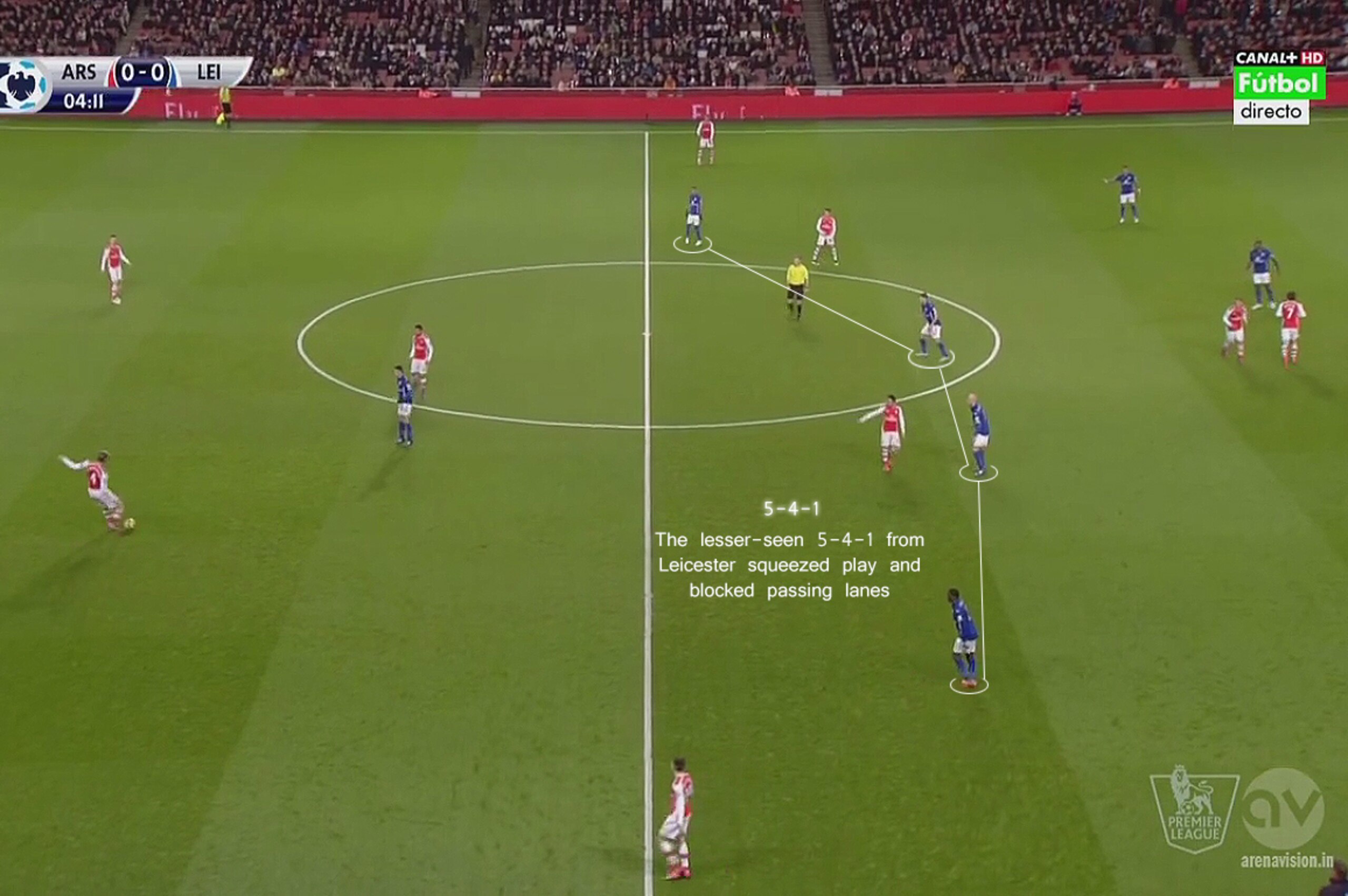
It was compact stuff, with three hulking centre-backs trying to dominate the middle. Arsenal started with one striker, so the Foxes could have allowed a defender out to follow the runner (dragging deep) and still defended with two, but they opted to stay put and not risk opening a hole. Wise.
In attack, it was up to Esteban Cambiasso to collect the ball under pressure post-turnover and find a man. He looked for Kramaric up top, but he was often isolated, so Plan A was always a curved pass into the path of Mahrez.
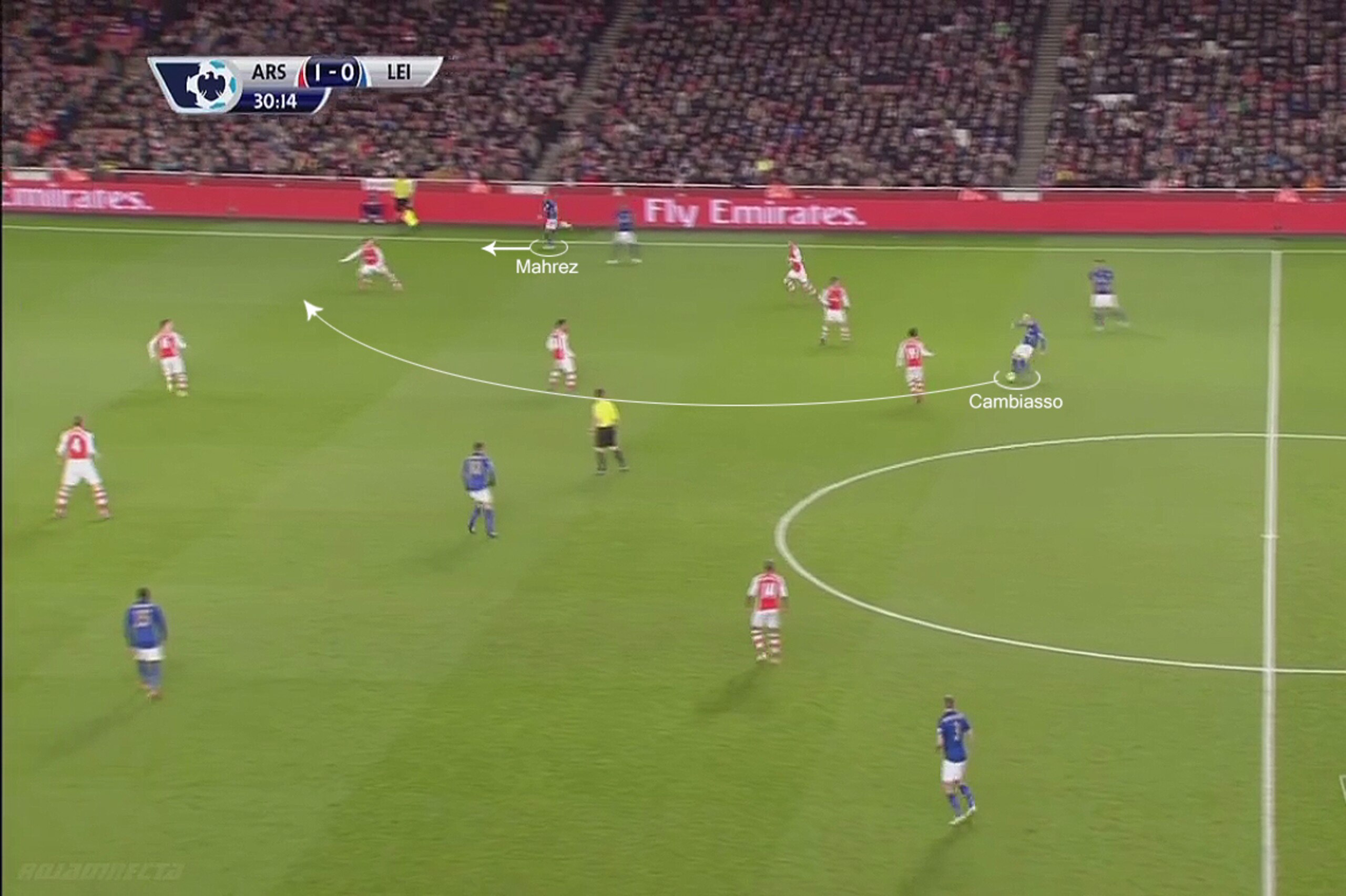
The Algerian roamed a little and sometimes popped up on the left side, but breaking out of a defensive structure, he was always the out-ball to the right. He came close to scoring twice with twist-and-turn efforts.
The Foxes didn't exactly enjoy the first half, but Cambiasso's tackling and passing, in addition to Mahrez's torturing of Nacho Monreal, were the bright points.
2. Free-flowing Arsenal
The Gunners started with what appeared to be Alexis up front, Theo Walcott to the right and Mesut Ozil nominally from the left. Tomas Rosicky and Santi Cazorla played central midfield, and Francis Coquelin glued it all together.
With Leicester cramming the middle, though, it became clear after 15 minutes that Alexis was being crowded out too promptly, and his intricate play wasn't getting results.
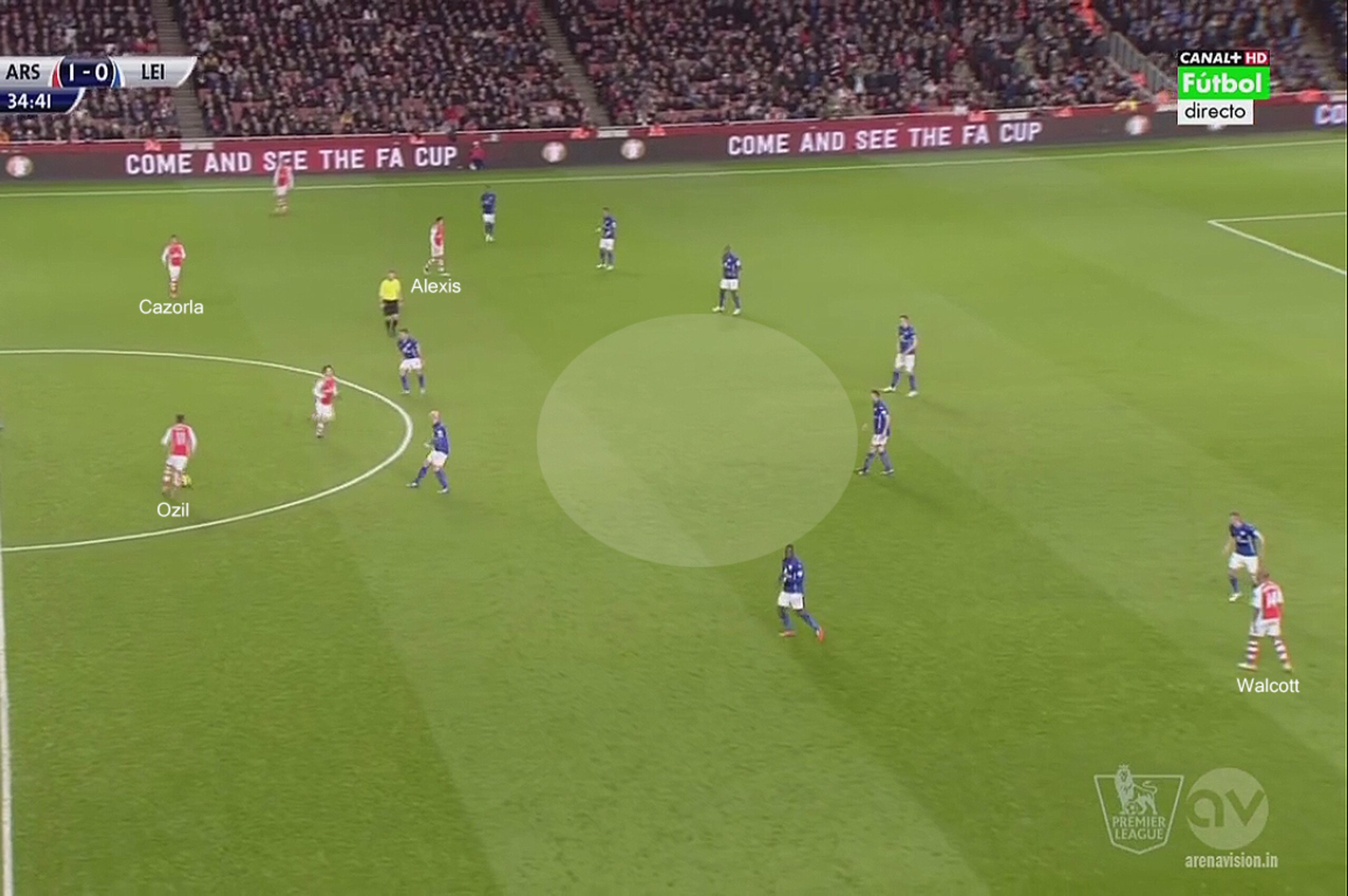
Arsene Wenger rejigged, sending Alexis to the left, keeping Walcott right and bringing Ozil inside to a No. 10-esque role. The Gunners then either played with no central striker or pushed Rosicky into the forward line simply to occupy and distract, pushing the centre-backs back.
This is where Ozil took over; his eye-of-the-needle passing produced a few chances for his runners, and he was constantly looking for Walcott over the top of Matthew Upson. His corner produced the first goal as Koscielny netted with ease via his dipping delivery. Then, his shot produced the rebound opportunity for Walcott to double the lead.

As Cazorla and Rosicky crept higher and higher to join in, Coquelin's role in blocking Cambiasso's counter-attacking passes became all the more important. He excelled in the first half.
3. Sloppy
Arsenal took their foot off the gas in the second half, and that's a concern for Wenger. Leicester grabbed a goal back via Kramaric after a breakdown from a corner, and, in truth, the goal had been coming.
Second balls, headers and clean tackles—the basics of football—were not being executed. With a two-goal cushion, Arsenal's midfield relented in its intensity and looked nonplussed while in possession.

Cambiasso and Co., on the other hand, thrived in the battle. Schlupp came alive ahead of the goal and took advantage of some reluctant defending to force a corner and create a chance.
Wenger responded by adding Olivier Giroud to the mix for some structure—pushing Ozil back to the left and forcing Cazorla to be more restricted in his central role near Coquelin—and then introduced Aaron Ramsey to spruce up the midfield legs.
It worked to a reasonable extent, and the intention was wise, but Ramsey lasted just nine minutes before hobbling off and being replaced by Mathieu Flamini. Wenger's intention to see the game out is a positive that must be praised—it's growth from earlier in the season—but Ramsey's injury is a big concern.
.jpg?w=2560 "Rams Eagles Football")
.jpg?w=2560 "Falcons Saints Football")
.jpg?w=2560 "Injury-stricken Seahawks signing veteran RB")

.jpg?w=2560 "2 NFL Officials Suspended")

