

Grading Every Boston Celtics Player Heading into 2015 NBA All-Star Break
With the constant barrage of trades, D-League signings and cuts, it’s hard to even keep track of who is on the Boston Celtics’ roster these days.
Since the season began, Boston has made nine trades, and there is no reason to think they’ll stop making moves before the deadline.
Still, while that makes it tough to grade the Boston roster, it is not an impossible task.
Brad Stevens has his team playing hard, and we’ve been able to get extended looks at players like Jared Sullinger, Avery Bradley and Marcus Smart who figure to be on the roster for the foreseeable future.
2014-15 was always going to be a rebuilding year, so it is not a shock that Boston has become a revolving door of trades and veteran players on their way out.
With the All-Star break upon us and a 50-plus game sample size to examine for many of these players, let’s break down each current Celtic and how they’ve performed thus far this season.
In order to accurately depict certain players the stats listed (accurate as of Feb. 9) may or may not reflect their time with Boston.
No. 15-11
1 of 11
15. Andre Dawkins
2014-15 Stats: 0.8 PPG, 0.5 RPG, 0.3 APG, 16.7 FG%, 16.7 3P%, 5.5 MPG
Andre Dawkins has already been assigned to the D-League, so it remains to be seen what he’ll ever amount to in a Celtics uniform.
He has always been an elite shooter, though he didn’t show it in a brief stint with the Miami Heat.
Dawkins’ biggest problem is that he isn’t a strong perimeter defender despite having decent size at 6’5”. He also isn’t going to do much off the dribble so if his jumper isn’t falling he can be a liability on both ends.
Hopefully Dawkins gets a chance as the season goes on, but given Boston’s crowded backcourt it seems unlikely.
Grade: Incomplete
14. Shavlik Randolph
2014-15 Stats: 1.1 PPG, 1.6 RPG, 0.2 APG, 0.3 SPG, 24.0 FG%, 6.3 MPG
Coming to Boston in the Austin Rivers deal, Shavlik Randolph should be a familiar face to C’s fans as he spent time with the team back in 2012-13.
Randolph has yet to suit up in green, but he did have a brief stint with the Phoenix Suns earlier this year.
He’s a decent rebounder, particularly on the offensive end, and can finish in the paint.
Ultimately, Randolph won’t get more than spot minutes, but he at least has one NBA-level skill.
Grade: Incomplete
13. Gerald Wallace
2014-15 Stats: 0.8 PPG, 1.0 RPG, 0.1 APG, 0.5 SPG, 38.5 FG%, 7.4 MPG
Gerald Wallace’s past two seasons are a cautionary tale for wing players who rely solely on athleticism.
Wallace’s play has fallen off tremendously since he lacks a consistent outside shot, and he has now moved to the end of the Boston bench.
He’s still a heady passer and a decent defender, but he simply has no offensive game at this stage of his career.
Unfortunately, Wallace’s remaining $20.2 million on a contract that runs through 2015-16 makes him a tough trade chip, so fans might have to buckle in for one more grim season of the player formerly known as “Crash” sitting on the bench.
Grade: D-
12. Phil Pressey
2014-15 Stats: 3.2 PPG, 1.3 RPG, 2.1 APG, 0.6 SPG, 35.6 FG%, 27.9 3P%, 11.3 MPG
Though he has shown some flashes of competency as a facilitator, Phil Pressey’s 2014-15 season has been disappointing on the whole.
For as good of a handle as he has Pressey cannot shoot the ball a bit and defenders sag far off of him.
Because of his diminutive size Pressey also struggles to finish at the rim, so when his playmaking game isn’t going he doesn’t provide much spark.
The C’s don’t have much point guard depth now that Jameer Nelson is gone, but it has become abundantly clear that Pressey simply is not an NBA rotation piece.
Grade: D
11. James Young
2014-15 Stats: 3.1 PPG, 1.3 RPG, 0.6 APG, 0.1 BPG, 37.7 FG%, 25.0 3P%, 9.2 MPG
This grade is in no way representative of James Young’s potential, just the limited opportunities he has received as a rookie.
Bouncing between the Celtics and the D-League, Young hasn’t gotten a consistent rotation spot, but he has looked decent in short minutes.
He’s a terrific athlete and a decent shooter who could potentially be a big-time scorer in this league, but his lack of weight makes him a real defensive liability.
The organization likes Young’s offense, per MassLive’s Jay King, “It's the other end where Young most needs to improve, bulk up, become more aware.”
This won’t be a memorable campaign for Young, but if he works hard in the offseason he’ll have a shot to be a sophomore breakout.
Grade: C-
No. 10: Marcus Thornton
2 of 11
2014-15 Stats: 8.8 PPG, 1.8 RPG, 0.9 APG, 0.6 SPG, 41.7 FG%, 40.7 3P%, 16.2 MPG
Marcus Thornton has done one thing well for the Celtics this season: shoot the basketball.
He isn’t playing much, but Thornton’s shooting has been a nice boost for a Boston team bereft of perimeter scoring.
Thornton is a terrific catch-and-shoot option and also has a little bit of juice off the dribble in case an opponent closes out.
He’s attempting 3.1 threes per game in just 16.2 minutes, so there’s no hesitance from Thornton when it comes to getting up shots.
Still, Thornton is a defensive liability and at 6’4” lacks the size to cover the league’s bigger 2-guards.
He can’t create shots for his teammates either, so as the season goes on expect Thornton’s minutes to dwindle and Young to start logging time in his place.
Grade: C
No. 9: Tayshaun Prince
3 of 11
2014-15 Stats (with Celtics): 8.6 PPG, 3.0 RPG, 2.0 APG, 0.5 SPG, 58.5 FG%, 57.1 3P%, 21.4 MPG
Acquired from the Memphis Grizzlies in the Jeff Green trade, Tayshaun Prince has quietly put together a very nice stretch in his brief stint with the Celtics.
After struggling mightily to shoot with the Grizzlies, Prince has certainly found his shot in Boston.
He’s hitting threes and mid-range jumpers at an unsustainably high clip, including 58.8 percent from 16 feet to the three-point arc, per Basketball-Reference.
Those numbers will obviously dip, but it’s nice to see Prince carving out a role on offense after never quite fitting with Memphis.
He has also thrived defensively, using his length and instincts to offset his diminishing athleticism.
Per 82games, Prince is holding opposing 3s to a 2.3 PER and opposing 4s to a 14.4 PER.
Prince may still wind up being dealt or bought out so he can join a contender, but he has been great thus far in green.
The lower grade here is more a reflection of his limited time with Boston and unsustainably hot shooting than his actual performance.
Grade: C+


No. 8: Evan Turner
4 of 11
2014-15 Stats: 8.7 PPG, 4.7 RPG, 4.5 APG, 0.9 SPG, 42.6 FG%, 31.0 3P%, 25.5 MPG
After thriving early in the season with the ball in his hands, Evan Turner has come back down to earth somewhat in recent weeks.
He’s still a terrific passer, but he is averaging 2.4 turnovers per game and throws some risky passes at times.
Turner is a strong mid-range shooter, hitting 43.4 percent of his jumpers from 16 feet out, according to Basketball-Reference, but he is a non-threat from downtown.
Given the Celts’ dire point guard situation, Turner’s positional versatility has been appreciated.
Smart isn’t ready to have the ball constantly, and Bradley is best utilized slashing and cutting, meaning that there is a playmaking void Turner needs to fill.
He hasn’t been stellar, but Turner has made some improvements as a decision-maker, relying more on his off-the-dribble game than usual.
Turner has also showcased some clutch chops, a big deal for a team that struggles to execute in the fourth quarter.
Defensively Turner will never be a standout, but he has found a role as a versatile swingman off the bench and redeemed himself after a ghastly stint with the Indiana Pacers.
Grade: C+
No. 7: Kelly Olynyk
5 of 11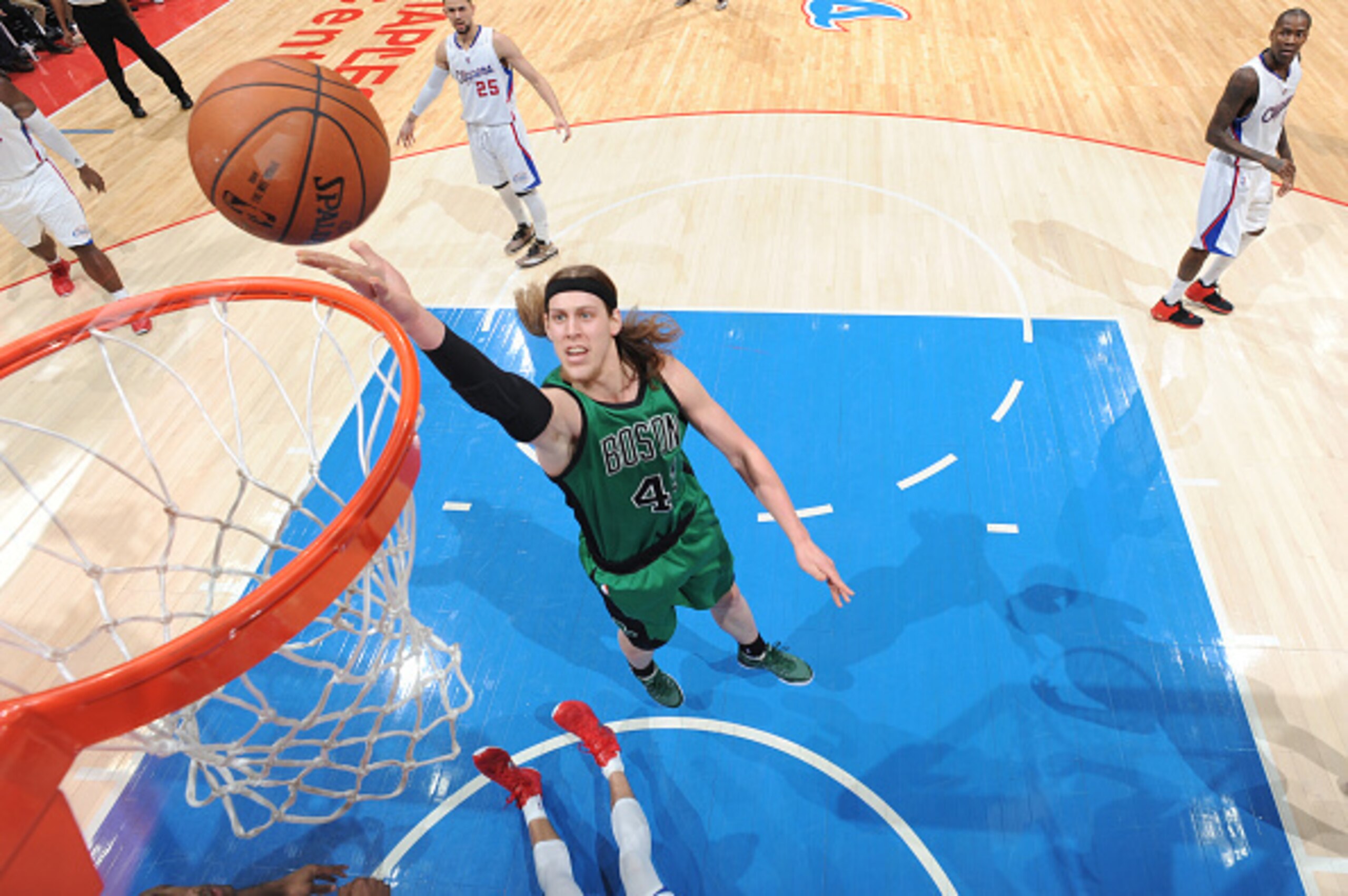
2014-15 Stats: 11.1 PPG, 5.4 RPG, 1.7 APG, 1.0 SPG, 50.6 FG%, 35.3 3P%, 24.5 MPG
Kelly Oynyk is having a strong offensive season, but perpetual foul trouble has hurt what has been a promising sophomore campaign.
He is averaging 5.3 fouls per 36 minutes and too often picks up cheap ones for lazy reaches defensively.
His overall play on that end of the court has been mediocre. Per 82games, Olynyk is holding 4s to a solid 13.5 PER but allowing a 17.6 PER to 5s.
Olynyk’s limited quickness hurts him covering more mobile bigs, and he doesn’t offer much in the way of rim protection either.
On the offensive end though, Olynyk’s versatility and intelligence shine.
His three-point shooting has regressed somewhat, but he can still hit open threes above the break and help stretch out the defense.
He also has a terrific handle for a big man and is capable of driving to the hole and making smart passes when he needs to.
With his shooting ability, Olynyk can thrive as a pick-and-pop option, something Boston needs given its lack of backcourt shooting.
He needs to develop on the defensive end of the court, but Olynyk overall has shown some decent growth in his second year in the league.
Grade: C+
No. 6: Jae Crowder
6 of 11
2014-15 Stats (with Celtics): 7.3 PPG, 3.3 RPG, 1.3 APG, 1.0 SPG, 46.5 FG%, 32.7 3P%, 20.9 MPG
The Dallas Mavericks never gave Jae Crowder much freedom, but the Marquette product has played well with a longer leash in Boston.
He’s the only player still on the roster that the C’s acquired for Rajon Rondo, and it seems like Crowder has found a long-term home.
It would be nice to see Crowder find more consistency from distance, but he does a respectable job driving to the basket and canning mid-range jumpers.
He is also a willing passer who brings some of the Mavs’ trademark ball movement to the Boston offense.
Crowder is never one to force the issue or try to do too much as a scorer, making him a perfect complementary piece.
Defensively, he has been impressive playing small forward almost exclusively. He holds opposing 3s to a respectable 13.6 PER, according to 82games.
He’s a terrific athlete and has the strength to defend bigger wing players too.
Already 24 years old, Crowder may max out as a role player on a good team, but he at least provides some value in the otherwise one-sided Rondo deal.
Grade: B-
No. 5: Brandon Bass
7 of 11
2014-15 Stats: 9.6 PPG, 4.2 RPG, 1.1 APG, 0.5 BPG, 47.6 FG%, 20.8 MPG
Poor Brandon Bass.
He’s playing incredibly hard and putting in quality minutes, but the 10-year veteran simply no longer fits with what Boston wants to do.
The C’s have a crowded power forward rotation, and often Bass has been the odd man out.
When he does play he puts up solid numbers, displaying his traditional feathery mid-range jumper (45.9 percent on mid-range shots from 16-plus feet, per Basketball-Reference).
Bass seems like an ideal trade candidate, but according to NESN’s Ben Watanabe he has yet to receive any serious trade interest.
Surely some team could use a decent third big man like Bass to come off the bench, hit jumpers and play decent defense.
He isn’t a post-up threat, but Bass knows how to get open offensively and has developed a decent one-dribble game when opponents close on him.
As an expiring contract, it is hard to see the Celtics getting anything meaningful for Bass in a trade, but they may be able to nab a second-rounder or a trade exception from a team that needs a little more frontcourt scoring.
Bass has been solid for Boston this season on both ends, but it certainly seems like his days in green are numbered.
Grade: B-
No. 4: Tyler Zeller
8 of 11
2014-15 Stats: 9.7 PPG, 5.5 RPG, 1.3 APG, 0.7 BPG, 55.9 FG%, 20.2 MPG
While Tyler Zeller is no longer shooting 70 percent from the field, he has remained an incredibly effective offensive player even without Rondo.
Zeller is probably Boston’s best pick-and-roll big man, as he can make hard drives to the rim and finish consistently.
The C’s have lacked a true center for years, but the 7-footer Zeller finally gives them someone who can fill that role.
He is one of Boston’s few legitimate post-up threats and also has the ability to hit mid-range shots if left open.
Zeller has also proved he can play well alongside either Olynyk or Sullinger, which is huge for Boston’s positional flexibility.
Unfortunately on the defensive end, Zeller allows a 22.0 PER to opposing 5s, per 82games. That’s unacceptably high and likely limits his upside long term.
Still, Zeller’s not the walking foul that Olynyk is, which will allow him to stay on the court for longer stretches.
He’ll probably never be a starter on a playoff-caliber team, but Zeller has shown plenty of growth in his first season with the Celtics.
Grade: B
No. 3: Marcus Smart
9 of 11
2014-15 Stats: 6.7 PPG, 2.9 RPG, 3.6 APG, 1.2 SPG, 36.5 FG%, 35.3 3P%, 24.3 MPG
King of the weird box-score game, Marcus Smart hasn’t taken off like many expected since Rondo was dealt, but he has shown improvement over his rookie year.
Stevens is finally trusting him to play 30-plus minutes, and while Smart isn’t scoring at an efficient clip, he is making big contributions in other areas.
During February, Smart is averaging 7.2 points, 6.2 rebounds, 5.8 assists and 1.6 steals, albeit while shooting 31.4 percent from the floor and 25 percent from deep.
He’s clearly not ready to run a quality NBA offense, but Smart is already a splendid defender and one of the game’s toughest guards.
Although allowing a 16.0 PER to opposing point guards, per 82games, Smart is a menace pressuring ball-handlers and does a terrific job avoiding screens.
He can defend both 1s and 2s, giving the C’s defense some nice flexibility.
Offensively, though he has shown off a respectable three-point shot, he needs to improve his shot selection and mid-range game.
Smart is also jacking up far too many outside shots, as 63.9 percent of his field-goal attempts are coming from three-point range, according to Basketball-Reference.
Still, he has been impressive for a rookie and looks poised to become one of the league’s best point guards in a few seasons.
There’s a reason Boston was willing to trade Rondo, after all.
Grade: B
No. 2: Avery Bradley
10 of 11
2014-15 Stats: 13.5 PPG, 2.7 RPG, 1.5 APG, 0.9 SPG, 43.2 FG%, 35.6 3P%, 30.8 MPG
Since signing a four-year, $32 million extension, expectations have increased for Avery Bradley. And while he hasn’t shown huge growth, he is turning in another solid campaign.
Bradley will never be a lead guard, but he’s a nice two-way player who has worked hard on his game at both ends.
With Rondo and Green gone, he has shouldered more responsibility on offense, and he has responded by jacking more threes than ever before.
Per Basketball-Reference, 33.7 percent of Bradley’s shots are coming from three this season. He’s hitting a decent amount of them but needs to get back to the off-ball movement that made him such a potent weapon alongside Rondo.
Too often, Bradley settles for a long two-pointer or a three off the pick-and-roll instead of attempting to penetrate.
Still, he has made strides as a scorer and has a nice chemistry with Smart in the backcourt.
Defensively, he remains a solid option at either guard spot.
He’s holding 1s to a 14.6 PER, and 2s to a 13.3 PER, according to 82games.
Bradley doesn’t force a ton of turnovers, but he knows where to be defensively, makes few mistakes and does a nice job of staying in front of his man.
The 24-year-old Bradley will continue to improve as he gets accustomed to an increased offensive role, and the defensive presence is already there.
He’s hardly a thrilling player to watch, but Bradley has turned in another solid all-around campaign for Boston.
Grade: B+
No. 1: Jared Sullinger
11 of 11
2014-15 Stats: 14.4 PPG, 8.0 RPG, 2.4 APG, 0.7 BPG, 44.9 FG%, 28.7 3P%, 28.7 MPG
The A- grade is on a bit of a curve, but Jared Sullinger has turned in an impressive 2014-15 campaign despite a recent shooting slump.
Sully began the season hot from three-point range but has cooled off considerably, including hitting just 18.8 percent of his triples in the last five contests.
Still, he isn’t hesitating to take threes, which has helped to open up the floor somewhat.
He has also developed very quietly into a good mid-range shooter, connecting on 47.8 percent of his 16 to 23 foot jumpers, per Basketball-Reference.
Perhaps most importantly, Sullinger is Boston’s clear-cut best rebounder. He’s excellent on the offensive and defensive boards, using his strength and timing to offset a pedestrian vertical.
He’s fantastic at carving out space and going up for contested rebounds in traffic, while having the touch and coordination to convert on difficult putback attempts.
Unsurprisingly, defense hasn’t been Sully’s forte, but he’s working hard at both the 4 and 5 spots.
Because of his lack of height, Sullinger can have difficulty covering taller bigs, and he’s allowing an 18.1 PER when he plays the 5, per 82games.
Still, Sullinger is one of Boston’s few foundational pieces on the roster. He’s a versatile scorer who is improving his off-the-dribble game, and he has become a more willing passer this season.
It remains to be seen if he can become a 20-10 player like many predicted he would be while at Ohio State, but Sullinger has been nothing short of impressive in his third NBA season.
Grade: A-

.jpg?w=2560 "Grading WWE Raw 🔠")

.jpg?w=2560 "Bijan's INSANE 1st Half 🤩")
.jpg?w=2560 "Viral Rams Coach Vid 🖕")
.jpg?w=2560 "Injury-stricken Seahawks signing veteran RB")

.jpg?w=2560 "2 NFL Officials Suspended")