

Counter-Attack Has Become Arsenal's Best Weapon This Season
Arsenal won again when they swept Aston Villa aside, 5-0, at the Emirates Stadium. It was another three points for the team that's won nine games out of its last 11. But it was also another example of how important the counter-attack has become to this season's Gunners.
In fact, striking on the break is now the best weapon manager Arsene Wenger's team possesses. How else do you explain Arsenal scoring five times despite owning just 48 percent of the ball, per BBC Sport reporter Phil Dawkes?
Finding goals that are easy to come by while being more economical with the ball has become a common thread for this particular team, as recent results and statistics show:

.jpg?w=2560)

| Match | Date | Score | Goals | Possession |
| Away vs. Liverpool | Dec. 21, 2014 | 2-2 | Mathieu Debuchy, Olivier Giroud | 36.5% |
| Away vs. West Ham United | Dec. 28, 2014 | 1-2 | Santi Cazorla, Danny Welbeck | 42.2% |
| Away vs. Manchester City | Jan. 18, 2015 | 0-2 | Cazorla, Giroud | 35.3% |
| Home vs. Aston Villa | Sunday, Feb. 1, 2015 | 5-0 | Giroud, Mesut Ozil, Theo Walcott, Cazorla, Hector Bellerin | 48% |
Four games, including three tough away trips, have yielded 10 points and 11 goals. That's the reward for Arsenal's greater fluency and subtlety on the counter.
But while this is becoming a regular occurrence for this team, it's a rarity during the second half of Wenger's tenure. In fact, FourFourTwo.com confirmed just how rare it is in the aftermath of the dismantling of Villa: "Arsenal scored five or more goals in a Premier League game and recorded below 50 percent of possession for the third time since the start of 2003/04."
There's two things telling about that particular stat. The first is why it hasn't occurred more often. The reason is simple.
Since the heady days of the unbeaten 2003/04 league campaign, Wenger has completely changed the type of players he makes the foundation of his teams. Specifically, he moved away from powerhouse midfielders, as athletic as they were technically proficient.
It was easier to dominate games, fight for the ball and stay on the front foot when Patrick Vieira and Gilberto Silva bossed the middle. Arsenal had the physical dynamism to win the midfield scrap and own the ball once they seized it.

But starting in 2005, the final season at Highbury when Vieira was moved on and succeeded by pint-sized pass-master Cesc Fabregas, Wenger has sought to change the dynamic.
Recognising Fabregas' exceptional vision and guile, Wenger surrounded the cerebral Spaniard with like-minded schemers. That meant diminutive, pass-and-move playmakers such as Tomas Rosicky, Alexander Hleb and Samir Nasri.
Plassing become more intricate, and physicality was forced into the shadows. When it worked, the combination football was exhilarating.
But the drawback to loading up on so many pocket-edition creators was a team long on flair but short on brawn. Those Fabregas-led teams rarely broke at pace with quick transitions because they lacked the players to turn defence into attack in an instant via a crunching tackle or a powerful drive from deep.
Those teams had to get on the ball and own it because they didn't have the power and speed to win battles at both ends of the pitch. In those days, it was Arsenal who suffered on the break more than anyone else.
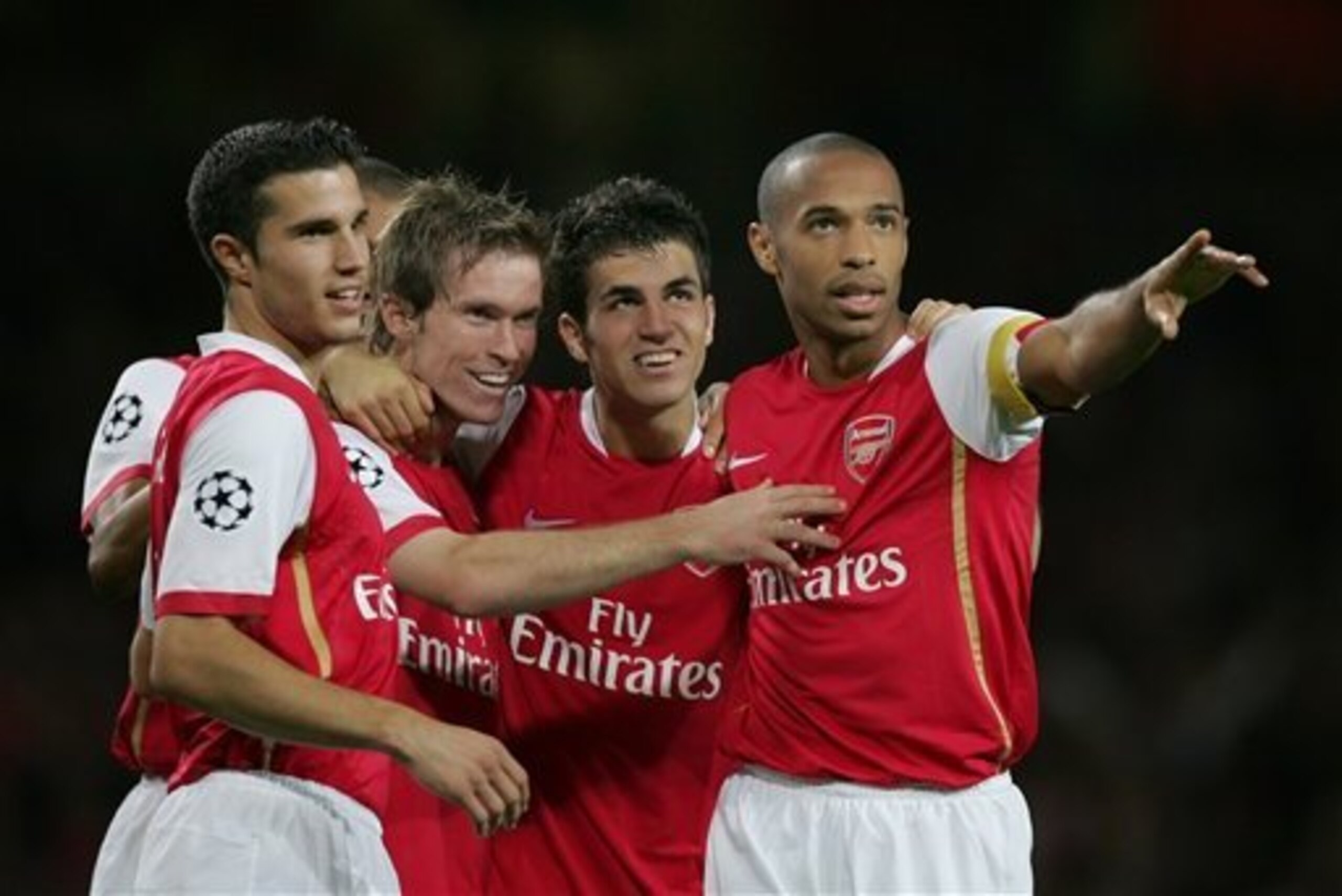
Of course, it wasn't always that way. The other side of that FourFourTwo stat is the proof that even Wenger's best team could cede possession, sit back and stay coiled, waiting to strike.
Back then, a long-striding forward break from Vieira attempted to keep pace with Thierry Henry's lightning-fast gliding, a sudden scamper from Robert Pires and the lung-bursting running of Freddie Ljungberg.
Even a bit-part player like Sylvain Wiltord added a turbo engine to Arsenal's counter game. Any one of the thundering sprinters could be picked out by the guile of one of the others or the mercurial artistry of Dennis Bergkamp.
The combination was a simple one: pace and imagination on the break. Since those halcyon days, the Gunners have rarely embodied both qualities going forward.
Until now that is.
It's ironic how the current squad has straddled both eras of the Wenger era. The group has been hovering between the ability to overpower Henry, Vieira and company and the clockwork elaboration of the Fabregas clan, searching for its own identity.
Last season, this team attempted to emulate the latter style. A lack of pace, compounded by Theo Walcott's injury woes, forced Arsenal to play eye-of a-needle football.
Things have changed this season, thanks to the summer arrivals of Alexis Sanchez and Danny Welbeck, along with less fitness concerns for Walcott and Alex Oxlade-Chamberlain.
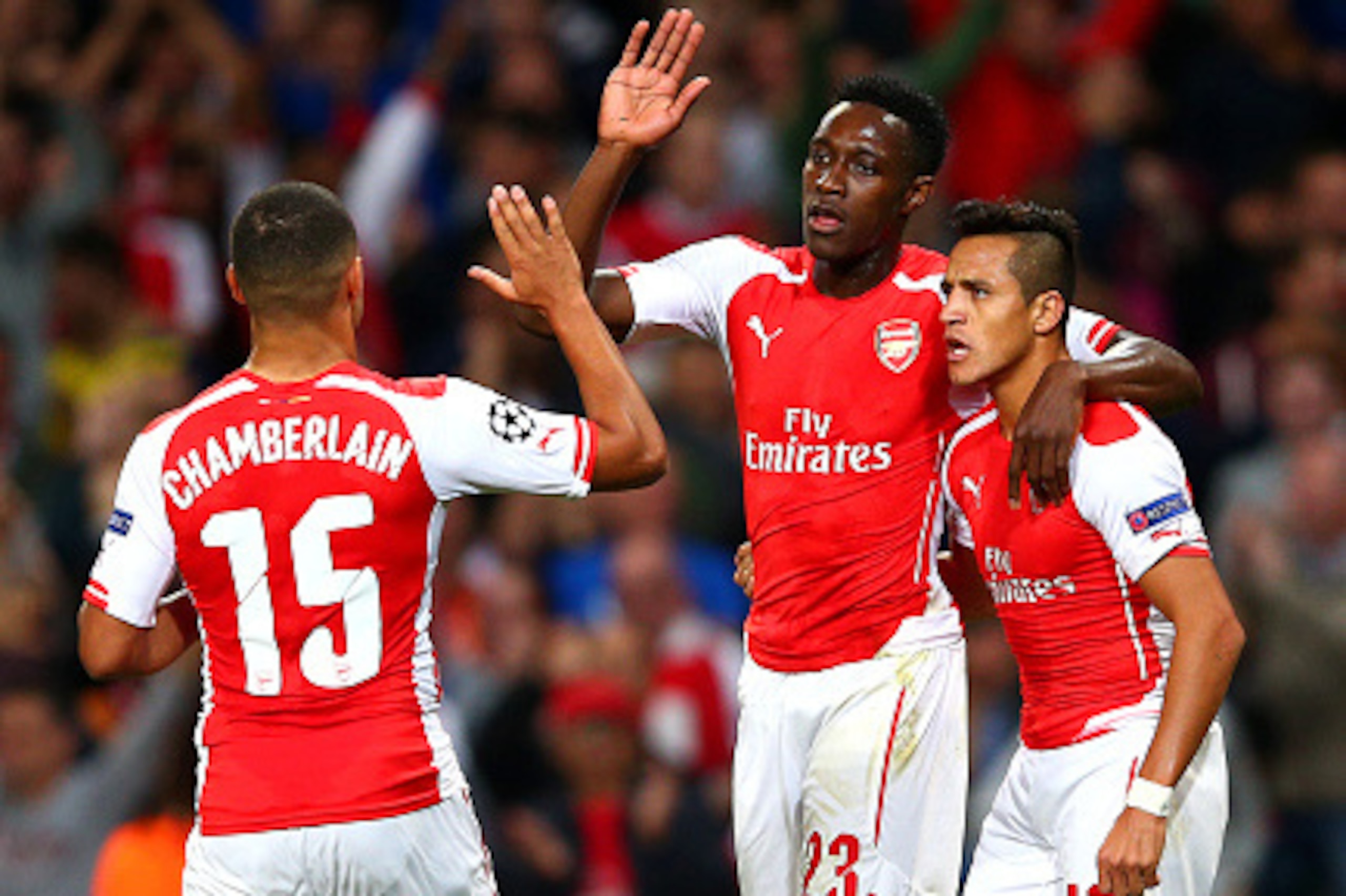
But what's more important is how this Gunners squad hasn't merely settled at one end of the Wenger stylistics spectrum. Instead, the group has hit on a happy balance that plays to its best qualities.
It starts with dropping off in the middle, rather than engaging in a scrap for the ball. That makes sense, since this team still lacks a power player and will never win a heavy-handed tussle for possession.
Instead, Wenger's men have been better served retreating deep and filling passing lanes. Whenever an Arsenal player intercepts a pass, he can usually find a provider capable of releasing a batch of rapidly moving counter hitters.
Perhaps the prime example was the team's second goal against Villa. Walcott won the ball just outside the Arsenal box as a Villa attack broke down.
The England international quickly countered, carrying the ball forward as centre-forward Olivier Giroud and playmaker Mesut Ozil made runs ahead of him. Meanwhile, Santi Cazorla also broke forward in support.

Walcott passed to Giroud, who quickly nudged a smartly judged pass between two defenders for Ozil to meet before soon guiding the ball into the net. Three passes between as many quick-countering forwards and Arsenal had scored.
The process repeated itself for the Gunners' third. One ball out from the back found Walcott, who exchanged passes with the scurrying Cazorla, before firing home. Three more passes and another goal.
Both goals owed everything to sudden, fluid football between a quartet of fleet-footed and creative, forward-thinking players. Wenger now has a plethora of options who fit that mold.
Substitute Sanchez, Welbeck or Chamberlain for any one of Ozil, Giroud or Walcott and the same result is possible. Just as it would be if Rosicky came in for Cazorla.
The Gunners can now invite teams on because they're more sudden, ruthless and efficient when they have the ball. That's because Arsenal's game is now all about pace and imagination on the break.
That's the secret behind the recent winning run in a nutshell. Arsenal no longer need the ball for 65 to 80 percent of the time just to grind out a tough win.
Now the Gunners can strike from anywhere at any time and in the blink of an eye. Wenger has finally struck a balance between defence and attack that works for what these players can and can't do.
It's a formula that is making Arsenal look increasingly dangerous at just the right time of the season.
.jpg?w=2560 "Falcons Saints Football")
.jpg?w=2560 "Rams Eagles Football")
.jpg?w=2560 "Injury-stricken Seahawks signing veteran RB")


.jpg?w=2560 "2 NFL Officials Suspended")
