

Marshawn Lynch's Performance During 2014 Season Justifies a Potential Extension
Normally, it wouldn't be advisable to offer a major extension to a running back approaching 30 years old. Marshawn Lynch isn't a normal running back.
Technically speaking, Lynch's contract doesn't expire until after the 2015 season. He's due to make a base salary of $5 million, which is arguably much lower than his true market value. According to Spotrac, four running backs will have a higher base salary next year.
According to NFL.com's Ian Rapoport, the Seattle Seahawks are prepared to table a much more favorable deal that would run through 2015 and beyond:
TOP NEWS

New NFL Power Rankings 📊
The Robinsons POUND the Rock 🪨
Takeaways from Falcons' dominant MNF win
"The deal is believed to include more than $10 million for Lynch in the 2015 season alone. Lynch currently is slated to make $5 million in 2015, the final year of what originally was a four-year, $31 million deal.
"
The Seahawks believe that Lynch, who has rushed for at least 1,200 yards in each of the past four seasons, has outplayed his contract, sources say. They want to reward him for his work.
Rapoport wrote that only Adrian Peterson would make more money than Lynch for running backs.
Regarding when this might get done, ESPN's Ed Werder added that the two sides will meet in a week to potentially hammer out the details:
CBS Sports envisioned a humorous way the Seahawks might be able to save money with the extension:
At least one thing is clear: The Seahawks don't want Lynch going anywhere. Back in November, head coach Pete Carroll spoke about his desire to keep his Pro Bowl running back, per Jim Corbett of USA Today:
Inevitably, there are certain risks to committing long term to a running back who turns 29 in April. The position doesn't have a long shelf life, and the decline is often swift and cruel for even the best backs.
Indeed, ESPN's Andrew Brandt hinted that Lynch might get paid a lot initially and then find himself out of a job a year or two into the deal:
With that said, Lynch has been one of the most consistent running backs in the league over the last four years, and he's showing no signs of slowing down. Here's a look at his numbers from 2011—his first full season in Seattle—and on.
| 2011 | 285 | 1,204 | 4.2 | 12 | 28 | 212 | 1 |
| 2012 | 315 | 1,590 | 5.0 | 11 | 23 | 196 | 1 |
| 2013 | 301 | 1,257 | 4.2 | 12 | 36 | 316 | 2 |
| 2014 | 280 | 1,306 | 4.7 | 13 | 37 | 367 | 4 |
He finished fourth in rushing yards and tied for first in rushing touchdowns in 2014. He also ran for 318 yards and two touchdowns, including 157 yards in the Seahawks' comeback win over the Green Bay Packers in the NFC title game, in the postseason.
Russell Wilson gets a ton of the credit, and he'll get a ton of money very soon. But Lynch is arguably the heartbeat of the Seahawks offense. His toughness and defiance have come to symbolize so much of what has made Seattle successful over the last few years and make back-to-back Super Bowls.
Having Lynch in the backfield also takes so much pressure off Wilson. Wilson could very well thrive in a more pass-happy offense, but the way in which Lynch complements Wilson's style allows the Seahawks to perform at peak efficiency.
According to Football Outsiders, Seattle ranked fifth in offensive DVOA (defense-adjusted value over average) in 2014. They were seventh in 2013 and fourth in 2012.
Take Lynch out of the equation and you're bound to see some regression. For a team that could conceivably make the Super Bowl in any of the next two or three years, there's no reason to lessen those chances by getting cheap and removing a key offensive piece.
Lynch could very well fall off a cliff in terms of production over the next year or two, making any sort of financial investment risky.
With that said, some running backs simply continue playing at a relatively high level through their 30s.
Jerome Bettis, who was recently announced as a 2015 Hall of Famer, was one such player. Although his last 1,000-yard season came when he was 29, "The Bus" averaged 3.5 yards a carry and 9.5 touchdowns a season from ages 30 through 33.
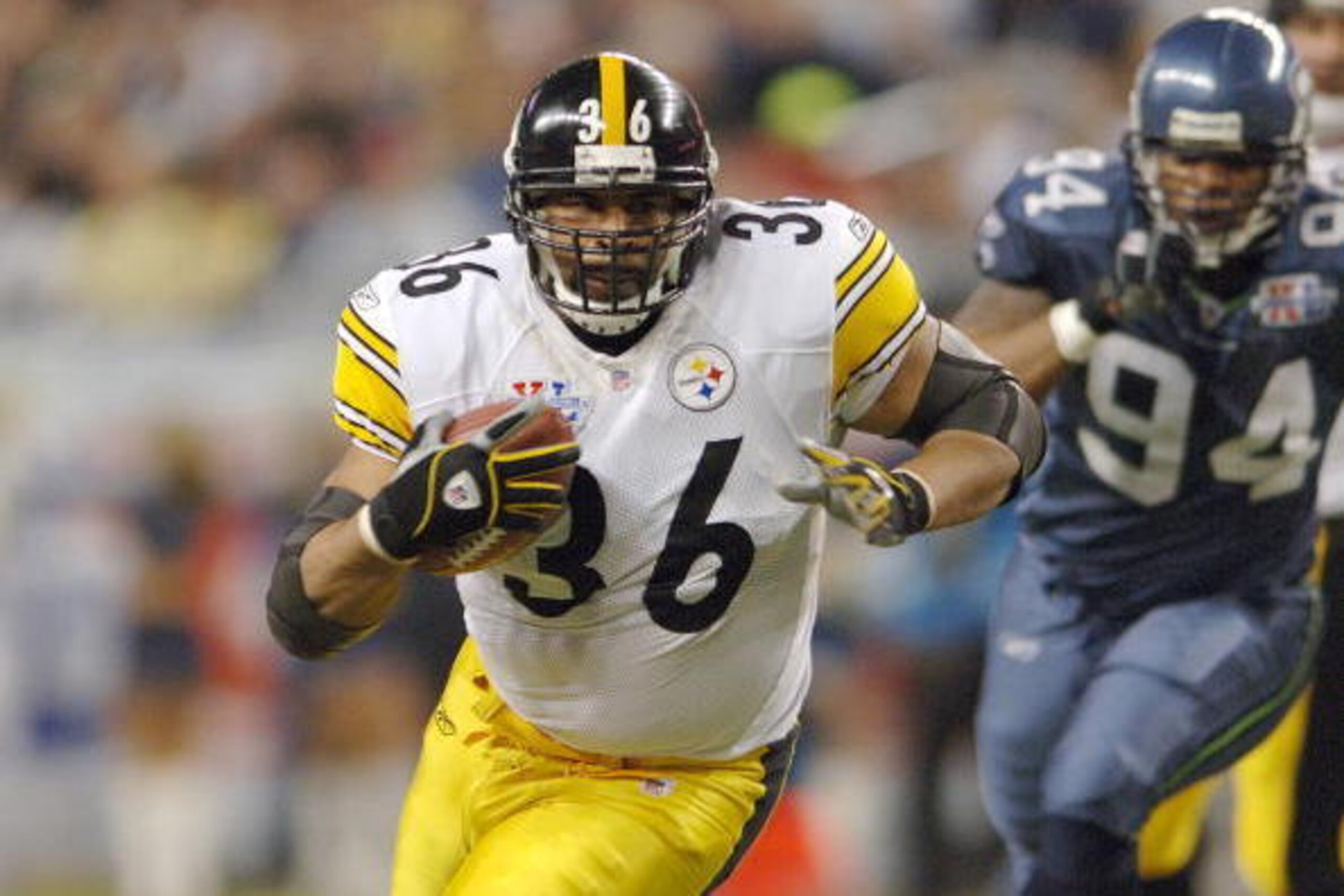
Those numbers aren't too bad when you consider the wear and tear on Bettis' body to that point in his career—he finished with the fourth-most carries of all time.
Emmitt Smith had three 1,000-yard rushing seasons, but it would be a bit unfair and unrealistic to compare Lynch to one of the greatest running backs of all time.
Either way, Bettis and Smith both show that the age of 30 doesn't have to be a running back's death sentence.
Yes, Lynch has a lot of mileage on his legs, and no, he can't continue being his regular Beast Mode self for much longer.
But Lynch could remain a fixture in the Seahawks' backfield and a great goal-line threat as the franchise hands off the reins to Christine Michael, Robert Turbin or another younger running back. Bettis co-existed well with Amos Zereoue, Duce Staley and eventually Willie Parker in his final three years.
Given the massive contract extension Wilson is likely to sign with the Seahawks at some point down the line, money will be tight for Seattle.
However, the franchise should make sure it's setting aside enough to lock up Lynch for the long term.

.jpg?w=2560 "Rams Eagles Football")
.jpg?w=2560 "Grading WWE Raw 🔠")


.jpg?w=2560 "2 NFL Officials Suspended")
