Mistakes the NY Giants Can't Afford to Make This Offseason
As members of the New York Giants' front office prepare to roll up their sleeves and remake a banged-up roster that has underperformed the last two seasons, it will be interesting to see what, if any, philosophical shifts the team has moving forward.
The moves that will be made are going to be critical for a team that’s in a “win or else” mode. So let’s look at some of the mistakes that the Giants’ brass can ill afford to make this offseason and why these mistakes must be avoided.
Overpaying for Free Agents
1 of 5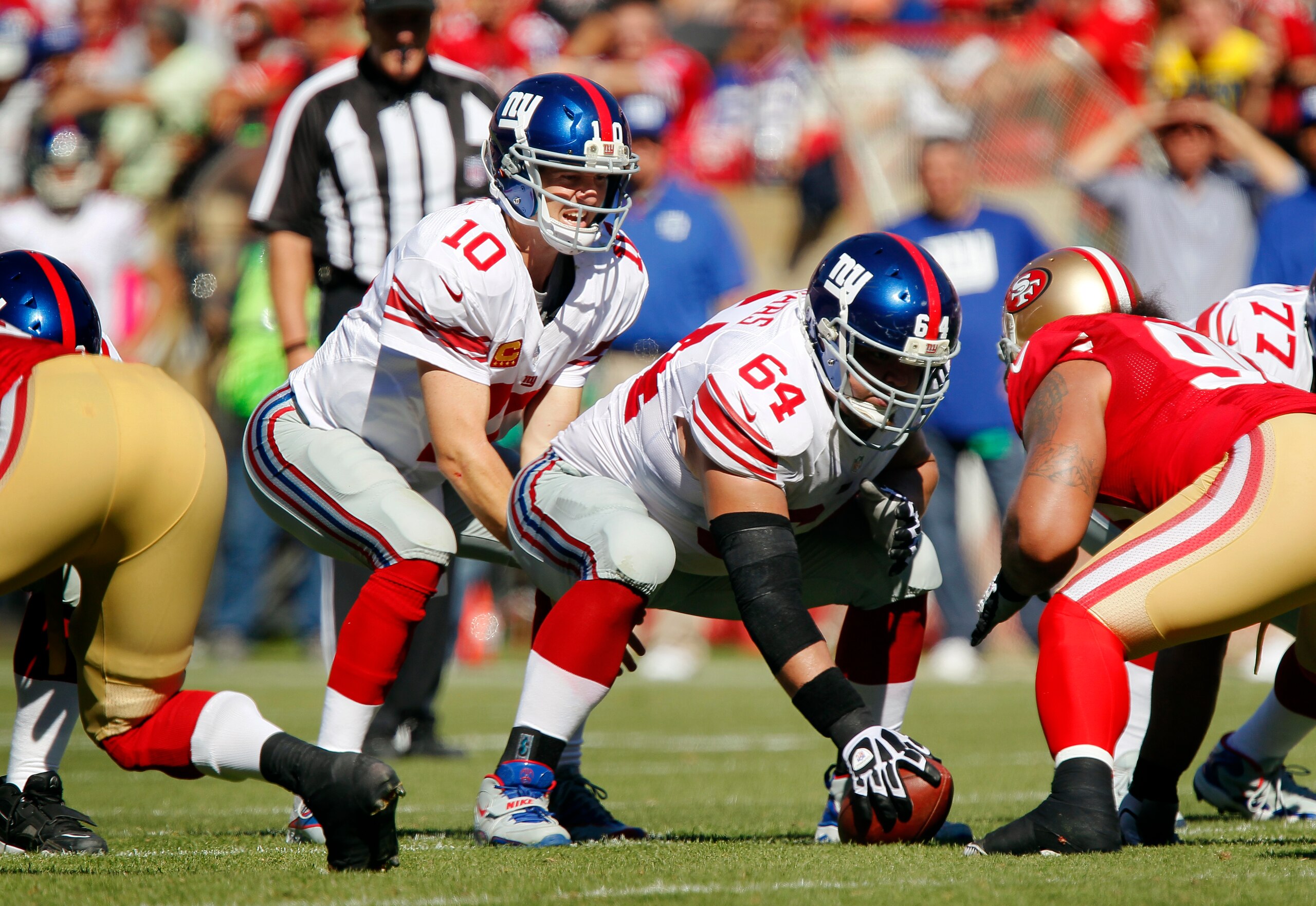
Just as a team can never have too many pass-rushers or cornerbacks, it can never have too many cap dollars to spend on talent that can potentially upgrade the team.
While the Giants have done a better job with being more judicious in their spending big money on free agents whose performances haven’t warranted such spending, there are going to be those one or two contracts that don’t make it to the end of their life cycle.
The result? Dead money—money that is tied up in a player who is no longer on the roster—which if it accumulates, can eat away at a significant amount of cap space.
According to Over The Cap, the Giants currently have $3.417 million in dead money already on the books.
One such contract they’re still going to pay for this year, even though the player was cut in 2014, is offensive lineman David Baas, who, per Spotrac, signed a five-year, $27.5 million contract in 2011.
Baas was designated as a post-June 1 cap transaction in order to alleviate the impact of his remaining $6.45 million prorated signing bonus against the team’s 2014 cap, meaning that, per Spotrac, $3.225 million of that signing bonus hit the 2014 cap and $3.225 million will be charged to the 2015 cap.
The good news is that team co-ownerJohn Mara told reporters in his year-end press briefing that he doesn't anticipate the Giants spending like the money is going-out-of-style in this year's free-agency sweeps.
Letting DE Jason Pierre-Paul Walk
2 of 5
After two seasons in which defensive end Jason Pierre-Paul dealt with health ailments, he finally started to get back on track to being the player he was in 2011, when he was voted to his first Pro Bowl.
At just 26 years old, a healthy Pierre-Paul is entering the prime of his career and should flourish in Steve Spagnuolo’s defense, a system that emphasizes the pass rush.
Of course the big question is not the why, but the how when it comes to keeping Pierre-Paul. Certainly, his 2014 numbers—12.5 sacks and 77 total tackles—are nowhere near worthy of a J.J. Watt-type contract.
Might his contract numbers be worth say 50 percent to 60 percent of Watt’s six-year, $100 million pact?
Per Pro Football Focus’ signature stats, in 548 pass-rushing snaps, Pierre-Paul recorded 11 of his sacks against opposing blindside protectors and 51 of his 60 total pressures.
Pierre-Paul was also the Giants' best run defender, and it wasn’t even close. PFF credited him with 31 stops (for zero or negative yardage), second-best among 4-3 defensive ends who played in at least 75 percent of their team’s defensive snaps.
The Giants would be foolish to let Pierre-Paul go, though in order to keep him—there is bound to be a difference of opinion as to what they think he is worth and what Pierre-Paul thinks he is worth—New York will likely have to apply the franchise tag.
That amount, per Jason La Canfora of CBS Sports, is projected to be $14.68 million. While that total would easily wipe out most of the $15,726,246 cap space that Over The Cap projects the Giants to have (based on a $140 million salary cap), remember that the Giants aren’t going to go crazy in free agency like they did last year—they’ll probably re-sign more of their own free agents than they will outside guys.
Also, there are numerous ways for the Giants to clear more cap space. These methods include terminating the contracts of DE Mathias Kiwanuka, RBs Peyton Hillis and David Wilson, and OL J.D. Walton; extending quarterback Eli Manning and cornerback Prince Amukamara; and having linebacker Jon Beason and punter Steve Weatherford reduce their respective 2015 base salaries.
Not Addressing the Defensive Line’s Interior
3 of 5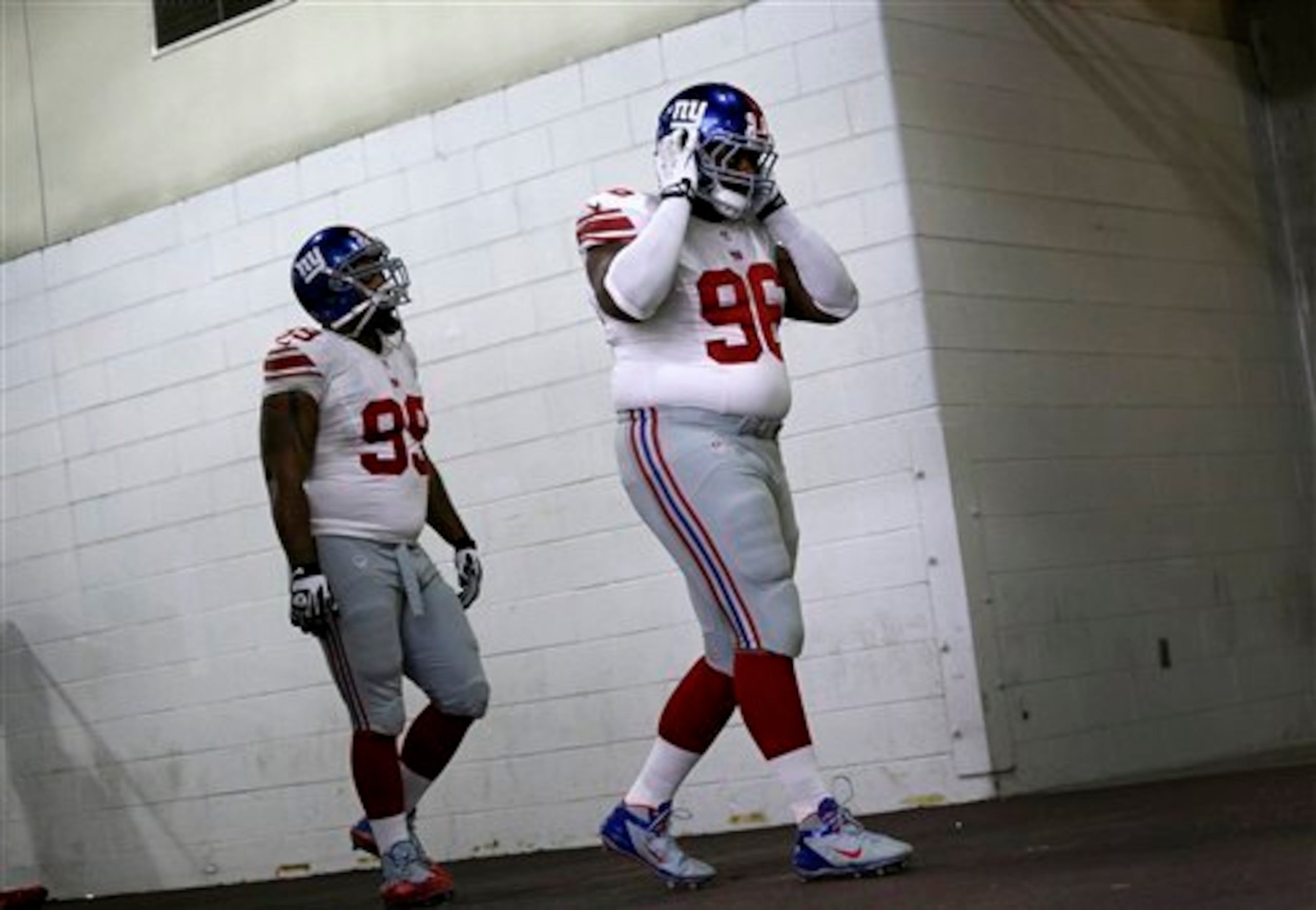
While on the subject of the defensive line, the Giants really need to consider adding another defensive tackle to their current group.
The leader as far as performance and production is Johnathan Hankins, who will enter his third season in 2015. Per Pro Football Focus, Hankins was the top overall defensive player on the Giants in 2014, passing defensive end Jason Pierre-Paul in both run defense and pass rushing—and not by just a few decimal points either.
After Hankins, the drop-off in talent is concerning. Cullen Jenkins, who had been a physical force, had an injury-filled season that cost him four games. At 33 years old, Jenkins might very well be looking at his best days in the rearview mirror.
Mike Patterson is another veteran on the wrong side of 30 whose best days might be behind him.
Markus Kuhn didn’t set the world on fire, while Jay Bromley the Giants’ third-round pick, produced just five tackles in the 113 defensive snaps, per Pro Football Focus.
Bromley could still develop into a player with another year of seasoning, so it’s too soon to give up on him after one season (thought to be fair, that a third-round pick didn’t contribute as heavily as the other rookies ahead and behind him despite having the opportunity to do so is a bit concerning).
Regardless, the Giants need another defensive tackle, whether it’s a free agent or a draft pick. Obviously among the projected free agents, Ndamukong Suh of Detroit is the cream of the crop; however, the Giants probably won’t be able to afford Suh regardless of what they do with their cap.
Fortunately, there are some other interesting and younger options such as Stephen Paea of Chicago; Nick Fairley of Detroit and Dan Williams of Arizona.
Paea in particular is an intriguing option. He’ll turn 27 in May and is coming off his best season last year, with 33 tackles, six sacks and two forced fumbles, all single-season career highs.
The bad news is that the Bears do have cap room if they want to re-sign Paea—and Bob LeGere of the Daily Herald seems to think that Paea should be a top priority as far as those players the new Bears regime retains.
According to Over The Cap, the Bears are projected to have over $27.6 million in cap space (based on a $140 salary cap), certainly enough to extend a promising young defensive interior lineman like Paea.
Do the Giants instead look toward the draft for this position, maybe at Washington’s Danny Shelton? It would be surprising if the Giants look to draft a defensive lineman that high, so the more likely scenario, assuming they do part ways with Jenkins and do not re-sign Patterson, is to get a veteran free agent.
Regardless of how they fill the position, one thing is for sure, and that is it would be a mistake if they go into 2015 with just Hankins, Bromley, Kuhn and, if they retain him, Jenkins.
.jpg?w=2560 "Seahawks Chiefs Football")


Keeping Players 'On Scholarship'
4 of 5
Lost in general manager Jerry Reese’s year-end press conference was a rather telling quote that offers insight into how he looks to shape the roster.
To recap, Reese was asked about holding onto draft picks who were unable to get onto the field, and if there was a fine line between cutting them loose or holding out hope that they will emerge into players by the time their rookie deals (typically four years) expire.
“We try to give guys a chance to fail. If you give them a chance to fail and they fail, that’s fine, we made a mistake,” Reese said. “But you have to give guys a chance to fail first before you push them out the door.”
That “scholarship” mentality has to change moving forward. Simply put, if a player doesn’t show consistent improvement every week from the moment he walks in the door, he needs to go.
A perfect example of this is offensive lineman James Brewer, a fourth-round pick in 2011.
Brewer was given a chance to make the starting left guard job his during the 2013 season.
However, his play was so inconsistent—per Pro Football Focus, Brewer had negative grades overall, in run blocking and in pass protection—that Reese decided to upgrade the left guard position by signing Geoff Schwartz last winter.
Why then, keep Brewer around if he failed? The most logical reason is because he is a draft pick. Meanwhile Brewer was inactive for 12 games this season, four due to a back injury and two because of a concussion, the latter of which ended his year.
That he was a healthy scratch in five games when he might have instead been first off the bench in case of an injury is disappointing.
Bargain Hunting for Offensive Linemen
5 of 5
In 2012, the Giants got very, very lucky when they signed unrestricted free agent Sean Locklear to a one-year minimum qualifying offer that, per Spotrac, was worth $890,000.
Locklear, who played mostly at right tackle for the Giants that season, performed reasonably well. Per Pro Football Focus, he didn’t allow a quarterback sack and was only at the root of 29 total quarterback pressures.
Unfortunately, the Giants haven’t really had that kind of luck with signing reserve offensive linemen to one-year minimum-qualifying deals.
As Giants fans know, last year they picked up Charles Brown and John Jerry with the idea of having both serve as depth when concerns about the younger players on the roster came to a head.
Brown turned out to be such a disaster that the Giants sent him packing after a disastrous showing in Week 11 against the Sn Francisco 49ers.
While Jerry made it into the starting lineup (this due to injuries to Geoff Schwartz and the retirement of Chris Snee), he finished with his worst overall grade from PFF, a minus 16.3 which included a minus-16.4 run-blocking grade.
Simply put, the Giants can’t continue to look for bargain basement players who, whether it’s because they need a change of scenery or because their previous team no longer wants them back, are willing to jump at a one-year minimum offer.
While landing a veteran for depth isn’t necessary the wrong way to go, the old cliche that you get what you pay for often applies.
Since the Giants are potentially looking at starting from scratch regarding their offensive line depth, they are going to have to bring on board a veteran or two, perhaps even on a multiyear contract until the youth is ready for the bigger stage.
All contract data from Over The Cap unless otherwise noted.
Patricia Traina covers the Giants for Inside Football, the Journal Inquirer and Sports Xchange. All quotes and information obtained firsthand unless otherwise sourced. Follow me on Twitter @Patricia_Traina.