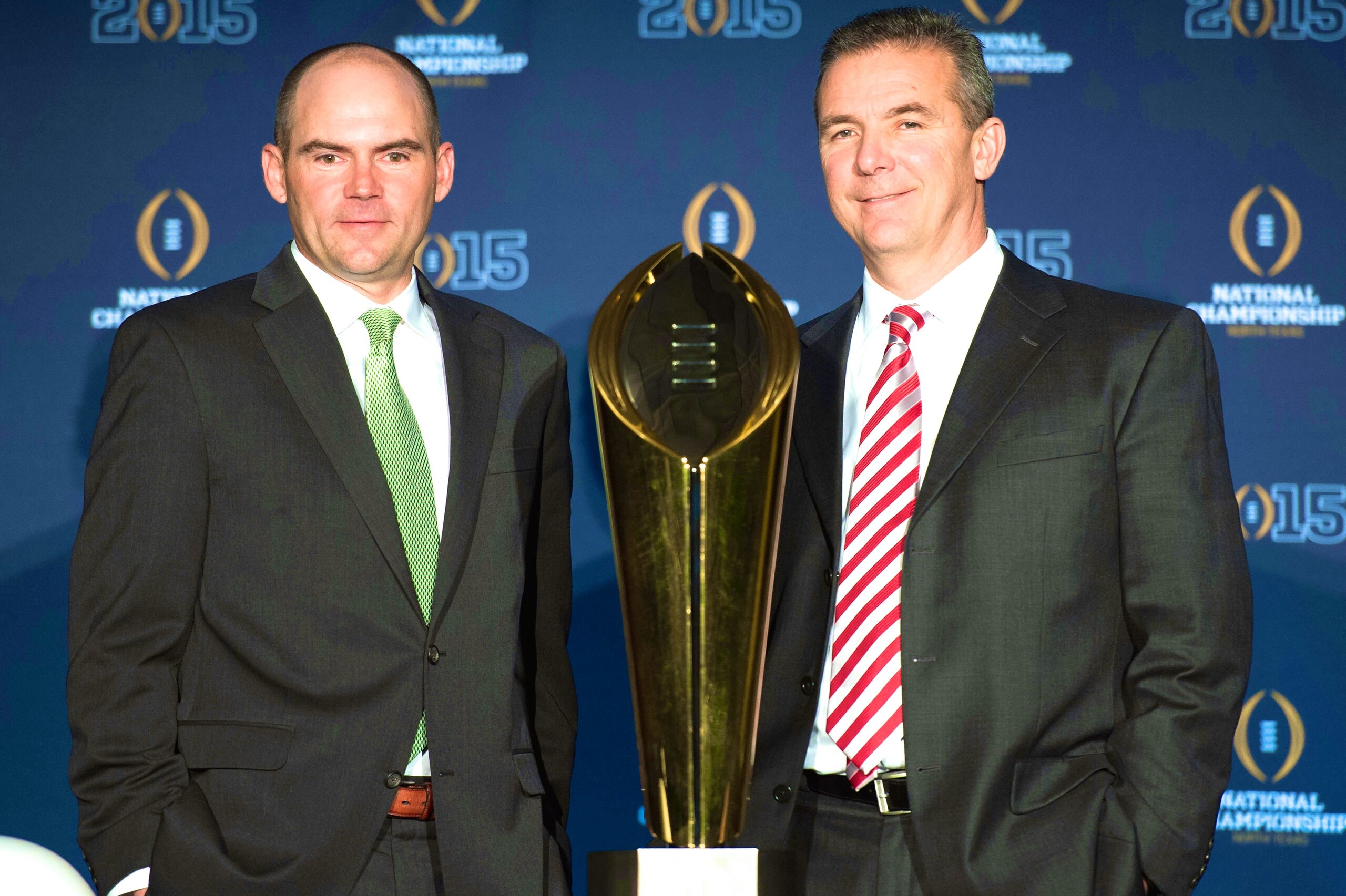

All-Spread National Championship Represents Future of College Football
DALLAS, Texas — Sitting at his table on the second floor of the Kay Bailey Hutchison Convention Center in downtown Dallas, Scott Frost was visibly annoyed.
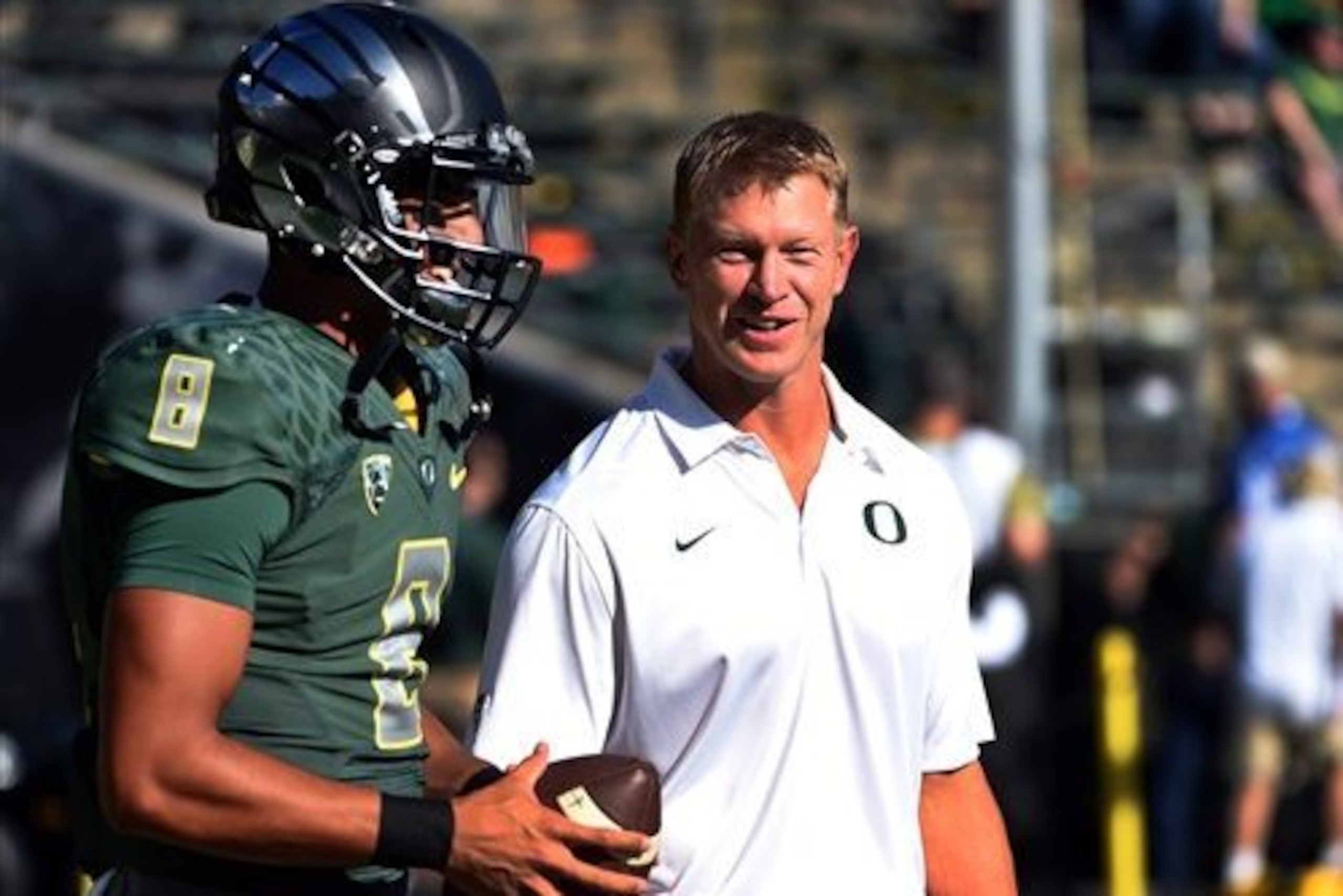
Only it wasn't another compare-and-contrast question about Ohio State, or inquiry into ineligible wide receiver Darren Carrington that irked Frost at the College Football Playoff championship media day. Rather, it was the suggestion that the spread offense was no longer working in the NFL that caused the Oregon offensive coordinator to shake his head.
"I don't see that at all," Frost said. "I think it will cautiously move in that direction."

.png?w=2560)
But while the spread may be the future of professional football, according to Frost, it's very much the present of the college game. That is something that won't ever be more evident than it will be in Monday's championship game.
It will be there that Frost's Oregon team takes on Ohio State inside the walls of Arlington's AT&T stadium. Two of the sport's most progressive offenses, the Ducks and Bucks, have stayed ahead of the curve in college football, with Monday night serving as a high point in the spread's evolution.
"We run similar offenses," Ohio State head coach Urban Meyer said of his title game opponent. "A lot of similar plays."
The success of the modern spread offense has lasted nearly a decade, dating back to Vince Young guiding Texas to a national title in 2005. Meyer would capture two of the next three crystal balls at Florida, solidifying the scheme as more than just a gimmick.
In fact, dating back to the 2005 season and excluding this past year, five spread teams have won national championships, with another six appearing in the national title game. The championship games for 2006, 2008, 2010 and 2013 each pitted opponents who ran elements of the spread against one another, but never has a title game matchup possessed as much power as Monday's will.
That shouldn't come as a surprise, considering that Meyer himself is one of the godfathers of the modern spread offense. Taking over a Bowling Green team that went 2-9 in 2000, Meyer knew he had to do something different or his first Falcons team wouldn't stand a chance.
"We had to make a decision. We weren't very good," Meyer said. "I looked at our schedule and we were playing some good teams, and the options were run wishbone, which I think is a great offense, equalizer offense or come up with some unique scheme. And that's where that all started."
Meyer had some ideas—he had studied Scott Linehan's Louisville offenses as the wide receivers coach at Notre Dame and often chatted with then-Clemson offensive coordinator Rich Rodriguez. But it would take two months worth of elongated workdays inside of what he called an "old, nasty" team meeting room at Bowling Green before Meyer and assistants Gregg Brandon, Dan Mullen and Greg Studrawa had created something that was uniquely their own.
"Every time it rained, the water would drip down on the table," Meyer recalled. "And we sat there for the month of February and the month of March, every morning coming in for 10 hours—from the huddle to the snap count, 'cause there was no other model."
The result was a power-spread hybrid, where Meyer used the spread spacing he learned from Linehan to open up the power run game ideals that he picked up from former Ohio State head coach Earle Bruce. Ideally, to Meyer, half of his plays would be runs and the other half would be passes, although he knew that wouldn't always be possible.
"The concept of our offense is a power offense in the spread set. That's ours," Meyer said. "It's not the basketball on grass and all that."
It didn't take long for Meyer to realize that what he had created in Bowling Green was ahead of the curve.
Taking an undermanned Falcons team to Missouri in his head coaching debut, Meyer walked away with a 20-13 victory. The Tigers had struggled to account for the spacing of their opponent's scheme, even if it was yet to have the personnel to match it.
"We had two receivers that couldn't catch, but we put them out there and they still covered them," Meyer said with a smile. "It was all the learning stages, early stages of it."
As the spread gained traction, defenses would catch up, but Meyer always managed to stay a step ahead. It certainly didn't hurt that the players who were running his system got better as he climbed up the coaching ranks.
Moving from Bowling Green to Utah to Florida before taking over Ohio State in 2012, Meyer has always adjusted his scheme to best suit the players on his roster. "It's all personnel-driven. It's not system based," he insists.
But that hasn't stopped Meyer from tweaking the core values of his offensive beliefs. Whether it be from Brandon, Mullen, Steve Addazio or Tom Herman, Meyer hasn't been afraid to take input from his offensive coordinators or seek the advice of other programs.
That was the case in 2011, when Meyer made the biggest tweak to his spread scheme. Visiting Oregon as an ESPN analyst during a one-year sabbatical from coaching, Meyer seriously considered adopting then-Ducks head coach Chip Kelly's uptempo philosophy, which had just catapulted Oregon to a BCS National Championship Game appearance.
"Their tempo was No.1 on the hit parade at Florida," Meyer said.

In essence, Kelly took spread elements that he had learned studying Meyer's Utah and Florida teams and sped them up. The Ducks would get a big gain and hurry up to the line, not allowing opposing defenses to substitute or adjust before another big gain would inevitably occur.
Despite his preference to huddle—he said he liked the leadership aspect of it—Meyer was intrigued, hiring a hurry-up expert in Herman as his offensive coordinator when he arrived at Ohio State. Members of both the Bucks and Ducks insist that the similarities between their schemes are overblown, but neither denies their hurry-up offenses being the blueprint for the future of college football.
"It is. Everybody says it's not—it is," Meyer said. "It's an advantage for the offense. And if you don't take it, then that's fine. But even I know Alabama is moving in that direction. Is it full-speed all the time? We're not. But certainly that gives us an advantage at times."
Of course, it helps that the Ducks have a Heisman Trophy winner in quarterback Marcus Mariota directing its offense, while the Buckeyes went from Braxton Miller to J.T. Barrett to Cardale Jones without missing a beat. Oregon and Ohio State might be a step ahead in their X's and O's, but unlike Meyer at Bowling Green, neither is lacking in the Jimmies and Joes.
"The players and the execution," Frost said when asked what the secret to his offense is. "I think we've got a pretty good scheme, but these players work their tales off and get better for it...guys go out and perform."
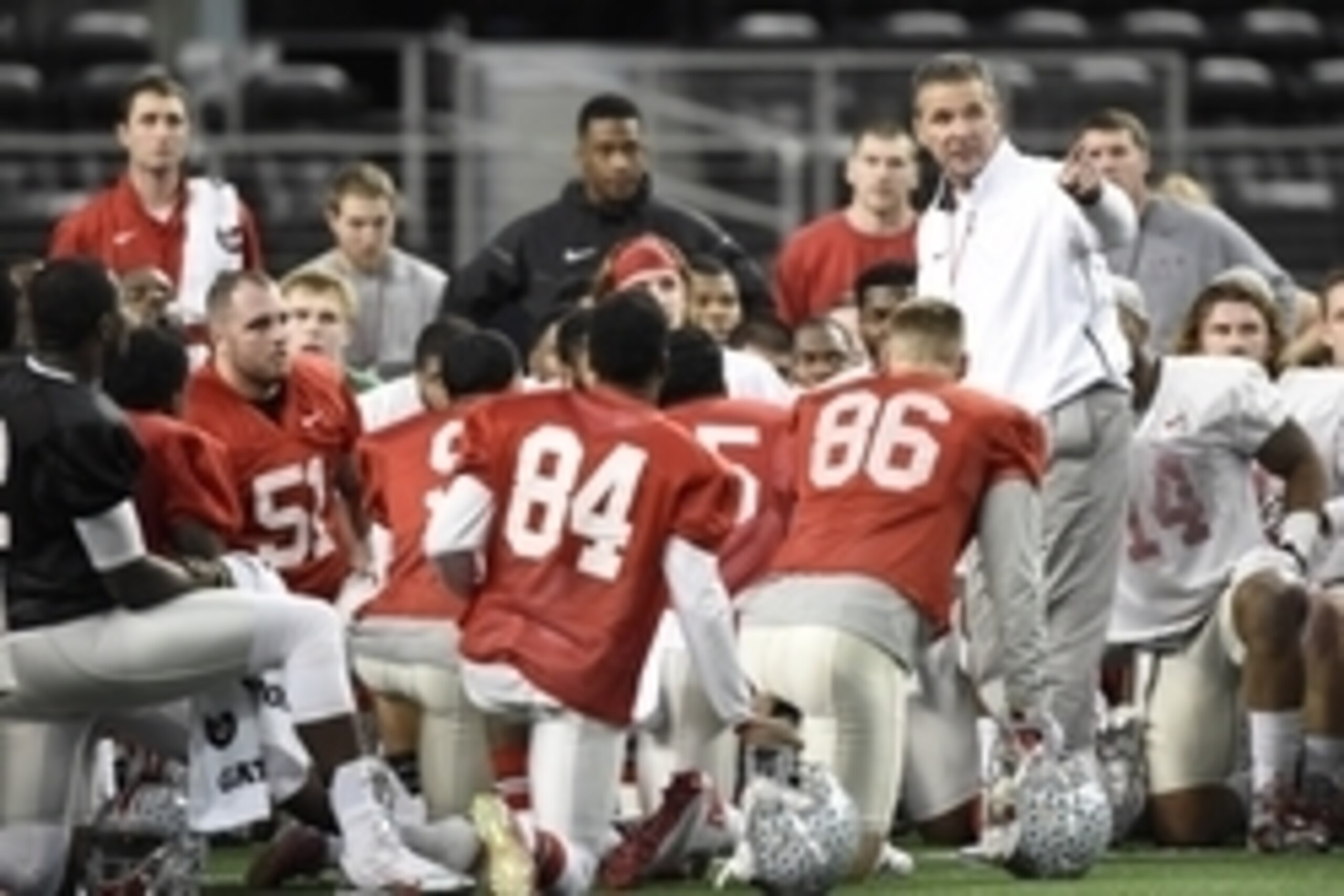
That will be apparent Monday, although rather than Kelly, it will be Mark Helfrich standing across the way from Meyer as the Ducks head coach. Kelly has since taken his hurry-up offense to the NFL's Philadelphia Eagles, who have averaged 28.6 points per game in the past two seasons—much to Frost's delight.
"To ask me if this doesn't work in the NFL," Frost said. "That's not true."
As for Meyer, he'll look to add a third national championship to his resume, using the same edge he created 14 years ago in northwest Ohio. But that won't stop him from constantly tweaking and evolving his scheme to maintain that inherent advantage.
"He's committed to it. I think one of his greatest fears is falling asleep on the game and the game passing him by," said Buckeyes wide receivers coach Zach Smith, who played for Meyer at Bowling Green. "He's not going to let that happen."
Ben Axelrod is Bleacher Report's Ohio State Lead Writer. You can follow him on Twitter @BenAxelrod. Unless noted otherwise, all quotes obtained firsthand. All statistics courtesy of cfbstats.com and recruiting information courtesy of 247Sports.


.jpg?w=2560 "Chiefs, Steelers Eye WR Trades")





.jpg?w=2560 "WWE Raw Live Grades 🔠")