

Rajon Rondo and Monta Ellis Pairing Holds Greatest Promise, Peril for Mavericks
When the Dallas Mavericks acquired Rajon Rondo in late December, there were early question marks as to whether he could coexist with the trigger-happy Monta Ellis. Eight games in, the duo has shown some promise.
The early worries were legitimate. Both Ellis and Rondo excel when they have the ball in their hands. Rondo is exceptional at probing a defense and finding his teammates with nifty passes, while Ellis' drive-and-kick game fuels Dallas' offense.
While the now-departed Jameer Nelson didn't have Rondo's talent, he was still a guy who could knock down threes and happily play off the ball. As a result, Ellis had plenty of room to operate when attacking the basket. Rondo's inability to shoot was perceived as a potential hindrance to those rim attacks.

So far, the results have been mixed. Opposing defenses have sagged off Rondo and left him insultingly open while doubling down on Dallas' other threats.
There have been games in which Rondo has hit his looks and forced opponents to second-guess their initial strategy. There have also been instances when his shot has been completely flat and caused the Mavs to go cold offensively.
Statistically, the Mavs' league-leading offensive efficiency has slowly declined since Rondo's arrival, while the defensive efficiency is moving up in the rankings. Despite this, the offense has still been very good and even looked elite in the last couple of games.
Ultimately, Dallas head coach Rick Carlisle should be able to figure out how to maximize the talent he has on his roster. Since Rondo's arrival, Dallas is putting up 109.8 points per 100 possessions, which would rank as the fourth-best offense in the league. It's not quite what it was before, but it's not as if Rondo has turned the Mavs into a mediocre offensive team.
The 99.6 points per 100 possessions Dallas has allowed since Rondo's arrival is the biggest positive. That figure would have the Mavs as the fourth-best defensive team in the league. If the Mavericks can maintain this balance, they will be scary come playoff time.
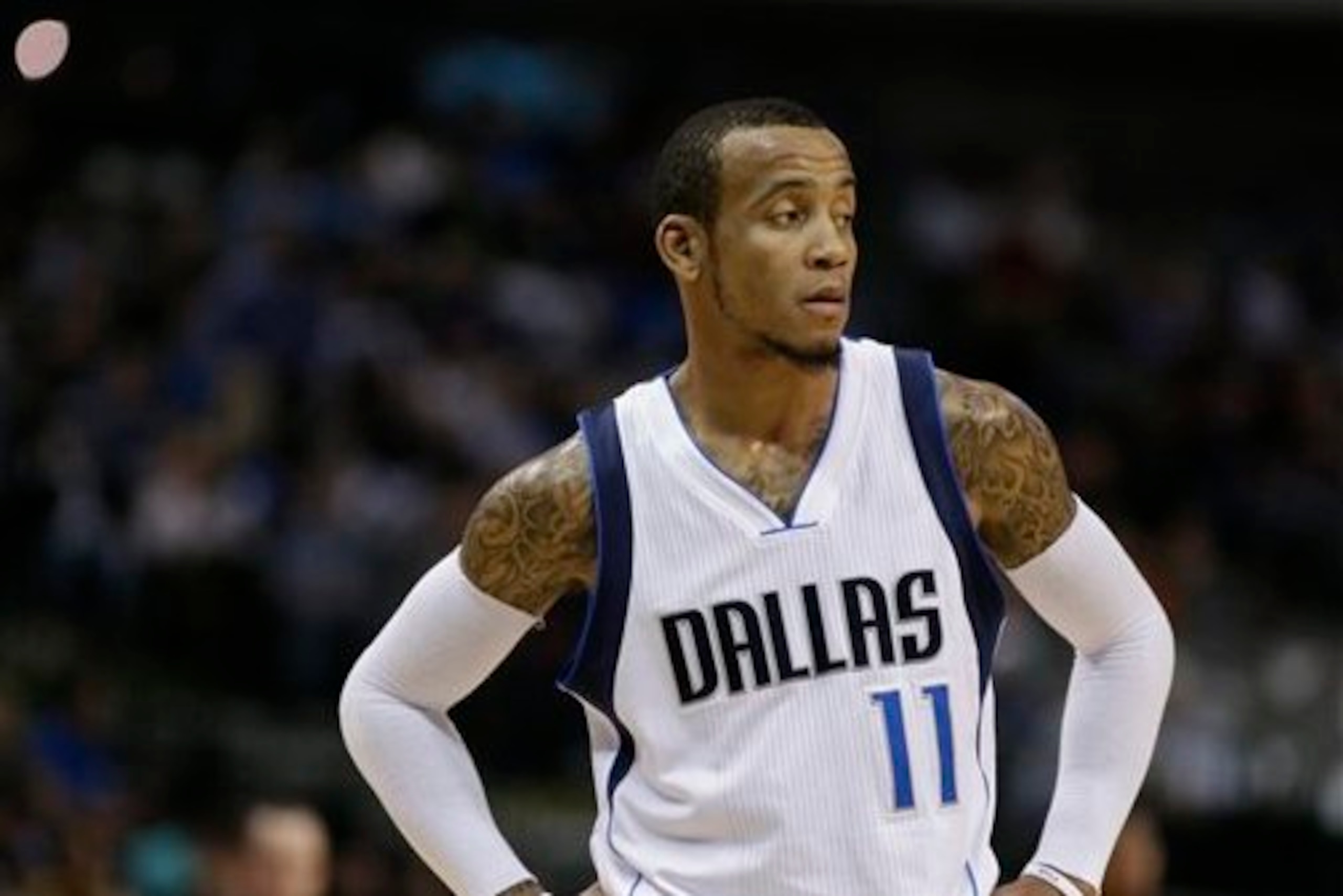
Ellis' individual scoring numbers haven't changed much either since joining forces with the former Boston Celtic. He is efficiently putting up over 20 points per game in the last eight contests.
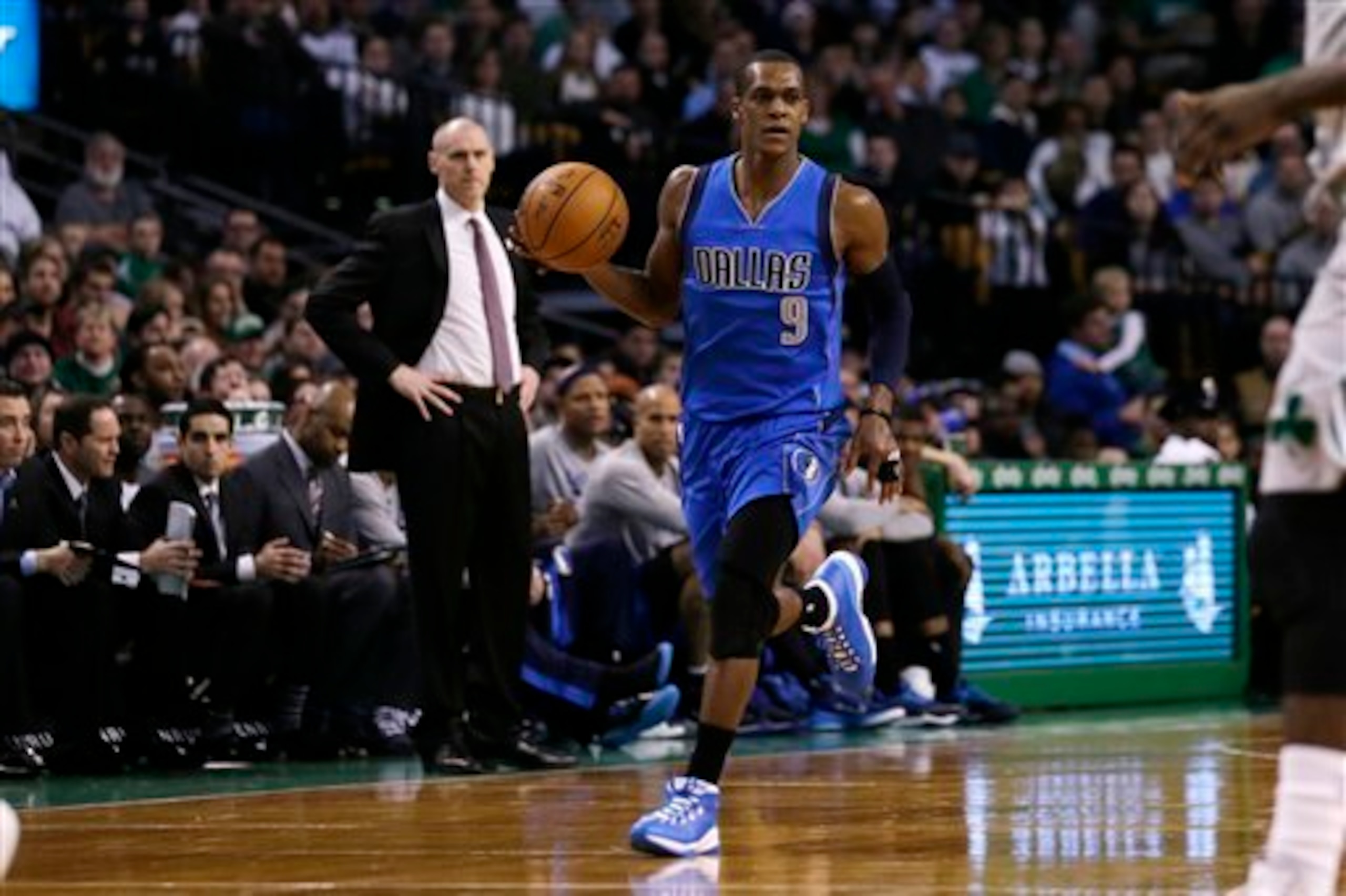
Carlisle has looked for the right rotation since acquiring Rondo, and he has separated his starting backcourt in several different lineups.
In the last eight games, Rondo and Ellis have played 32.3 and 33.3 minutes per game, respectively. They have spent 23.9 minutes per game sharing the floor. That's around a similar amount of time Nelson and Ellis averaged playing together, even though Nelson was often on the bench at the end of close games.
Devin Harris is a great player to plug in next to either Ellis or Rondo. That provides Carlisle with the freedom to maintain a sufficient amount of talent on the floor, while keeping his starting backcourt separate when the offense jams.
Since the spacing is more cramped when Rondo is on the floor, Carlisle has allowed the offense to run through Dirk Nowitzki post-ups a lot more lately. He has also been taking Dirk and Rondo out early in games and returning them together at the end of opening quarters. This grants Ellis the freedom to dominate the offense as the primary threat during certain periods.
When Rondo and Ellis play together, they often take turns running pick-and-rolls on their respective wings. In those situations, smart defenses tend to force the Mavs into scenarios such as this:

The freeze frame shows Ellis combining on a pick-and-roll with Tyson Chandler. Ellis crosses over to his left but has absolutely no space to drive with Rondo being completely unguarded. In that particular play, Ellis considered his options and eventually swung the ball back to Rondo, who was hesitant to shoot even with a ton of space.
As mentioned, Carlisle has opted to utilize Nowitzki's ability to absorb a defense to alleviate the spacing issue. Both Ellis and Rondo are great at reading plays with or without the ball, and they have utilized Dirk's presence as a bridge on plays such as this:
It's a relatively simple set that involves all three players. Nowitzki is constantly on defenders' minds, and Ellis abuses that with a nice backdoor cut. After some slick ball movement, Monta ends up with a great look at the basket.
On that particular play, Rondo didn't have time to clear out the strong side after hitting Dirk with the entry pass. Whenever Nowitzki catches the ball in the low post, Rondo generally cuts to the opposite side of the floor, overloading the weak side. Unless someone makes a full cross-court rotation, that often gives Nowitzki and Ellis enough space to either shoot or work the handoff game.
Rondo's acquisition was always going to hinder Dallas' offense, even if only temporarily. However, he brought a lot of defensive accolades with him to the Western Conference, and the Mavs hope that his presence will improve a shaky perimeter defense. Rondo himself admitted that it might take time to shake off the rust on that end of the floor:
"I haven't played defense in a couple years," Rondo said, according to ESPN.com's Chris Forsberg. "I've been able to hide a lot with Avery Bradley on the ball. He's helped out, the young guy. But [in Dallas] they expect me to play defense and, in the West, if you don't play defense you'll get embarrassed every night at the point guard position."
Even if the offense doesn't quite reach historic heights, a more balanced effort on the other end would certainly push the Mavs into title contention. As Rondo admitted, he has some bad defensive habits built up over the last couple of years. Still, when he has been engaged, his one-on-one defense has been smothering.
The fact that Ellis doesn't have to guard the best offensive guard of the opposing team is also beneficial to the pairing. Monta's game is built on speed and explosiveness, which he gets to preserve when guarding off the ball.
Whether or not Rondo can regain his consistency and focus defensively remains to be seen, but Dallas traded for him with the assumption that he could, according to ESPNDallas.com's Tim MacMahon:
"The statistics indicate Rondo had been closer to average than dominant defensively since returning from his knee injury. The video the Mavs reviewed showed the numbers didn't lie, but Dallas' decision-makers firmly believed Rondo would regain his feisty form with the natural motivational fuel that comes with playing for a contender.
"
In fact, that was one of the primary reasons the Mavs coveted Rondo, knowing they had no realistic shot of emerging from the wild West without a defensive stopper to deal with the conference's plethora of premier point guards.
On paper, Ellis is the guy who should have the hardest time adjusting to Rondo's game, but he is doing an admirable job so far. He is still managing to find ways to get to the rim, with or without Rondo on the floor.
As the two players continue to develop chemistry, the Mavs will only become more of an intimidating presence in the West.
All statistics are courtesy of NBA.com, unless otherwise noted.

.jpg?w=2560 "Chiefs, Steelers Eye WR Trades")
.jpg?w=2560 "WWE Raw Live Grades 🔠")

.jpg?w=2560 "🚨Jay-Z Headlining Super Bowl")
.jpg?w=2560 "Cowboys Handle Eagles on MNF 🤠")