Packers Offensive Line Proves to Be Super Bowl-Caliber
The time has come for the Green Bay Packers' offensive line to be considered among the NFL's very best.
Any sliver of doubt about the caliber of the five men protecting quarterback Aaron Rodgers and opening holes for running back Eddie Lacy has been squashed over the second half of the 2014 season, with last Sunday's decisive victory at the line of scrimmage over the Detroit Lions serving as the culmination showcase of the unit's emergence as one of the NFL's elite.
Featuring a game plan dead set on running the football right at one the best statistical defenses of recent NFL history, the Packers established the tone early and never wavered. And once Rodgers returned from another calf injury, the line protected its suddenly immobile quarterback against a talented pass rush that could have feasted on a gimpy passer.
.jpg?w=2560 "Titans Giants Football")

The final result was 152 rushing yards (the most allowed by the Lions over the 2014 season), zero sacks of Rodgers and a 30-20 win that clinched Green Bay's fourth straight division title.
Rodgers' heroic return after reinjuring his left calf received most of the headlines. Yet his MVP moment wouldn't have been possible without the impressive work done by the five players controlling the line of scrimmage for 60 minutes, which Rodgers acknowledged.
"The line has been great," Rodgers told reporters Sunday. "They've been the key to our success, especially the last 8-10 weeks. They've been blocking really, really well. Tonight I wasn't sacked, and, frankly, not touched much the entire game. That's a quarterback's dream right there."
Rodgers dropped back to pass 23 times against the Lions. He was under pressure only six times, according to Pro Football Focus (subscription required), and his 17 unpressured snaps resulted in 15-of-16 passing for 207 yards and a touchdown (plus a 13-yard run). Official stats credited the Lions with just one quarterback hit on Rodgers. Detroit's only sack came with backup quarterback Matt Flynn in the game.
Meanwhile, the Packers confidently hammered away at a Detroit defense that came into the contest allowing 63.8 rushing yards per game, which—if it had continued through Week 17—would have been the sixth-best mark of all time.
Lacy rushed for 100 yards on 26 carries, becoming the first running back since Week 16 of last season to hit the century mark against the Lions defense, and Green Bay's 152 total rushing yards beat the previous high allowed by Detroit in 2014 by 20 yards. Overall, the Packers called 36 running plays, the most the Lions have seen this season.
| Rushing Yards/Game | 97.5 | 142.1 |
| Yards/Carry | 4.0 | 4.7 |
| 100-yard Rushing Games | 3 | 8 |
| Eddie Lacy Rushing Yards | 428 | 711 |
| Sacks of Aaron Rodgers | 20 | 8 |
| QB Pressures Allowed | 59 | 52 |
The effectiveness of both the pass protection and run-blocking is only surprising to those who haven't been paying attention over the last two months.
According to PFF, the Packers finished the 2014 season with the second-most efficient pass-blocking offensive line. Only three lines allowed fewer total pressures, and Rodgers' sack percentage of 5.1 represented a new career low.
Over the final eight games, the Packers allowed just eight sacks of Rodgers. The New England Patriots took him down three times in Week 13, but he was sacked only once or not at all in the other seven games.
The run blocking has been equally good during the second half of the season.
After averaging 97.5 rushing yards per game over the first eight games, the Packers completed the final eight rushing for 142.1 per contest. Only five teams averaged more yards from Week 9 and later, and only four teams had a higher yards-per-carry average than Green Bay's 4.7 over the final eight games.
Look no further than the Packers' first drive against the Lions for evidence of how good the offensive line can be opening holes for Green Bay running backs.
On the very first play from scrimmage, the Packers lined up with three receivers and a tight end in the pistol formation—designed to lessen the load on Rodgers' injured calf. The Lions countered with their nickel defense, with six players in the box and both safeties playing deep.
It was a look that stopped the Packers cold in the first meeting. Unable to run against a soft front, the Packers also found nothing against seven-man coverages in a seven-point effort.
Not this time.
Here is the hole Lacy was given to open the game:
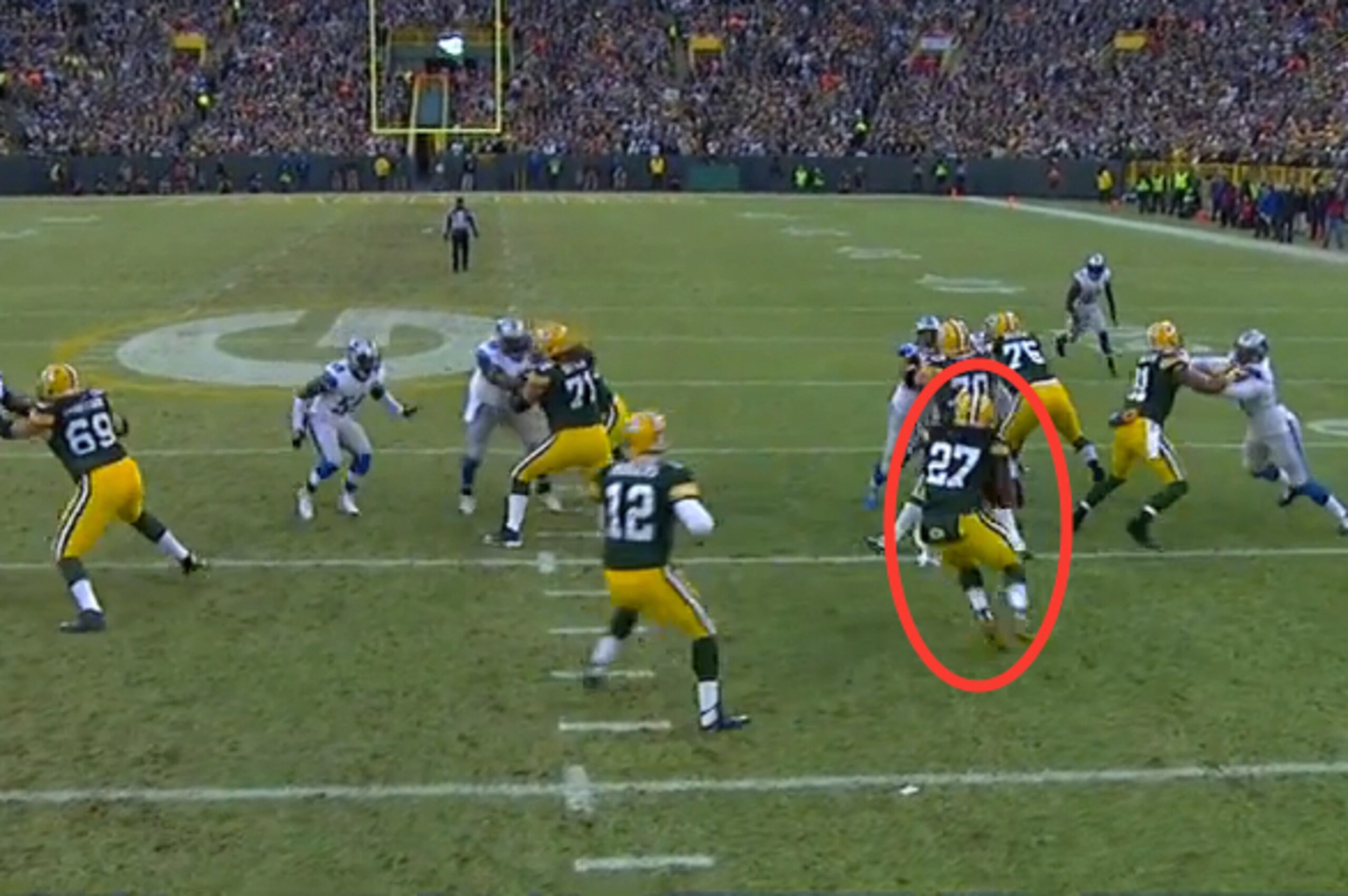
The man-on-man blocking is a picture of perfection. Guard T.J. Lang (70) has Ndamukong Suh moved out of the hole, and center Corey Linsley and guard Josh Sitton (71) have a combo block working on the nose tackle. Three Lacys could have fit through the opened hole, and that's saying something.
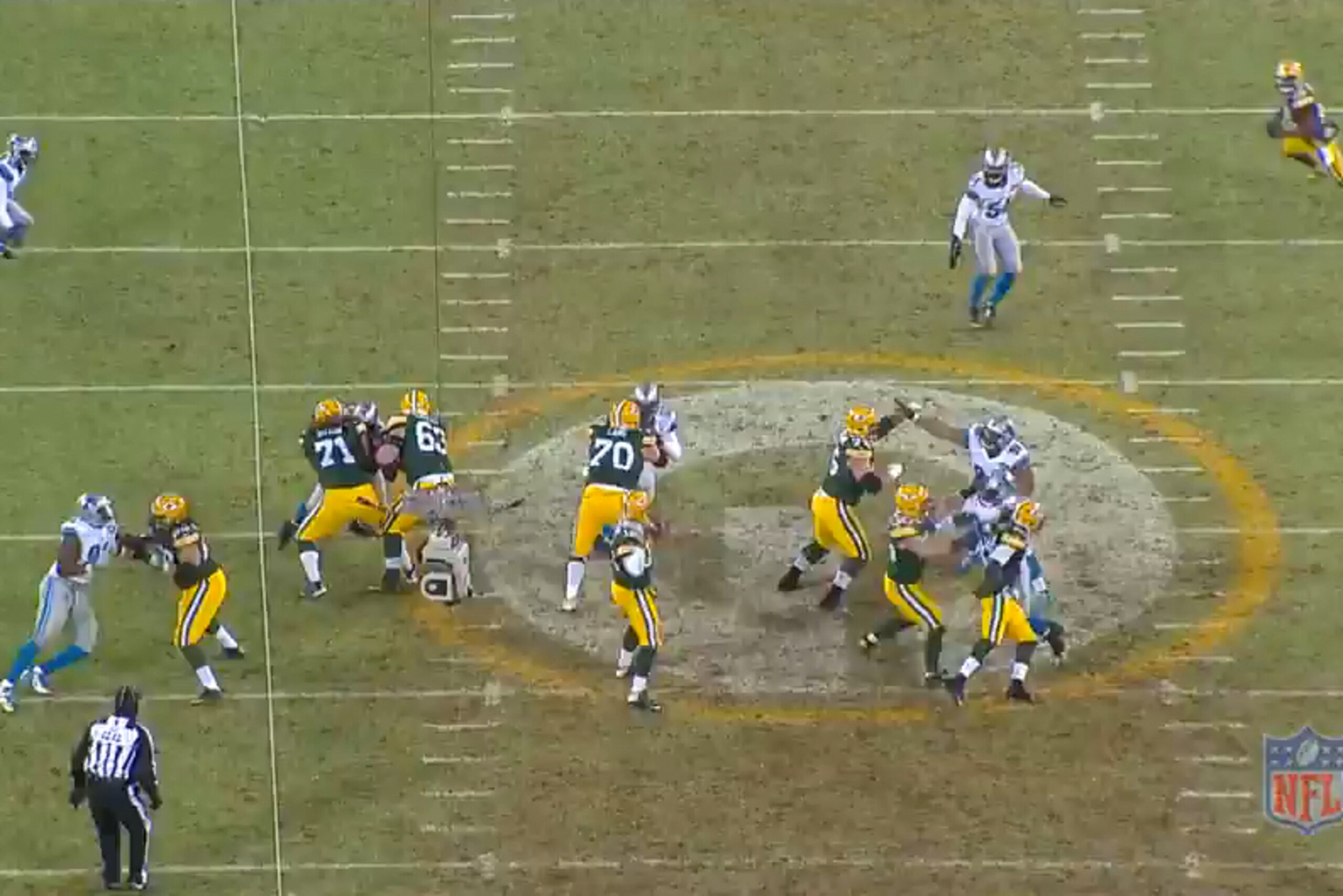
The All-22 look gives a better look at how the opening formed:

Again, Lang's block on Suh makes the play happen. Right tackle Bryan Bulaga also immediately gets to the second level and takes away Lions linebacker DeAndre Levy. Tahir Whitehead (shown in the blue rectangle) misread the play, but this angle shows Linsley was in position to complete the combo block and wall off Whitehead to maintain the hole.
Lacy rumbled through and picked up 22 yards to start the proceedings.
After two more Lacy runs gained 13 yards, it was James Starks' chance to do some damage. And just like Lacy, the offensive line made sure Starks' first touch would be an easy one:
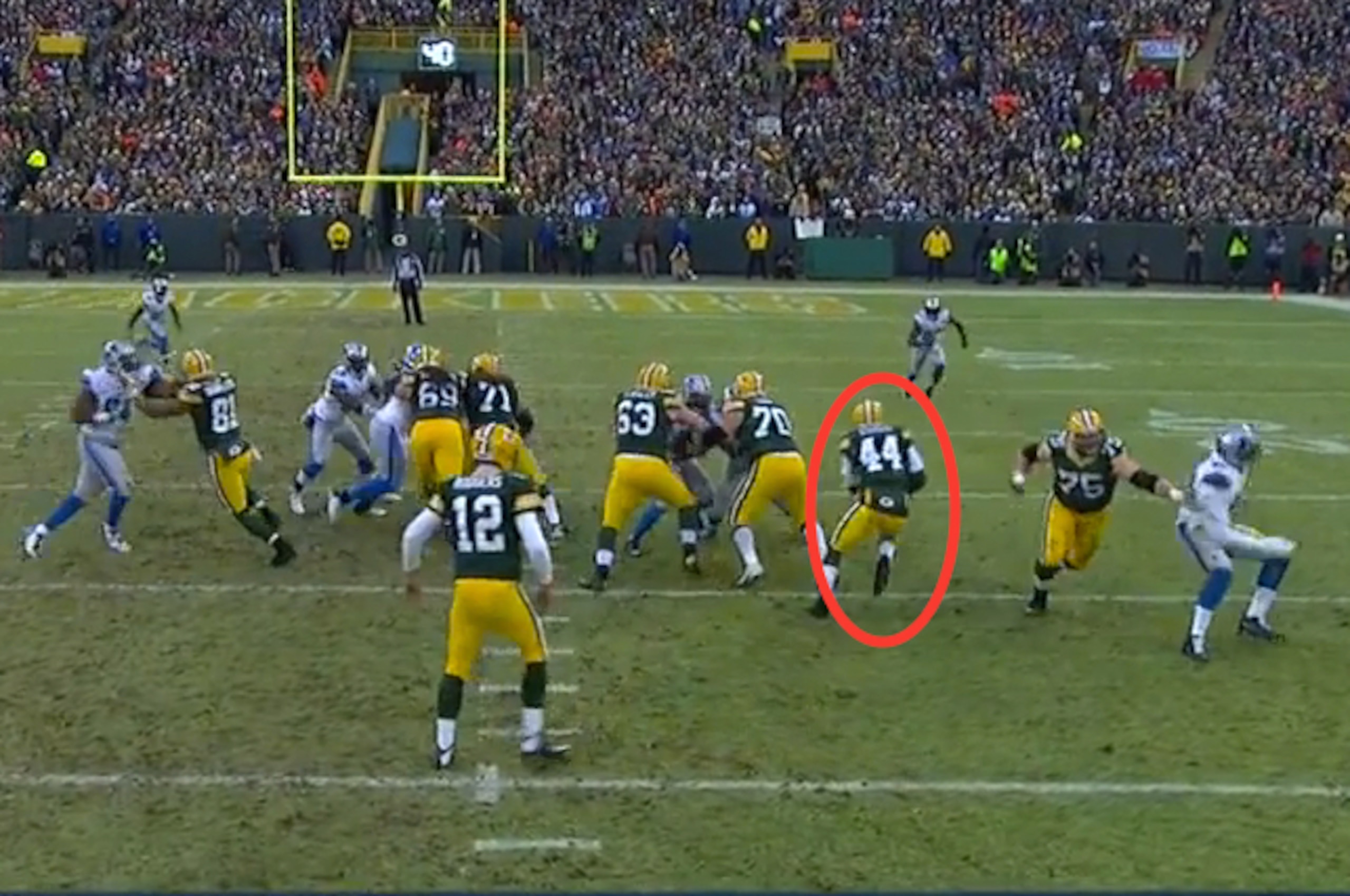
The Lions simply haven't allowed gaps like this up front all season.
Once again, the play is made when Lang sticks his block on Suh. This was undoubtedly one of Lang's best games of the 2014 season. He didn't win every battle against Suh, but he won his fair share. The Lions All-Pro defensive tackle wasn't a major factor in the game, and that's a credit to the every-down work of the Packers right guard.
Assisting Lang was Bulaga, who had an easy kick-out block of the out-of-position defensive end, and Linsley, who took care of Levy inside. Sitton and left tackle David Bakhtiari did enough on the backside to ensure Starks would run free to the second level, where he made safety James Ihedigbo miss for a 21-yard pickup.
The Packers would eventually fail to score given seven goal-to-go opportunities, but the tone for the game had already been set.
"The line, from the start of the game, really controlled the line of scrimmage," Rodgers said. "That first drive, we had 60 yards rushing or so, and went right down the field. Those guys looked at it as a big challenge, (facing) that defense."
The game briefly turned on its head when Rodgers went out of the game with the Packers up 14-0. The Lions stormed back, scoring touchdowns on both possessions with Rodgers hobbled and Flynn in the contest.
The game still could have slipped away once Rodgers, a quarterback who relies heavily on his ability to move and make plays on the run, returned with only one healthy leg.
The offensive line ensured a one-legged Rodgers would be more than enough to calm the storm.
The Packers ran three straight times to open up the first series following Rodgers' return. He dropped back to pass on the fourth.
This is the pocket he was provided:
There isn't a Lions defender within three yards of Rodgers. This is the definition of a clean pocket—with no defender in the face or at the legs of the quarterback, and a clear passing lane to deliver the throw. Suh is a non-factor, and defensive end Ziggy Ansah is a full five yards from Rodgers and under the control of Bakhtiari.
Rodgers completed his stress-free throw for 29 yards to Randall Cobb, setting up Green Bay's go-ahead touchdown.
Later, Rodgers was given ample time in the pocket to bounce around and find Lacy out of the backfield for 15 yards.
It would have been telling to see how Rodgers and his reinjured calf responded to a pressured look in the second half, but there simply wasn't a great example. The closest the Lions came to hitting Rodgers came on his 15-yard completion to Jordy Nelson in the fourth quarter, which all but wrapped up the game and provided the setting for Suh's two-step on Rodgers.
Even in the first half, the Lions struggled to disrupt the Packers passing game with front-four pressure.
Here is the pocket Rodgers threw from while completing a 34-yard pass to Cobb in the second quarter:

Again, the Lions do not have a rusher within three or four yards of Rodgers. Give him this much time and even a seven-man coverage isn't going to be enough. The Packers scored—and Rodgers was hurt—two plays later.
It's one thing to manhandle a defensive front such as the Atlanta Falcons or Tampa Bay Buccaneers. It's quite another to go head-to-head with a defensive line like the Buffalo Bills or Lions and score a decisive win at the line of scrimmage.
There will be fronts during the NFC playoffs that will test the Packers on offense. But there now seems to be an aura of confidence to the offensive line, likely developed over games such as Sunday's win over Detroit.
The Packers are no longer Aaron Rodgers and a bunch of receivers making up for the liabilities along the offensive line. Green Bay now has a front five that can be rightfully considered Super Bowl-caliber, an elite group capable of enhancing Rodgers and powering Lacy no matter the opposition.
Zach Kruse covers the NFC North for Bleacher Report.