Packers' Young Defenders Finally Clicking with Capers' Complex Defense
If you would have told Green Bay Packers fans after a 1-2 start that not only were the Packers going to finish with a first-round bye in the NFC playoffs, but that Dom Capers' defense was going to thrive down the stretch, they would have thought you were insane.
Capers, Green Bay's defensive coordinator since 2009, has been one of the go-to punching bags when the team struggles. Despite a Super Bowl victory under his belt, you'll see a few #FireCapers hashtags on social media when the team is behind. As of recently, they've been more sarcastic than literal.
According to Pro Football Focus (subscription required) the Packers defense is 13th in pass coverage, 13th in pass rush and 27th in run defense. The passing game is Capers' forte. When he was a member of the Pittsburgh Steelers coach staff, he was part of the development of the fire blitz.
.jpg?w=2560 "Commanders 49ers Football")
.jpg?w=2560 "Colts Football")
.jpg?w=2560 "DOLPHINS-AIKMAN")
The fire blitz is essentially the disguising of blitzes to confuse quarterbacks. In the past, a quarterback was taught to throw into the area where a player had blitzed from, the vacancy given up by the defense to create pressure. A fire blitz involves dropping a defensive lineman into the zone, giving the quarterback an immediate read of a blitz, forcing him to release the ball quickly, but as the play progresses the lineman replaces the vacancy left behind by the linebacker or defensive back.
As far as the run game is concerned, the numbers aren't great, and Green Bay has struggled, but with two undersized 3-4 defensive ends as starters in Mike Daniels and Datone Jones, and a missed season from would-be-starting nose tackle B.J. Raji, there weren't high hopes for the unit coming into the 2014 regular season.
According to Football Outsiders' advanced statistic DVOA, the Packers had the 13th-best defense in the NFL heading into Week 17. If nothing else, you can call the 2014 defense consistent. Still, the improvement from 2013 has been massive. The same site listed Green Bay's defense as the 31st in the league for its final 2013 rankings.
So, what's changed for the squad?
Well, first there are the additions to the defensive side of the ball. After no safety recorded an interception for the team in 2013, Alabama stud Ha Ha Clinton-Dix fell to the Packers in the NFL draft. With his selection, Ted Thompson, the franchise-building general manager of the team, locked up the future of the position, pairing him with Morgan Burnett.
Another key contributor to the 2014 Green Bay defense came via the preceding offseason, but he joined the squad from a typically unused method by the team: free agency. Julius Peppers, a future Hall of Famer who had spent his career in Carolina and Chicago, Green Bay's divisional rival, was added as an outside linebacker. Previously a 4-3 defensive end in his entire career, tackling a new role looked like a risky move by one of the generation's best. Entering the lineup as a starter, he displaced 2012 first-round pick Nick Perry to a rotational role.
There was also development from the players already on the team. Jones, the undersized defensive end mentioned previously, was beaten up by the end of his rookie season of 2013. In 2014, while missing some time due to injury, he's drastically improved, becoming one of the most efficient interior penetrators in the league.
Sam Barrington, a seventh-round linebacker from the 2013 class, has taken over the starting inside linebacker role after it was originally stripped from Brad Jones, then Jamari Lattimore and given to Clay Matthews. While Matthews performed well in the role, his initial position, outside linebacker, has much more impact in today's NFL, and he was moved back when the team was comfortable with hanging Barrington out with the big boys.
The rotation of the inside linebackers speaks about Capers. He accepts the roles of players and puts them in a position to win. On the defensive line, there are some similarities. Josh Boyd, a much bigger defensive lineman than Jones, has replaced the defensive end on run downs.
Even Clinton-Dix, the top selection by the team in 2014, didn't get the starting role until he was eased into snaps. In the first handful of weeks of the year, Micah Hyde, a college cornerback and safety who had played cornerback in his rookie season of 2013, was the starting safety next to Burnett.
One reason the team transitions young players into the lineup is the complexity of the system. When talking to coaches or fans of the X's and O's of football, one thing you'll hear about Capers is that his defense is hard to learn but is similar to the defenses of the Pittsburgh Steelers and Alabama Crimson Tide, two squads who have had a recent winning tradition under their current schemes.
For example, Alabama's head coach Nick Saban is known as a defensive backs wizard. One of his favorite plays is a concept based on a modified Cover 3 scheme. Now, the modification only works if everything is executed correctly. If one player is on the wrong page, it could mess up the entire snap, which is why these defenses where coverage is read live instead of pre-snap can be so volatile, and in Capers' case, easy to criticize by armchair coaches.
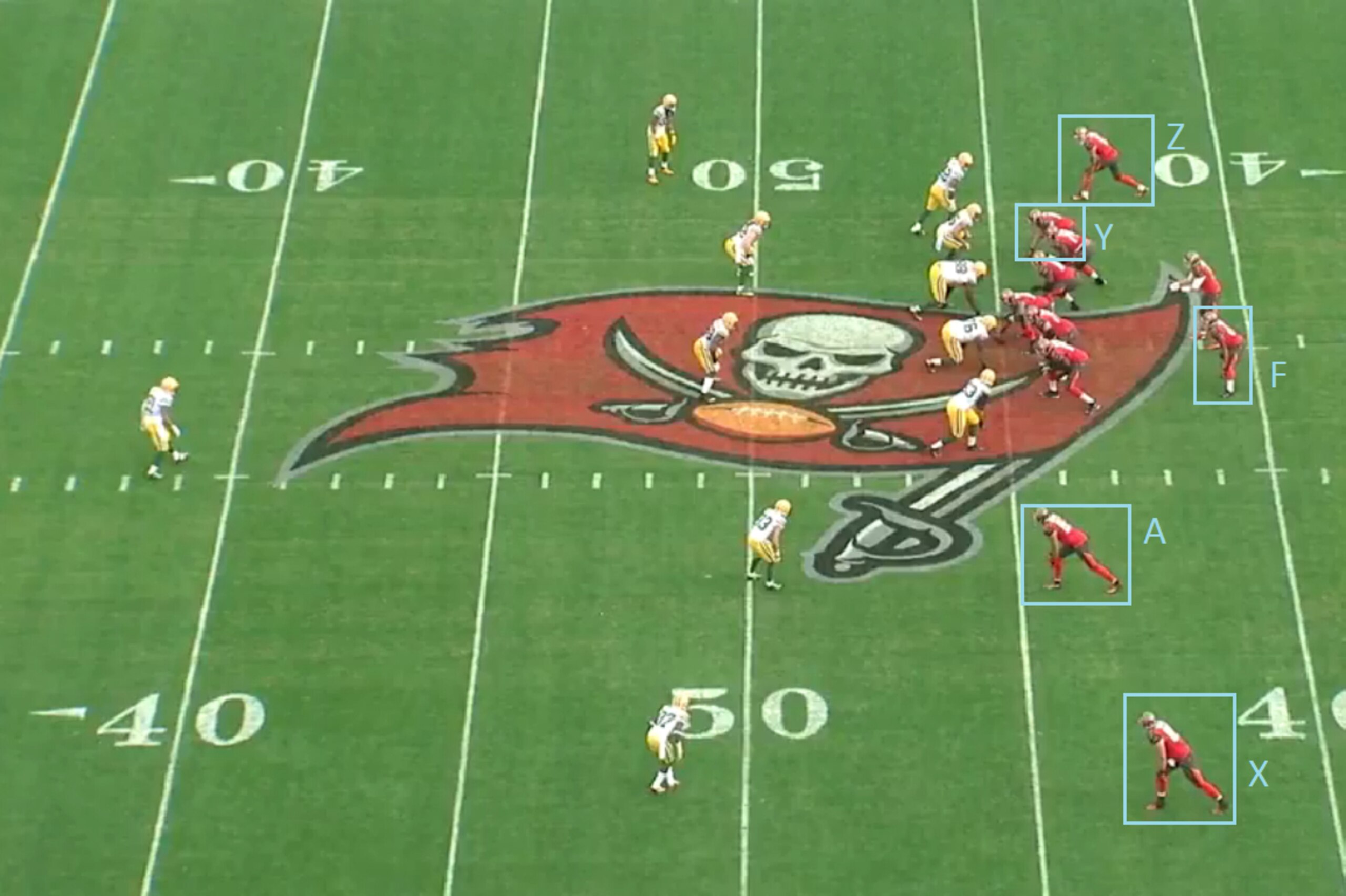
This is a play from early on in the Green Bay and Tampa Bay matchup from last Sunday. The Buccaneers came out in what coaches call 11 personnel, meaning they had one running back and one tight end.
An offense labels the boundary receivers as X (left) and Z (right,) while the slot receivers are labeled A, B and C going from left to right. On this play, there's only X, A and Z. The tight end is typically labeled Y, unless he's in the backfield, in which case he may be labeled H, for H-back, another name for a movable tight end. The F is the feature back or running back of the offense.
What you'll notice here is that there's a short bunch to the boundary side of the field on the right. With the Y and Z so close, they could be running some sort of switch vertical concept trying to beat man coverage.
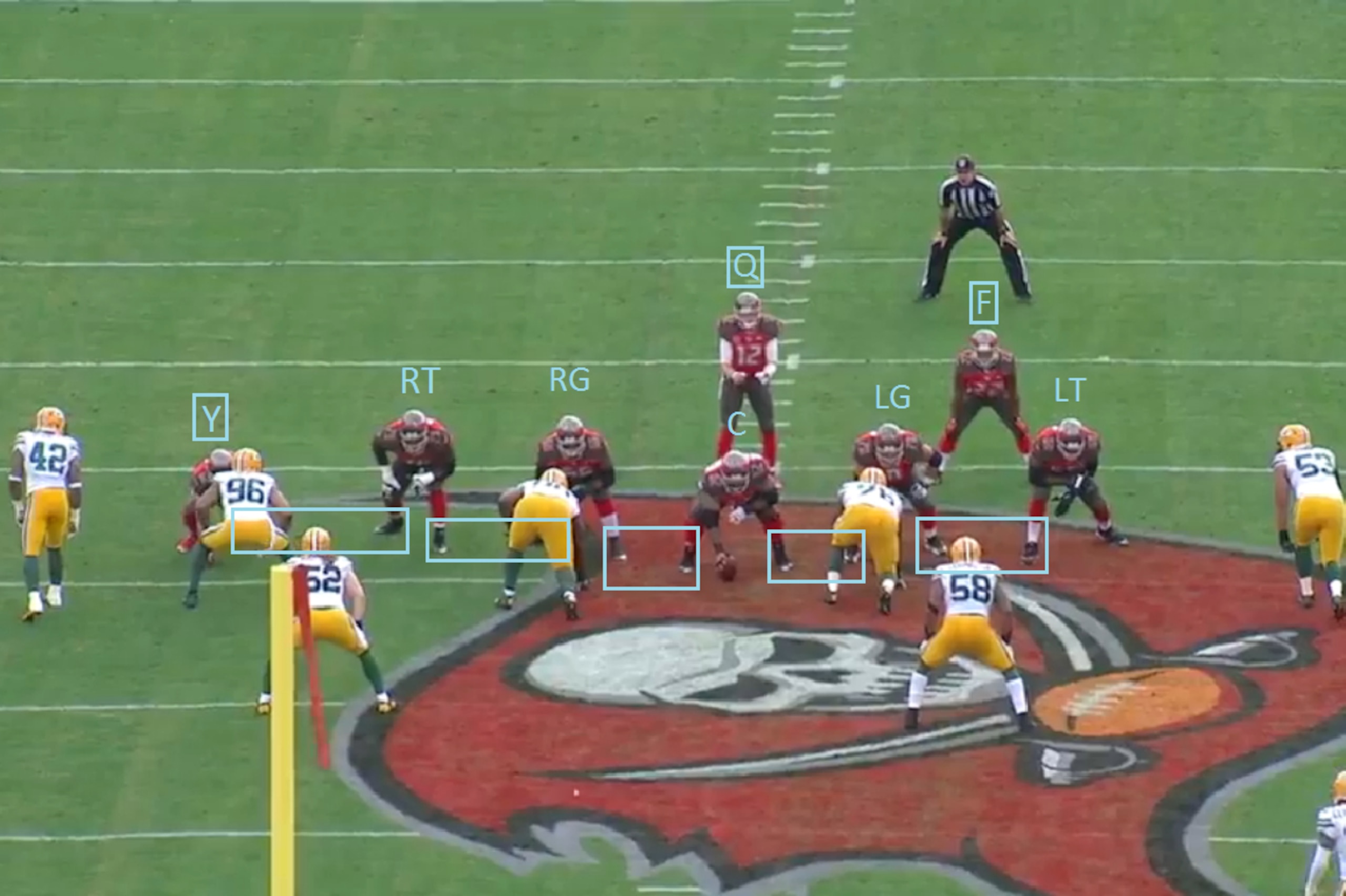
The look from the end-zone camera gives a solid view of the splits the offensive linemen have. The spacing between the center and guards are shorter than the spacing between the guards and tackles, meaning that if this were a run play, the center and guards could be working in tandem.
The Y is also further out from the right tackle than any one of the linemen are from each other, meaning he could be trying to split himself from the line to run a route or block on the second level.
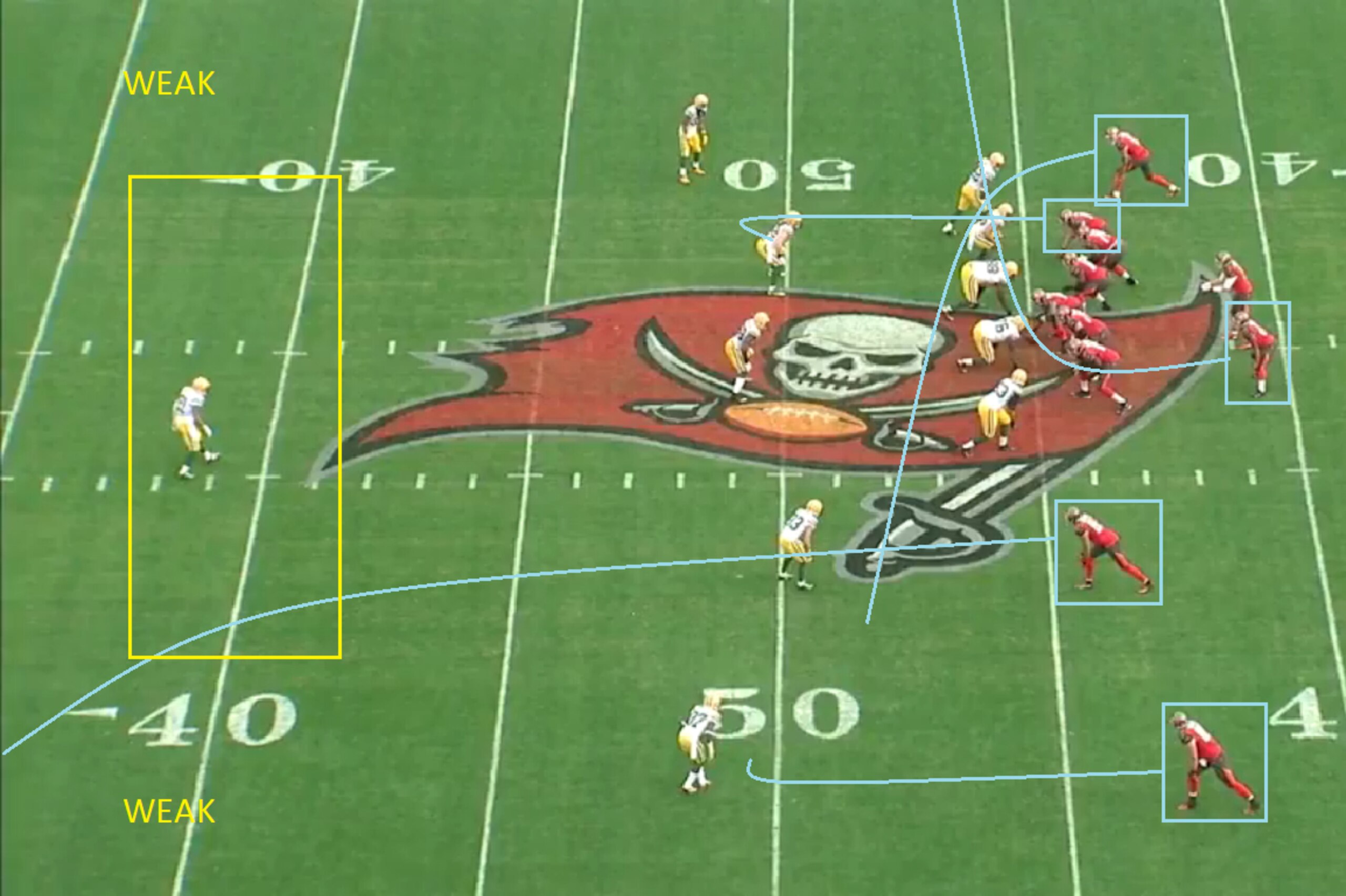
Knowing all that, here's what Tampa Bay's play looked like. The X and Y ran curl routes while the Z ran a shallow crossing pattern, the A ran a corner and the F ran a checkdown route near the line of scrimmage.
The reason this play made sense at the time was the positioning of the safeties. Clinton-Dix was playing single-high, as Burnett dropped into the box over the tight end. This meant the Packers were either in Cover 1 or Cover 3. In 2013, this play isn't ran, as Green Bay didn't have a trusted free safety.
In Cover 1, the weakness of the deep shell is the boundaries, as one safety can't cover the entire top section of the field. A corner route, which targets the boundary, is exactly the right call in the situation.
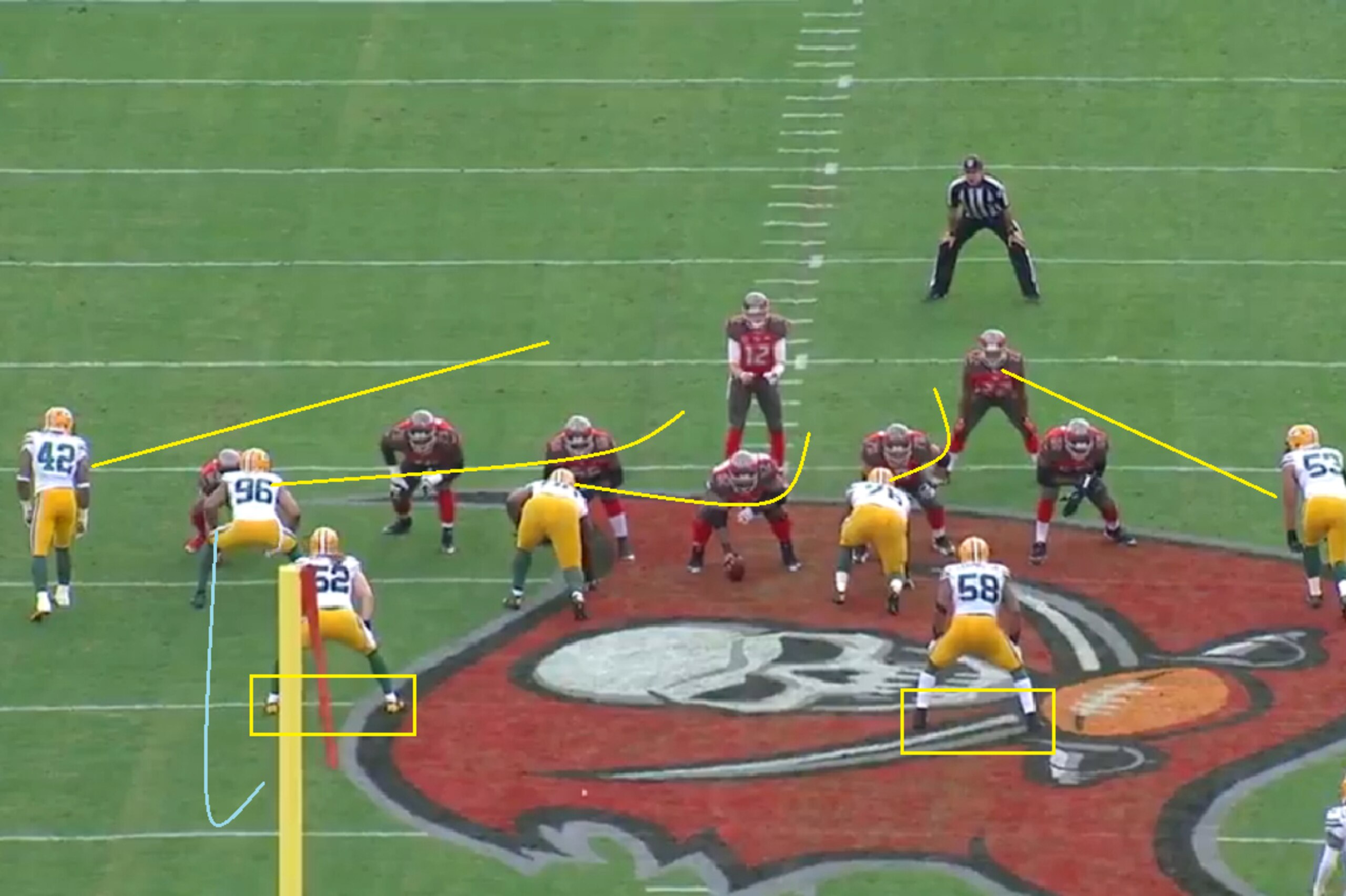
Green Bay wasn't going to let the Buccaneers just take yardage from them, though. Capers dialed up a blitz that involved Burnett. The pairs of defensive linemen and outside linebackers attacked the left shoulders of the offensive linemen, leaving what would be a one-on-one battle of speed for the safety and right tackle.
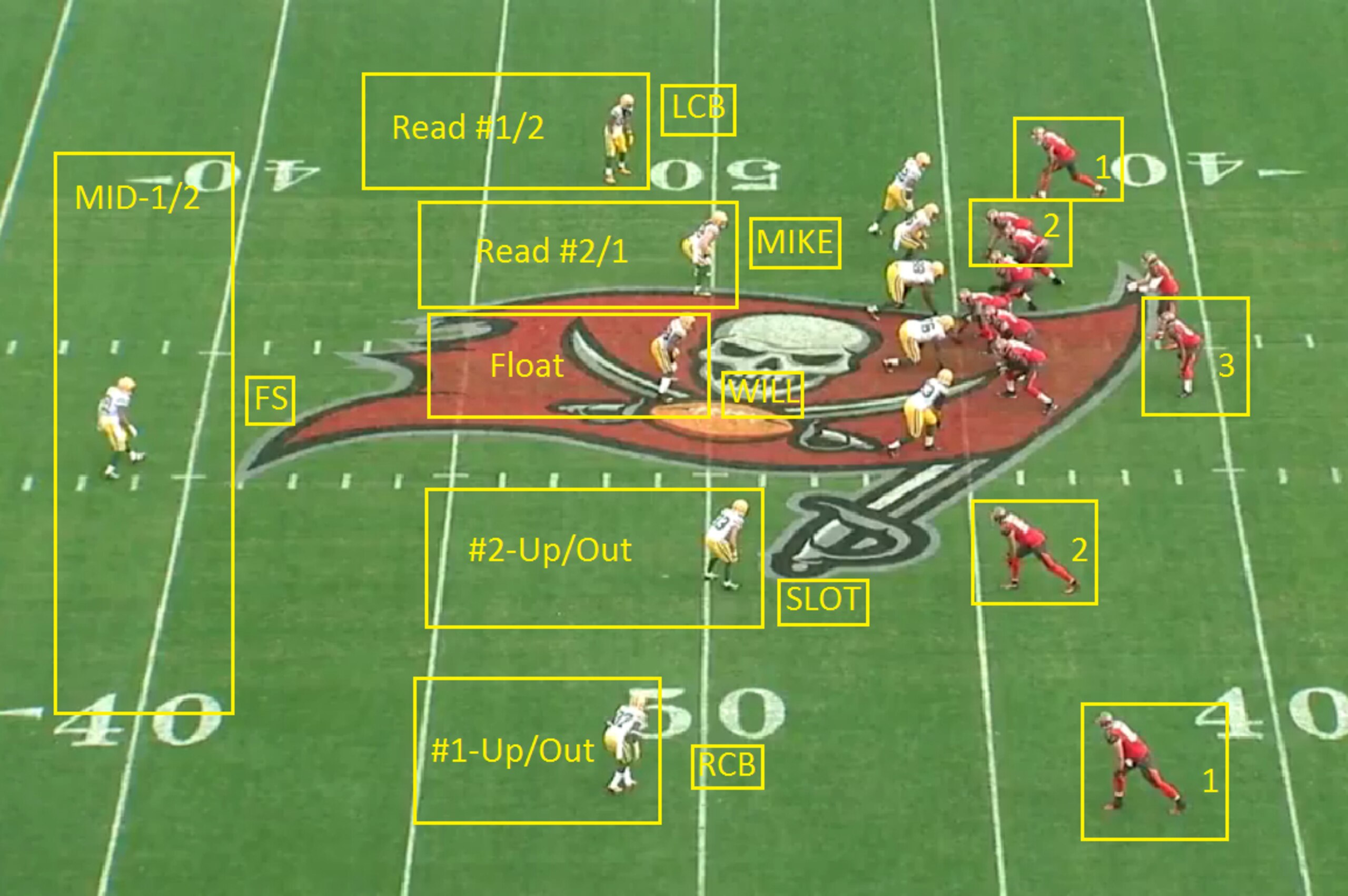
On the back end of the defense came the modified Cover 3 play described earlier. While it may seem overwhelming at first, it's based on fundamentals. The reason it's a modified Cover 3 is due to the boundary assignments. If the boundary receivers go vertical, the boundary cornerbacks go vertical, covering the weakness of the Cover 1 defense. This in effect turns the play into a Cover 3 call mid-snap.
There's a solid chance Tampa Bay saw this tendency, which is why it ran a vertical route by a slot receiver and ran curls with its boundary players.
Not only do the cornerbacks cover their men vertical, but also outside, as they are the furthest outside players on the defense. This also goes for the slot cornerback on the play.
What makes the play more difficult is the coverage on the short side of the field. Because of the bunch set and threat of a switch vertical combination, the cornerback isn't going to play man, but take the man closest to his zone vertical or outside. The same can be said about the "Mike" linebacker Matthews.
The final inside linebacker, Barrington, doesn't have a man assigned to read on the play but will float in his zone, trying to take away passing windows from Josh McCown.
Clinton-Dix, lined up as a single-high safety, will have Cover 1 assignments on the play.
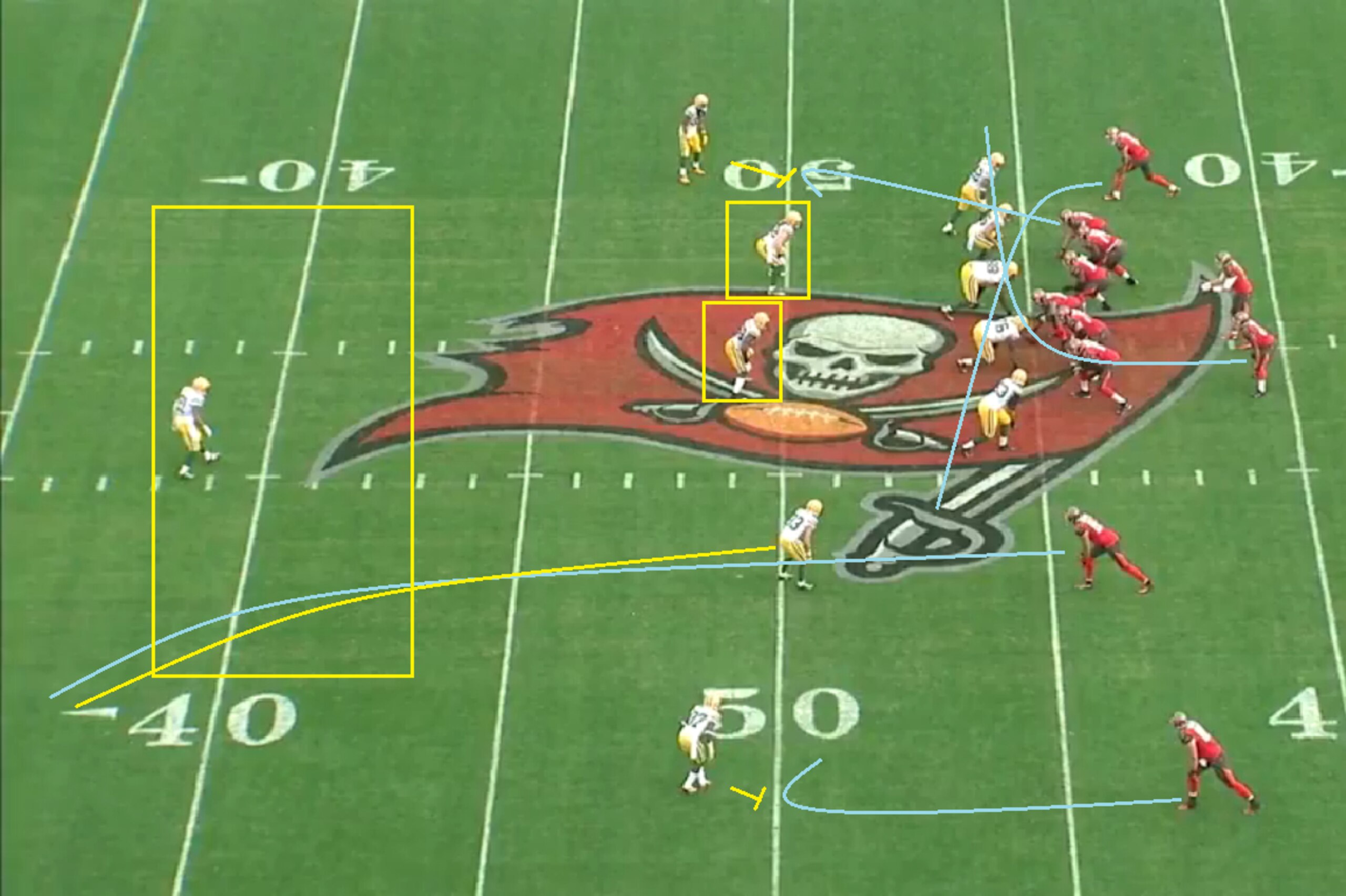
All together, this is how the play should look. The boundary corners should sit on the curl routes, as there's no vertical or outside threat from their men. The Z and F will run crossing patterns through the zone defense of the linebackers. The A will run a corner in man-to-man coverage and Clinton-Dix will stay on top of the defense as a high safety.
Simply enough, McCown's reads should be the corner route, then crossing routes.

As he hit his drop, sure enough, his first read was the corner route. Everything on the play was going according to the plan. The boundary corners were giving their men space but reading the eyes of the quarterback, making those curl routes unthrowable. The Z was about to enter Matthews' zone in pass coverage.
Unfortunately for the Buccaneers, Hyde, the slotback on the play, was doing a great job of roughing up the target and disrupting the flow of the play. As mentioned, McCown had already hit his drop. He was ready to let the ball loose, but the corner route was nowhere near ready to be thrown.
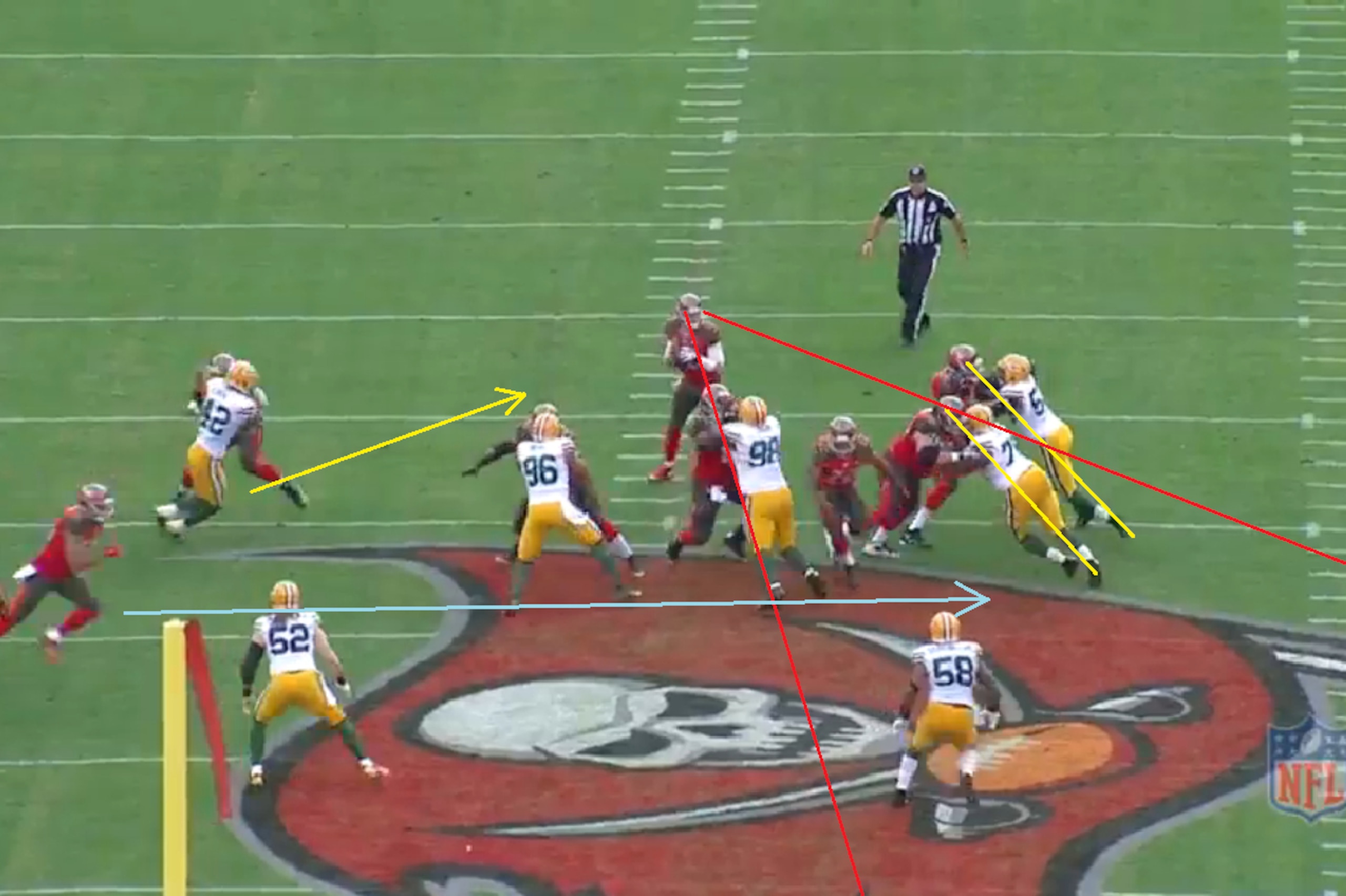
This a shot from the same time from the end-zone angle. As you can see, the Z is about to enter Matthews' coverage.
The right tackle on this play continued to step back as he waited for Burnett to make contact on the blitz. Overthinking it, he went too far back, opening up a lane for Burnett to nail McCown from a blind spot. Capers' complex coverage and blitz not only had the opposing quarterback holding the ball but had offensive linemen allowing free men in five-on-five situations.
The two pass-rushers on the right of the play, Perry and Daniels, had already won their leverage battle and began to crash the pocket.

When McCown tried to reset his feet to hit the underneath crossing patterns, it was over. Burnett was clearly going for the kill shot at this point, and the passer still had his shoulders parallel to the line of scrimmage, completely out of position. Out of sync, the timing route of the Z receiver, which had to be hit in the window between the linebackers, wasn't an option.
Mike Neal, the left outside linebacker on this play, was right in the passing lane, too, just waiting to swat down a pass.
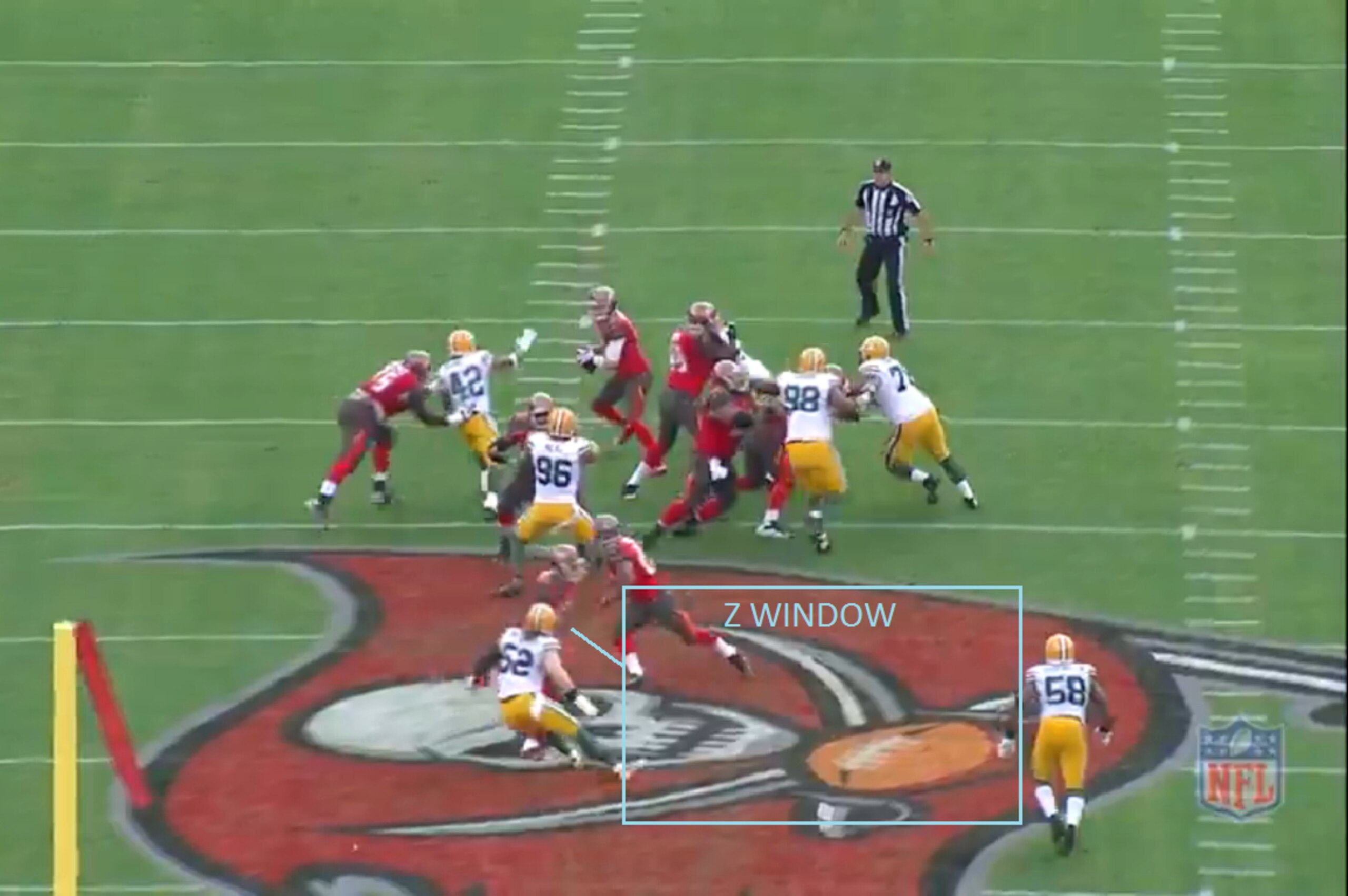
As the Z's window opened, Matthews transitioned to the F target. McCown, with Burnett running at his face and his offensive line crashing on his back side, had to try to escape the blown pocket.
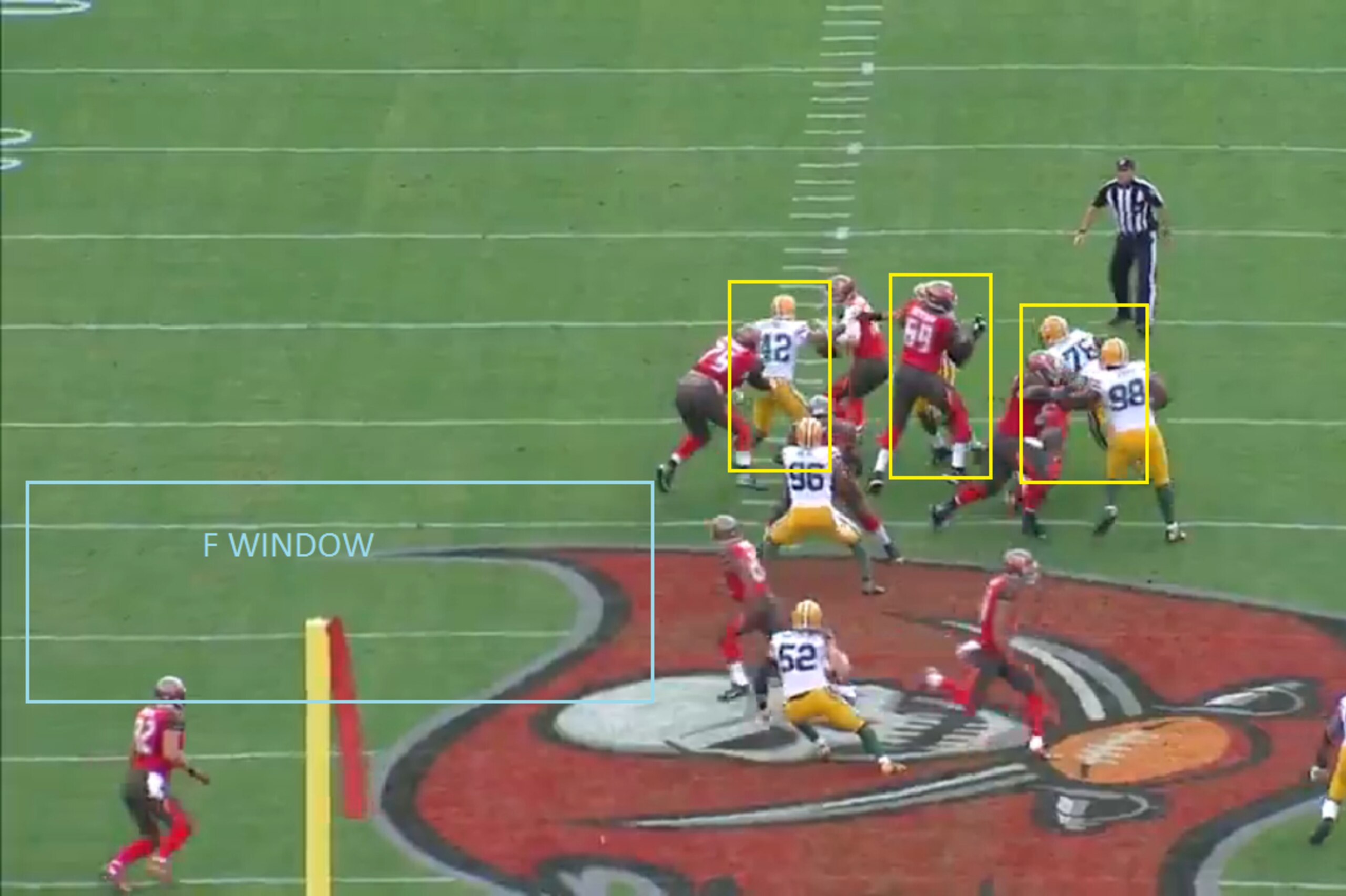
Checkdowns are typically open, but the issue is staying alive while the window is shut. Here, the F, the final read for the passer, finally is ready for a pass. McCown, with three bodies ready to tackle him, isn't, though.

Burnett, Daniels and Perry all got a piece of him, but Burnett and Daniels were credited for a sack on the play.
As you can see, not only has the defense statistically improved from 2013, but on tape, the Packers finally seem to be jelling.
Loaded with young defenders after investing in a weak defense in recent years, the rookies and second-year players finally are meshing with the complex defense of Capers. The defense that used to confuse the Brad Joneses and M.D. Jennings in 2013 now confuses opposing quarterbacks and offensive linemen in 2014.
The great strides taken is in part the reason for Green Bay's 11 wins over its last 13 games. Those who will have been screaming for the firing of the coordinator may be celebrating his progress in February.
.jpg?w=2560)
.jpg?w=2560 "NFL Paris Football")


.jpg?w=2560 "Malik Beasley Negotiating Plea Deal (AP)")