Josh Smith at a Career Crossroads as He Prepares for Free-Agent Decision
It's possible, albeit unlikely, that Christmas will come a day early for a contender hoping to land a piece to put them over the edge. Josh Smith, shockingly waived by the Detroit Pistons on Monday despite having two years and $27 million remaining on his contract, officially clears waivers at 5 p.m. ET on Christmas Eve.
Assuming he goes unclaimed—a near-guarantee given only the tanking rebuilding Sixers have the cap space to add his $13.5 million cap hold—he'll have no shortage of suitors. ESPN's Chris Broussard reported "nearly every" playoff contender, with the exception of Smith's former stomping grounds in Atlanta, has reached out to Smith's representatives.
TOP NEWS
.jpg?w=2560 "NBA Gambling Charges")
Malik Beasley Negotiating Plea Deal (AP)

Yaxel: Luka Not MJ 🗣️
Knicks, Spurs On Wrong Side of History
The Rockets are widely seen as the front-runner given Smith's closer relationship with Dwight Howard and the biannual exception giving them a financial leg up on teams only offering the minimum. But it nevertheless is obvious why anyone remotely close to the title picture would kick the tires.
Whatever his decision-making and personality issues, Smith will be by far the best buyout/midseason release guy on the market this season. He's the best in recent memory. Most players who hit the waiver wire in January and February are aging veterans thrown in as salary flotsam as part of a bigger trade—ninth or 10th men whose name value far exceeds their on-court production. Jason Terry types.
Smith, despite the two-season Detroit dalliance that's eroded his remaining goodwill with fans and analysts alike, is decidedly not at that point in his career. He's a yet-to-turn-30 gifted two-way forward who still can be a force on both ends when he's not getting in his own way. LeBron James, Nicolas Batum, Rudy Gay and Smith are the only four non-guards averaging 4.5 assists per game this season; he's one of two players (Michael Carter-Williams being the other) to average 10 points (he's at 13.1), seven rebounds and four assists on a nightly basis.
For what he lacks in shooting, Smith helps make up in good passing from the elbow and a strong post presence. He is a player who, one year ago, commanded $13.5 million per season—a number that was seen as only a slight overpay at the time—who will wind up making a prorated $1.5-$3 million over what teams hope will be a six-month rental.
This is a decision so easy David Kahn could make it.
For Smith, it's more complicated. Playing with his BFF Howard in Houston is undoubtedly enticing, and nearly every contender (especially in the Western Conference) has a pitch good enough to make you think they're the right destination. Dallas needs an athletic big after moving Brandan Wright; the Spurs can work their Popovichian magic; Oklahoma City could wind up with a ridiculous small-ball frontcourt of Kevin Durant, Serge Ibaka and Smith; the Clippers have Smith's former coach in Mike Woodson and myriad defensive needs.

At the risk of sounding hyperbolic, the choice is the most important of Smith's career. It's the difference between becoming a reclamation project destined for a 15-year NBA career or being on his way out of the league.
The reason Smith has become such a widely derided player is that anyone with a basic knowledge of basketball knows his biggest issue. He cannot shoot. I mean, he is such a bad outside shooter you wonder whether he's doing this ongoing self-saboteur social experiment every time he steps outside of 15 feet. He might actually be better at punting the ball from midcourt than shooting it from 24 feet.
In 2013-14, Smith had the second-worst three-point percentage in NBA history among players who attempted 250-plus such shots. And that's not a one-year anomaly. Kirk Goldsberry at Grantland charted every one of Smith's shots for his career. The results outside the restricted area look like a Game of Thrones wedding:
Smith will probably end his career as one of the two brickiest three-point shooters in league history. Only Charles Barkley has shot a worse percentage from distance among players who have at least 1,000 long-range attempts. (Barkley was a career 58.1 percent shooter from inside the arc, a full 10 percent better than Smith. So, yeah. That's where the comparisons stop.)
Stan Van Gundy did a nice job of pushing Smith inside the three-point arc this season by splitting him and Greg Monroe up as much as possible. What's concerning for Smith's future is that it did nothing to help his efficiency. He was shooting a career-low 39.1 percent from the field when waived and beginning to show signs of regression in areas where he once thrived.
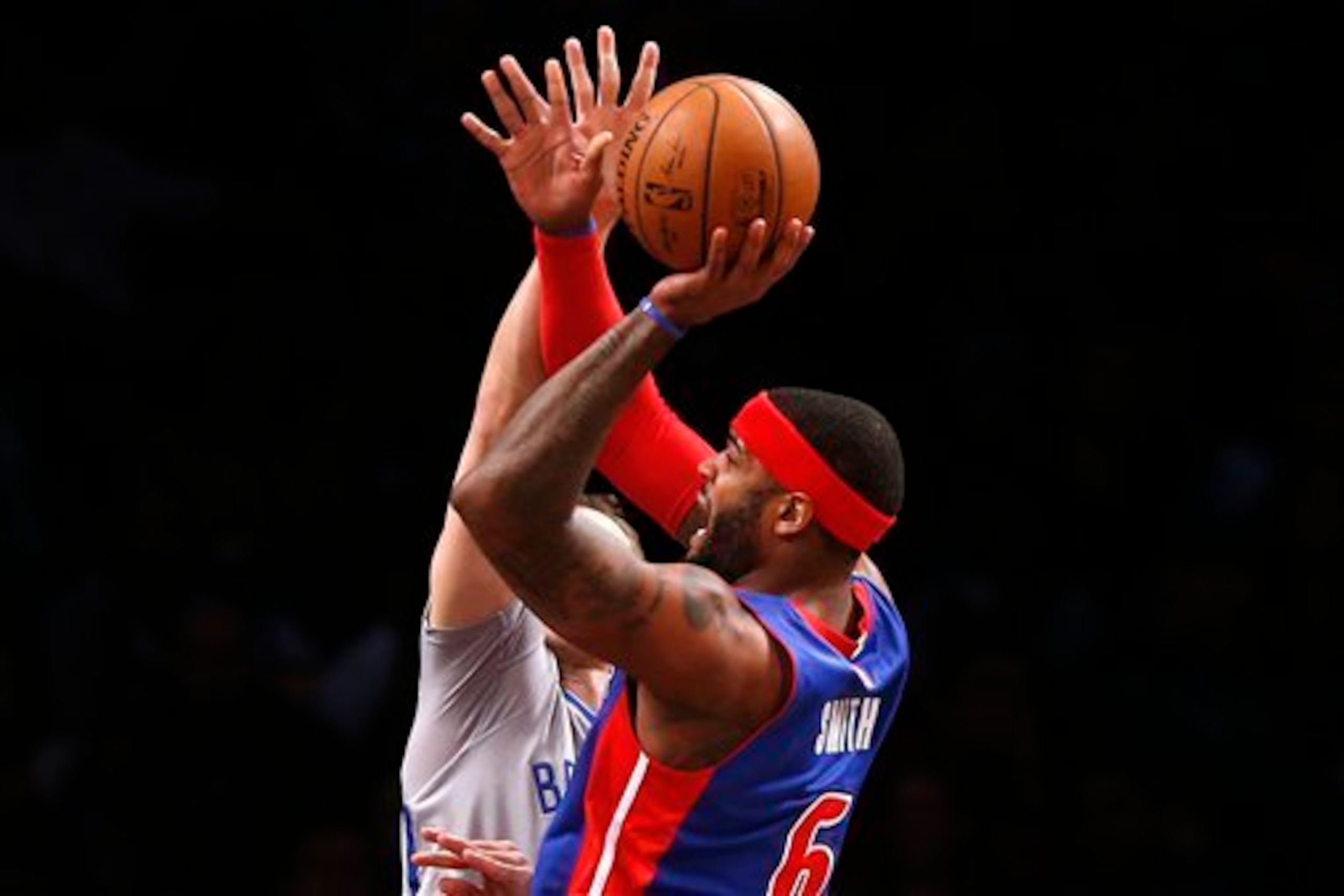
One of the NBA's most efficient players near the rim for much of his prime, Smith was shooting a career-worst 58.6 percent from that area. While we can attribute part of that to sample size bias and a little more to awkward spacing fits, those did not deter Smith last season, when he was a 71.1 percent shooter in the restricted area.
Smith is also a significant step down from the All-Defensive selection he was in Atlanta. The Pistons allowed two points per 100 possessions more when Smith was on the floor this season, and he had no statistical impact in 2013-14.
Again, fit has something to do with that; Monroe, Andre Drummond and Smith never quite figured out how to play together. Smith's not quite quick enough to keep up with the NBA's best small forwards, Monroe tops out at below average and Drummond can be a jumpy mess at times. That said, Smith has been just plain lazy at times.
Just like on offense, Smith's new team would be best-served keeping him near the basket, where he's still a good enough leaper to disrupt shots. Opponents are shooting 47.6 percent when he's within five feet of the basket and the player attempting the shot, per NBA.com, on par with the Timofey Mozgovs and Jonas Valanciunases of the world.
At issue here isn't whether Smith can be an effective player this season. He can. Used correctly, Smith is a weapon talented enough to swing the title picture. Maybe the right situation, one where he's forced to compete every night on a championship level instead of languishing in anonymity, will rejuvenate the player we saw in Atlanta.
The question is whether Smith allows himself to be used properly and uses his release as a springboard to the second half of his career. There's a reason the Hawks made no real attempt to sign him last summer and have no interest now. There's a reason Van Gundy ate more than $5 million in cap annually through 2020 just to have him off the roster. He's clashed with multiple coaches, displays body language that could nicely be described as "sulky" and has such bad shot selection that opposing players just straight up throw him under the bus.
This isn't a player who has endeared himself as publicly ornery but lovable behind the scenes like Rasheed Wallace. There won't be a network of coaches willing to give their buddy a chance like Stephen Jackson, who for some damn reason was signed by the Clippers last season.
Smith needs to treat his next destination not just as another stop but as a proving ground. Another team will assuredly give him a chance next season and probably the next regardless of how the remainder of 2014-15 turns out.
But the clock is ticking faster than he realizes.
Follow Tyler Conway (@tylerconway22) on Twitter
All stats are via Basketball-Reference.com unless otherwise cited



.jpg?w=2560 "Aikman Blasts Cowboys WR 🫣")
.jpg?w=2560 "Jonathan Taylor Landing Spots")