Indiana Pacers' Personnel, System Creating Flawed Offensive Blueprint
The Indiana Pacers offense is bad this season. According to Nylon Calculus, they're averaging an abysmal 100.9 points per 100 possessions, 29th in the NBA. This is the third straight season the Pacers have had an offense below the league average.
The problem has been, and still is, a flawed overlap between system and personnel.
Since Frank Vogel took over midway through the 2010-11 season, the Pacers' modus operandi has been to try to take advantage of their size, pounding the ball inside. Having lost Lance Stephenson to free agency and Paul George to injury, it seemed obvious that the Pacers would double down on that perceived strength this year.
TOP NEWS

Pic of LeBron's Helicopter Commute 🚁
Duren Calls Out 'False' Rumors

NBA Power Rankings Entering Preseason 🔢
As Candace Buckner of the Indianapolis Star reported this fall, Vogel was not interested in tweaking the team's fundamental offensive principles:
"I studied our team and I studied some of the better offenses in the league. Just to see if there are ways we can tweak what we do. A lot of the better offenses sacrifice defense to be a good offense and I'm not interested in doing that. I'm interested in becoming better offensively while staying big and staying with two big guys.
"
Even though most of the league has moved toward a perimeter, pick-and-roll heavy offensive style, banging on the interior is not inherently unworkable. The problem for the Pacers is that the mix of elements they have doesn't allow this offense to work at an optimal level.
Spacing
Last season, Got Buckets' Justin Willard researched spacing and found that the number of shooters in a lineup was a hugely positive offensive factor, beyond the simple benefit of those shooters making shots:
"Using a regression on five years of lineup data from seasons 2007 – 2008 through 2011 – 2012, it is reinforced that units shooting more three-pointers are significantly better offensively. Adjusting for homecourt advantage and the expected offensive efficiency of the lineup, for each one unit increase in the average 3PA per 100 offensive possessions, the offensive efficiency increased by 0.77 points per 100 possessions. With a t-value over 9 and nearly 53,000 observations, that is highly statistically significant. And recall this is already corrected for shooting efficiency via the offensive rating inputs; the results suggest the benefit of spacing are meaningful and indicative of something powerful. Replacing one non-shooter with a three-point bomber, by the numbers, can lead to a couple more games won based on spacing alone.
"
Willard also parsed the data by position and found that the impact differs dramatically:
"All players, regardless of position, help the offense through spacing the floor, but position/height can make this more valuable. For the height input at each position, the average height is used, taken from previous work of mine. According to the regression model, three-point shooting is twice as valuable from a center compared to a point guard and roughly two-thirds more valuable for big men than perimeter players, again reinforcing the results from the other methods.
"
All of this is hugely important to the context of the Pacers in two different ways. The first is that they have trouble fielding lineups with a wealth of shooting. Willard's work found that lineups with three shooters is generally the tipping point where the positive effects of spacing are felt.
Of the Pacers' 14 most-used lineups (those which have played at least 20 minutes together this season) just three have featured three or more shooters on the floor together.
It's worth noting that the definition Willard is using for shooters (greater than 5.0 three-point attempts per 100 possessions) doesn't include Solomon Hill. He just misses the cut at 4.8 three-point attempts per 100 possessions, but the distinction is probably moot because he's only shooting 30.2 percent on three-pointers.
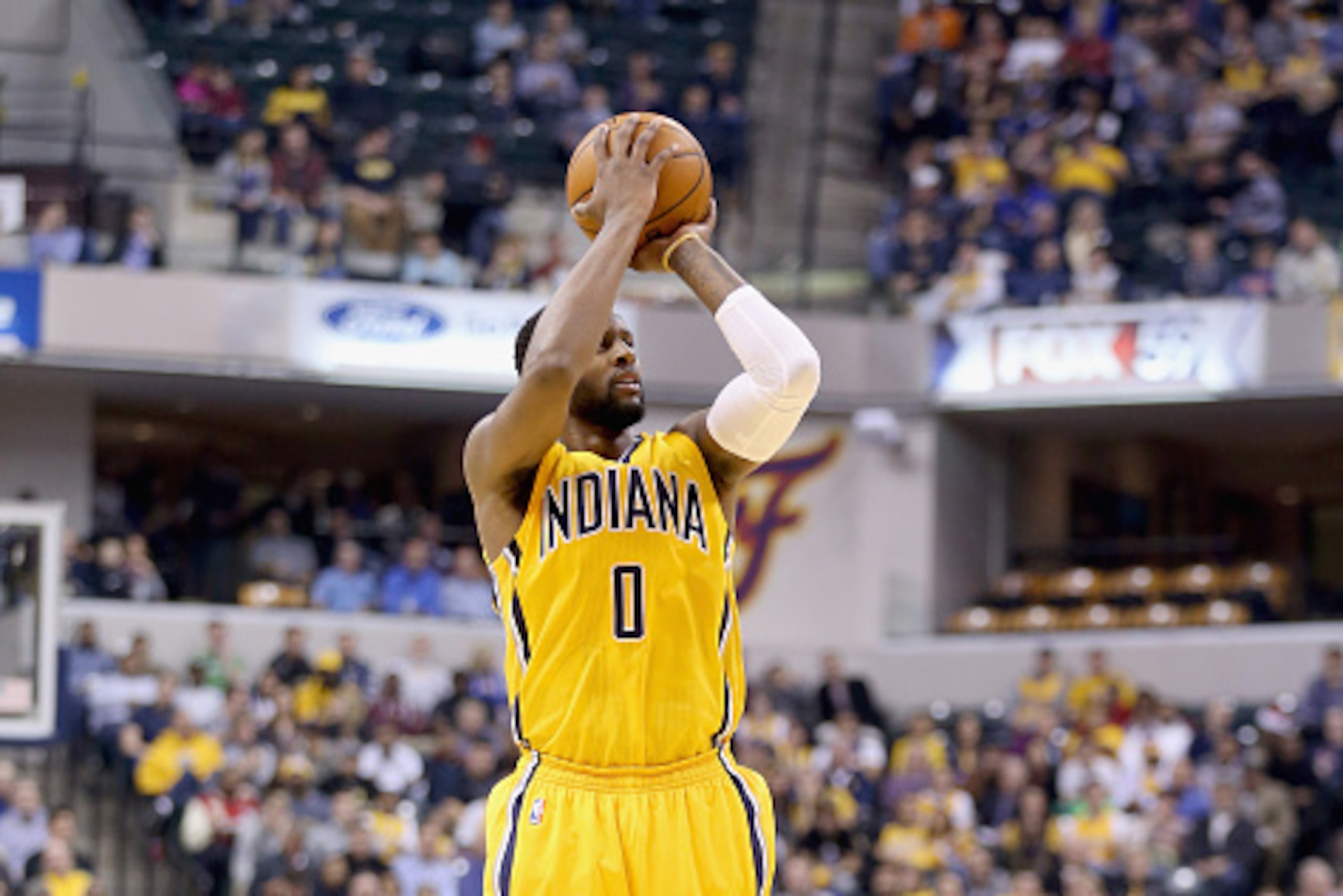
Which brings us to the other problem. The shooters on the Pacers roster are mostly defined by style as opposed to effectiveness. Of the six players averaging more than 5.0 three-point attempts per 100 possessions, just two—C.J. Watson and A.J. Price—are shooting better than 35.0 percent on three-pointers. Price was a stopgap, brought in on a 10-day contract and is no longer on the roster.
The players that the Pacers nominally employ as shooters may not affect spacing as much as the numbers imply simply because they don't command defensive respect.
Obviously, some of the low percentages are situational. C.J. Miles and Damjan Rudez came in with well-earned reputations as shooters, and each has been a disaster. George Hill has just returned to the lineup, and if Paul George were healthy, things might look different in the percentage department.
But in terms of lineup options, having Hill and George available simply means substituting one shooter for another. There would be little added variability because Vogel is still committed to lineups with two bigs and there are no three-point shooting bigs on the roster.
Lavoy Allen, Luis Scola and David West are all comfortable mid-range shooters, but their range peters out well before the three-point line. The margin of just a few feet makes a huge difference in the defensive pressure opponents can apply on the inside.
Not being able to space the floor effectively means the defense can collapse on the interior without fear of repercussions. This gives Roy Hibbert, David West and Luis Scola less room to work with around the basket and decreases the effectiveness of pounding the ball inside.
The best interior offenses balance scoring on post-ups and using post-ups as a way to move the defense to create open shots on the perimeter. The Pacers haven't been able to find that balance at all.
Post Scoring

An effective offense built around pounding the ball inside requires effective inside scorers. Although the Pacers have plenty of big bodies, the actual post scoring abilities of those players are not fantastic.
Hibbert, in particular, leaves a lot to be desired. The table below shows the percentage of his field-goal attempts from different distances this season and his field-goal percentage from each area, per Basketball-Reference.com:
| 0-3 ft. | 3-10 ft. | 10-16 ft. | > 16ft. | |
|---|---|---|---|---|
| % of FGA | 16.5% | 39.1% | 20.6% | 23.5% |
| FG% | 65.0% | 40.0% | 36.0% | 43.9% |
Hibbert has always struggled to get deep post position, a fact you can see reflected in the numbers. Of his attempts within 10 feet of the basket, more than twice as many shots come from at least three feet away than those that are right at the basket. You can see from the table how much his efficiency drops off after that three foot distance.
The further he is from the basket, the closer he is to the perimeter defenders who are available to double-team because they don't feel threatened by the Pacers' shooting.
Scola is inconsistent. Ian Mahinmi and Allen have no post-up games to speak of. West is a capable scorer in the low post, but he plays so many of his minutes with Hibbert that he simply doesn't get an opportunity. Hibbert has very little shooting range, so the Pacers can't reasonably invert their sets with West at the basket and Hibbert floating around the elbows.
The result is that the Pacers end up pounding the ball inside—right into the teeth of the defense because of their spacing problems—in the hands of players who are average interior scorers.
Plan B
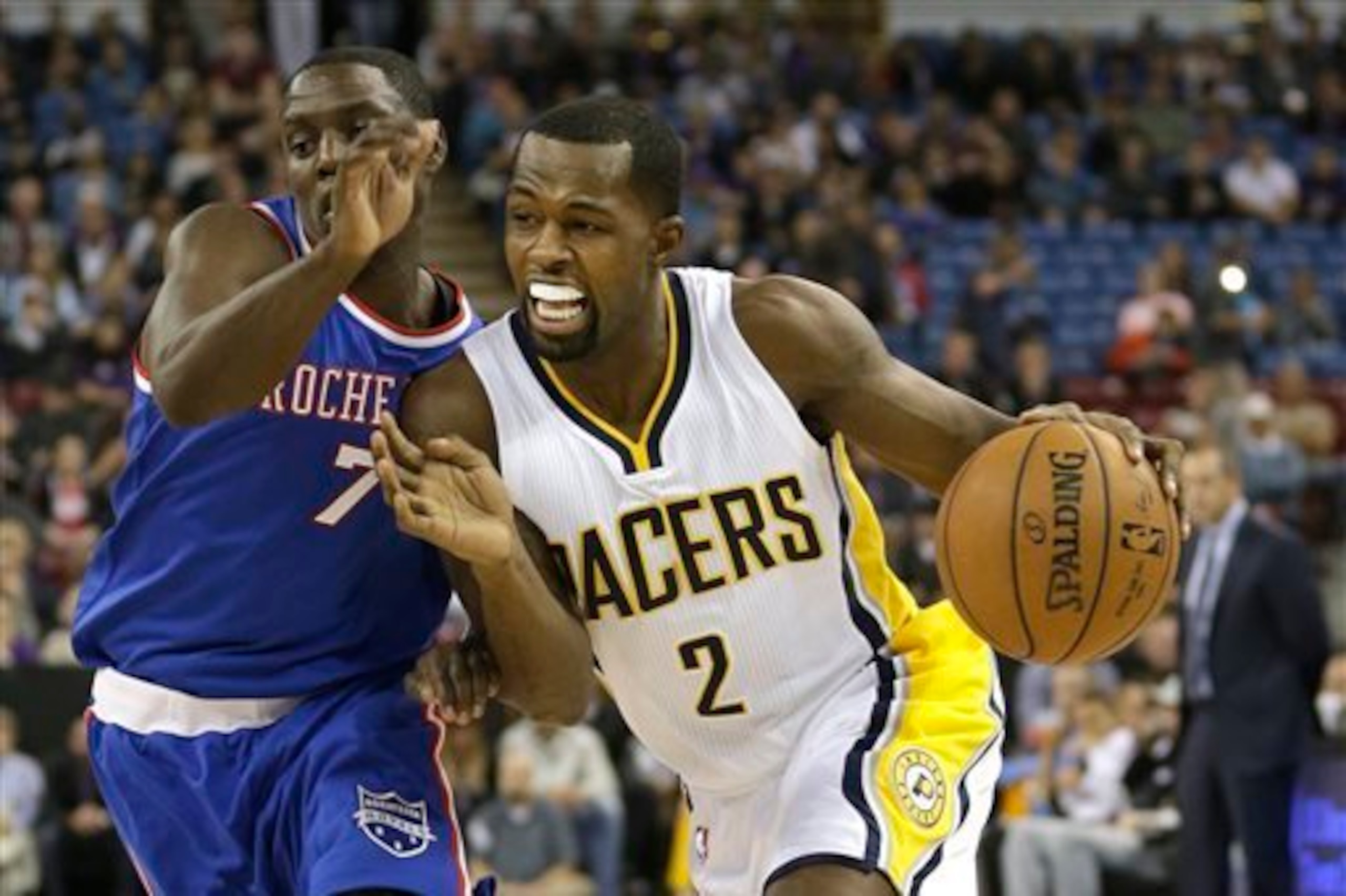
The Pacers have to rely on this flawed interior structure so heavily because they don't have a way to balance it with a backup plan. The Pacers rank 22nd in the league in drives per game, according to the NBA's SportVU Player Tracking statistics. They rank 24th in team points scored on drives per game.
Over the past few seasons their pick-and-roll game has consistently been a sore spot. Their big don't set good screens. Hibbert isn't mobile enough to regularly collapse the defense when rolling to the basket. West and Scola are far more likely to pop to the elbow, a repetitive pattern that becomes increasingly easy to defend. Then, the lack of threatening shooting and spacing exacerbates all of those problems.
To be clear, this was a problem even last year when the Pacers had the added talent of George and Stephenson on the wings. The mix of skills and comfort zones is just too muddied. Too many players are trying to operate in the same spaces, pulling added defenders to the ball.
Replacing George and Stephenson with Miles and Rodney Stuckey shrinks the margin for error, but the problem is bigger than talent. It's about the mix and the system.
Hibbert in the post works best with four shooters around him. The Pacers simply can't field those lineups, especially while maintaining their defensive integrity. West's range helps, but it's not nearly enough to solve the spacing problem.
In the end, the solution to this problem—changing rotations and moving the focus away from the interior—may not be changes the Pacers are willing to make.
They appear to have weighed the costs and decided the defensive sacrifice is too steep. More talent and a healthy Paul George would help, but it takes a rare and specific combination of players to play defense the way the Pacers do while still spreading the floor at the other end.
.jpg?w=2560 "OBJ Calls Out Giants After Release")



.jpg?w=2560 "Saquon Out for Game")