Drugs, Gangs and Titles: HBO Documentary Shows Boxer Johnny Tapia's Crazy Life
Shirtless, his tattoos symbols of his survival, Johnny Tapia sat in a dimly lit boxing ring telling his story. Tears dot his eyes at times, incongruous with his world-weary appearance. It's a tale about heart. How it's broken, mended, but ultimately never completely healed.
There are moments of the sublime, sure. But mostly? Mostly this is the story of darkness. How it envelops a man. How it changes him. And how, if he embraces it with open arms, he can use it to achieve greatness.
That's the basis of the new HBO special Tapia, debuting Tuesday night at 11 p.m. EST on the premium network, the story of one of America's great boxers, a soul nearly lost to drugs, mental illness and the crippling memories of a life that began a misery and rarely got much better.
TOP NEWS
Dalton Smith Retains WBC Belt 🏆
Later: Emanuel Navarrete vs. O'Shaquie Foster

Malachi Toney Sets ANOTHER Record
"It's almost like watching a self eulogy in a way, watching him tell his life story. It was just very powerful to me," boxing promoter Lou DiBella, who brought the film to HBO, said. "There's a poignancy. It's almost like he had a premonition, like he knew he wasn't destined to be around for a long time. Within weeks of completing those interviews, he passed away.
"I don't think Johnny ever defeated his demons. But he fought them. Because of his relationship with his wife Teresa he had hope to the very end despite all the darkness he walked through."
It's a story that began on the wrong side of the tracks, in the kind of neighborhood that spawns drugs, gangs and athletes, its proverbial soil good for little else. In that, if nothing else, Tapia was a boxing cliche.
"Rich kids don't fight," DiBella explained. "Poor kids fight. Usually people are fighting their way out of something. They fight their way out the streets. They fight their way out of gang life. They fight their way out of addiction. Johnny fought through all of these things while he was winning world championships."
But Tapia's tale is particularly dark, even for a boxer. Already about as low as you can go, Tapia found out early that there are always further depths to plumb. Boxing writer Thomas Gerbasi explains:
"...there were demons, starting with a harrowing childhood that saw his mother murdered when he was just eight years old, a horrific bus crash, and a birth father that he never knew was his until a chance conversation in 2010. The die was cast from those moments on, yet boxing provided a brief respite from a life that soon spiraled into drug and alcohol addiction, battles with the law, and sadly, countless battles with himself.
"
His mother never left him. And how could she? He saw her dragged away, eventually stabbed 22 times with an ice pick. There was a fatalism to Tapia, a feeling that he didn't really deserve to be here with us. No amount of success, happiness or familial love could seem to shake it. In his autobiography, Mi Vida Loca, Tapia wrote:
"My mother was murdered when she was 32. I didn't think I would outlive her. I never thought I'd make it past my own 32nd birthday. I didn't even want to make it past her 32nd birthday. After turning 31, I could feel that time was coming on. It started growing in the back of my mind, and it was always there in my head. I was counting down the days, weeks, and months to the time that I would be the age she was when she died. I started to feel that time was running out for me.
"
The result was a fast life. Too fast. On five occasions he was dead in the hospital from an overdose, only to have doctors bring him miraculously back to life. His boxing career, so promising, was delayed nearly four years for a stint in prison. Even his wedding night, his chance to reinvent himself with his new wife Teresa, was spent with a needle in his arm in the bathroom, an overdose and another near-death experience.
"We all have our demons," DiBella said. "But Johnny had them to an extent that's almost impossible to believe. He was fighting addiction. He was fighting mental illness. He spent years in jail. I think that's one of the things that makes the movie so powerful to watch.
"It shows us the resiliency of the human spirit and also the power of darkness demons and addiction. As much as Johnny talked about living and life, Johnny also had an awareness of death. He'd died so many times and been revived. He had so many demons. But through it all he never gave up."
| Record | Knockouts | Career Duration | World Championships | |
| 59-5-2 | 30 | 1988-2011 | Super Flyweight, Bantamweight |
His life sounds like a cautionary tale. This should be the story of a fighter who nearly made it. The almost. A man derailed by cocaine and the street life. But Johnny Tapia made it despite all those things. He became Albuquerque's favorite son, a man so admired that even former Governor Bill Richardson felt compelled to note his passing and his impact on the community.
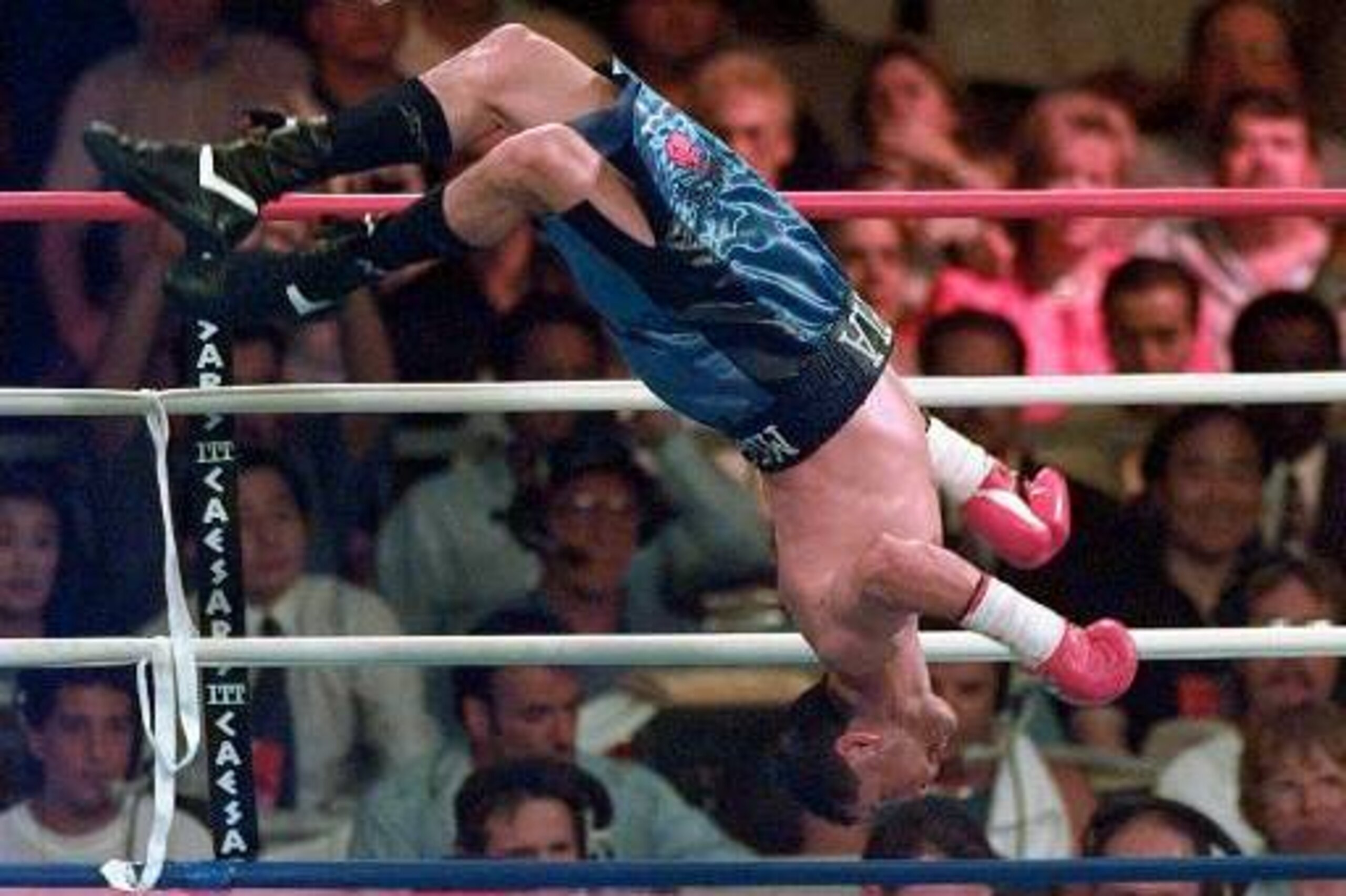
"I lived in a mobile home, a trailer park. We get together all the little kids, and I had this pair of boxing gloves I'd gotten from the flea market. We would throw down, man," Albuquerque base MMA fighter Diego Sanchez remembered with a laugh. "I'd say 'Johnny Tapia, Johnny Tapia' and I'd impersonate him and hit myself in the face. I'll never forget. He was one of us."
Even far from home where, rightfully, he should have been the visiting villain, Johnny Tapia was adored. Steve Bunce described a late career appearance at the legendary York Hall in London:
"He entered the ring and bowed to all four corners but the noise was relentless. His opponent was even clapping with his gloves on! Tapia seemed a bit overwhelmed and teary-eyed. It was a homecoming for a man who had never before been to the place, an ovation from boxing fans in celebration of a man they all adored.
"
It's a big story to process in just an hour, but director Eddie Alcazar makes expert use of haunting interviews with Tapia. The result is a special piece that really captures the essence of who Johnny was.
"I think it's more a story about life than it is a boxing film," DiBella said. "Even though Johnny was most comfortable inside the ring. Inside the ring he had peace. Outside the ring? He had almost no peace. It was full of a lot of dark moments, but also moments of light. And hope. It's an extremely disturbing story in many ways—but an uplifting story in some ways too."
There was something about Tapia that made you want to root for him to make it. In the end, he did. When he passed away in 2012, fans waited impatiently for the autopsy report.
It was assumed his demons, in the end, had gotten to Johnny one last time. Instead, it turns out his heart could only stand being Johnny Tapia for 45 years. Some people float through life. But Johnny Tapia? He lived.
Jonathan Snowden is Bleacher Report's Lead Combat Sports writer and the author of The MMA Encyclopedia. Unless otherwise noted, all quotes were compiled firsthand.
.jpg?w=2560 "NBA Gambling Charges")

.jpg?w=2560 "Jonathan Taylor Landing Spots")

.jpg?w=2560 "Aikman Blasts Cowboys WR 🫣")