USC Football: How Will Trojans Stop Nebraska RB Ameer Abdullah?
The man in red on whom USC football will be focused this holiday season does not come from the North Pole, but Nebraska running back Ameer Abdullah is known for producing magic.
The Trojans defense is tasked with slowing down the Cornhuskers' multifaceted playmaker in the Dec. 27 Holiday Bowl. It's not the most desirable of chores, to be sure; Abdullah heads into the postseason affair averaging 126.9 rushing yards per game with four games of 200 yards or more as well as an average of 144.3 yards per game from the line of scrimmage.
Still, USC's defense is well-equipped to contain the explosive running back, as the Trojans have demonstrated at times this season.



Obviously, the Trojans' efforts start on the line, and standout lineman Leonard Williams' ability to shed blockers will be vital to USC controlling the Cornhuskers up front.
He'll get help from Antwaun Woods and end Claude Pelon, both of whom have come on of late. Woods has made 10 of his 37 tackles in USC's last two games while head coach Steve Sarkisian has praised Pelon for his emergence in the back half of the season.
But stopping one of the most electric running backs in college football is going to take more than the play of the line due to his wide-ranging skill set.
Elements of Abdullah's role in the Nebraska offense are comparable to that of Arizona State running back D.J. Foster.
Beyond their similar size—Abdullah is 5'9", 195 pounds, and Foster is 5'11", 205 pounds—both are capable pass-catchers.
While Foster is used in that capacity far more often—he has 53 receptions to Abdullah's 16—Abdullah is just as dangerous when taking a swing pass as he is on a carry.
For this reason, USC cannot simply limit its efforts in containing Abdullah to between the tackles. Slowing him down extends sideline to sideline but starts with pressure in the backfield.
When the Trojans hosted Arizona State on Oct. 4, USC defensive coordinator Justin Wilcox's game plan had USC selling out on Foster behind the line of scrimmage.
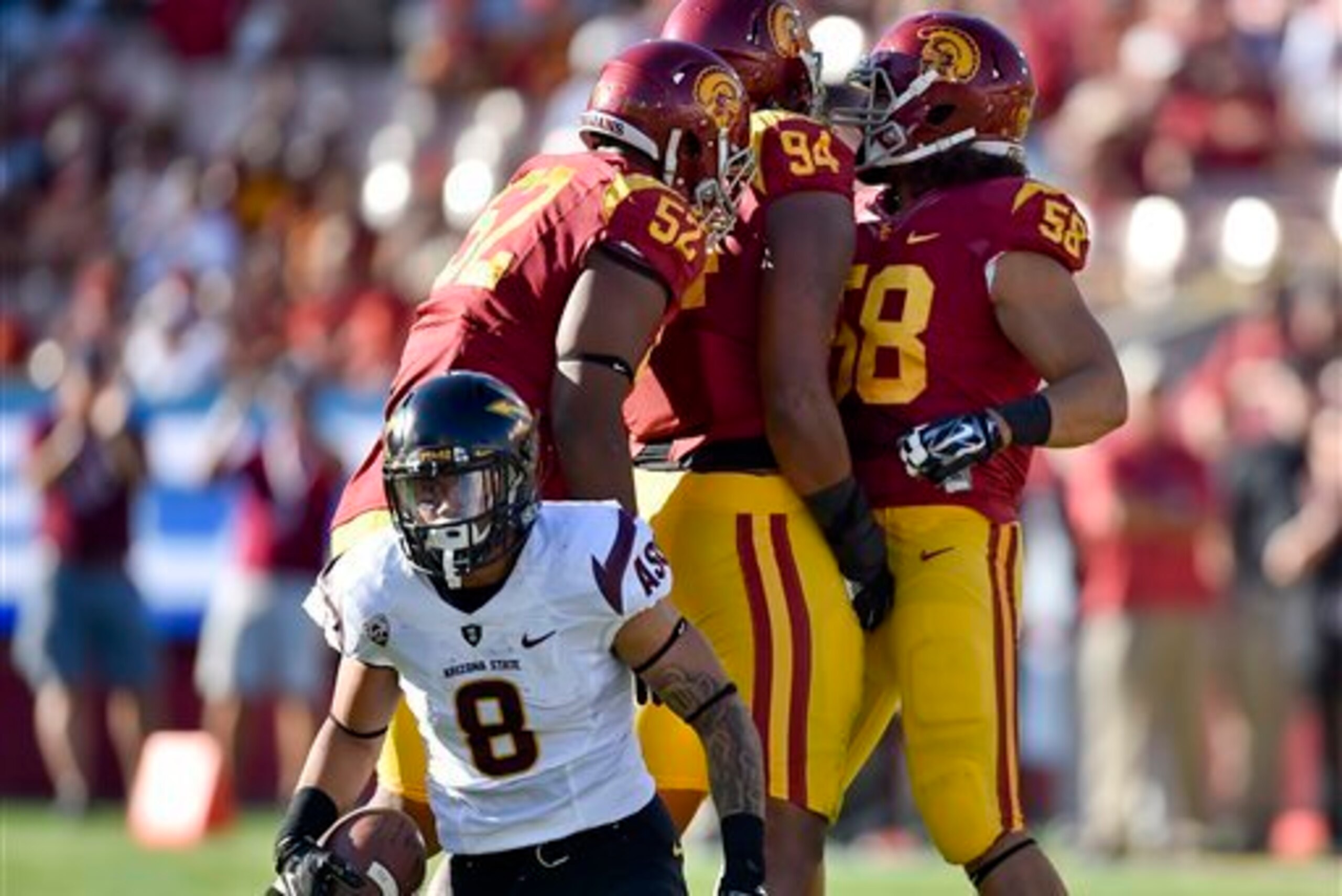
The first-quarter result, per the USC athletic department's official game stats:
- Run for three yards
- Run for a loss of two yards
- Incomplete pass
- Run for a loss of five yards
- Run for two yards
- Reception for seven yards
USC was aggressive up front, opting to cover wide receivers one-on-one with the linebackers supplementing the rush.
That included hybrid linebacker-defensive back Su'a Cravens, who played up on the line for much of the evening.
By swamping Foster in the backfield, USC made Arizona State an almost exclusively downfield passing team. In many ways, that strategy mirrors how Michigan State game-planned for Abdullah and Nebraska in the Spartans' Oct. 4 win.
Michigan State held Abdullah to 45 yards rushing on 24 carries. Linebacker Riley Bullough explained the Spartans' strategy, per MSUSpartans.com:
"He's quick, he was going to try to cut back on us, so we preached all week that we all got to swarm to the ball. We all know schematically what we want to do and I think for the most part we achieved it. The big thing was we wanted to get heads to the ball and I think we did that.
"
Simple enough in theory. More difficult in execution. But USC's ability to do so against Abdullah—or not—will likely determine the Holiday Bowl's outcome.
Quotes obtained firsthand unless otherwise cited. Statistics courtesy of CFBstats.com.
.jpg?w=2560 "Malik Beasley Negotiating Plea Deal (AP)")

.jpg?w=2560 "Jonathan Taylor Landing Spots")
.jpg?w=2560 "Aikman Blasts Cowboys WR 🫣")