3 Crazy Experiments the New York Knicks Might as Well Try
With a 4-18 record and no imminent end to their dysfunction, the New York Knicks have reached the point at which the most off-the-wall ideas are also the most worthwhile to try.
Derek Fisher's charges have begun displaying comprehension of the triangle offense's positioning and requisite actions, but that has not translated into winning.
There are multiple reasons for that sustained failure. First off, per Chris Herring of The Wall Street Journal, New York finds itself in the midst of a painfully prolonged stretch of close defeats:
TOP NEWS

Pic of LeBron's Helicopter Commute 🚁

Duren Calls Out 'False' Rumors

NBA Power Rankings Entering Preseason 🔢
That part's not sustainable; even though these Knicks are performing lousily, some tight games will start bouncing their way. However, the facets of that futility will not self-correct via the law of averages.
New York's players are moving the ball solidly and generating decent looks, but they're not yet comfortable with those shots within the flow of the offense.
To a certain extent, that could correct with time, but it's also partially due to the system utilizing incompatible personnel. Even if Samuel Dalembert keeps getting chances from 15 feet out, taking them frequently is not in the Knicks' best interest.
And of course there's the abysmal defense, which is also a matter of roster composition. Save for Iman Shumpert, every single Knick is below average at best on D—and even Shump has shown a tendency to waver for spurts.
The offense is progressing toward a low ceiling, and the defense is a lost cause. That'll net a nice lottery pick, a fabled treasure in the five boroughs. But how can the Knicks achieve on-court growth in 2014-15?
With a healthy dose of creativity, that's how. Plus a touch of madness. Fisher and company have proven they can lose close with a traditional triangle.
Stretching it, testing different permutations of it and seeing how it interacts with the tenets of hyper-efficient modern basketball might turn some of those losses into blowouts, but it could also show the way to future wins.
Iman Shumpert, Point Guard

In a sense, this strategy predates Fisher's own experience running the triangle. This is the Ron Harper theory—that a 6'6" guy can play the point in a system that values jump shooting and doesn't require a penetrating ball-handler. (Though doing so alongside Michael Jordan and Scottie Pippen certainly doesn't hurt, either.)
Shump stands an inch shorter than his spiritual triangle predecessor, but at 220 pounds, he has a significant strength advantage over the 185-pound Harper.
The 24-year-old Knick would have thrived in the 1990s NBA, where he could have leveraged his size with more physical play and hand-checking. But even with today's more finesse perimeter defense, Shumpert's size is a two-way asset.
The defense would benefit most from more point-Shump, if only because the Knicks' natural point guards all have significant defensive flaws.
For Jose Calderon and Pablo Prigioni—who are 33 and 37 years old, respectively—the years have robbed them of the legs necessary to chase today's speedy threats.
Twenty-two-year-old Shane Larkin has the quickness for the job—if not always the headiness—but generously listed at 5'11", he faces a height disadvantage against practically anyone he guards.
Shumpert is fast enough to cover all but the league's very speediest, and he can use his muscle to deny his man a preferred spot on the floor.
He can't spot up or throw entries the way Calderon can, and at no point this season will Shump usurp him as starter, but the younger guard will only hone those skills with reps—and without a safety net.
With Calderon out to start the season, Shump didn't get much PG run, but he was empowered to operate with the ball in his hands. He played the most fluid, confident offense of his career out of the gate, and that's significant.
Contrast that with last year's shattered Shumpert, who clanked shots and coughed up turnovers all the way into Mike Woodson's doghouse, and consider how he has cooled since Calderon's return.
He is observably better when his coach rewards him with greater responsibility. Making him the perimeter alpha dog on both ends could catalyze his development into an important long-term piece for the Knicks.
The Four-Guard Triangle
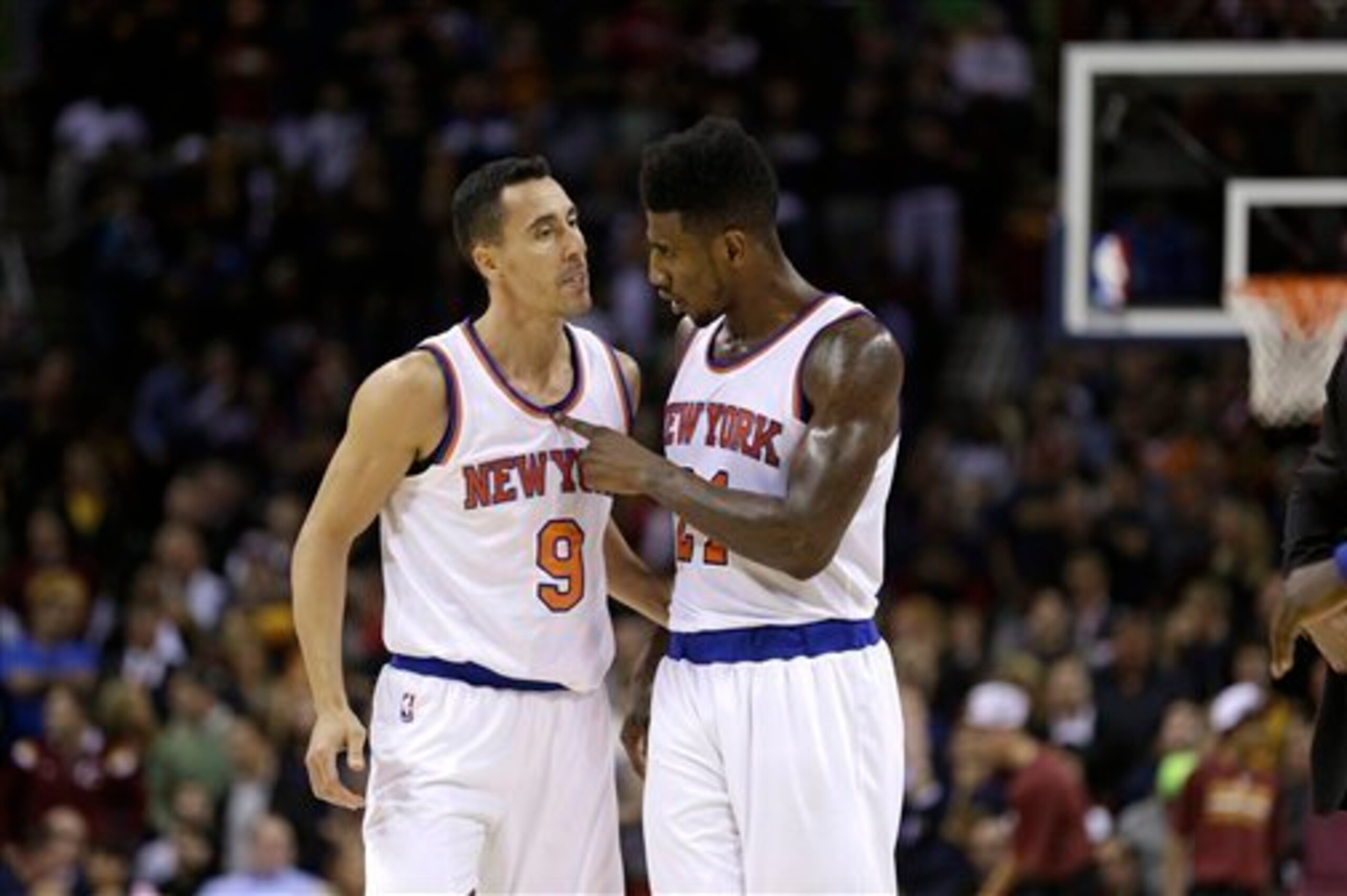
Playing point guard could transform Shumpert's future in New York, but shifting him way up to power forward could revolutionize a legendary offense.
The necessity of passing bigs, a rare and precious commodity in a spacing-happy league, is a fundamental difficulty with running the triangle.
In order to keep the interior unclogged, those forwards have to be able to score outside the paint, too—which has brought about Dalembert's wonky mid-range game and big minutes for limited, dismal Jason Smith.
But what if, in very specific situations—when the opponent's post scorers have gone to the bench and New York faces a safer second unit—the Knicks just trot out as many of their best passers and cutters as possible? What if Phil Jackson's triangle sought to emulate 2006 Villanova's four-guard offense?
Let's consider a specific five-man grouping: Prigioni, Tim Hardaway Jr., J.R. Smith, Shumpert and Amar'e Stoudemire.
No Carmelo Anthony here. At 6'8", 240 pounds, he's stout enough to serve as a small-ball power forward, but playing him as the nominal center without a true big alongside him is just irresponsible.
STAT gets the nod here because he has been an effective low-post scorer this season, and at 6'11", he's less of a defensive liability here relative to Melo. Besides, Anthony plays 35.5 minutes per game; he could use a breather, and this fivesome will play fast.
Shump and Smith are also necessary additions.
Iman, super-small-ball power forward, will do a lot of fronting and ball-swiping to deny whatever backup he draws. No matter how impotent offensively, that guy will still have a major advantage facing a traditional wing, so Shump's strength and swiping will be essential.
Though he has his erratic streak, J.R. can create off the bounce, both for himself and for others, making him a nifty secondary ball-handler for this lineup; it avoids going even smaller with Larkin, and it keeps more speed on the floor by separating the older point guards.
To fill out the lineup, Prigs is the steadiest second-unit hand Fisher has at his disposal, while TH2 is the most potent bench shooter. Hardaway's an awful defender, but the combination of Smith, Shump and sneaky Pablo should cause enough havoc to partially hide him.
In short spurts, this lineup can severely stress an opposing defense with its speed and firepower. It's extremely possible that it gets blown off the floor on the other end, but it potentially has enough peskiness with the four perimeter guys to keep things from getting too out of hand.
The downside if this didn't work would just be a miserable couple minutes—an idiosyncratic blip in the course of a game. If it proves effective, then Jackson could invest in big, Joe Johnson-esque wings capable of playing the super-small 4 in seasons to come.
Significantly Pare Back the Rotation

With this season already a lost cause, standings-wise, the Knicks need to play for next year and beyond, full stop. That means ruthlessly tightening the rotation, excising guys the moment it's clear they are not part of New York's future plans.
That means Jason Smith, currently getting 15.8 minutes of run per game, needs to stop playing immediately.
Yes, he can hit two-point jumpers nicely, but he doesn't have a single other basketball skill. Rather than utilize that one-dimensionality, Fisher would be better off trying to run the offense with more varied bigs who might stick where Smith clearly cannot.
Per ShamSports, his contract expires this coming summer, so New York ought to shop him for whatever it can get back—provided the return doesn't cut into the organization's long-term flexibility.
If the Knicks wound up with another expiring guy, they could put him through the same paces: Fit in, or get cast aside without sentiment.
And if Smith solicits no buyers, then Fisher should glue him to the bench. His minutes would be better served going to a younger guy like Cole Aldrich or an unknown like Andrea Bargnani, who has yet to play this season due to multiple injuries.
If and when Bargs proves himself incompetent in the triangle, it shouldn't matter that he played nearly 30 minutes a game last year; he should wind up right next to Smith riding the pine.
Bargs would be tougher to potentially trade, with an $11.5 million cap hit compared to Smith's $3.278 million.
Dalembert, whose $4.05 million deal also expires after 2014-15, might also seem like a transaction candidate, but his rim protection is too important. He's not going to be New York's multiyear interior anchor, but the Knicks could hardly attempt to defend without him.
Then there's the matter of the young'uns. Limiting minutes for guys like Smith could presumably open time for rookies Cleanthony Early and Travis Wear.
Wear's roster spot is basically tethered to him knowing what he's doing in the triangle, even though he has no upside beyond the uninspiring work he is currently doing.
He would be better served facing D-League competition, and his few minutes would be best split between a Hardaway and a Quincy Acy, who still have something to prove.
Early should go to the D-League in order to actually get better at basketball. He has struggled more than the rest with operating within the offense, and he's too weak of an NBA defender right now to justify letting him work out his kinks in significant minutes.
The Westchester Knicks offer a safe place to learn without as difficult a task for Early on the other end.
Early, the top prize of New York's 2014 draft at 23 years old, would ideally already be making a nice contribution to the rotation. Hopes for 2014-15 are now irrelevant.
Even if it means knocking guys down multiple pegs, whether they're rookies or highly paid vets, it's time for Fisher and Jackson to start making some changes.
All stats via NBA.com.
Josh Cohen writes about the NBA for Bleacher Report. Follow him on Twitter @arealjoshcohen.
.jpg?w=2560 "OBJ Calls Out Giants After Release")



.jpg?w=2560 "Saquon Out for Game")