
San Francisco 49ers' Most Important Players for the Stretch Run
Which members of the San Francisco 49ers need to play great for the 49ers to make the playoffs?
There are a couple of ways to answer this question. The first, easiest and least informative would be to say “all of them do”—after all, a playoff team needs all of its parts working at a high level to compete at a high level. While true, this is about as useful as saying a player needs to give 110 percent and leave it all out on the field—great rhetoric, but not a useful diagnostic tool.
Another way to look at it would be saying that the great players need to keep playing great. Players like Antoine Bethea and Ray McDonald need to keep playing at Pro Bowl-caliber levels. That makes a bit of sense—you lead with your stars, and if your best players play great, they could drag the rest of the team with them through a winning streak.
A third way to look at it would be saying the bad players need to step up their game. Players who have struggled a little bit this season, like Jonathan Martin or Vernon Davis, need to improve their play. After all, a team is only as strong as its weakest link, and other clichés.
I think there’s a better way to look at this, actually. The 49ers have gotten to 7-5 so far this season despite good players playing good and bad players playing bad. Davis has struggled when the 49ers have won, and he’s struggled when they have lost—the fact that the 49ers win or lose seems to be independent of Davis’ performance. Similarly, Bethea has played great in both wins and losses—he just plays great, period.
What I wanted to do was to find the players who have the biggest gap in their performances between 49ers wins and 49ers losses. That is, I want to find the players whose performances seem to have the largest impact on the results of the game. When these players are at their best, the 49ers tend to win. When they have an off day, the 49ers tend to lose.
Here then are the five players who I feel are most critical to the 49ers’ success from here on out. These are the top five players whose performance best correlates between wins and losses this season.
Advanced stats courtesy of Pro Football Focus; basic stats courtesy of Pro Football Reference.
5. WR Anquan Boldin
1 of 5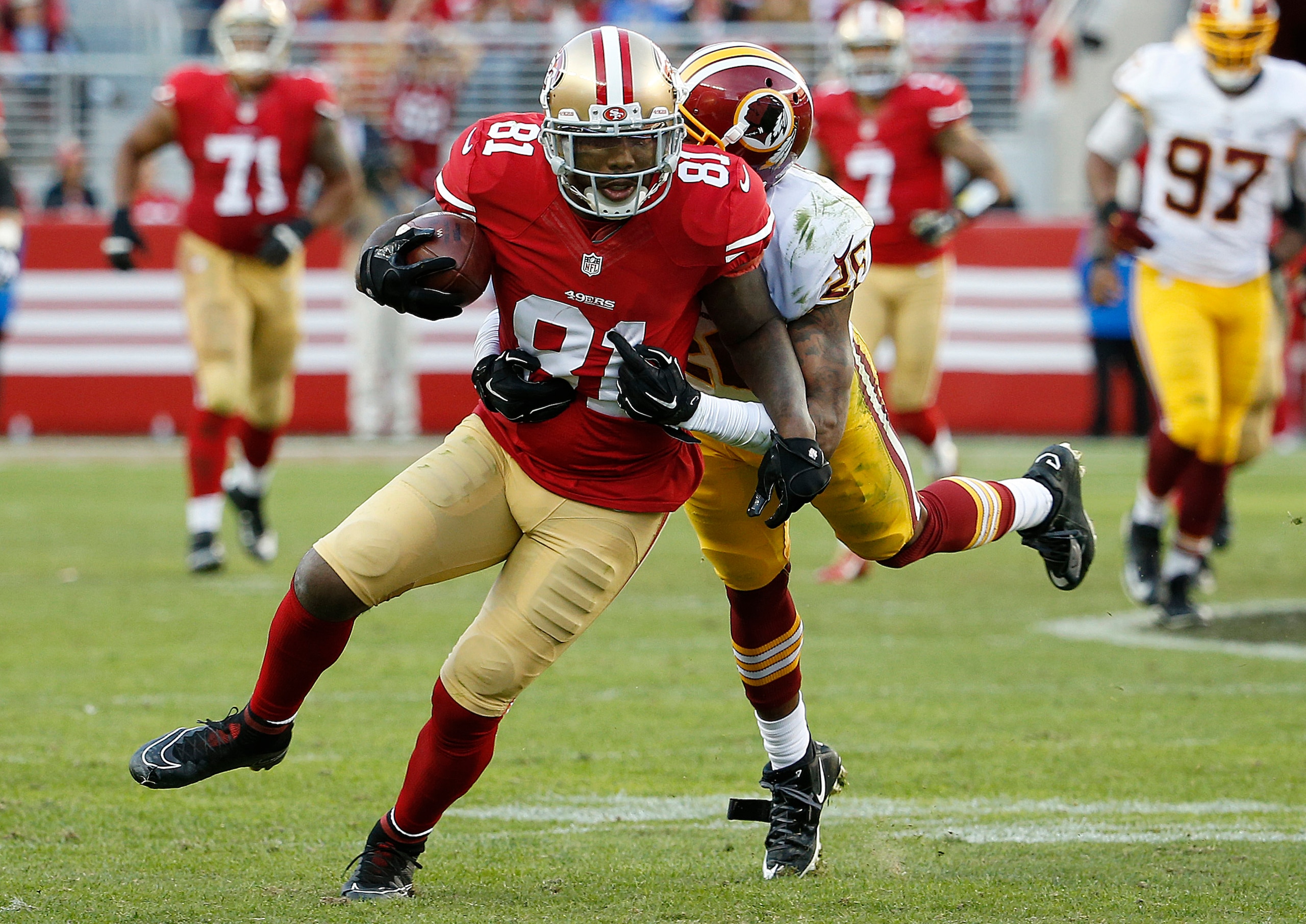
Stats in wins: 44 receptions on 65 targets; 67.7% complete. 612 yards receiving, 13.91 yards/reception. Three touchdowns. Pro Football Focus grade: +7.7
Stats in losses: 24 receptions on 34 targets; 70.6% complete. 231 yards receiving, 9.63 yards/reception. One touchdown. Pro Football Focus grade: -3.4.
Anquan Boldin has been the key cog in the 49ers’ passing game this season. He leads the team in targets, receptions, yards and touchdowns—he’s been the most reliable performer on offense.
Boldin’s also the trigger man on third down. When the 49ers need a big third-down reception, they look for Boldin first and foremost—he’s been targeted 33 times on third down and caught 21 passes, both leading the team by a substantial margin.
I pick Boldin over choosing Colin Kaepernick for several reasons. It feels, to me, that when Boldin is really on fire, all of Kaepernick’s passes look crisper and more thought out. When he knows that his safety blanket is going to be available, Kaepernick spends more time looking over the defense, knowing he can get back to Boldin when need be.
There’s also the fact that Boldin’s four biggest days in terms of receiving yards all have come in wins, and his four lowest days have all come in losses. The 49ers have not won when Boldin’s been held under 50 yards receiving, and they haven’t lost when he’s been at 95 or more. Kaepernick, on the other hand, has put up some gaudy numbers in losses—he had a quarterback rating of 103.3 in the loss to Arizona, for example. There seems to be a stronger trend with Boldin’s performance than Kaepernick’s.
When the 49ers have lost, Boldin has not played all that well. He’s had trouble getting open, and his receptions, when he does make them, don’t have nearly the same impact as they normally do.
When the 49ers win, however, Boldin is playing like one of the best five receivers in football. Prorate his stats in wins out to the full 12 games of the season so far, and he’d have 111 receptions for 1,049 yards. That would be the most receptions in the league in the top 10 in yardage, to boot.
When the passing game is clicking through Boldin, the 49ers win. They need to keep feeding him the ball as an integral part of their passing offense.
4. RT Anthony Davis
2 of 5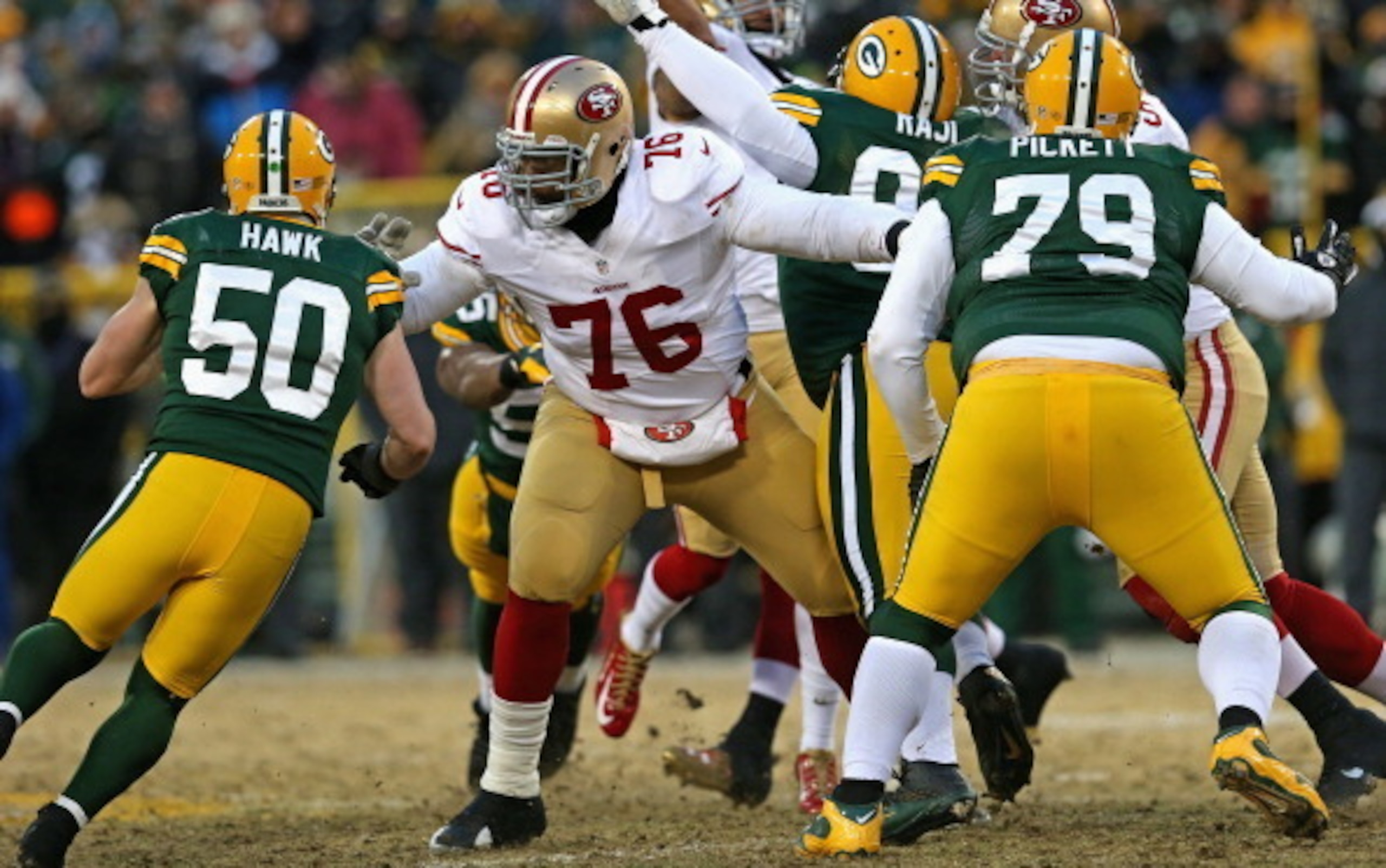
Stats in wins: 0 sacks allowed, 1 quarterback hit allowed, 8 quarterback hurries allowed. PFF grade: -1.1
Stats in losses: 3 sacks allowed, 1 quarterback hit allowed, 3 quarterback hurries allowed. PFF grade: -6.3.
The two highest gaps in Pro Football Focus’ grade along the offensive line between wins and losses actually belong to Joe Staley and Mike Iupati, but both players have shaken off early-season slumps to play well for most of the year. Recently, they’ve been playing well regardless.
That leaves Davis, who has had an injury-plagued season this year. He’s currently recovering from a concussion he suffered after the win against the Giants in Week 11. He also missed the first three games of the season with a hamstring injury and two more games in the middle of the season with a sprained MCL. It’s safe to say he’s been the walking wounded all year long.
When he’s been out, he’s been replaced by Jonathan Martin, who has left something to be desired. Martin is 58th out of 77 offensive tackles rated by Pro Football Focus (subscription required), which is obviously less than ideal. Last year, a healthy Davis ranked 29th with a +5.8 grade. That’s a huge improvement.
Davis has only played in five games this season. In the three games he played in which the 49ers won, he has allowed zero sacks. Against Denver and St. Louis, however, he allowed multiple sacks. He was also never penalized in the wins and penalized twice in the losses.
That’s too small of a sample size to really say that when he plays poorly, the 49ers lose. The fact of the matter is, he hasn’t played much at all, and his replacement has played poorly. We’re going beyond the raw numbers to say that a healthy, rested Davis is better for the 49ers than Martin is. I don’t think that’s exactly an earth-shattering revelation, but it’s why Davis’ health is so important for the last four games.
3. CB Dontae Johnson
3 of 5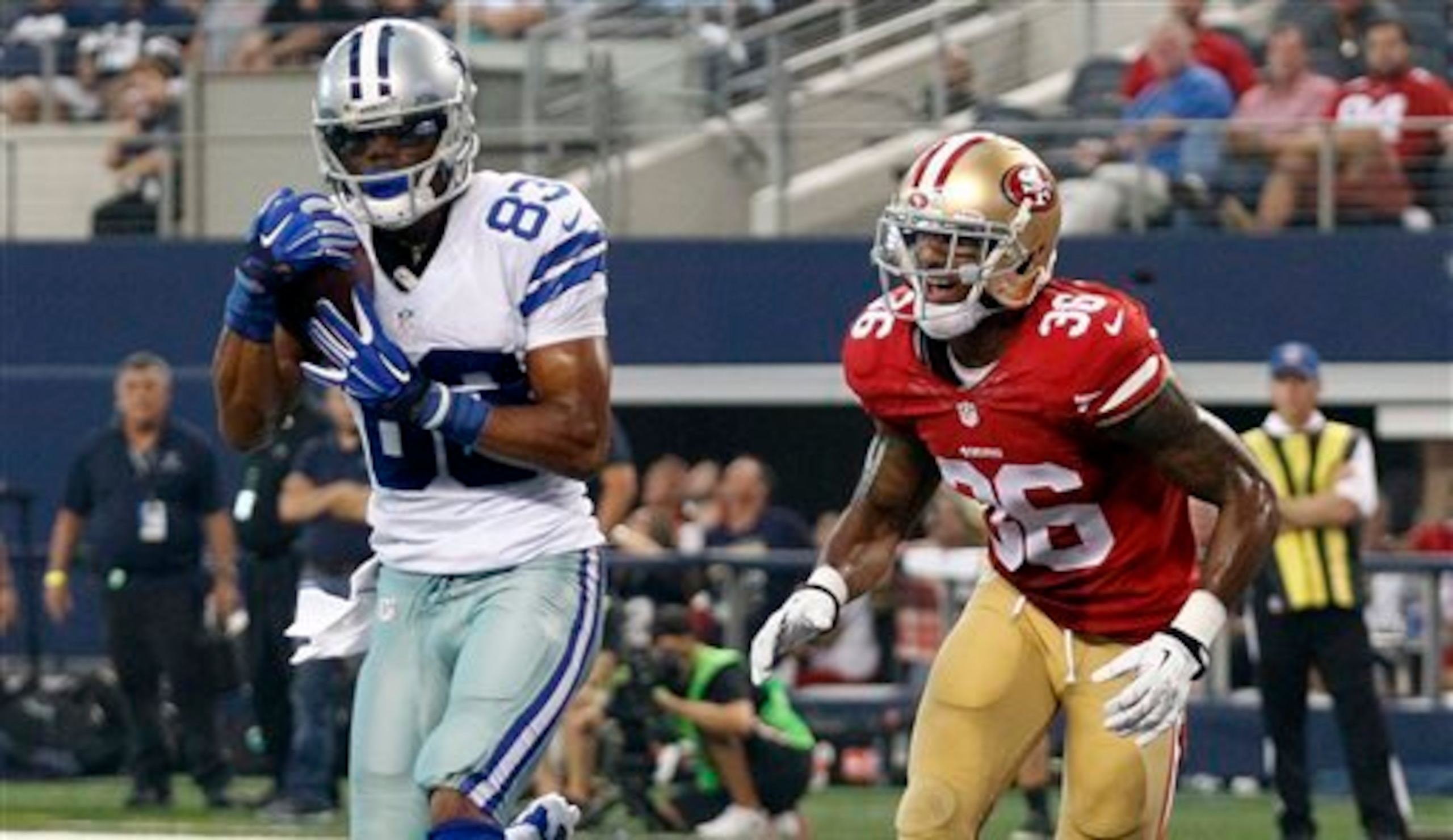
Stats in wins: Targeted 16 times, allowed six receptions for 60 yards and one touchdown. One interception, three passes deflected. PFF grade: +6.5
Stats in losses: Targeted five times, allowed three receptions for 18 yards and one touchdown. PFF grade: -2.5
You look at the raw numbers, and you think the rookie hasn’t had too much to do in the losses. How can he have a big impact when opponents are not targeting him? Yes, a 60 percent completion rate isn’t great, but it’s only on five targets in losses—that’s a small sample problem if I’ve ever heard one, right?
Well, yes and no. A lot of his negative PFF grade comes from just five snaps in the Chicago loss, when he allowed a key nine-yard reception to Brandon Marshall to set up the Bears first touchdown, and then an illegal contact penalty which gave them a first down after a failed third-down pass late in the third quarter. Had he not committed the penalty, the Bears would have punted down 20-7 rather than score the touchdown to make it 20-14, and perhaps the rest of the game unfolds differently. Still, a -1.4 grade for five snaps seems harsh.
On the flipside, Johnson’s shown sparks of being a very solid player at times, and when he’s shown those sparks, good things have happened for the team. His interception, remember, ended the road game against the St. Louis Rams, when they still had the chance for a miracle comeback. His deflections broke up key passes against the Dallas Cowboys and the Giants, too—when Johnson’s been around the ball, he’s made good things happen.
He’ll likely have to keep doing that. With Tramaine Brock still recovering from his hamstring injury and Jimmie Ward out for the season, Johnson’s been thrust into a role the team was not expecting a fourth-round pick to be in so early—primary nickel cornerback.
Ideally, Brock heals up and Johnson can go back to being a very good dime cornerback. If not, however, he’s going to have to cover some tough receivers in the slot over the rest of the season—James Jones, Doug Baldwin, Eddie Royal and Larry Fitzgerald. Johnson’s ability to handle those players may be the difference between the 49ers making the playoffs and not.
.jpg?w=2560 "Titans Giants Football")

2. LB Chris Borland
4 of 5
Stats in wins: Two QB hurries, 27 solo tackles, eight assists, four missed tackles, 18 stops. PFF grade: +15.9
Stats in losses: One QB sack, two QB hurries, 36 solo tackles, two assists, four missed tackles, 25 stops. PFF grade: +1.0
Chris Borland’s meteoric rise has been the story of the second half for the 49ers. If they miss the playoffs, he’s the positive story of the season. Despite not starting a game until Week 7, he’s a legitimate contender for Defensive Rookie of the Year.
Again, the raw numbers lie a little bit—they do that on defense, where a lot of raw numbers might indicate the team simply not being able to get off the field. He has a lot more tackles and stops in losses than wins, but a huge number of those plays—17 tackles and 12 stops—came against the Rams in Week 9, which came down to the wire. I don’t think you can blame the defense for losing that game.
Throw that one out, and the only two times the 49ers have lost with Borland in the mix have been against the defending Super Bowl teams, Seattle and Denver. Both of them, at times, figured out how to slow Borland down. The Seahawks, for example, found a way to get hands on Borland with some exotic protection packages. He still found his way around the ball, but was occasionally then pushed out of the play. He’s a rookie, and that will happen from time to time—he’s still getting his NFL-caliber instincts honed.
Borland’s been a huge spark for the defense ever since Patrick Willis went out. It’s not a coincidence that Borland’s been putting up huge numbers—he’s shown, albeit in a small sample size, the ability to be a star in this league. It’ll be an interesting topic this offseason of what the 49ers will do with three stud inside linebackers.
Speaking of which, there’s still no sign of NaVorro Bowman returning. He still has another week with the NFI protocol he’s working through, but if he’s not activated then, he can’t be activated for the rest of the season. That would put the hat for leader of the middle of the defense squarely on Borland’s head. That’s a tall task to ask—to essentially replace both Willis and Bowman. If Borland can continue his small sample-size success, the 49ers will be much better off.
1. DE Justin Smith
5 of 5
Stats in wins: Three sacks, five QB hits, 11 QB hurries, 12 solo tackles, five assists, 10 stops. PFF grade: +19.5
Stats in losses: Two sacks, three QB hits, six QB hurries, seven solo tackles, four assists, seven stops. PFF grade: +1.6
For all the talk about injured players coming back and rookies stepping up, at the end of the day, the team MVP needs to play like a team MVP if the 49ers are going to be playoff-bound.
Justin Smith is the team’s MVP. Especially now that Patrick Willis is out, Smith is the heart and soul of the defense—a leader and savvy veteran who is performing at an incredibly high level despite being 35 years old. At this point in his career, he’s polishing up a potential Hall of Fame resume, mostly thanks to his six years of service as a star on San Francisco’s defense.
Here’s a fact for this season: Smith has had seven games this year where he’s received a “green” grade from PFF—that is, 1.0 or greater. The 49ers are 6-1 in those games, with the only exception being the loss to Arizona back in Week 3. In the five games he hasn’t reached that green mark, the 49ere are only 1-4.
It should be made clear that Smith hasn’t played badly at all this season. It’s just he’s sometimes played like an average starter—a Corey Liuget or Cory Redding—and sometimes, he’s played like a superstar—like Calais Campbell down in Arizona or Muhammad Wilkerson in New York. In games the 49ers have won, you can make the argument he’s the best 3-4 defensive end not named J.J. Watt in all of football.
When Smith is going well, it frees up other players to also play well. It frees up Aldon Smith off the edge to pass rush. It makes the game easier for cornerbacks and safeties, because they know the quarterback will have to make faster decisions. It makes the game easier for rookies like Chris Borland and Dontae Johnson, because they know that the right side of the defense is clamped down.
When Smith isn’t stopped, the 49ers defense rolls. When the 49ers defense rolls, the offense gets the ball in better situations. When the offense gets the ball in better situations, they don’t turn the ball over and at least kick field goals. When the offense doesn’t turn the ball over and keeps putting up points, the 49ers win.
Bryan Knowles is a featured columnist for Bleacher Report, covering the San Francisco 49ers. Follow him @BryKno on twitter.




.jpg?w=2560 "Saquon Out for Game")
