Drew Stanton Will Hold Cardinals Back While Struggling with Simple Throws
Football doesn’t need to make sense all the time. In playbooks it’s designed to, with arrows beating the bubbles that denote zone coverage, or a lot of blitzing X’s on one side overloading the blocking O’s. But inherently it’s a game of organized chaos. So happenstance will follow, as will events that aren’t explained easily.
The Arizona Cardinals don’t have an event or series of events that are difficult to explain. They have a person who isn’t explained easily: their quarterback, Drew Stanton.
Stanton was inconsistent and wildly wayward Sunday during a loss to the Atlanta Falcons that sent the Cardinals’ quest to an NFC West division title—and to some extent, their playoff hopes too—further into a tailspin. With the Seattle Seahawks rolling after winning five of their last six games (and allowing only six points over the past two), Arizona could become the first team to blow a three-game division lead with six weeks remaining.
.jpg?w=2560 "Commanders 49ers Football")
.jpg?w=2560 "Colts Football")
.jpg?w=2560 "DOLPHINS-AIKMAN")
There are a number of problems at the heart of Arizona’s abrupt regression back to normalcy, including a sudden lack of defensive support and cornerback Patrick Peterson giving up 174 yards in coverage Sunday, according to Pro Football Focus (subscription required). That number doesn’t seem real.
But Stanton’s spraying is a fundamental and possibly fatal flaw. With Carson Palmer done for the season, he’s the centerpiece of an offense that hasn’t done much of a pretty important thing generally associated with offenses: scoring points.
When you turn on Stanton’s game tape, immediately there’s a brow-furrowing reaction. He's a confusing quarterback, which is likely a statement we could loosely label on most backups.
They’re not starters for a reason, but each backup quarterback is on a specific roster because their skill set jells well with the offense. If the starter crumbles then the Stantons of the NFL can ascend the depth chart with little discomfort. There will be mistakes, sure, and they can be tolerated. But the offensive continuity Stanton has brought with his deep arm is key.
Over time, however, a natural process happens. With a higher volume of work the backup’s flaw is exposed, and the result is diminishing returns.
That’s what Week 13 was for Stanton: sporadic success mixed with declining production and execution. The confusion with him lies in simplicity and Stanton’s laboring struggle with the easier throws while displaying pinpoint accuracy on others with a much higher degree of difficulty.
Stanton has now thrown five interceptions over his last three starts. That’s a swift fall when compared to his three starts earlier this season when Palmer first missed time due to a shoulder injury.
| First three starts | 98 | 0 |
| Most recent three starts | 97 | 5 |
The deep, booming cannon attached to Stanton's body is very much to head coach Bruce Arians’ liking. Stanton is often asked to chuck darts that take a deep journey, ideally to a waiting set of friendly hands.
The frequency of his long-ball heaving in Arians’ vertical offense is reflected in Stanton’s air yards. He’s third with 61.8 percent of his passing yards coming through the air, per PFF (among quarterbacks who have taken at least 25 percent of their team’s snaps).
When you see Stanton completing those deep throws often and seemingly with ease, an assumption is quickly formed. If he's comfortable completing low-percentage throws, then shorter and much easier passes must be a yawn fest, right?
Nope, and that’s where the struggle with simplicity begins.
Both of Stanton’s interceptions Sunday were on throws to wide-open receivers at short-to-intermediate distances. The second one—a quick throw to wide receiver Michael Floyd—was the most glaring and difficult to comprehend. Floyd was only three yards away on a play designed to put him in space for a run after the catch.
Yet the ball was about two feet over his head, and what should have been a routine completion landed in an area with lots of enemy hands and jerseys.
It was the most significant misfire against the Falcons on a throw that should have been a completion through muscle memory alone but hardly the first.
Arians surely recognizes the weaknesses of his backup quarterback, which is why he mixed in a healthy diet of short throws hoping Stanton developed something that resembled rhythm and timing.
That started in the first quarter when a quick hit was called. Stanton’s aim defaulted to its natural state when he’s asked to play catch with a receiver: wonky.
On 3rd-and-10 with the Cardinals at their own 20-yard line in the first quarter, Arians attempted to minimize risk. He gave Stanton an opportunity for a safe checkdown up the middle to wide receiver Jaron Brown. If completed, Brown may have had enough room to fight for a first down.
For a completion Stanton had to lead his receiver, placing the ball in front and allowing Brown to catch it in stride. Instead he did the opposite...

Then came another awful throw and a pass that should have been intercepted. On 2nd-and-13 from the Falcons’ 26-yard line with just less than three minutes remaining in the second quarter, Arians called a play to gain a significant chunk of the required yardage.
The difficulty on this throw was higher though still not substantial. Brown and fellow wide receiver Michael Floyd were to Stanton’s left before the snap as he waited in shotgun. Brown ran a quick out route to draw coverage, creating a throwing window that would close quickly. But with proper ball placement there was still plenty of time to connect with Floyd 10 yards down field up the seam.
Stanton was trusting Floyd to make a contested catch in traffic, which is very much part of his job description. The throw needed to be aimed at Floyd’s back shoulder, forcing the wideout to turn slightly and corral the ball. With that placement, Stanton would avoid any danger because both Falcons defenders were to the inside. A throw outside would have ensured either Floyd made the play or the ball fell harmlessly incomplete.
But Stanton didn’t deliver a throw to the outside. Nope, once again he did the opposite.

Falcons cornerback Robert McClain should have secured that interception, killing one of the few moderately successful Cardinals drives (they settled for a 44-yard field goal).
Stanton threw two interceptions, but against a secondary that wasn’t ranked the worst in the league prior to Week 12 he would have thrown at least four passes to the other guys. McClain dropped one seemingly guaranteed pick, and then cornerback Josh Wilson whiffed when Stanton inexplicably decided this was a good place to throw a football.
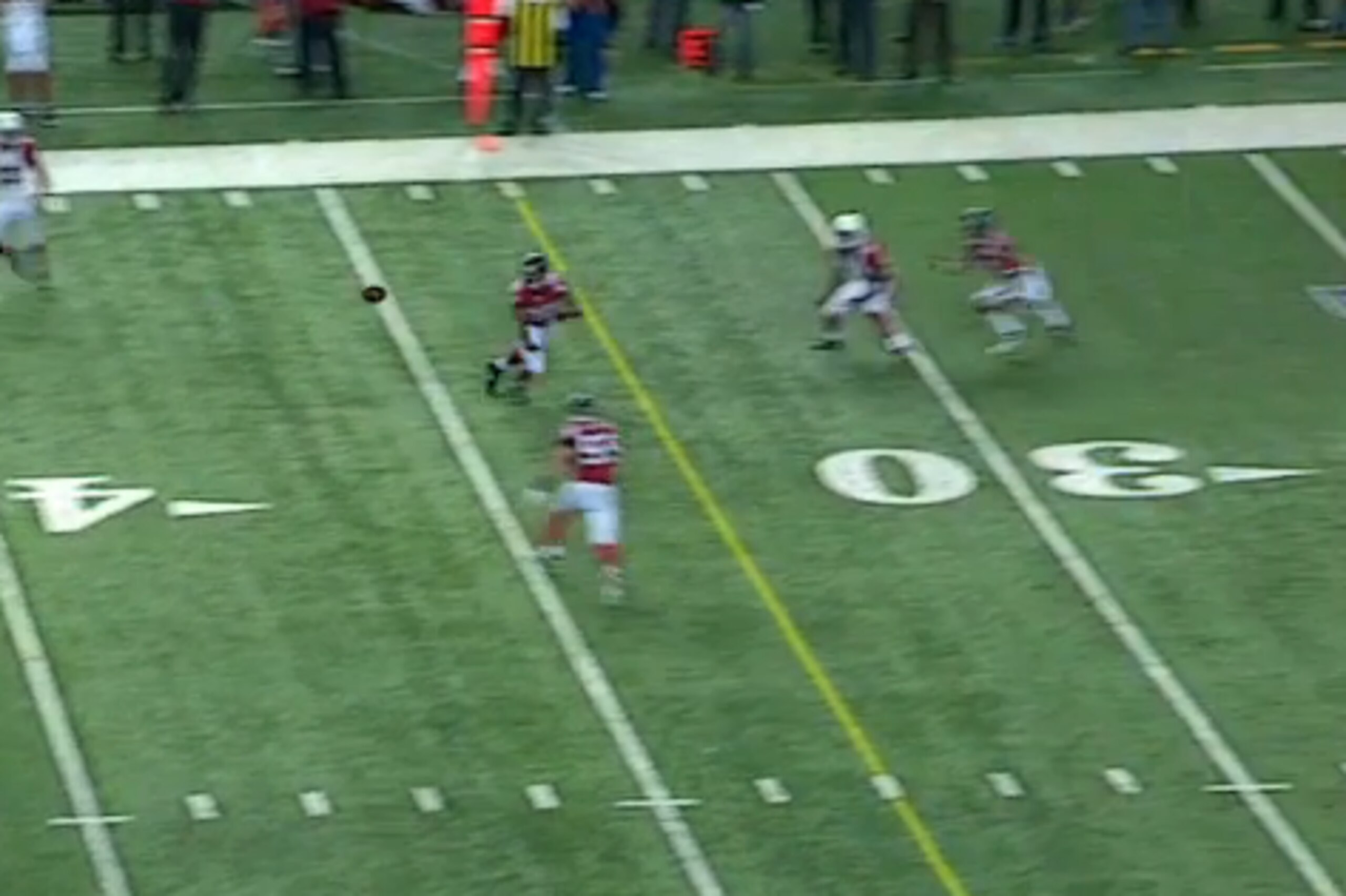
So the bad Stanton who struggles with the simple life was brightly and horribly displayed.
But go look at those air yards again (868 of them in total over only six starts), and his five completions for 20-plus yards Sunday. And also note his passer rating of 122.3 on balls traveling over 20 yards through the air to the right side beyond the numbers, compared to a rating of only 56.8 on throws to the same side but traveling less than nine yards (all per PFF).
What we see is a quarterback who rises to the difficulty level. In the same game when Stanton sailed his interceptions to wide-open targets, he also zipped one through this peephole.
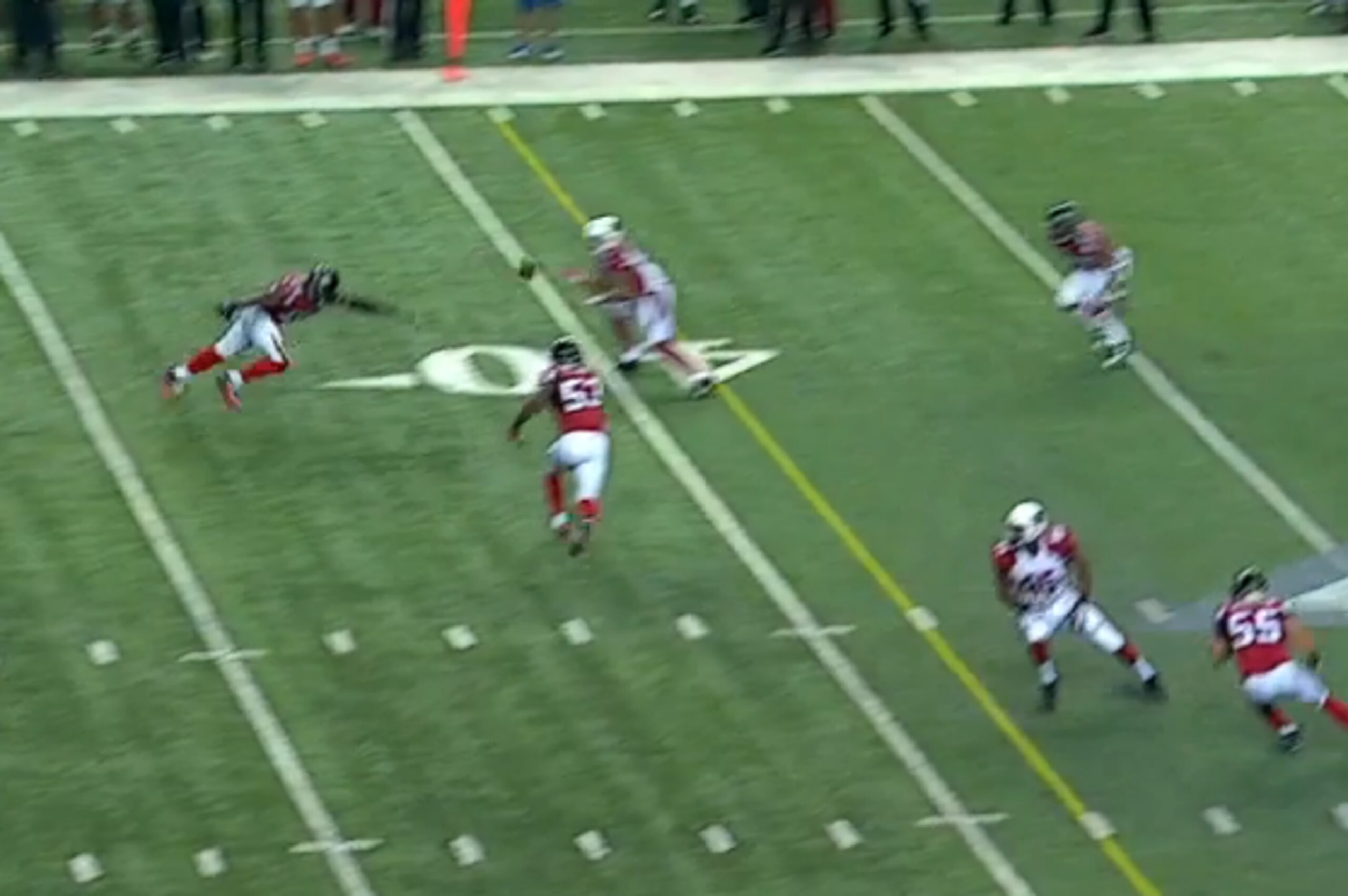
That’s a second-quarter throw that had to go above the short zone coverage from a linebacker and fall in front of the cornerback who was sitting deep and waiting. It traveled about 15 yards through the air from where Stanton unloaded behind the line of scrimmage to where it fell safely in Floyd’s hands.
Then there was a 13-yard hookup with wide receiver John Brown in the third quarter. After Brown ran a curl route from the slot, Stanton’s opening was specific: high. He had to elevate the ball high enough that it was beyond the reach of Falcons safety Dwight Lowery but still within Brown’s wingspan so he could make a leaping catch.
And that’s exactly the bull's-eye Stanton hit.
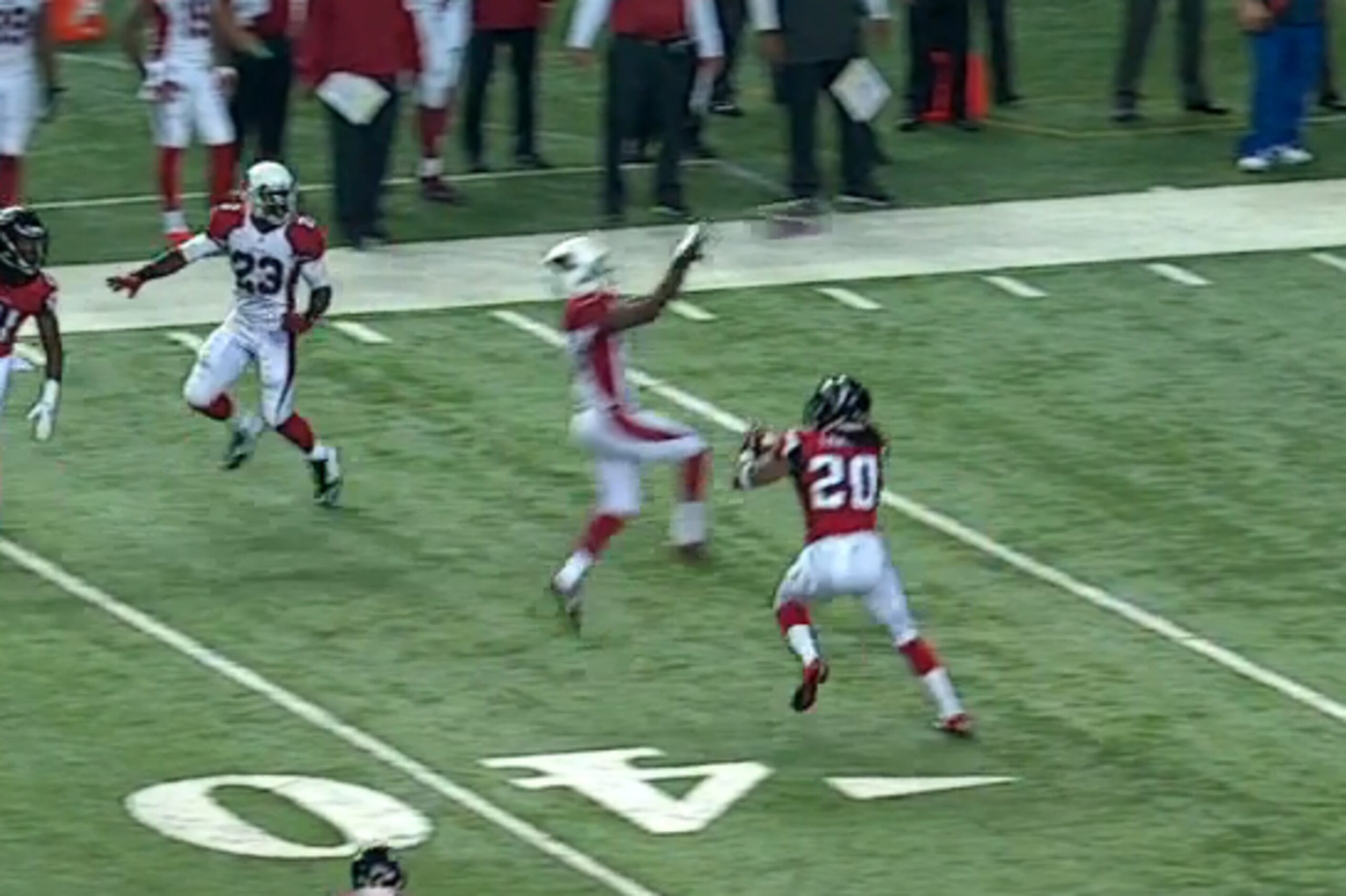
Stanton’s struggles with high-percentage throws are mostly rooted in feeling pressure when little (or none) is there, which is an expected side effect of minimal in-game experience. At 30 years old Stanton is in his seventh NFL season, but he’s started only 10 games. Worse, prior to this season his last start came in 2010.
That’s the reality of who we’re watching and judging when we criticize Stanton and who the offense of a team that started the season 9-1 now flows through. He has strengths (that arm!) and many more weaknesses (that accuracy!) that need to be either utilized or managed.
All of that is understood when a backup quarterback is at the helm of an offense. But at some point a quarterback worthy of even being on an NFL roster should be trusted to complete the most simplistic and painfully routine throws.
The Stanton we saw Sunday failed when failing was difficult, and he did it far too often. If that continues he won’t meet the core requirement for any successful backup quarterback: being impressively adequate.
Instead, he’ll derail what started as a promising season with championship potential.
.jpg?w=2560)
.jpg?w=2560 "NFL Paris Football")

.jpg?w=2560 "Malik Beasley Negotiating Plea Deal (AP)")