
Is It Officially Time for Washington to Bench Robert Griffin?
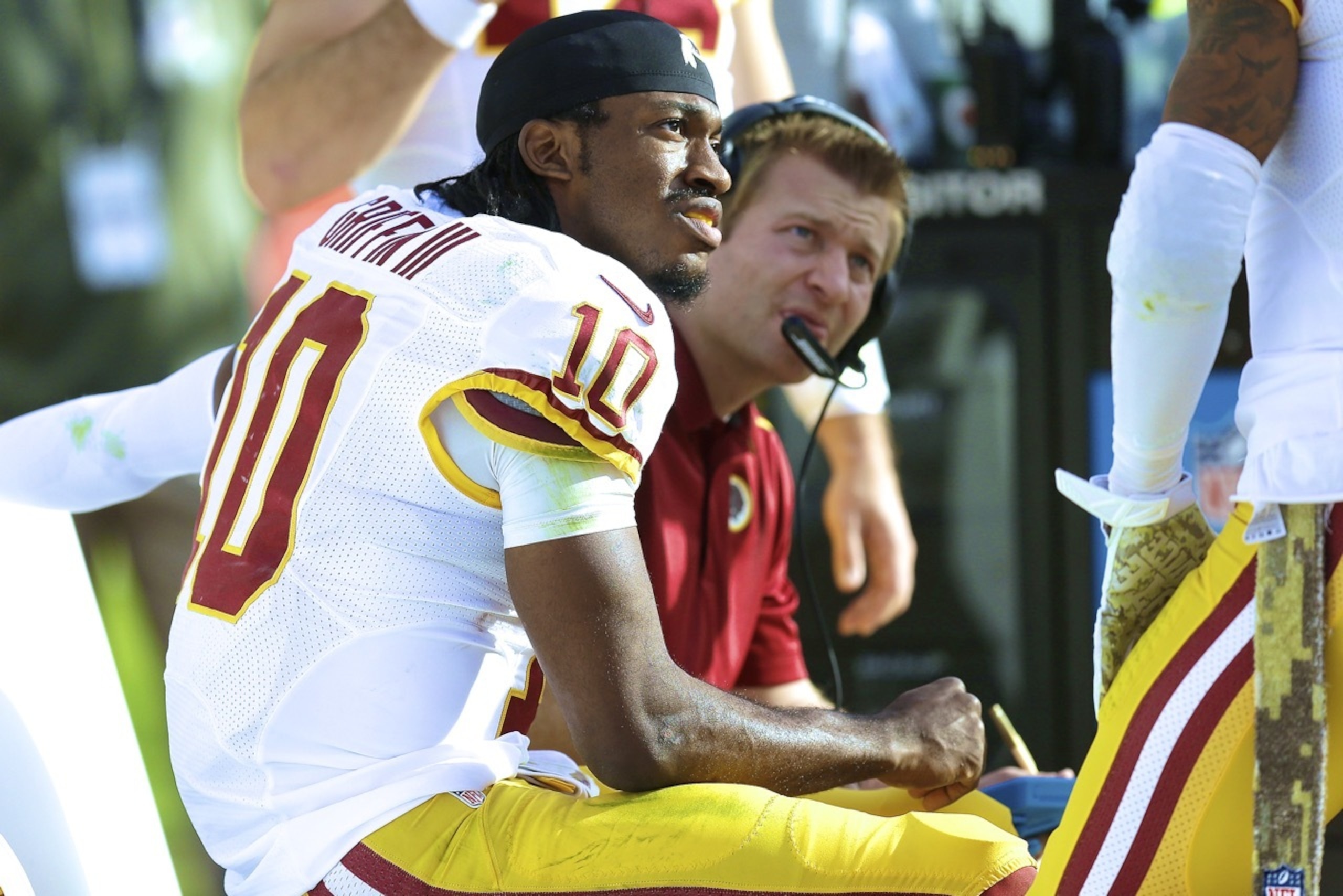
Washington starting quarterback Robert Griffin III should be benched.
His head coach called him out. He's petulant with media members. His numbers don't look good. Mike Shanahan broke him. Why did the franchise give up so many draft picks for him? Colt McCoy is a better leader of men.
Calling for Griffin's benching is a relatively simple argument to make. It requires no real nuance and is a very popular opinion to spout right now. The evidence is obvious, no? Washington isn't winning games, Griffin's numbers aren't good and McCoy won the two games he played.
.jpg?w=2560 "Chargers Mack")
.jpg?w=2560 "Green Bay Steelers Football")
.jpg?w=2560 "Giants Football")
This seems like a no-brainer.
"Seems like" being the key part of that sentence. Quarterback changes are always treated as simple decisions to make when you're not the person who is actually tasked with the move. Is the starter producing good numbers? Is the team winning with him? Yes to either question means no quarterback change; no to both means you change the quarterback.
Realistically, making that decision isn't so simple.
Changing your starting quarterback can have long-term ramifications on that position but also the franchise as a whole depending on who is the backup option. The decision to bench a quarterback should only come after a layered discussion that considers a lot of context.
Plenty of quarterbacks in the league are playing poorly enough to be benched, but for various reasons, it doesn't make sense to move on right now.
For example, Chad Henne deserved to be benched for the rookie Blake Bortles by the Jacksonville Jaguars earlier this season. Bortles immediately improved the offense, but the Jaguars are still competing for the first overall pick in next year's draft while the rookie QB appears to be regressing.
If Bortles damages his long-term development because he was rushed into a situation where the Jaguars weren't winning regardless, did it make sense to change the quarterback when Henne wasn't playing well?
A quarterback's benching has two parts: the player who is being replaced and the player who is doing the replacing.
If Washington decides to replace Griffin, it will be moving back to McCoy.
McCoy is a 28-year-old, physically limited quarterback who has just one more touchdown than turnover for his whole career. Before landing in Washington this season, Brandon Weeden replaced him in Cleveland and Blaine Gabbert did the same in San Francisco. Gabbert took McCoy's backup spot while performing terribly in the preseason.
Even if we accept the idea that McCoy is potentially a better fit in Jay Gruden's offense, that improvement would be marginal due to his limited overall ability.
With Washington at 3-8, it doesn't make sense to move to a short-term option at quarterback for a minor upgrade. It would take a miracle for this team to make the playoffs now. Soon it will be mathematically impossible, so Gruden's team will only be playing for pride and future roster spots.
McCoy, like Kirk Cousins before him, is only an attractive option over Griffin because he's the other option. Alone, in his own right, he doesn't offer anything of significant value.
As an NFL head coach, Gruden is predisposed to be desperate to win games. However, at this stage of his spell in Washington, wins aren't crucial for saving his job. Losses don't help anyone, except for giving the franchise a higher spot in the upcoming draft order, but they're unlikely to curtail much development on this roster either.
It's more important for Gruden to figure out if any of his current quarterbacks can at least compete for the starting spot in 2015. Griffin is the only one with enough talent to be considered for that spot.
Because Griffin hasn't had a huge sample over this season and because he's recovering from injury while adapting to a new offense, he needs more time on the field to prove if he is worth keeping. Despite the perception of his play and character, his on-field performances have been closer to inconsistent than disastrous.
The Bad
Within the pocket, Griffin is a hesitant quarterback. He rarely makes quick decisions, and he doesn't consistently make smart decisions. Part of that is him adjusting to a new style of play under a new head coach, but he's not where he needs to be regardless of why he is uncomfortable.
Early on against the San Francisco 49ers, Griffin made two very bad decisions and two very bad throws from the pocket.
The first play featured something that has been a hot topic since he tore his ACL at the end of his rookie season: his footwork.
On 3rd-and-12 deep in his own territory, Griffin is forced to hold on to the ball. Behind Washington's offensive line, holding the ball in the pocket often means throwing under pressure. That was the case on this occasion as he was met with a defender right in his face as he let the ball go.
Interior pressure disrupts the discipline of most quarterbacks in the NFL, but Griffin can't use that as an excuse for his awful footwork on this throw.
He doesn't step into the throw properly; instead he throws the ball in such a way that allows him to shield himself from the incoming defender. His right foot is swinging sideways through the air as he releases the ball, meaning he is leaning his weight to the side on his left foot.
Griffin never follows through with his upper body so as to protect himself, but that motion causes his pass to sail over the head of his intended receiver. If he wanted to avoid taking the hit, his only option was to slide to the right and step up in the pocket to where there was space.
To compound the poor throw from the pocket, Griffin also made a bad choice of where he threw the ball. Even an accurate pass was going to be forcing the ball to a covered receiver with an arriving safety. Being aggressive on third down isn't necessarily a bad thing, but deep in your own territory early in the first quarter would disqualify this play from simply being aggressive.
Instead it should be considered reckless.
Griffin was fortunate not to be intercepted on this play. The incompletion ended the drive, but Washington quickly had the ball back, and Griffin made another decision that initially seems inexplicable and indefensible.
This play doesn't come on a third down. But it is 2nd-and-13, so it does call for some aggression if there are chances to throw the ball down the field. The play call from the sideline is aggressive, as it features play action to the back before multiple deep routes from the three receivers to the bottom of the screen.
After carrying out the play fake, Griffin takes a deep drop in the pocket. He actually slips at the top of his drop but shows off impressive balance and pocket awareness to step forward and negate the edge-rushers. Griffin settles in a clean pocket before releasing the ball down the field.
To this point, Griffin has been impressive. His pass was still a poor decision.

Griffin heaves the ball to a double-covered DeSean Jackson even though the deep crossing route looked open. This initially seems to be a blatantly poor decision and an interception-worthy throw, but it appears this choice may not have been the quarterback's.
Washington coaches tell their quarterbacks to force the ball to Jackson even when he is covered, according to John Keim, an ESPN beat reporter for the team.
Our information is limited in this instance as we don't know how the coaching staff applies this. The coaches may just say force the ball to Jackson on specific plays, and we can't be sure if that is this specific play. Furthermore, we don't know if the coaching direction is what was in Griffin's mind when he threw this ball.
If it was the coaching direction, there is no reason to blame to Griffin for this play. Later in the game against the blitz, there was a play when Griffin clearly deserved the blame for a poor play from the pocket.
This play came against the blitz.
Before the snap, the 49ers didn't mask their intentions.
At the snap, they sent seven players after Griffin in the pocket. He stares down his tight end, Niles Paul, who is wide open from the very start of the play. The quarterback has enough time to deliver the ball, but he is seemingly waiting for the tight end to turn around.
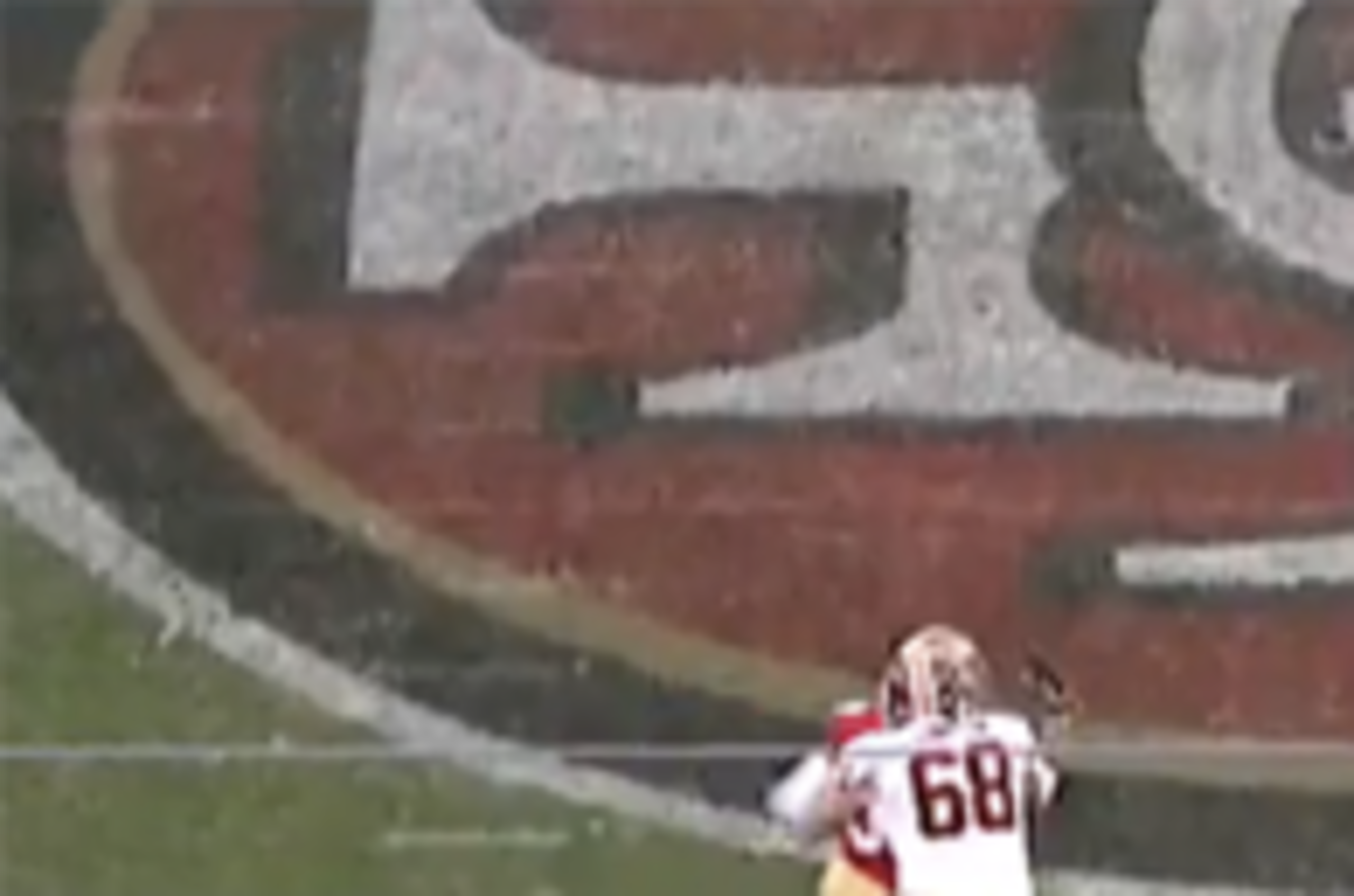
Paul is running an out route, and he turns to look back before the pass rush can close onto his quarterback. Griffin has plenty of time to stand tall and deliver the ball. He can even hold it for a split second more to make sure of his mechanics.
With Paul in position and Griffin looking directly at him, this should be a simple throw to negate the blitz.
Instead, Griffin begins his throwing motion then stops quickly and hesitates. He holds the ball long enough for the pass-rushers to close on him and take him down in the pocket. Griffin turned a simple throw to negate a blitz into a sack with his hesitation.
This is the kind of frustrating play that will make fans want to change the starting quarterback, but it can also be considered a comfort play—a play that may get easier with more time on the field away from injury.
The Good
During his exceptional rookie season, Griffin largely built his success throwing the ball deep down the field off of play action.
Over the first 12 weeks of Griffin's rookie season, during which he threw for 78 percent of his passing yards and 80 percent of his passing touchdowns for that regular season as a whole, Griffin attempted 306 qualifying pass attempts. Qualifying pass attempts don't include throwaways or laterals that drift forward.
Of Griffin's 306 pass attempts, 133 came after play action, 49 came on screens and eight came on designed rollouts.
That means only 24.8 percent of Griffin's passes came on traditional dropbacks that asked him to manage a pocket and read coverage down the field—coverage that hadn't been disrupted by motion behind the line of scrimmage.
With that in mind and considering his second season was largely destroyed by injury, Griffin hasn't really had the time to develop as a pocket passer on the field. Yet, in spite of that, he is still showing an impressive ability to make throws on play-action plays.
Of Griffin's 26 dropbacks against the 49ers, 10 came off play action. Those 10 plays resulted in seven completions and three incompletions for 85 of his 106 passing yards.
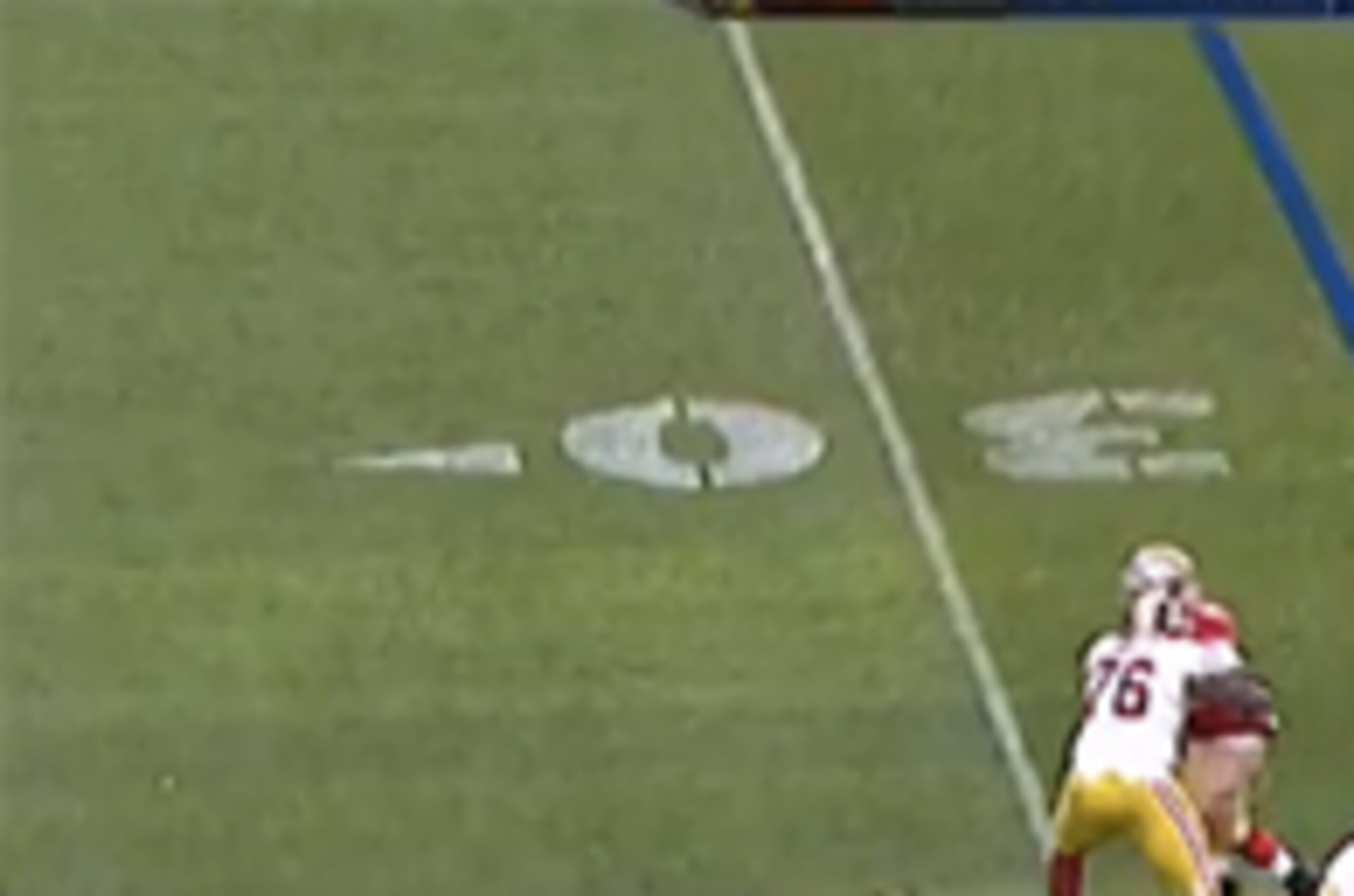
This play was a staple of Kyle Shanahan's offense, Griffin's coordinator during his rookie season. It puts Griffin in position to read the defense while carrying out the play fake. That play fake manipulates the two linebackers over the middle of the field, creating space down the field for the offense's receivers to run into.

Griffin makes an immediate decision after the play fake and gets rid of the ball quickly. He finds Jackson open down the field for a relatively simple big play. This wasn't an exceptionally difficult play, but Griffin executed it perfectly.
While Griffin may not be the spectacular athlete he once was, he doesn't need to be a spectacular athlete to show off his ability to throw the ball down the field off play action.
Even in his diminished state, Griffin is still more athletic than your average NFL starter. He comfortably carries out any type of play fake that is asked of him, whether it be a simple, subtle fake like the one above or a more elaborate design.

On this play, the Washington offense only sends two receivers out into routes. Instead of offering Griffin more receiving options to choose from, it instead uses its extra eligible receivers to create a completely clean pocket for him between the tackles.
Despite the hard play fake, Griffin never leaves the pocket. Instead, the offense around him adjusts to move with him.

Griffin has time to survey the field, but because he only has two receivers running routes and both are working deep down the field, he has to hold on to the ball. Pressure from his blind side arrives relatively quickly, but Griffin releases the ball in good time.
Pierre Garcon is running a deep crossing route between defenders down the field. Griffin hits him in stride with an accurate pass that allows him to continue across the field toward the sideline. He gains a relatively simply 25 yards because of Griffin's accuracy.
At the very worst, Griffin is still showing off an ability to be effective in a specific scheme.
Outside of those specific play designs, he is also flashing ability as a pure pocket passer even when put under pressure. Over the past three weeks, Griffin has made a number of impressive plays behind a crumpling offensive line.
Those plays were fewer against the 49ers, but there was still some evidence of their existence.

On this play, Griffin holds the ball in the pocket long enough for Andre Roberts to come open on an out route at the first-down marker. However, holding the ball that long invited pressure onto him as his pass protectors were pushed back into his face.
When Griffin releases the ball, he has a defensive lineman's hand in his face. His pass still arrives accurately and on time.
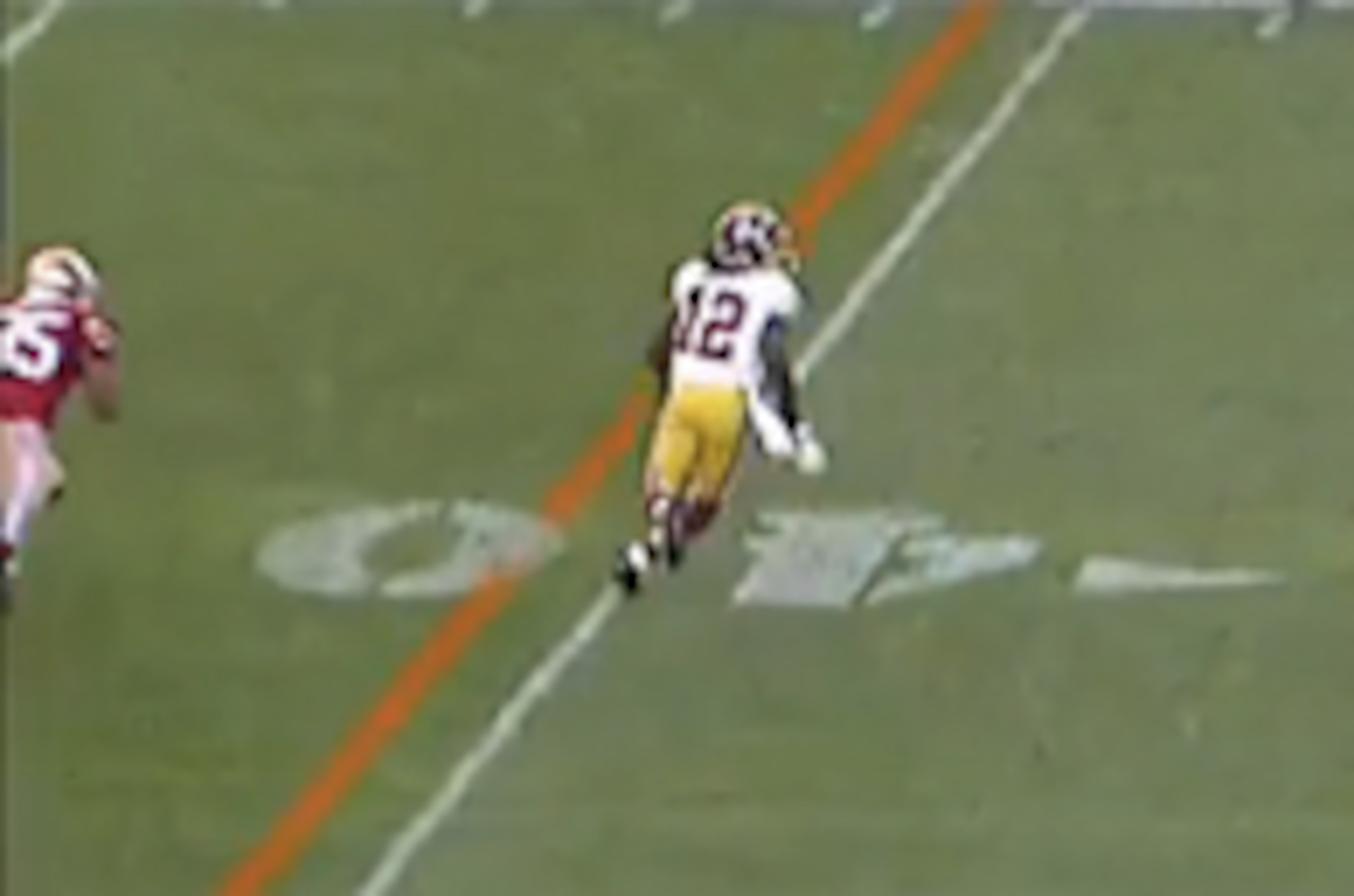
On a similar play at another point of the game, Griffin released the ball to Roberts on an out route again for a first down. This time his pass was accurate and on time, but more significantly he was hit by a free rusher as he released the football.
Griffin stood strong against two rushers to deliver the ball in an important situation. These aren't exceptionally difficult or impressive plays, but they are signs of his ability to develop this side of his game.
The Supporting Cast
Nobody in Washington should be happy that Griffin isn't a star quarterback, but the media storm that surrounds him has helped to draw attention away from the team's other major flaws.
The offensive line in front of Griffin has been very poor in recent weeks. On non-play-action or max-protection plays, Griffin has consistently seen pressure that wasn't of his creation. At times, this pressure has been overwhelming and would be overwhelming for the majority of starting quarterbacks in the league.
Nothing takes away a quarterback's options quicker than an effective four-man rush. A defense that can get pressure with just four or fewer pass-rushers is able to crowd coverage and tighten passing windows. Against four rushers, the offensive line is expected to be effective.
As we saw last week, this often proved too tough a task for Washington's offensive line.

On this 3rd-and-5 play, the Washington offense puts Griffin in the shotgun with one running back to his left side. Importantly, the offense also lines up a tight end to the left side, meaning that the right tackle and right guard have no help.
The 49ers only have one down lineman, but the other three players in the front are in position to rush the passer also.
Aldon Smith is lined up on the left side of the defense. At the snap, he runs inside of the down lineman. Smith draws two blockers on what is a simple stunt movement. This immediately frees the defensive lineman who is working his way outside.
Griffin hasn't been given time in the pocket despite the defense only rushing four players.

Wide receiver Andre Roberts runs a crisp out route to create space. He is in position to catch a first-down pass if thrown a catchable pass because the defensive back covering him has fallen down. Griffin's pass falls short of the receiver because he is forced to rush his process by the free pass-rusher.
This is a play Griffin can and should make, but it's unfair to simply blame him while overlooking the failures of his offensive line.

Griffin was inconsistent with his ability to throw the ball under pressure and his movement in the pocket, but there were both positive and negative plays. In fact, it's hard to say that the offensive line in front of him is clearly playing better than he is in the passing game.
The most important part of a quarterback's supporting cast is his offensive line.
If the offensive line can't give him time to read the coverage and throw the ball, the quarterback's responsibilities immediately multiply. Even a quarterback who has receivers who can't separate, throwing the ball accurately with anticipation from a clean pocket is significantly less taxing than hurrying up and complicating his actions as a whole.
On the field, Washington does need to help its quarterback as much as its quarterback needs to help it.
Benching Griffin is one option for Washington, but it's not any kind of a solution.
.jpg?w=2560 "Seahawks Cardinals Football")
.jpg?w=2560 "Commanders Cowboys Football")