How Will Notre Dame Deal with Navy's Option?
For the 88th consecutive season, Notre Dame takes on Navy in the longest running intersectional rivalry in college football. And for almost just as long, the Irish walk into a football game where there's little to gain yet much at stake.
A win against Navy? Pretty underwhelming, particularly now that the College Football Playoff selection committee already turned their noses up at the Irish's current slate of opponents.
As the rest of the Power Five teams get into the meat of their conference schedules, the Irish look almost old-fashioned as they take on the service academy, even if there are noble intentions behind the rivalry.

.jpg?w=2560)

Of course, looking past Navy should be done at your own risk. Even if people have forgotten that Navy had Ohio State on the ropes until the fourth quarter of its season opener, the Midshipmen and their vaunted triple-option attack make for a difficult matchup, especially in the middle of the season's grind.
Brian Kelly said on Tuesday:
"I can tell you among the coaches throughout the country, if we were just polling coaches, they would tell you nobody wants to play Navy. But sometimes when you talk about the average fan, they hear about an academy, and they don't think in terms of how difficult of an opponent it is.
"
Don't expect any fans to be playing the violin for the Irish this week, coach. But with Keenan Reynolds entering Saturday night's contest healthy after a monster game against San Jose State, Notre Dame will have to find a way to slow down the triple option and one of college football's most dangerous playmakers.
Here's how they can do it.

Take Away the Fullback
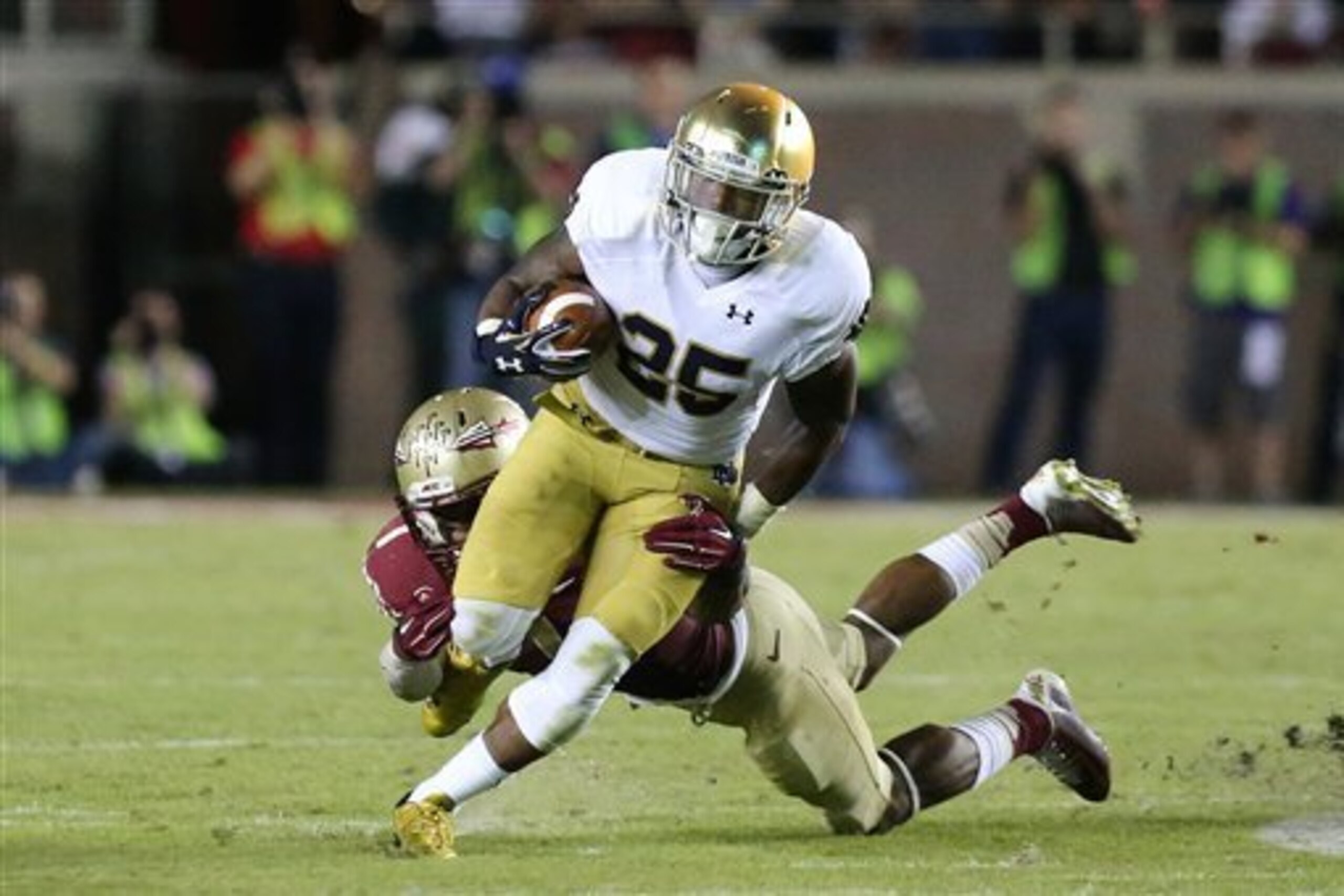
While Reynolds hasn't put up numbers like he did last season, the Navy fullbacks have been doing serious damage this year. The duo of Noah Copeland and Chris Swain are eating opponents alive with the fullback dive, running for a collective 1,057 yards on just 136 carries, a ridiculous 7.8 yards per carry on one of the most basic plays in all of football.
Navy fullbacks have worked their way into Irish nightmares in recent years. In 2009, Vince Murray ran for 158 yards on just 14 carries as he essentially ended the Charlie Weis era in Navy's 23-21 victory.
A year later, it was Kelly and Bob Diaco who got pantsed, this time by fullback Alexander Teich. Teich ran into the record books as he went for 210 yards on 26 carries, carving up the Irish defense from the inside.
The Irish coaching staff has made some adjustments since that fateful 35-17 beating, switching to a four-man front instead of their base three-down under Diaco. But that hasn't necessarily made stopping the fullback any easier, with Swain running for 5.3 yards a carry in last season's 38-34 escape.

Try to Dictate Terms Defensively
If we've seen any major change this season, it's been Brian VanGorder's hyper-aggressive mentality with the Irish's young defense.
While Diaco preferred to have his defense try its best to be "creaseless," making the Irish's defensive linemen hold the point of attack while reading the option, don't expect VanGorder to throttle back the aggressiveness.
Part of what's made VanGorder so successful early in his time in South Bend is his ability to see what an opponent does and try to neutralize that facet of their game plan. That's a little bit tougher with a system like Navy's, where the Midshipmen have specialized at something so specific that it's become a bit scheme-proof.
But with Navy's offensive line struggling with injuries and not as good as some of Niumatalolo's better fronts, Notre Dame's strength on the defensive line could take the Midshipmen out of their game plan through aggression alone.
Personnel-wise, we've gotten clues that Notre Dame will make some tweaks. Isaac Rochell will slide inside to defensive tackle, putting Sheldon Day at defensive end.
Kelly also talked about seldom-used fifth-year lineman Justin Utupo getting opportunities to contribute, a year after he played well against both Navy and Air Force.
The youth on Notre Dame's front means there'll be growing pains. But perhaps they can be negated by setting the tone, forcing Navy to make choices as opposed to having the defense read and react.
| 2013 | 38-34 | ND | -2 |
| 2012 | 50-10 | ND | +3 |
| 2011 | 56-14 | ND | -1 |
| 2010 | 35-17 | Navy | -2 |
| 2009 | 23-21 | Navy | -3 |
| 2008 | 27-21 | ND | -4 |
| 2007 | 46-44 (2OT) | Navy | Even |
Win the Turnover Battle
Few things will matter more on Saturday night than the turnover battle. With Navy sitting at 106th in the nation in turnover margin, the Midshipmen can't afford to give the ball away to the Irish offense, a unit that should be incredibly proficient against an undersized defense.
If you're looking for one of the key ingredients in Navy's best performances against Notre Dame since they broke the Irish's 43-game winning streak in 2007, turnovers tell the story. In Notre Dame's humbling 2010 loss, the Irish were minus-2. In the 2009 loss, Charlie Weis' squad was minus-3.
In games that Navy's managed to keep close—2013 and 2008 specifically—the Irish have won tight games even while being a collective minus-6 in turnover margin.
Niumatalolo was candid earlier in the week when he talked about the perfect recipe for a victory over Notre Dame. It required some help from the Irish.
"We played about as good as we can play and we still lost," Niumatalolo told Bill Wagner of The Capital earlier this week, when talking about last season’s 38-34 finish. "To even have a chance, we have to play perfect and they have to help us a little bit."
Score Early on Offense and Run Away from the Option
Just as Niumatalolo acknowledged, the Irish can win simply by coming out of the gate quickly. While winning the turnover battle is crucial, the best way to beat Navy's triple option is a quick offensive start by Notre Dame.
Converting in the red zone and putting points on the board early and often gives the Irish a rare opportunity for a first-round TKO. With a Navy option attack unable to play catchup on the ground, turning to their passing game would spell near-certain disaster, regardless of how competent Keenan Reynolds is as a passer.
Navy's offensive line has already given up 15 sacks this season. The Midshipmen have only thrown 86 passes all year. Forced to drop back and beat someone through the air, Reynolds won't survive, especially if VanGorder dials up a blitz package and Navy gets away from their bread and butter.
We saw that happen in 2011 and 2012, with efficient offense eliminating any threat from Navy before the first quarter was over. If the Irish can take a step forward behind Everett Golson (a game after nearly putting up 500 yards against Florida State), there's little Navy's option offense can do to stop it.
All quotes obtained firsthand unless otherwise noted.

.jpg?w=2560 "NFL House in Paris Closes for Protests")

.jpg?w=2560 "Trevon Diggs Cut by Seahawks")