Breaking Down Washington Redskins' Exotic Blitz Schemes
The Washington Redskins went into Dallas and beat the Cowboys 20-17 in Week 8. They did it thanks to an exotic blitz scheme expertly crafted by defensive coordinator Jim Haslett.
The key to that scheme was a daring Cover 0 concept. Simply put, Cover 0 is single coverage underneath with no deep safety help behind it.
By consistently leaving the deep void unmanned, the Redskins were able to regularly send seven and eight rushers on the blitz. Those pressures outnumbered and overwhelmed a young Cowboys offensive line.
TOP NEWS
.jpg?w=2560 "NFL Paris Football")
NFL House in Paris Closes for Protests
.jpg?w=2560 "Seahawks Chiefs Football")
Trevon Diggs Cut by Seahawks
.jpg?w=2560)
B/R's Expert Week 7 NFL Picks 🔮

Veteran quarterback Tony Romo noted how those pressures also forced him to rush decisions and release the ball ahead of time, per ESPNDallas.com reporter Todd Archer:
"They are banking on one guy making a tackle every single time. The ball has to come out of your hand when they are sending them. That was the most Cover 0 blitzes we have seen in a game. You don't necessarily think a team is going to run 10 snaps of it in a game. I'm not sure how many they did, but it was a lot.
"
These heavy pressure designs created big plays that ended Cowboys drives and snuffed out their best offensive weapons. Archer detailed the specific damage Washington inflicted with the blitz:
"Dez Bryant did not catch a pass after the first half, when he had just three catches for 30 yards. Murray led the Cowboys in receiving yards with 80 on four catches. The Cowboys entered the game converting an NFL-best 57.4 percent of their third downs. They were a season-low 42 percent Monday (5-of-12).
...
According to ESPN Stats & Information, the Redskins sent five or more pass-rushers on 60 percent of the Cowboys' dropbacks. Eleven times, they brought five or more rushers on third down. All five sacks came when Washington blitzed.
"
Let's take a closer look at two examples where Washington certainly brought more than five blitzers on third down. The first occurred on the second Dallas drive of the opening quarter.
The Redskins aligned in the Cover 0 look. Single coverage was present on each of the Cowboys' outside receivers, while the deep middle was left empty:
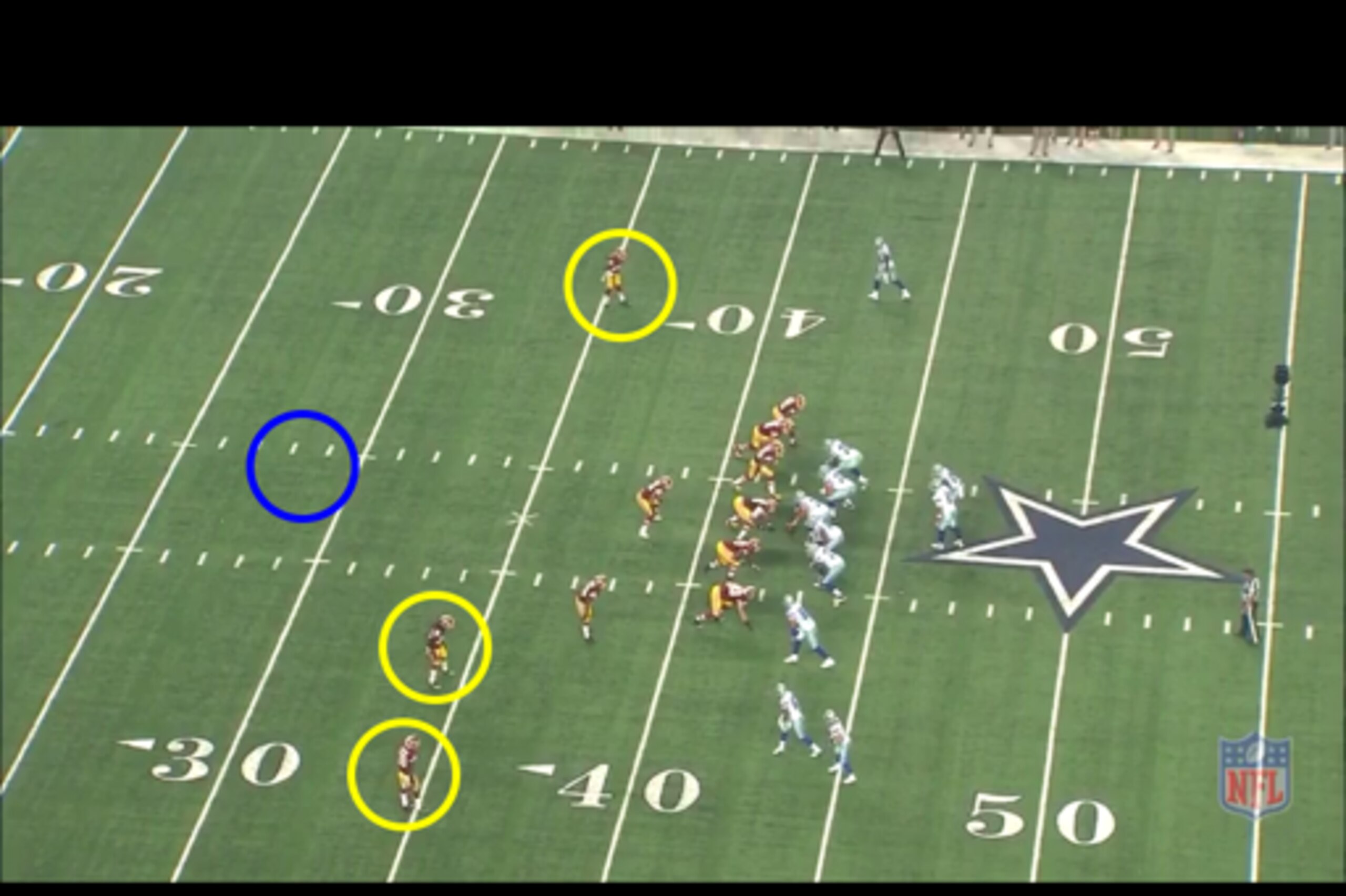
On this occasion, Haslett blitzed seven. He overloaded the right side of the offensive line by sending free safety Ryan Clark off the edge, while linebackers Keenan Robinson and Perry Riley Jr. rushed the middle:
By sending Robinson and Riley through the same gap, Haslett forced running back DeMarco Murray into pass protection. The star rusher had a difficult choice to make.
Murray eventually opted for Riley, but as is often the case, a running back trying to block a linebacker proved to be a mismatch. Haslett successfully used a Cover 0 blitz to create a matchup win for his defense.
But preventing Murray from releasing out of the backfield wasn't the best thing about this blitz. The true brilliance of the play was the way the pressure boxed Romo in the pocket:
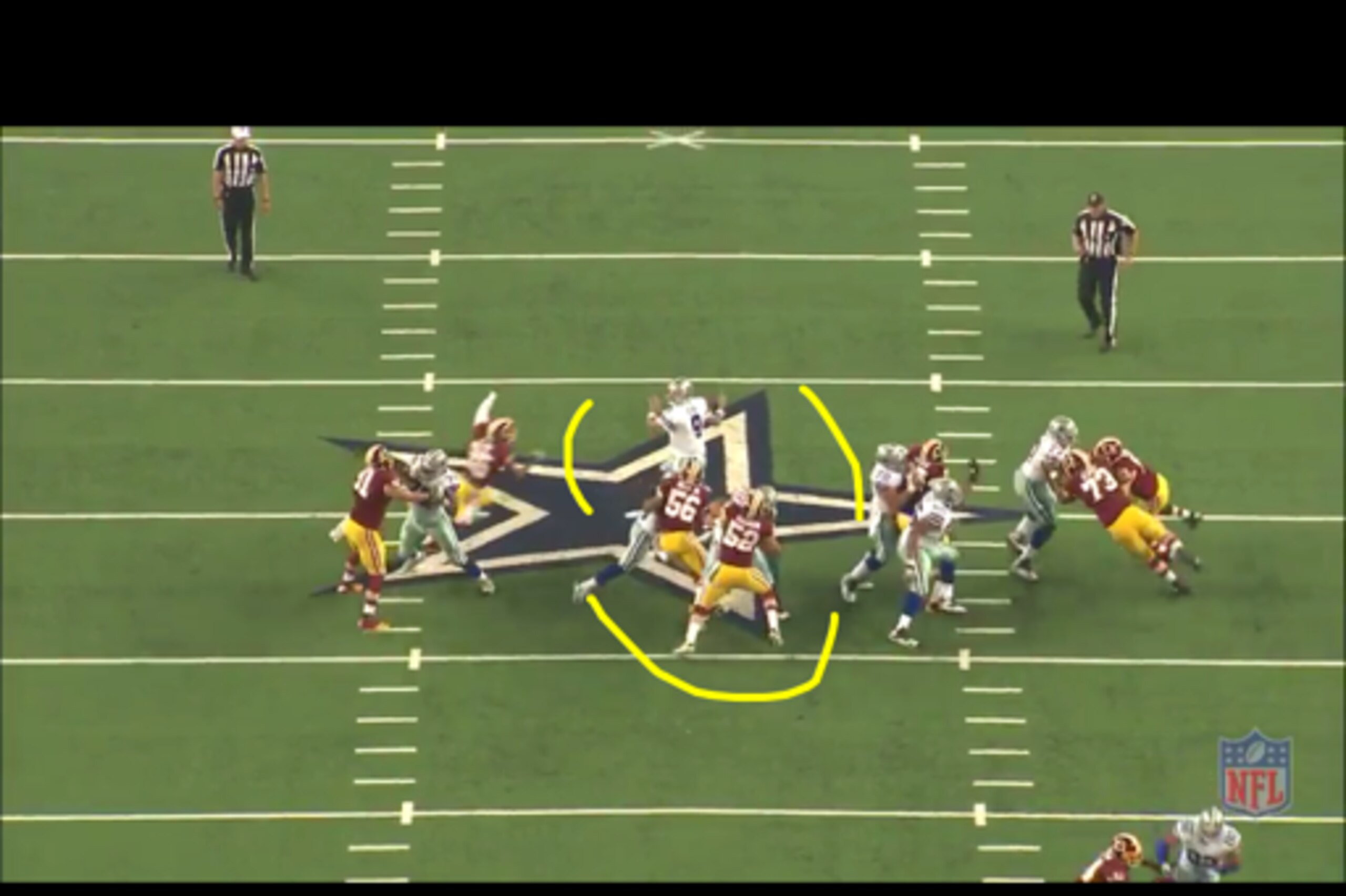
The nimble-footed ace has established a career-long niche for escaping pressure and manufacturing big plays on the move. The Redskins have suffered more than most thanks to Romo's talent for escapology.
Yet the 34-year-old was given no room to run in Week 8. Haslett's blitz concepts consistently succeeded at restricting him to the guard-center-guard gaps.
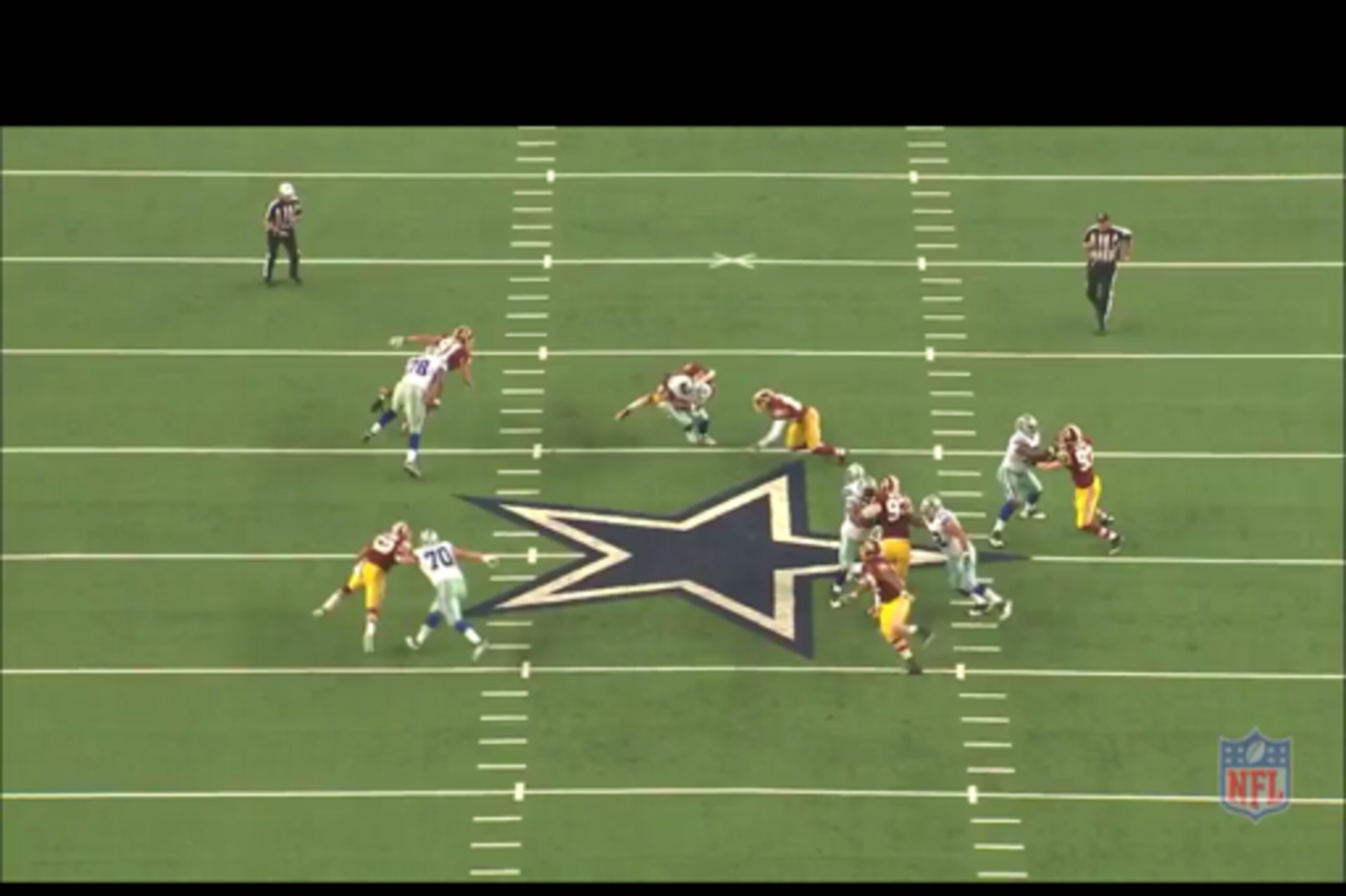
With no means of escape, Romo was felled by Riley for a loss of 12 yards:
But Haslett wasn't done sending Cover 0 pressure after Romo. He used the concept for an even bigger play in the third quarter.
Not content to let Riley have all the fun, this time it was fellow inside 'backer Robinson who got to Romo. Once again, the Redskins adopted their man coverage shell with no safety help:
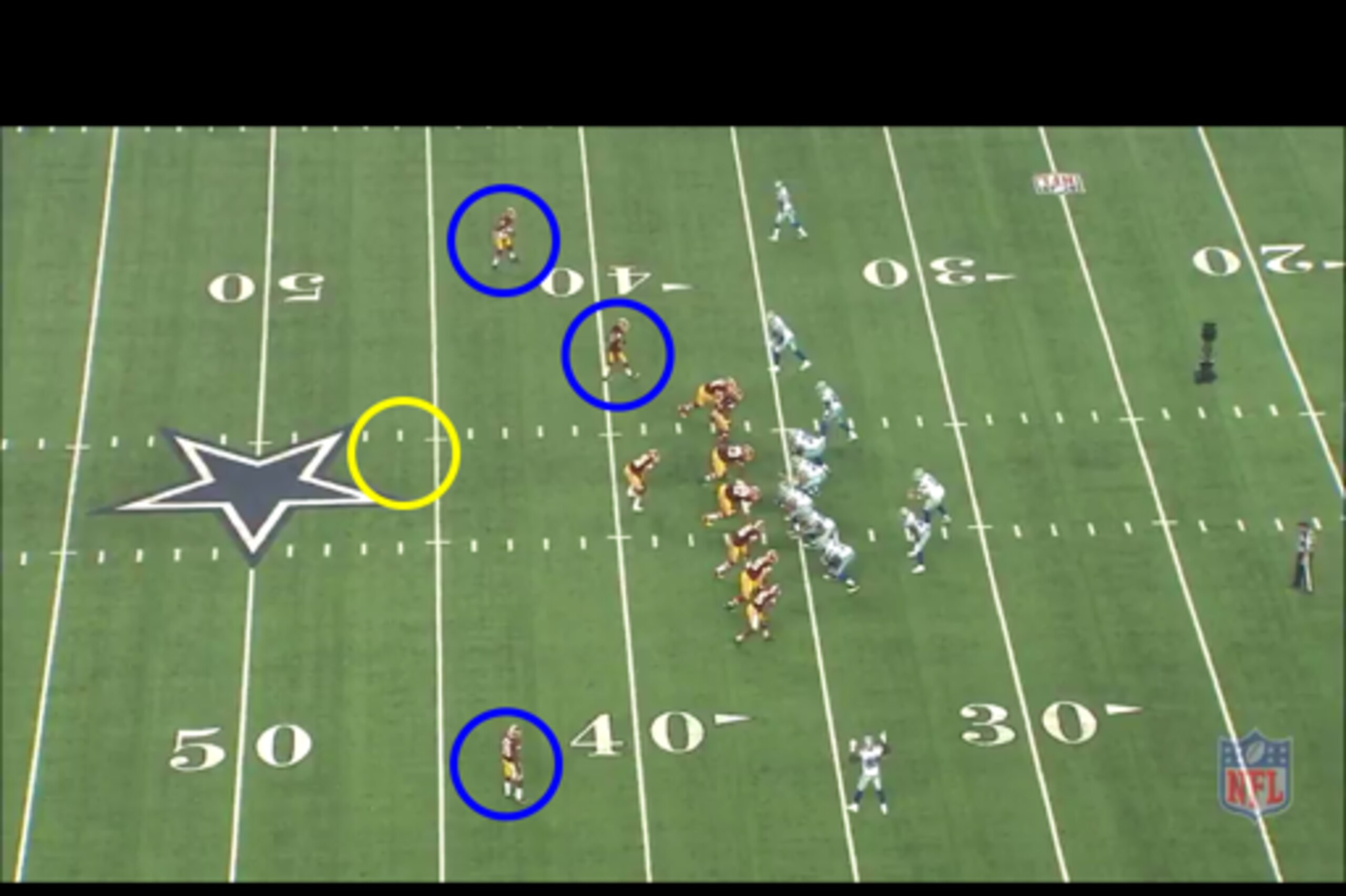
This time Haslett sent eight on the blitz. After attacking the right side of the Dallas O-line in the first quarter, Haslett now targeted the left side.
Riley and Clark rushed, along with rookie Trent Murphy, while Robinson slanted inside the A-gap, between center Travis Frederick and left guard Ronald Leary:

Riley, Clark and Murphy took wide-angled rush lanes, while the blitz from Brandon Meriweather over the right side forced Frederick to slide and help out that way. That created an open lane through the middle for Robinson:
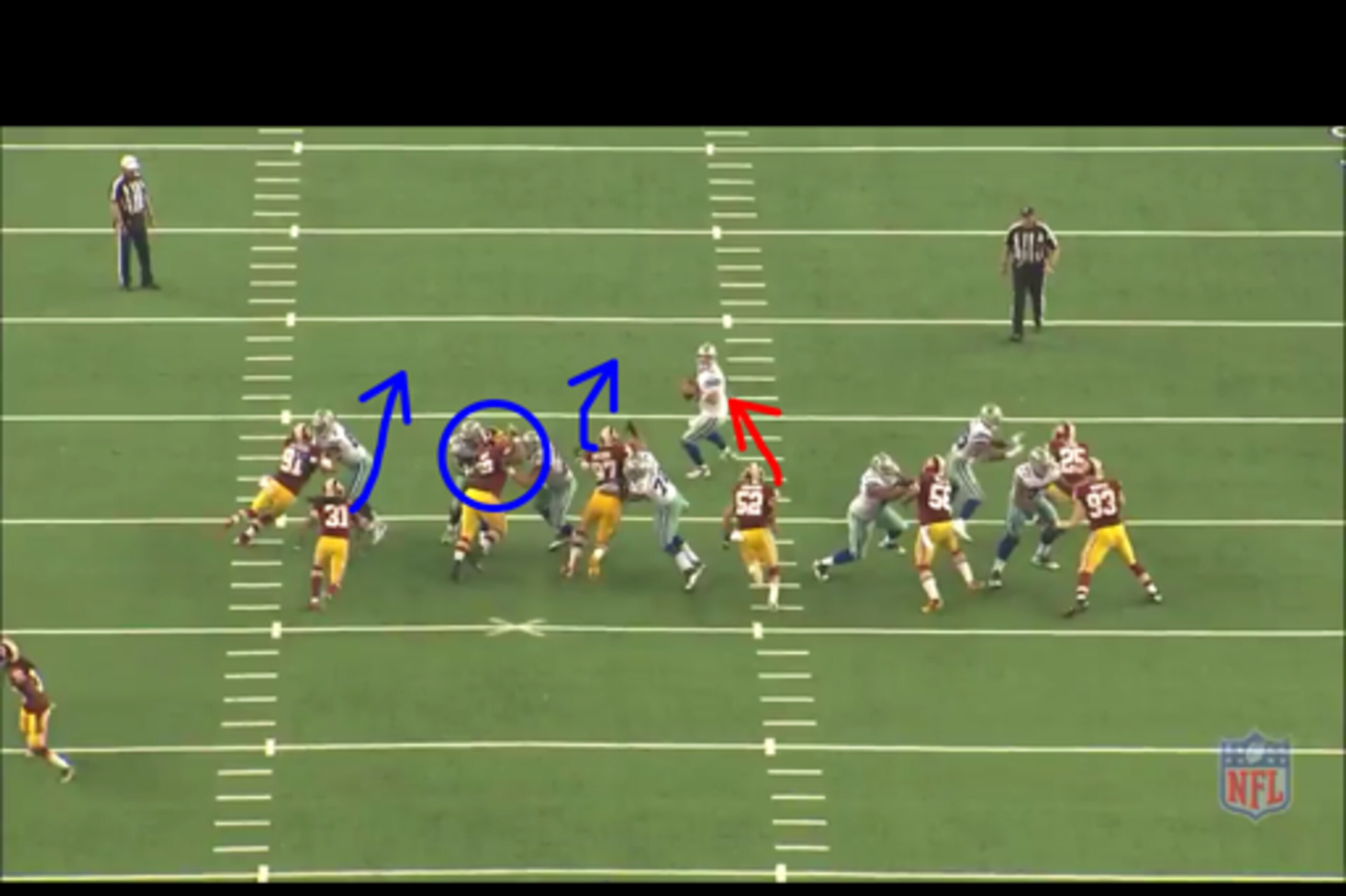
His path was left clear because Murray was once again drawn into the protection, this time by the overload on the left side:
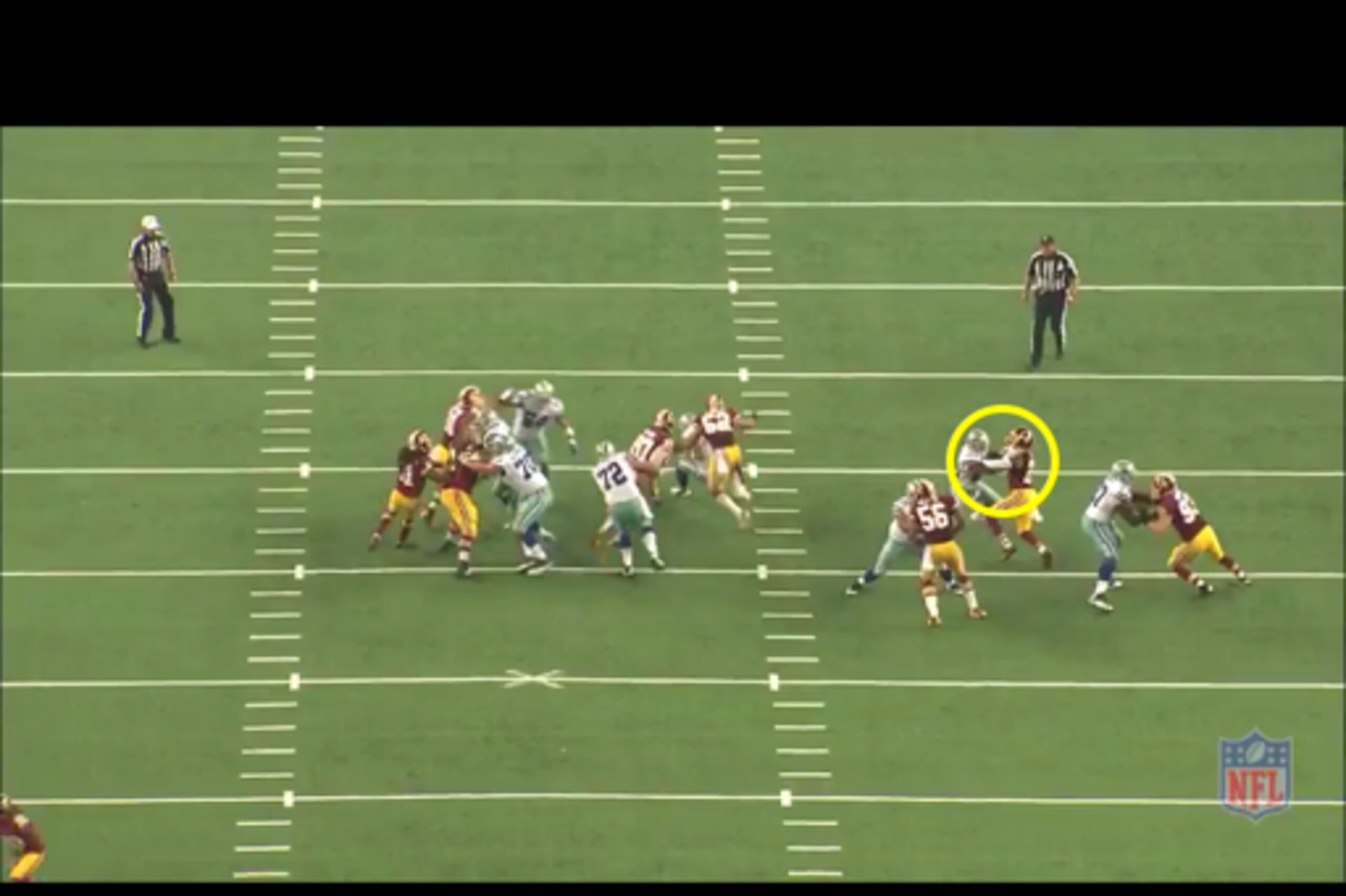
Robinson dropped Romo for another 12-yard loss. The hit was strong enough to knock the star passer out of the game for several minutes, something which clearly rattled the Cowboys.
In truth, Washington's bitter foe was already rattled thanks to Haslett's attacking defense. He used multiple rushers from various angles to overwhelm a talented yet inexperienced O-line (four of five starters entered the NFL in 2011 or after.)
Riley described how confusing Dallas' youthful blockers was a key part of the blitz-led defensive game plan, per ESPN.com Redskins reporter John Keim:
"We definitely saw on film they have problems with movement. It’s a good line. They’re powerful, but they’re young. We knew we would throw a lot of stunts and movements and blitzes and see how well they pick it up.
"
But Haslett's zero coverage schemes were as much a challenge to Romo's ability to diagnose pressure and reassign protection. Too often, Romo failed to meet the challenge.
Keim noted how Washington's D consistently won the numbers game:
Haslett certainly took chances to overrun the Dallas blocking schemes, as Keim detailed: "According to ESPN Stats & Information, the Redskins blitzed on a season-high 60 percent of the dropbacks (they entered sending an extra defender on 39.6 percent of dropbacks)."
Sending eight blitzers certainly represents a major gamble. Of course, any time you play single coverage without a deep safety, you're already tugging on Superman's cape and doing something you shouldn't into the wind.
But it wasn't all about reckless abandon to win the numbers game and create free rushers. Proving himself a sly fox, Haslett also used designs that were more subtle but just as damaging to the Dallas offense.
One of the best examples came on second down toward the end of regulation. The principle behind the play was to show an all-out blitz before dropping rushers into coverage on one side while utilizing delayed pressure on the other side.
The first major difference was the inclusion of a deep safety. The Redskins showed single-high coverage:
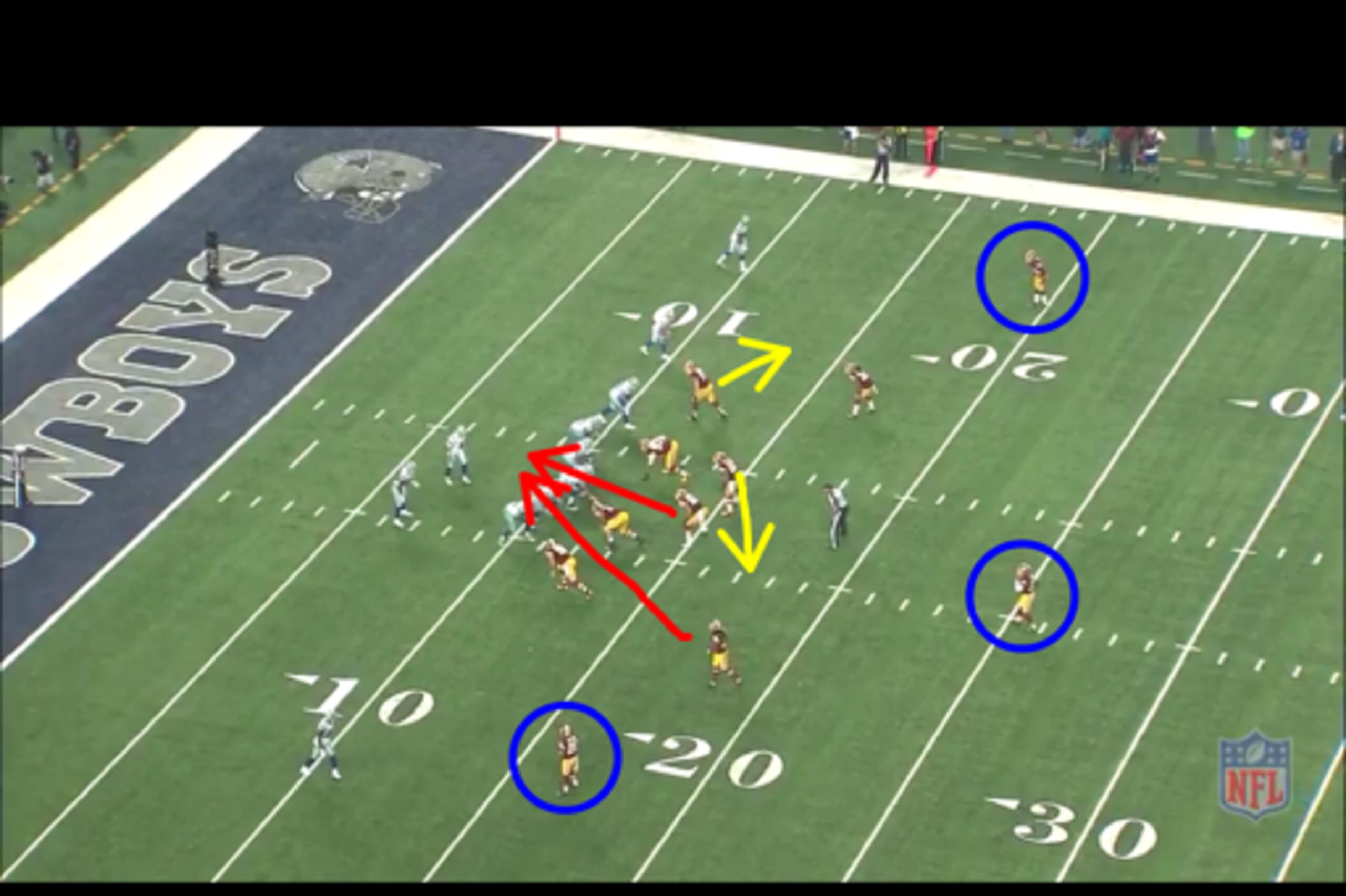
Haslett had Murphy and Riley drop into underneath coverage. He also kept the pressure strong by overloading the right side with blitzes from Robinson and Meriweather. The latter came on a delayed rush.
That overload once again put Murray in a bind. He would have to block either Robinson or Meriweather. Their blitz lanes were created by a wide rush from end Ryan Kerrigan and a slant by tackle Frank Kearse:
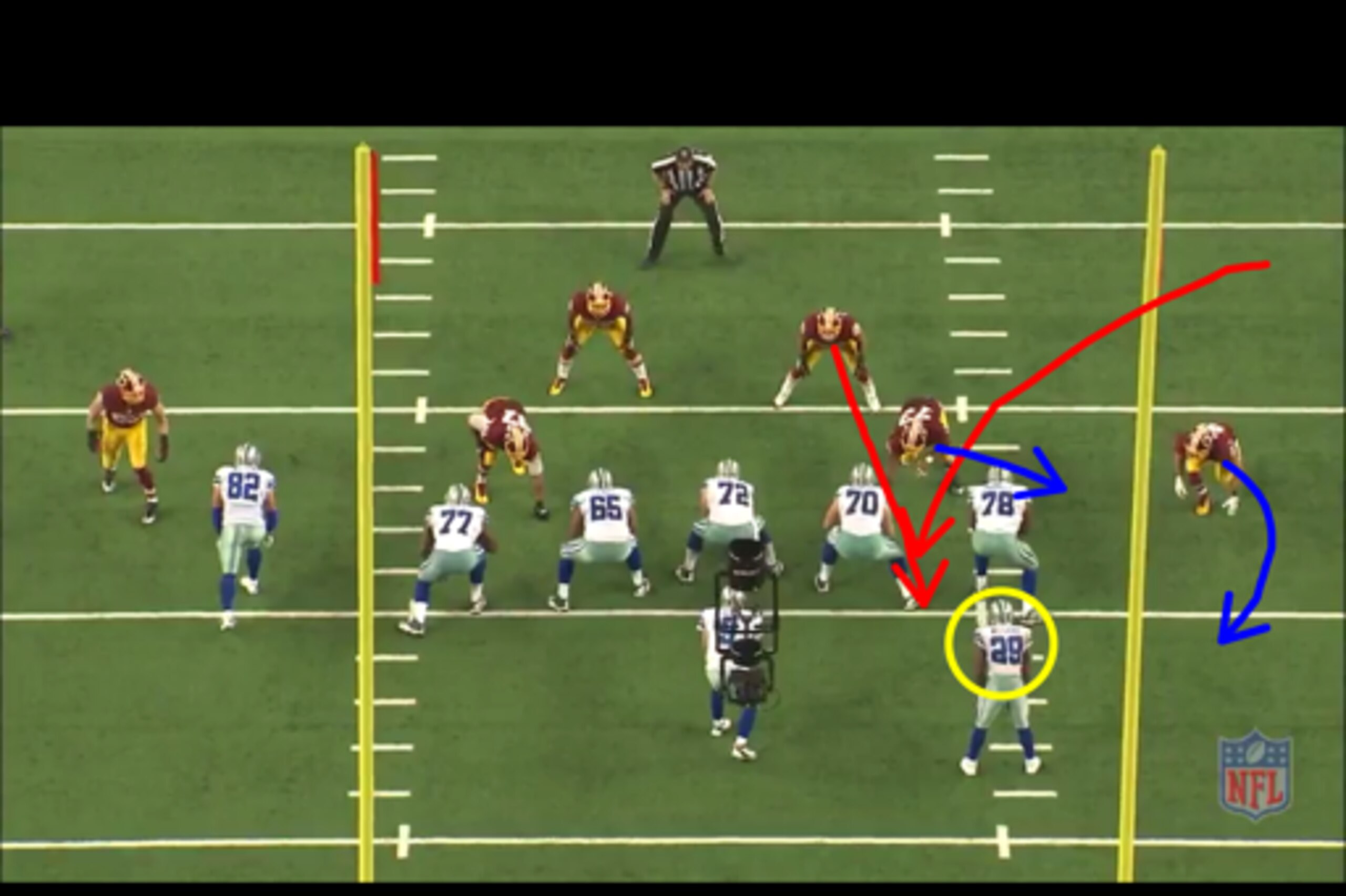
Because Meriweather delayed his blitz, Murray moved toward Robinson and didn't see the safety until it was too late. Meriweather dropped Romo for a nine-yard loss, knocking the ball loose in the process:

He could afford to wait to time his blitz because of the strength of the coverage. As zone droppers, Murphy and Riley helped the Redskins bracket the Cowboys' inside receivers.
Essentially, Washington adopted a three-deep, three-under coverage shell. That's the classic coverage scheme for a fire zone blitz:
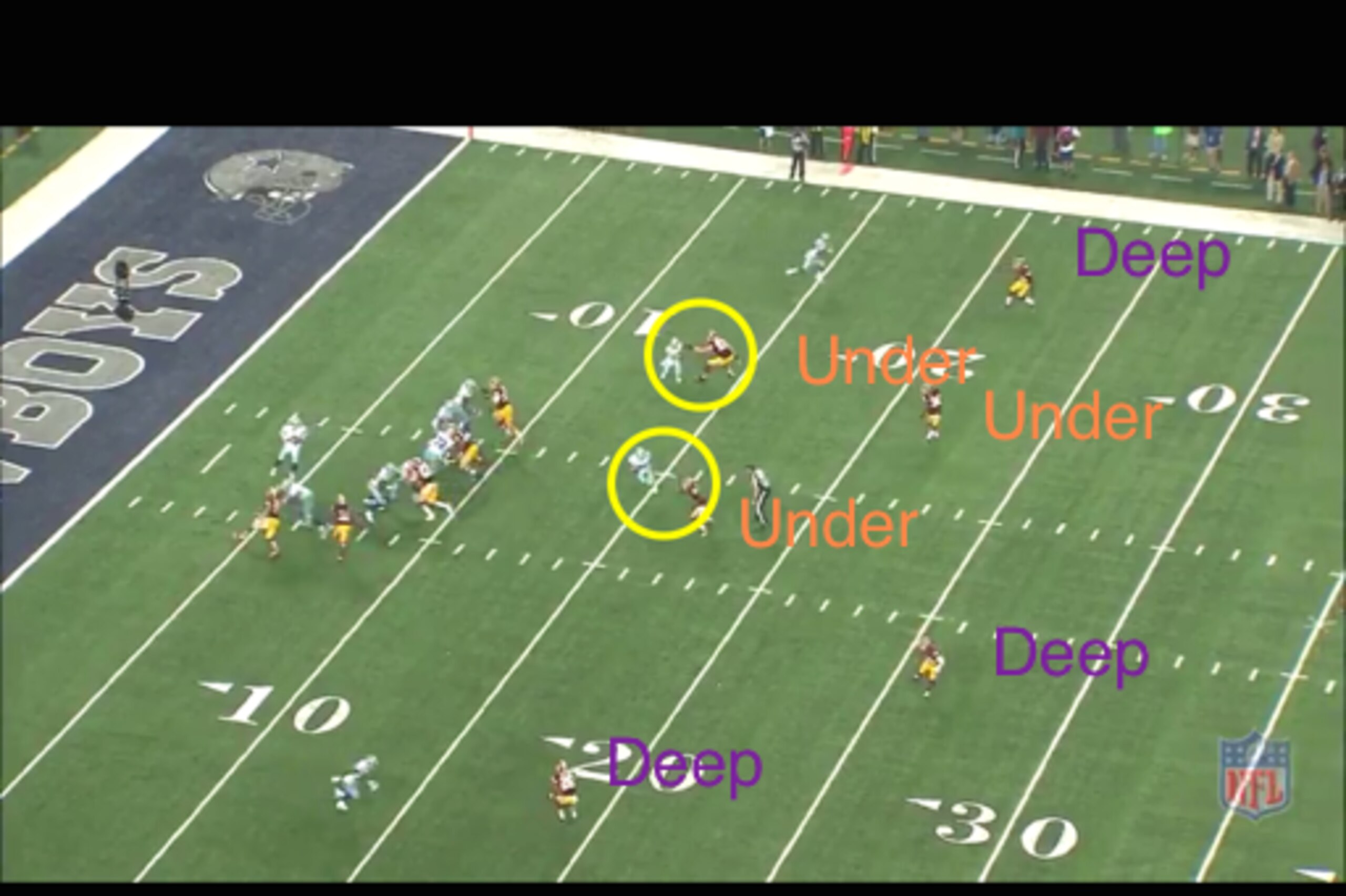
That's exactly what this play was. Haslett dialed up a mischievous zone blitz where he initially showed six potential rushers but sent only five. Apparent blitzers and covering defenders exchanged responsibilities.
A fire zone is a pressure designed to look like a blitz that actually relies on a safer approach. That made it a sudden change of pace after the all-out pressures earlier in the game. The schematic shift caught the Cowboys cold.
The purpose of mixing up looks and pressures isn't solely limited to creating confusion and big plays. Deception and aggression can also serve to restrict an opponent's key players.
That was most obvious on the game's final play. With the Cowboys facing 4th-and-3, Haslett showed what looked like a seven-man pressure:

Having spent many of the previous plays trying unsuccessfully to flee from Washington rushers, Romo was immediately rattled by the blitz look. He began trying to identify the pressure:

Romo then set about reassigning his blockers to adjust protection:

Seeing seven potential blitzers against only five blockers, Romo moved tight end Jason Witten from the slot and into the backfield. He was tasked with picking up edge pressure if Meriweather rushed again:
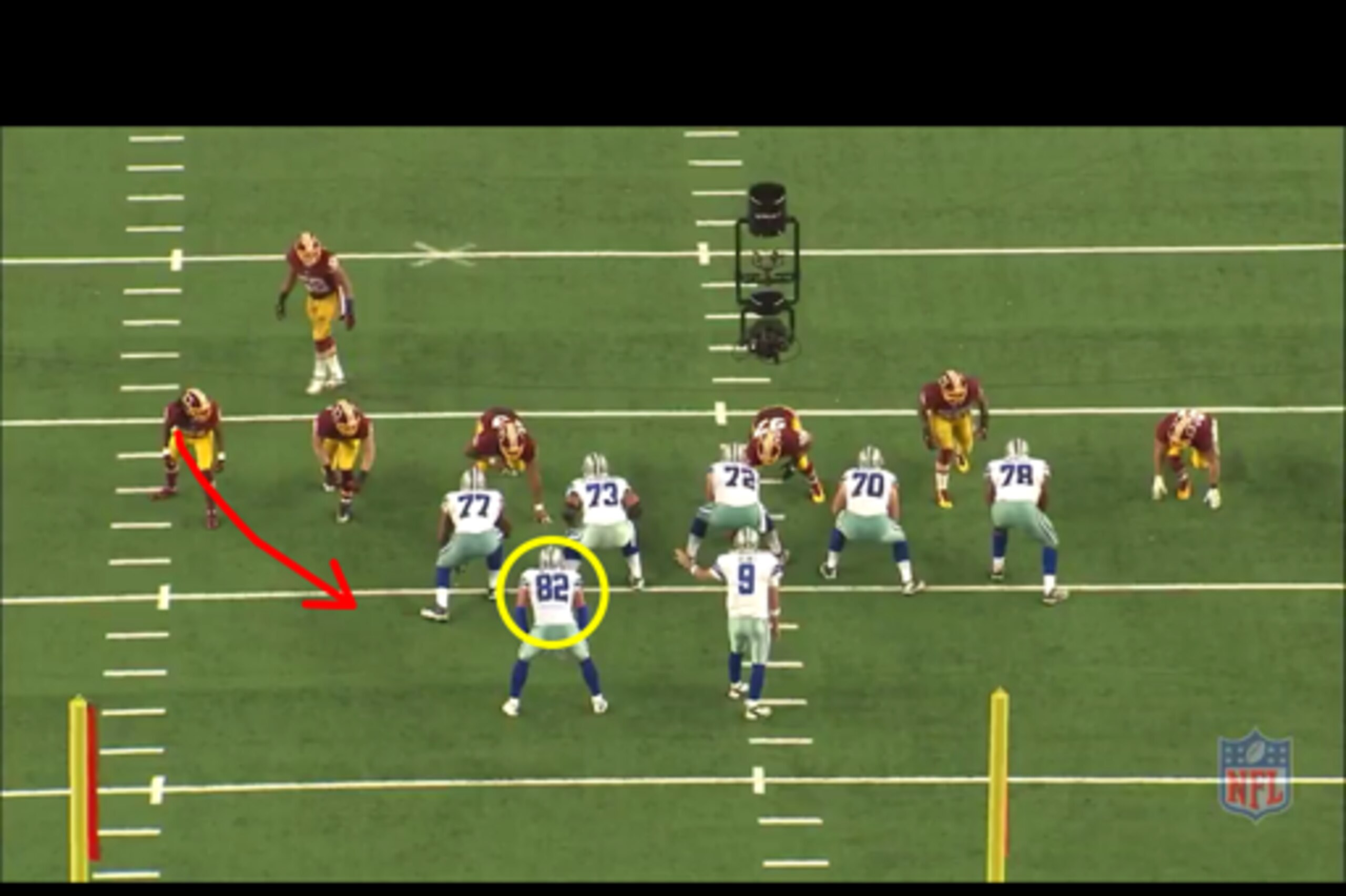
On a clutch down, the Redskins took Witten, Romo's favourite receiver and one of the most dependable and sure-handed pass-catchers in league history, out of the play before the ball had even been snapped.
That's how a coordinator truly earns his crust.
Meriweather did indeed blitz, not only giving Washington five rushers but also ensuring Witten would be restricted to the backfield:
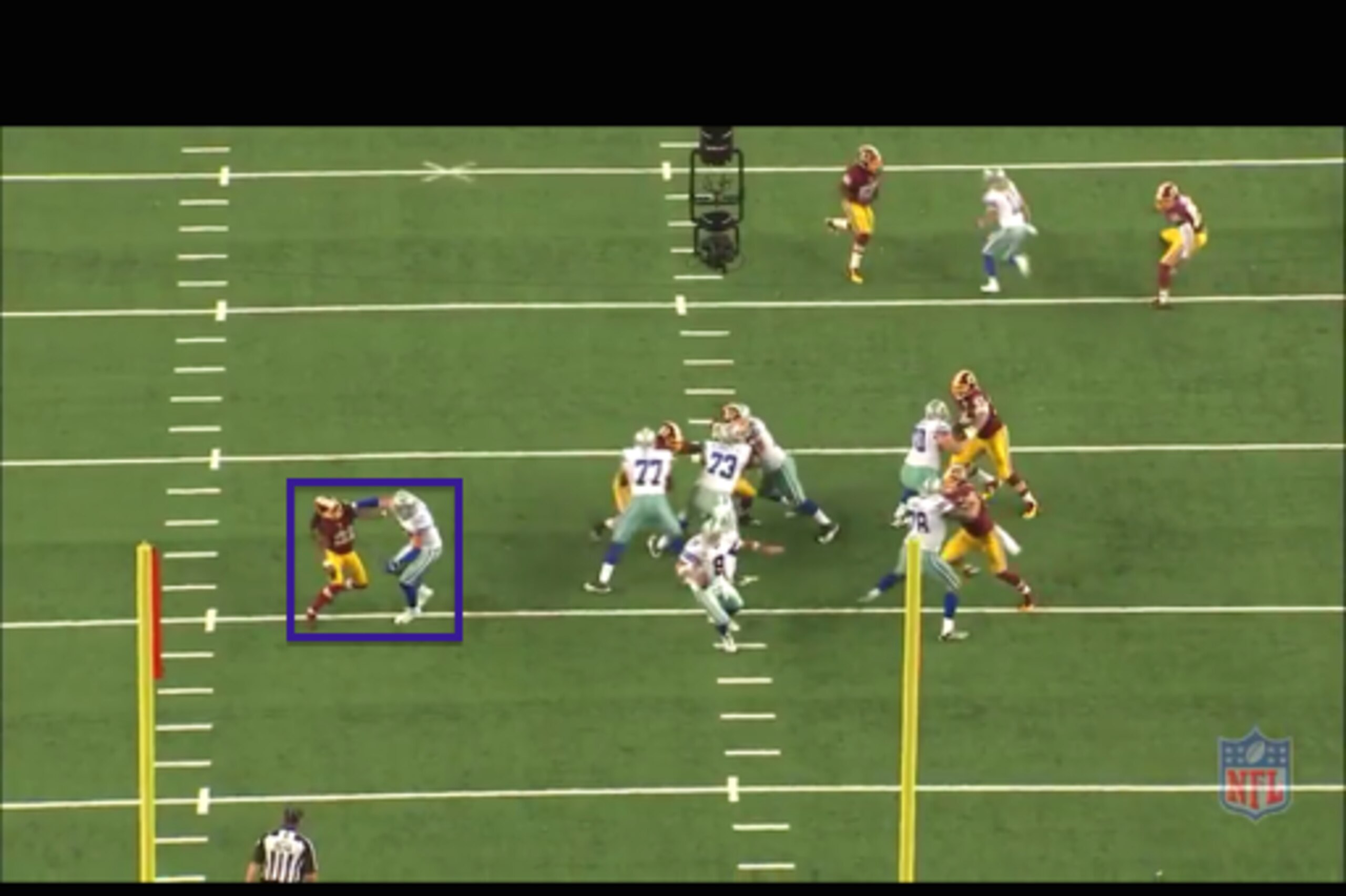
But as Meriweather blitzed, Haslett completed his bluff by having Riley, Robinson and Clark bail into underneath coverage:
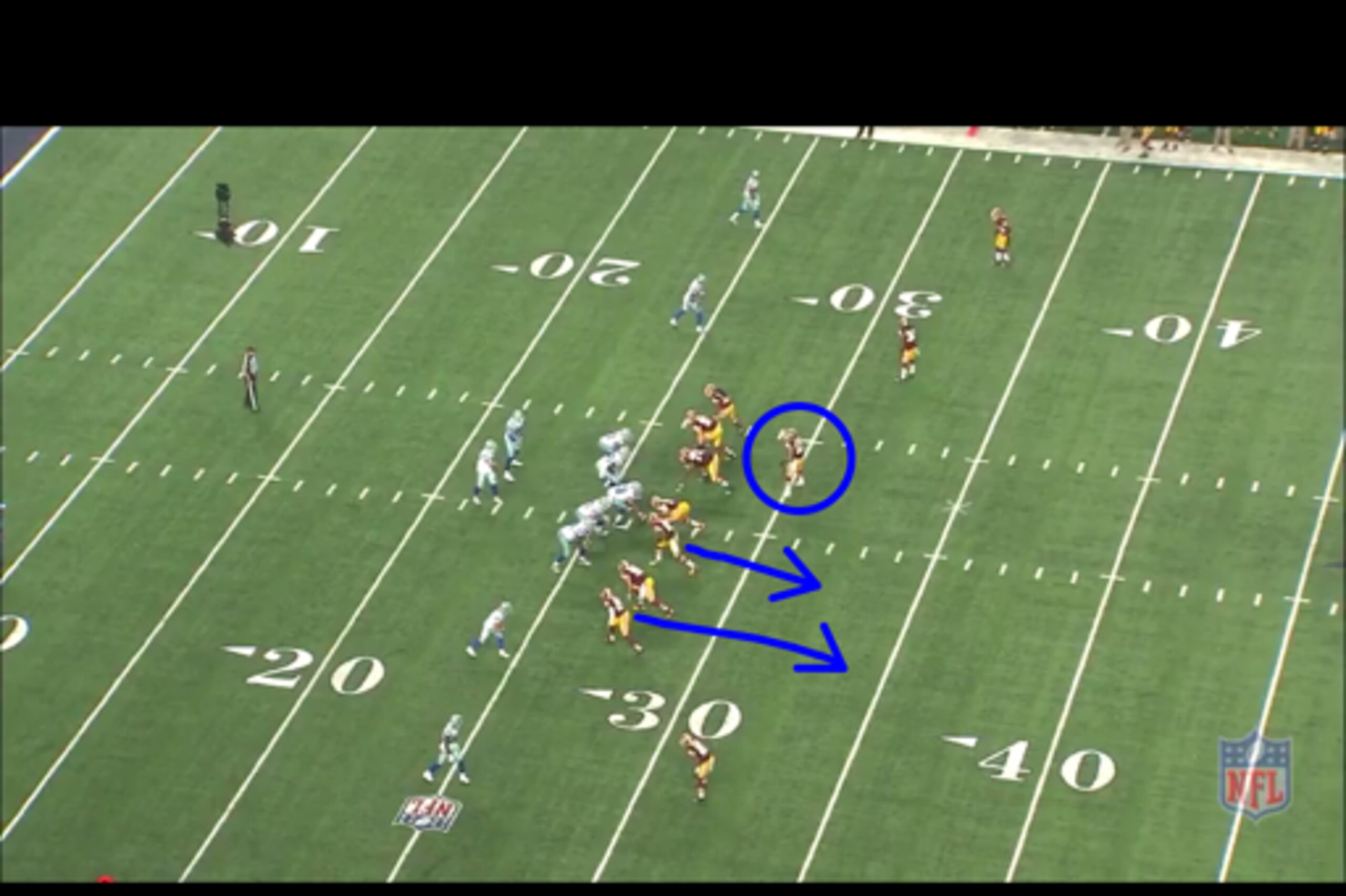
That left the Redskins with six covering defenders against just four receivers:

Under no small amount of pressure, Romo tried to force an outside throw to Dez Bryant which was promptly rejected by impressive rookie cornerback Bashaud Breeland.
After spending most of the game outnumbering Dallas on the blitz, Haslett brilliantly flipped the script to win the numbers battle in coverage on the game's decisive play.
The Washington defense is becoming increasingly efficient on the blitz. Haslett's scheme features variety, along with ample amounts of aggression and deception.
The Redskins have spent most of this season searching for a winning formula on defense. Judging by their success with the blitz, they've found one.
All screen shots courtesy of ESPN and NFL.com Game Pass.
.jpg?w=2560 "Colts Football")