Why the San Francisco 49ers Need to Give Stevie Johnson a Larger Role
Sharing offensive touches evenly doesn’t happen in any football game. It can’t because success isn’t a democracy.
Many factors dictate who is and isn’t featured prominently. That starts simply with talent and then trickles down to the game plan against each opponent.
For the San Francisco 49ers one of their wide receiver jigsaw pieces has largely been an afterthought despite consistent production in sporadic use. His name is Stevie Johnson, and he needs to have a football in his hands much more often.

Johnson has caught 25 passes for 315 yards over his first seven games with the Niners. The math on that is 45 receiving yards per game, which feels about right for exactly what Johnson is right now: the third wide receiver on the depth chart.
But immediately after breaking through those surface numbers you’re greeted by a blinding light. Sort of like the Bat Signal, just with Johnson’s face.
Let’s start with this statement of efficiency from Pro Football Focus (subscription required).
"AJ Green leads all qualifying WRs with 3.53 yards per route run this year. 2nd? Stevie Johnson at 3.18.
— Pro Football Focus (@PFF) October 23, 2014"
Yards per route run is one of the best metrics to gauge how often a receiver is getting open and what he’s doing with his playing time regardless how much or little he’s called upon. As a statistic its question is direct: When you’re on the field as a receiver and a pass play is called, how much are you contributing? Exactly how efficient are you with whatever time you’re given?
For Johnson the answer is more efficient than Demaryius Thomas (3.17 yards per route run), Antonio Brown (2.67), Dez Bryant (2.44) and anyone not named A.J. Green.
About that usage, then, or the lack of usage and general route running for Johnson. His cumulative numbers aren’t nearly on the same level as those mega-stud receivers because he spends much of each 49ers game watching comfortably from the sideline.
But that hasn’t seemed to matter much at all. Look again at Johnson’s receptions and yardage while this time comparing his snap count to the other three receivers on the 49ers’ depth chart. You see a talented wideout who’s vastly underused and doing a whole lot with very little.
| Anquan Boldin | 436 | 87.9 | 39 | 447 |
| Michael Crabtree | 361 | 72.9 | 32 | 322 |
| Brandon Lloyd | 190 | 44.8 | 10 | 252 |
| Stevie Johnson | 153 | 30.8 | 25 | 315 |
Fellow wide receiver Michael Crabtree has been on the field for 208 more snaps than Johnson. The 49ers are currently averaging 70.8 offensive plays per game, making Crabtree’s advantage in snaps nearly the equivalent of three games. Yet he’s still a mere seven receiving yards ahead of Johnson.
Considering the also large gap in snaps between Boldin and Johnson (283), the difference in receptions with those two is negligible as well.
This isn’t intended to be a judgement on the play of Crabtree and Boldin, who have both remained key pieces of the 49ers’ passing offense. But when seeing how much Johnson has done with his comparatively little use, a question is reactionary: Why isn’t he used more?
That question gets louder when we look at how comfortable quarterback Colin Kaepernick has become with his newest target. When throwing to Johnson he has a passer rating of 127.8, according to Pro Football Focus. That falls to a still fine though significantly lower 100.7 when looking to Boldin and 99.8 on Crabtree’s targets.
Take your pick then of which Johnson achievement so far this season is the most impressive and which makes him worthy of a larger role. I’m leaning toward this one…
| Anquan Boldin | 55 | 146 |
| Stevie Johnson | 32 | 140 |
| Michael Crabtree | 51 | 115 |
| Brandon Lloyd | 22 | 63 |
Because of where his name is on the depth chart Johnson’s usage is influenced by the game plan more than any other receiver, as he primarily appears in formations featuring at least three wideouts. Those formations have accounted for 51 percent of San Francisco’s offensive plays so far, according to Eric Branch of the San Francisco Chronicle.
With that in mind, for usage purposes it’s more appropriate to look at Brandon Lloyd’s snap percentage and how much of it Johnson can (and should) gobble up.
Boldin and Crabtree each have roles, with the former a tight end in a wide receiver’s body and the latter a short-yardage grappler. But Lloyd’s contribution is more rigidly defined. He's a vertical deep-ball blazer who has three 30-plus-yard catches this season (including an 80-yard touchdown) on only 10 total receptions.
Lloyd is explosive and therefore valuable in a running offense that needs as many chunk passing plays as possible. But Johnson is far more versatile, with less though still sufficient speed and the slipperiness to evade defenders.
That’s reflected in his 140 yards after the catch, his four forced missed tackles, per PFF, and his team-leading six receptions for 20-plus yards.
Yet Lloyd has still been on the field 14 percent more than Johnson. That’s certainly not a massive gap. But it’s also not nothing, and it should grow narrow quickly in the second half of the season.
Part of the reason for Johnson’s lagging usage early is the time required for Kaepernick to understand what exactly he’s doing and when he’s going to do it.
Throughout the preseason the two struggled to find that deeper understanding, with the word “unorthodox” repeatedly used to describe how Johnson finds open space. He was indeed getting open, which is useless when the guy throwing the ball isn’t seeing the same openings as the guy who so desperately wants to catch it.
That’s pretty much exactly what Kaepernick told Matt Barrows of The Sacramento Bee back in late August with training camp coming to a close, when there was legitimate speculation about the safety of Johnson’s roster spot.
"There are times that he's going to make a move on a DB, and you have to be ready because he's also making a move that you have to see. So I think that's something where it took a little bit longer just to get used to his body language because he has some unorthodox things that he does. But ultimately his separation is there, he's getting open.
"
The label of being unorthodox has followed Johnson throughout his NFL career. It’s not an insult or a negative characteristic. It’s Johnson doing what’s necessary to be successful.
At best his top-end speed fits under another label: good. He’s not a burner, and at 207 pounds he won’t overwhelm defensive backs physically. So instead he leans on quickness and creative footwork to find space and confuse cornerbacks.
Johnson spent his first six NFL seasons with the Buffalo Bills, finishing with over 1,000 receiving yards in three of them and 10 touchdowns in 2010. His unorthodox ways were noted often then too, and a few years ago Brian Galliford of Buffalo Rumblings made an appropriate cross-sport comparison.
Stevie Johnson is the knuckleball pitcher of wide receivers.
“Knuckleball pitchers throw knuckleballs not just because they're good at it, but because they may not be able to throw more traditional pitches at the same level as other pitchers,” Galliford wrote in 2012. “It's the same with Johnson: he's not a fast accelerator nor a top-end speed guy, so he makes do with quickness and creativity as he's trying to get open.”
You can see that in his jukes and choppy steps while releasing off the line of scrimmage or in the middle of a route. His moves and gyrations look awkward at first, but they all serve a purpose. Johnson is trying to gain a certain angle and get the defensive back turned in a specific direction for the route he wants to run.
In real time the trickery can be subtle, just as it was early in the second quarter of a Week 7 loss to the Denver Broncos. But after slowing things down it’s easy to see how Johnson broke away on a slant for 31 yards and why safety T.J. Ward was baffled.
The 49ers were backed up deep in their own territory after a sack. From their own 5-yard line they lined up with five receivers, and Johnson was one of two split to Kaepernick’s left. He was preparing to run a quick slant, the ideal option to gain some yards back and at worst offer the punter valuable space.
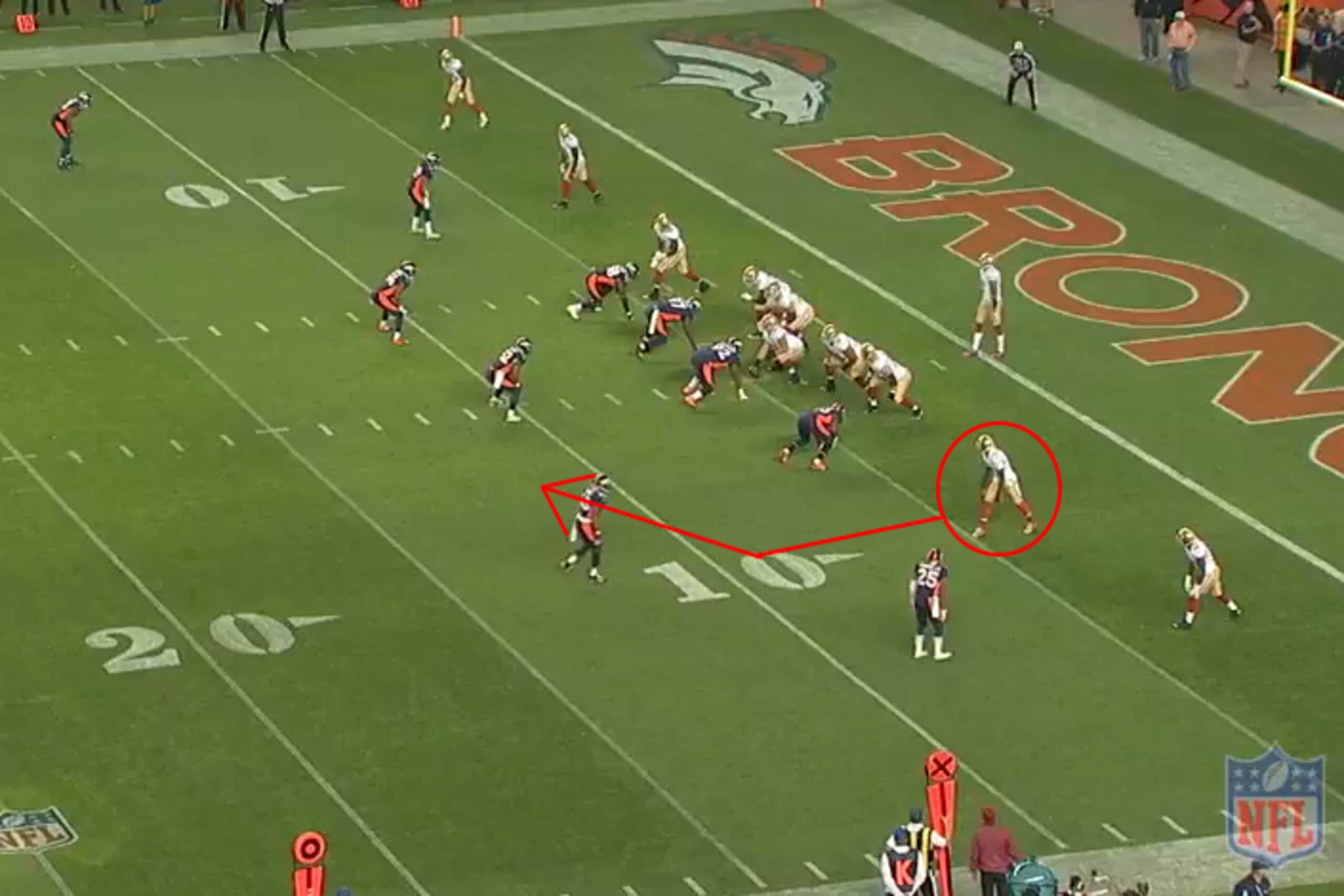
At the snap Ward gave a five-yard cushion, which should have offered him enough time to react and break on any route.
When drawn as it is above the route isn’t complicated. It’s a slant that breaks inside about four yards off the line of scrimmage. But everything is complicated with Johnson because complicated means receptions.
Johnson took two strides off the line. With his right foot planted on the second one he gave Ward a slight stutter step and shoulder fake. He’s breaking the route off quickly, but to where?

Johnson already had Ward's leaning and thinking the answer to that question is left toward the sideline. Now he had to sell that direction even more.
So he planted hard with his left foot, shifting his entire body weight.
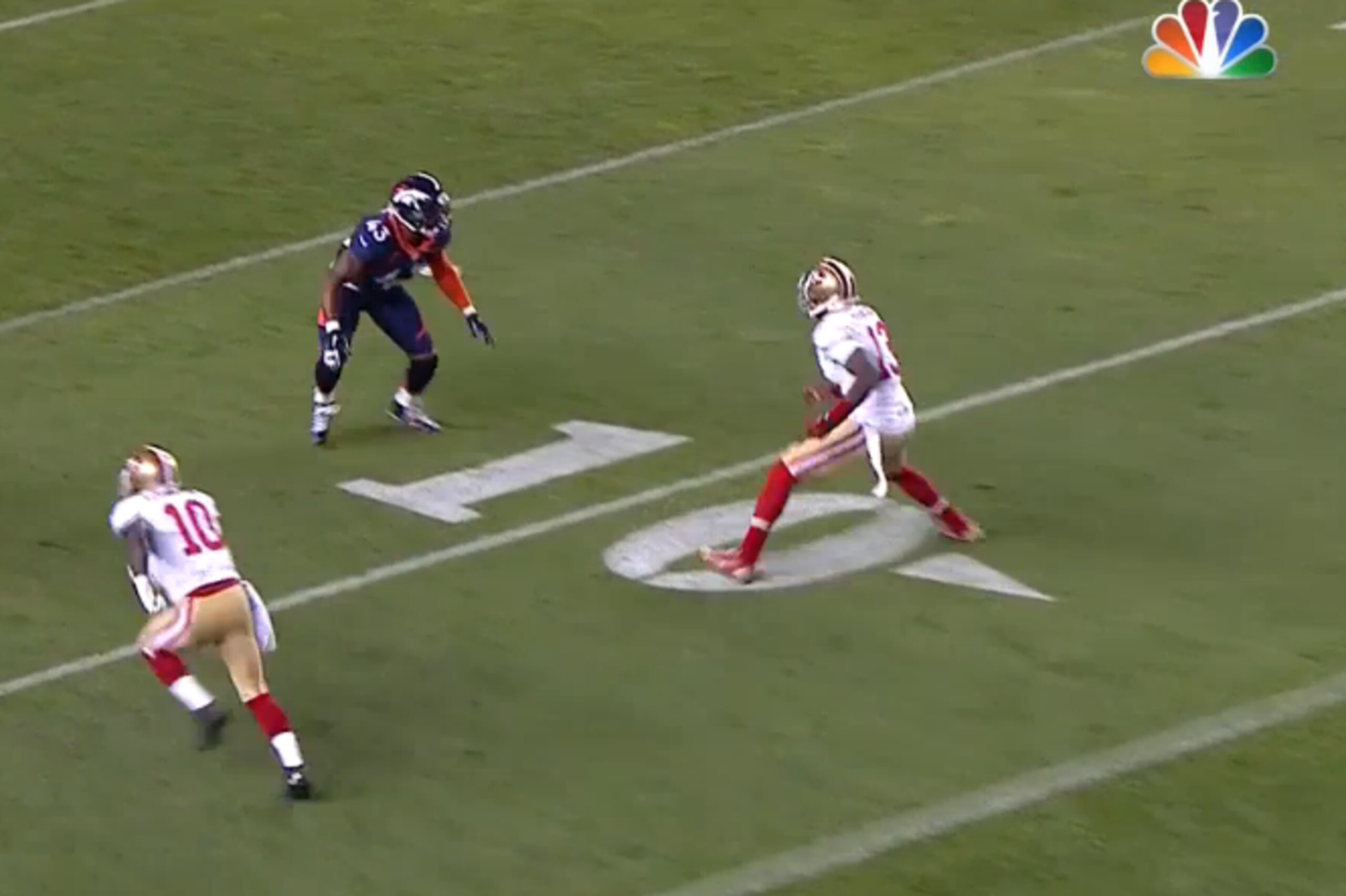
Now Ward was doing more than leaning. He had bitten hard on the false step, leaving a lot of green grass to the receiver's right.
Johnson had found the open space he wanted all along.

To review, that was a stutter step, a shoulder fake and a false step to create misdirection, and while doing all of that Johnson covered about three yards. On the same route we may see one of those moves from most wide receivers. Not all three.
At first Johnson’s approach led to confusion from Kaepernick. Now it’s confusing defensive backs, as the two have hooked up for three touchdowns over the past four games and 132 yards on 10 receptions over the past two.
The growth of Johnson's role needs to continue. It doesn’t need to spike sharply, and he doesn’t need to be the offensive focus. But a creative receiver should be given more opportunities to, well, create.
And through that he can manufacture yards, catches and eventually points.
.jpg?w=2560 "Colts Vikings Football")