Will Marcus Mariota and the Ducks Offense Avoid Another Stanford Shutdown?
SANTA CLARA, Calif. — Four hours is how long it took for the Oregon Ducks to make their latest bid for one of the four spots in the College Football Playoff.
The Ducks (7-1, 4-1) took care of Cal (4-4, 2-4) by the score of 59-41; however, there’s no time to enjoy this one as the Ducks must now turn their attention to their Achilles’ heel: Stanford.
With only four days until the College Football Playoff committee releases its first rankings, the Ducks knew they had to make a statement on Friday night under the lights at Levi’s Stadium. The Ducks certainly made a statement offensively, but questions remain about a Ducks’ defense that was suspect against Cal after consecutive impressive performances against UCLA and Washington.

.jpg?w=2560)
The good news for the Ducks is that this performance against Cal, which was at times impressive and at other times sleepy, won’t hurt them at all in the eyes of the committee.
What the Ducks really need to do to ensure themselves of a spot in the playoff is win out. That begins with taking down Stanford on Nov. 1. The Ducks should be treating that game as if it is their national championship.
The past two seasons the Ducks have come into the Stanford game riding high with an undefeated record. Both times they’ve walked away battered, bruised and without a shot at a title.
So will this year be any different? Can Marcus Mariota and the Ducks avoid another devastating loss to the Cardinal?
The answer is yes. However, they’re going to have to play a much better game on both sides of the ball than they did against the Cal Bears.
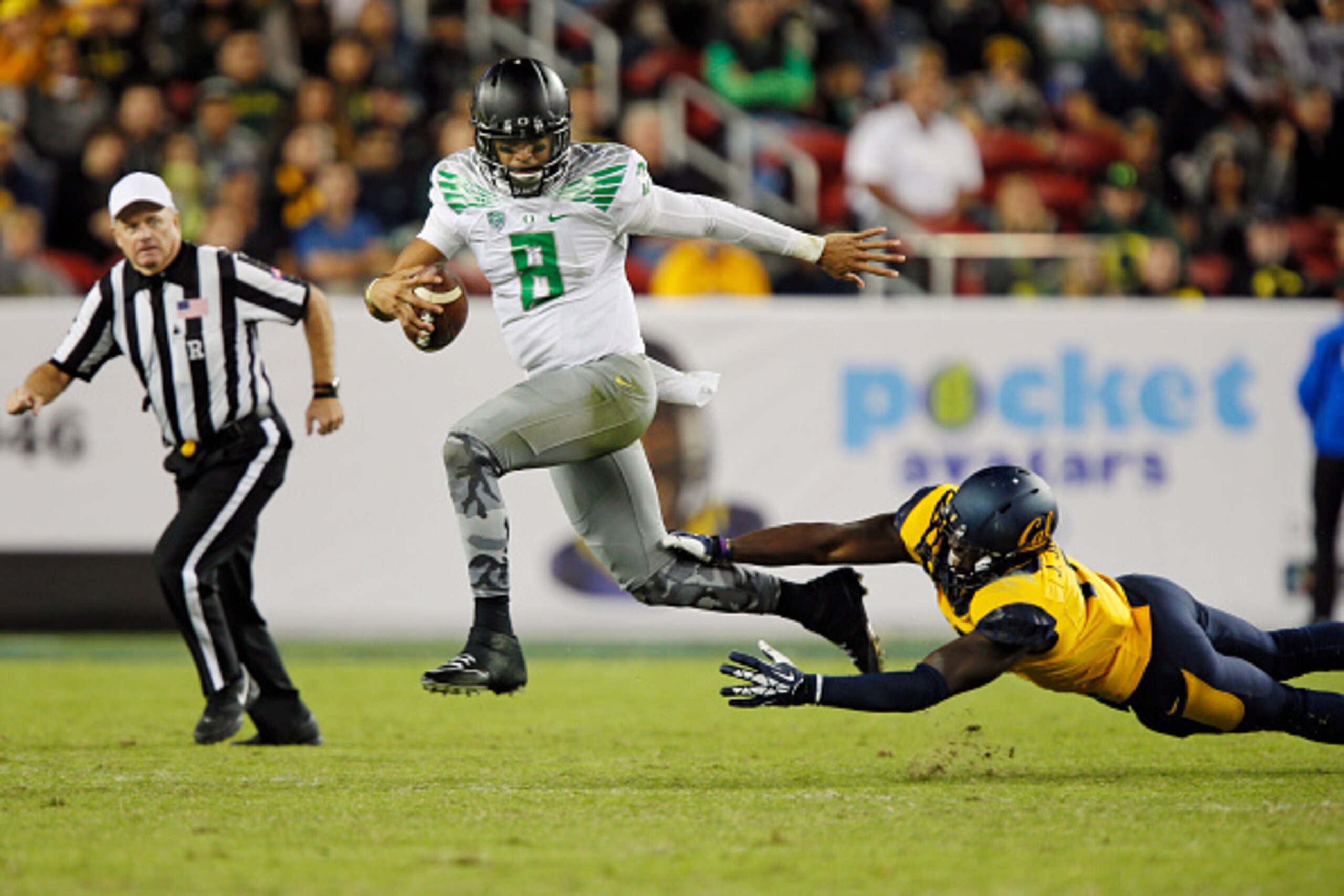
Can Mariota finally beat Stanford’s D?
There’s no doubt that Oregon’s offense is clicking at the right time of the season. Their offensive line is healthy, their playmakers are making plays and Marcus Mariota looks as dangerous as ever. In their last three games—against UCLA, Washington and Cal—the Ducks have averaged 48.7 points. In their first two conference games, with a deteriorated offensive line, the Ducks averaged only 31 points per game. The “blur” offense is back.
Despite the fact that Mariota threw his first interception of the season—in the red zone, no less—he had another incredible day and repeatedly destroyed Cal’s weak pass defense. On the night, Mariota was 18-of-30 for 326 yards and five touchdowns. The Ducks’ quarterback also added six carries for 36 yards.
Oregon head coach Mark Helfrich said Mariota made some mistakes tonight and quipped that Mariota still has another year at Oregon. “He had a couple of mistakes, which is almost funny because you expect him to be perfect. Marcus is such a stud and it’s great that he has another year-and-a-half left.”
While Oregon running back Thomas Tyner didn’t make the trip, the Ducks’ running game worked just fine against a suspect Cal defense. True freshman running back Royce Freeman had 112 rushing yards and two touchdowns on 22 attempts—his third consecutive 100-yard rushing performance. Byron Marshall, who led the Ducks with 1,038 yards last season, had four receptions for 133 yards—including a touchdown—and also ran the ball seven times for 57 yards. In total, Oregon rushed the ball 39 times for 234 yards.
Oregon also finally got a boost from its special teams—something the Ducks have been looking for all season. With the Ducks up 10 in the second quarter the Oregon defense forced a punt (success!) and freshman sensation Charles Nelson did his best De’Anthony Thomas impression. Nelson weaved his way 58-yards for a touchdown and gave the Ducks a 17-point lead. It proved to be a pivotal moment.
We’ve come to expect this sort of performance from the Ducks. They scored quickly and in a variety of ways. However, what we haven’t expected are the offensive flameouts that have occurred over the past two seasons against Stanford.
Oregon has failed to score more than 20 points in either game against Stanford over the past two seasons and has not been able to produce more than 405 yards of offense. Quite simply, Stanford’s defense has dominated Oregon’s offense.
Oregon has shot itself in the foot each of the past two years against Stanford.
The question remains: Can Marcus Mariota and the Ducks survive Stanford by outplaying and outwitting them on the offensive side of the ball?
Mariota and company have the requisite skills and schemes to break a Stanford defense that is ranked No. 2 in the nation. Heck, the Ducks put up 46 points against Michigan State in Eugene and the Spartans are ranked No. 9 in the nation in total defense.
It’s a familiar term in Eugene: “Just Do It.”
It’s time for the Ducks to show up against the Stanford D and prove they are the offensive juggernaut we all think they are.
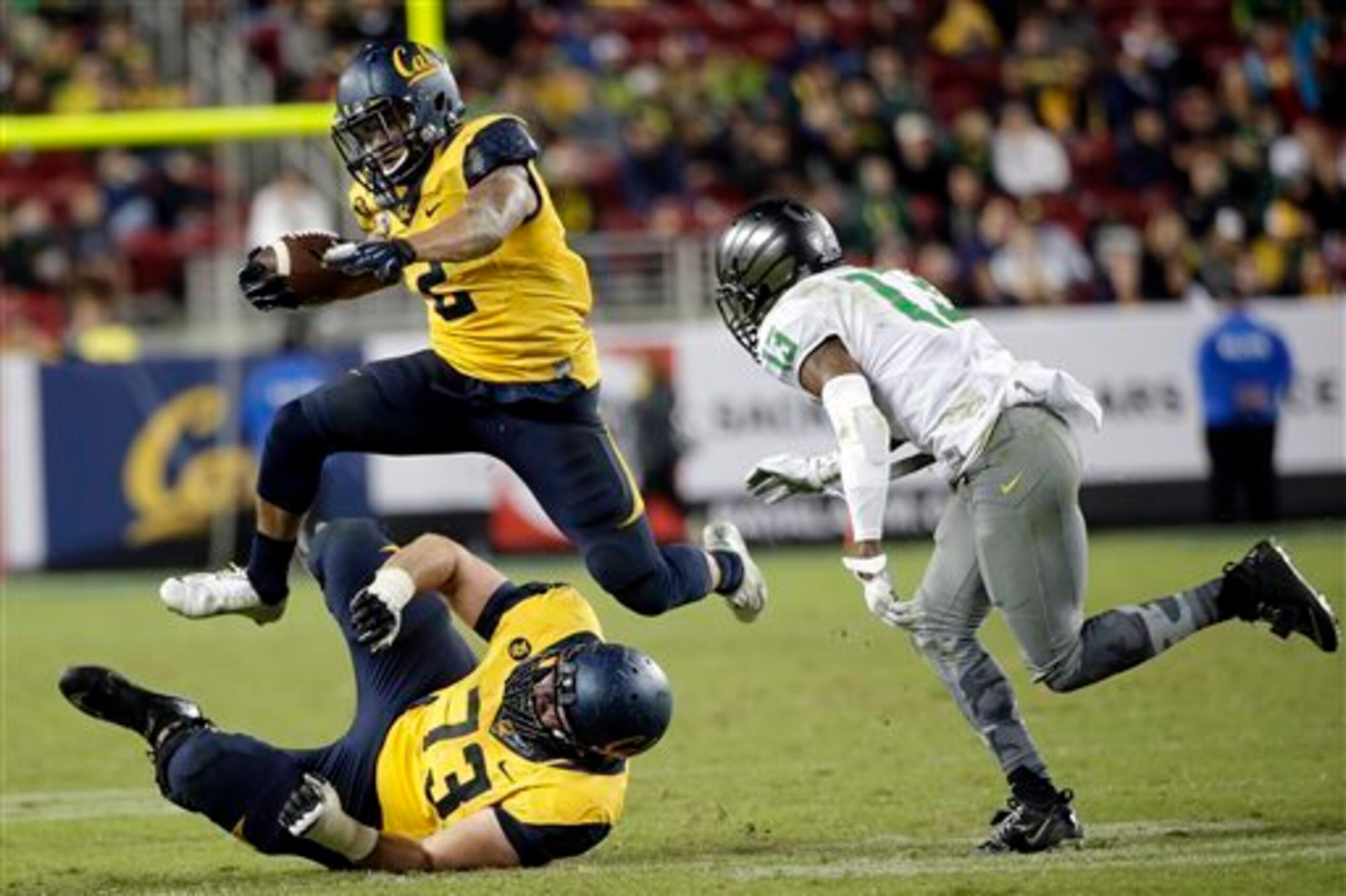
Where’s the Defense?
While Oregon’s offense needs to stay focused, it’s Oregon’s defense that may end up costing the Ducks a shot at a national title in 2014.
The Ducks defense clearly doesn’t understand the idea of “bend but don’t break.” Oregon’s defense didn’t necessarily contribute to the victory as much as they were just broken less often than the Bears.
Against Cal the Ducks allowed 560 yards of offense and 41 points. They were once again sliced up against the pass—allowing Cal quarterback Jared Goff to throw for 360 yards and two touchdowns. The Ducks run defense wasn’t much better. The Bears gained 193 yards on 38 carries—an average of 5.1 yards per carry—and scored four touchdowns on the ground.
Oregon’s defense clearly struggled for parts of the game, however, Helfrich indicated that he thought his defense was really solid at times. “Good in spurts. Really good at times” said Helfrich of his defense. “Our whole thing going into this game was that they were going to make some yards. They made some spectacular plays throwing it.”
While the Bears offense isn’t easy to prepare for, especially on a short week, the Ducks defense had been performing better as of late. After allowing 31 points per game in their first two conference games against Arizona and Washington State, the Ducks defense had only allowed 25 points per game against UCLA and Washington and about half of those points came after the game was well in hand.
We knew Cal was going to throw the ball against Oregon. That’s not a concern as the Ducks turn their attention to Stanford. In their past two meetings, the Cardinal have averaged 157 yards passing. This season, Stanford is ranked No. 63 in the country in passing offense. Stanford has only gained 235 yards per game through the air.
However, Oregon’s rushing defense should be a concern. Stanford has dominated Oregon on the ground over the past two years. In fact, Stanford has gained 474 rushing yards against the Ducks in their past two games. Conversely, the Ducks have only gained 274.
While Stanford is currently ranked No. 92 in rushing offense, they are gaining 4.29 yards per carry. Meanwhile, Oregon was ranked No. 75 in the country in rushing defense heading into the Cal game and allowed 193 yards. That ranking is heading in the wrong direction.
The Ducks need to shut down Stanford’s running game first and foremost. If they can do that and force Kevin Hogan to beat them with the pass, they should be able to come away with their biggest victory of the season.
Oregon has eight days to prepare for Stanford. The Cardinal have struggled mightily on offense this season but have dominated the Ducks on both sides of the ball over the past two seasons.
Something’s got to give if the Ducks are to finally slay the dragon. Will it be Mariota finally getting over the Stanford hump and making a case for the Heisman? Could it be Royce Freeman’s ferocious running that gets the job done? Maybe Stanford just isn’t the same team it was over the past two seasons?
When it comes to Stanford all the records go out the window. The only thing the Ducks should be thinking about is “0-2.”
It’s time for the Ducks to put up or shut up.
Statistics courtesy of NCAA.com unless otherwise stated. All quotes were acquired firsthand unless otherwise stated.
Jason Gold is Bleacher Report’s lead Oregon writer. Follow Jason on Twitter @TheSportsGuy33.

.jpg?w=2560 "NFL House in Paris Closes for Protests")

.jpg?w=2560 "Trevon Diggs Cut by Seahawks")