Auburn Football: Early-Drive Improvements Crucial for the Tigers' Future Success
AUBURN, Ala. — For all of the complexities to Gus Malzahn's hurry-up, no-huddle offense, it can sometimes be simple.
So when fans and analysts point to Auburn's drop in offensive production from 2013 to 2014, the architect of the attack points to just one area of flawed execution.
"When we get our tempo going at the rhythm, we really feel good about playing fast," Malzahn said during the Tigers' bye week. "But a lot of our problems have been getting started and not getting the initial first down."

.jpg?w=2560)
Malzahn's offensive game plan is built around stringing together first downs, forcing the defense to play catch-up and putting points on the scoreboard as quickly as possible.
But the Tigers have to get the chains moving before they can hit full speed—and that hasn't necessarily been an easy task this season.
Through the first six games of the 2014 season, Auburn has been either held to a three-and-out or has committed a quick turnover on 16 of their drives.
| Arkansas | 3 | 2 | 1 | 0 |
| San Jose State | 1 | 1 | 0 | 0 |
| Kansas State | 1 | 0 | 0 | 1 |
| Louisiana Tech | 4 | 4 | 0 | 0 |
| LSU | 2 | 1 | 1 | 0 |
| Miss. State | 5 | 3 | 1 | 1 |
By comparison, the Tigers offense only had those unwanted quick drives 11 times through the final six games of the 2013 season.
Auburn's inconsistent performance to start offensive drives this season has gone hand-in-hand with the team's general drop in first-down production.
The first-down numbers are down all across the board for the Tigers, who excelled in those areas in Malzahn's more successful years as Auburn's play-caller.
| Rushing Yards per Play | 5.49 (34th) | 6.66 (3rd) |
| Runs of 20+ Yards | 6 (36th) | 23 (1st) |
| Passer Rating | 128.05 (89th) | 157.26 (29th) |
| Completion Percentage | 63.3% (54th) | 67.0% (21st) |
This season's lowered rushing production on first down has been surprising, as Auburn was at or near the top of every national statistic in that area last season.
"A lot of it is execution," Malzahn said. "Some of it could be strategy, some of it could be scheme, but that is a big factor and difference between this year and last year. It really comes down to the execution part. We were very efficient especially in the second half of the year last year, and we’re hoping that the same thing will happen this year."
Malzahn believes the Tigers will receive a boost with junior Pat Miller's return from injury and true freshman Braden Smith's added responsibilities on the offense.
The two will add some much-needed depth to an Auburn offensive line that has already gone through some shuffling with 2013 starting left guard Alex Kozan missing the entire season and Devonte Danzey's emergence in place of Miller.
"If we can get our linemen in the same spot and stay healthy in the second half and really start working together and get some cohesion, there’s no doubt in my mind we’ll be more effective and more efficient in the run game," Malzahn said.
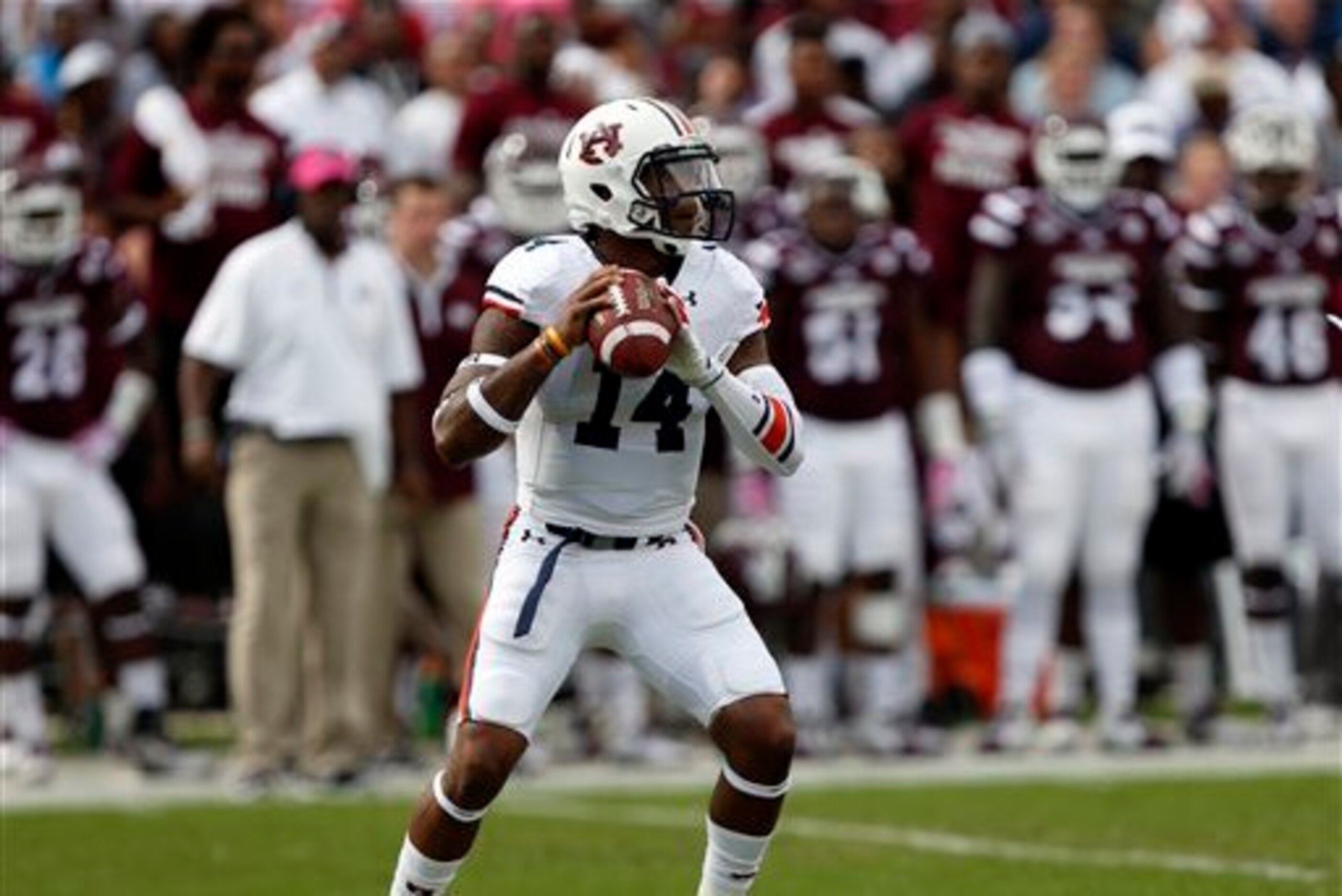
Another area of first-down execution that needs improvement is in Nick Marshall's passing game. All three of Marshall's interceptions this season have come on first down, including two on the first plays of drives.
Batted balls at the line of scrimmage have been an issue for the 6'1" Marshall, and the Tigers staff said it would be addressed during the recent bye week.
"Those are things we've got to do the best we can to avoid, whether it's the way we set protections, whether it's him finding an alley to throw through, whether the protection's good enough that he's not getting hit as he's throwing," Rhett Lashlee said. "The positive is he hasn't thrown it to guys through progressions. It's had to be tipped or it's had to be hit."
Whether it's a running play that isn't going for as many yards as it did last season or a misfired pass that sets the offense back, a bad early down can ruin an entire drive and set it on the path toward a frustrating three-and-out.
Both players and coaches have stressed the need for improvement in all areas on the first set of downs—and every unit can shoulder some of the blame.

"We're not even close [to being great]," senior wide receiver Quan Bray said. "We see the potential that we have. It's the little things. With this offense, it's just the little things that, because it takes all 11 on offense, and if one person doesn't do a job, the play won't work. On defense, somebody can mess up and you don't really see that. But it takes all 11 on offense—all 11 to get on the same page and play for one another."
Auburn's first-team offense went back to work on that execution during the recent bye week and got some extra work against the second-team defense, something that is rare during the middle of a tough SEC slate.
Bray believes those extra practices and days of rest have revitalized the entire offense as it heads into Saturday's matchup against South Carolina.
"In the first half of the season, we didn't do a lot of the little things," Bray said. "That's why we really weren't clicking like we were. But now that we've watched a couple of games and seen what we need to get done, I think we've worked on that in the bye week."
All quotes were obtained firsthand unless otherwise noted. All recruiting rankings and information courtesy of 247Sports. All stats courtesy of cfbstats.com.
Justin Ferguson is Bleacher Report's lead Auburn writer. Follow him on Twitter @JFergusonAU.

.jpg?w=2560 "NFL House in Paris Closes for Protests")

.jpg?w=2560 "Trevon Diggs Cut by Seahawks")