Teddy Bridgewater Showing Rookie Learning Curve in Up-and-Down Week 7 Loss
The roller coaster that has been the beginning to Teddy Bridgewater’s rookie season reached its most dizzying point in the Vikings’ 17-16 loss in Buffalo. It continued to drop at breakneck pace until the second quarter, when it shot straight back up. Let’s break down where the ride stands after three starts.
After a slow first quarter, it seemed the plunge wasn’t done yet.
The drop was made steeper by the injuries to the Minnesota offensive line so early in the game. Starting center John Sullivan (concussion) and starting right guard Vlad Ducasse (knee) both left in the first quarter, per the Fox broadcast. That left Bridgewater and the Vikings offense with a ragtag group up front. The offensive line was already struggling.
TOP NEWS
.jpg?w=2560 "NFL Paris Football")
NFL House in Paris Closes for Protests
.jpg?w=2560 "Seahawks Chiefs Football")
Trevon Diggs Cut by Seahawks
.jpg?w=2560 "Colts Football")
Jonathan Taylor Landing Spots
Before and after the offensive line became further ravaged by injuries, similar issues continued to pop up with the quarterback.
Bridgewater frequently held the ball too long in Week 6. That didn’t change early in this game. Wide receivers were blanketed on vertical routes, but his inability to find the best matchup and rip it is not excused. He waited too long for routes to develop.
The rookie spoke to this issue after the game, via VikingUpdate.com:
"Bridgewater said he was overthinking things early in the game. "I think I went back to my old training camp ways of trying to be perfect."
— VikingUpdate.com (@VikingUpdate) October 19, 2014"
He had the same problem last week. Bridgewater was trying to let routes come open and then throw to receivers within the structure of every play, almost as if aiming for a 100 percent completion rate, sans throwing the ball away. When plays were not giving him defined targets, he would try to extend plays or throw the ball away. That continued early in this game.
Turnovers got the best of Bridgewater again. Two early interceptions came as a result of his playing too slow.
The first was the result of Bridgewater trying to extend a play and keep a drive going. He escaped the pocket on a third-down play in Buffalo territory and tried to find tight end Chase Ford, who broke off his route. The defender ended up deflecting the pass, despite having his back turned, and it fell into the waiting hands of a Bills cornerback.
That interception was the result of Bridgewater trying to make a difficult play on the move, though throwing at a defender whose back is turned is not usually risky. The deflection was unkind to the rookie.
Blame cannot be deflected on the next one.
Again, the throw is just too late. The play design does not want the receiver slowing down at the sideline to make the catch. As soon as Bridgewater gets his man coverage read, his throw to the corner route should be out with better anticipation. This comes down to trusting the receiver instead of wanting to see him win on the route. By waiting, Bridgewater actually brought the defender into the play.
His start to the Buffalo game was a seamless continuation from the Detroit game. Bridgewater exacerbated the offensive line issues by not trusting his receivers to beat man coverage, thus not releasing quickly enough.
Then veteran receiver Greg Jennings got in his ear, and the elderly advice seemed to have an effect. Master Tesfatsion of the Star Tribune has the quote:
"After 2nd INT, Jennings told Bridgewater,"Whatever is going on in that head, that computer, just reboot it." Felt he settled after #Vikings
— Master Tesfatsion (@MasterStrib) October 19, 2014"
On the next offensive drive, the Vikings marched 60 yards for a touchdown and snatched a 10-7 lead. Bridgewater completed three consecutive passes totaling 57 yards, capping the drive with his first career touchdown pass.
For the most part, the rookie blues subsided for the remainder of the game. The most notable improvement came in the way Bridgewater quickened his process and became increasingly willing to throw into coverage, putting his faith into his receivers.
Growth also occurred in Bridgewater’s handling of third-down situations. After the second interception, he converted four of six third downs in which the play call was a pass. He moved the chains on each third down in the fourth quarter, one of which required 18 yards. The other two needed nine and 10, respectively.
On each conversion he was decisive with the ball, getting it out after quickly identifying the soft spot in the coverage. His performance on third downs displayed improved quarterback play and lifted the entire offense.
These pressure-packed conversions kept the Vikings offense on the field and the ball moving. Without a red-zone collapse from the offensive line, Bridgewater would have crafted a game-clinching drive early in the fourth quarter.
The 3rd-and-18 conversion showcased the way he adjusted and stayed aggressive after his early struggles.
Jarius Wright was streaking down the left sideline, well-covered. Instead of pulling the ball down or throwing it away, Bridgewater made a savvy back-shoulder throw 28 yards down the field. The first-quarter and Lions-game versions of Bridgewater do not make that throw.
Overall, that in-game growth provides a ray of light from a game with a dark ending for the Vikings. If those positive developments continue into the next few games, it would give the offense a much-needed spark.
Other aspects of Bridgewater’s performance will still stand out as needing correction. Despite downfield completions to both Wright and Jennings, the deep-ball bug bit again.
On Minnesota’s final offensive possession, one that would stall before the game could be closed out, Bridgewater missed his biggest opportunity. Cordarrelle Patterson had his defender beat on a deep post.
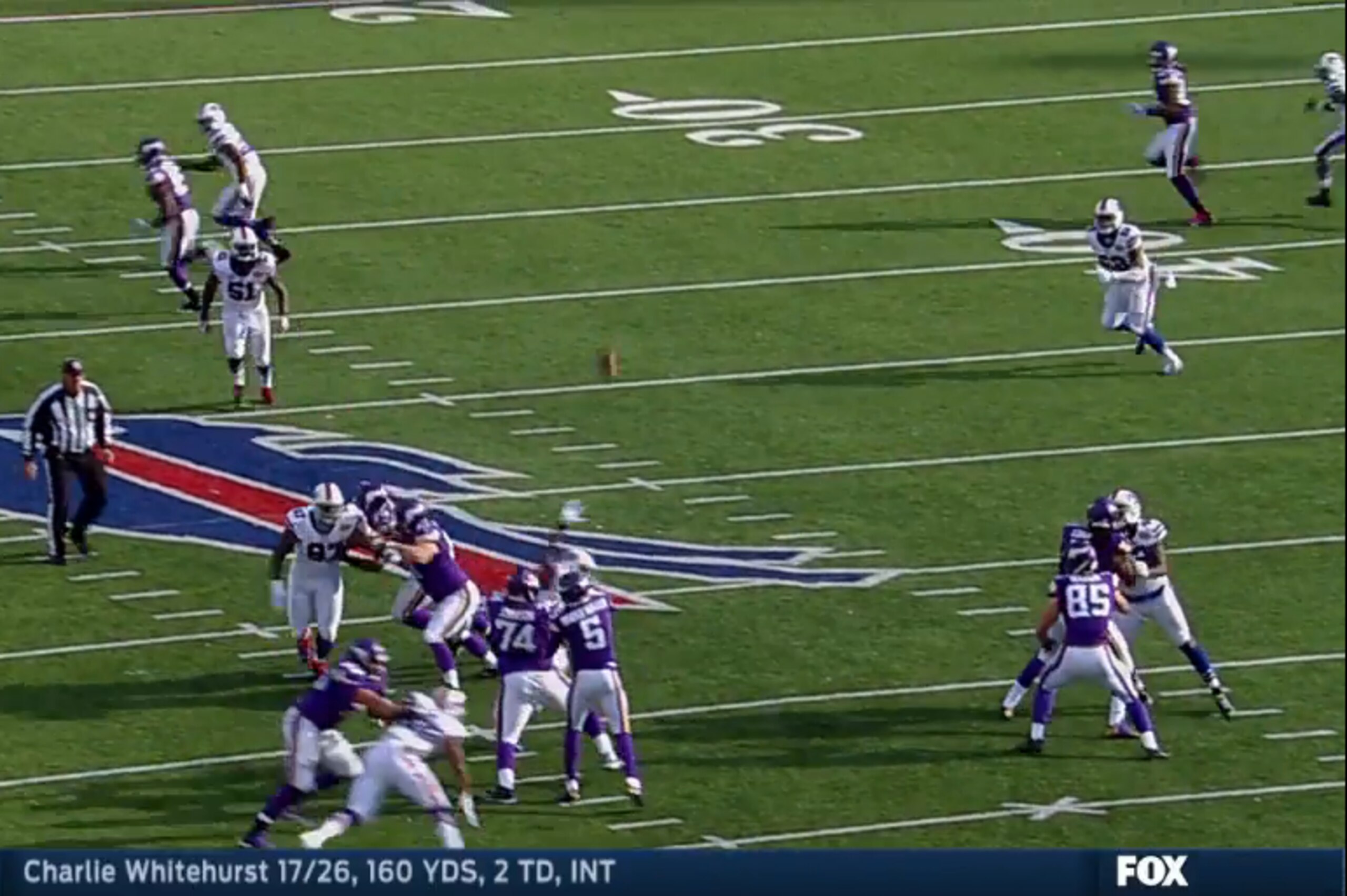
Bridgewater only needed to lay it out in front of his receiver, giving his throw enough loft for Patterson to run under it. He overthrew it, just barely, as has become a theme with his deep passing.
Until the rookie proves he can consistently bring a vertical element to the passing game, defenses will continue to clog short and intermediate passing lanes or challenge with press man coverage. Opportunities like these don’t come about often, so Bridgewater must take advantage. He didn’t do that consistently enough at Louisville and has failed to do it thus far in his rookie season.
These are all a part of the growing pains of a rookie quarterback. The goal is still for quickened decision-making, fewer turnovers, sharpened accuracy and more downfield passing output as the season moves forward.
For Bridgewater and the Vikings, it was an up-and-down day that continued to show how far the rookie quarterback still has to go to become a consistent NFL quarterback and to bring the Vikings offense back to competency.
Statistics via ESPN.com unless otherwise noted.
.jpg?w=2560)