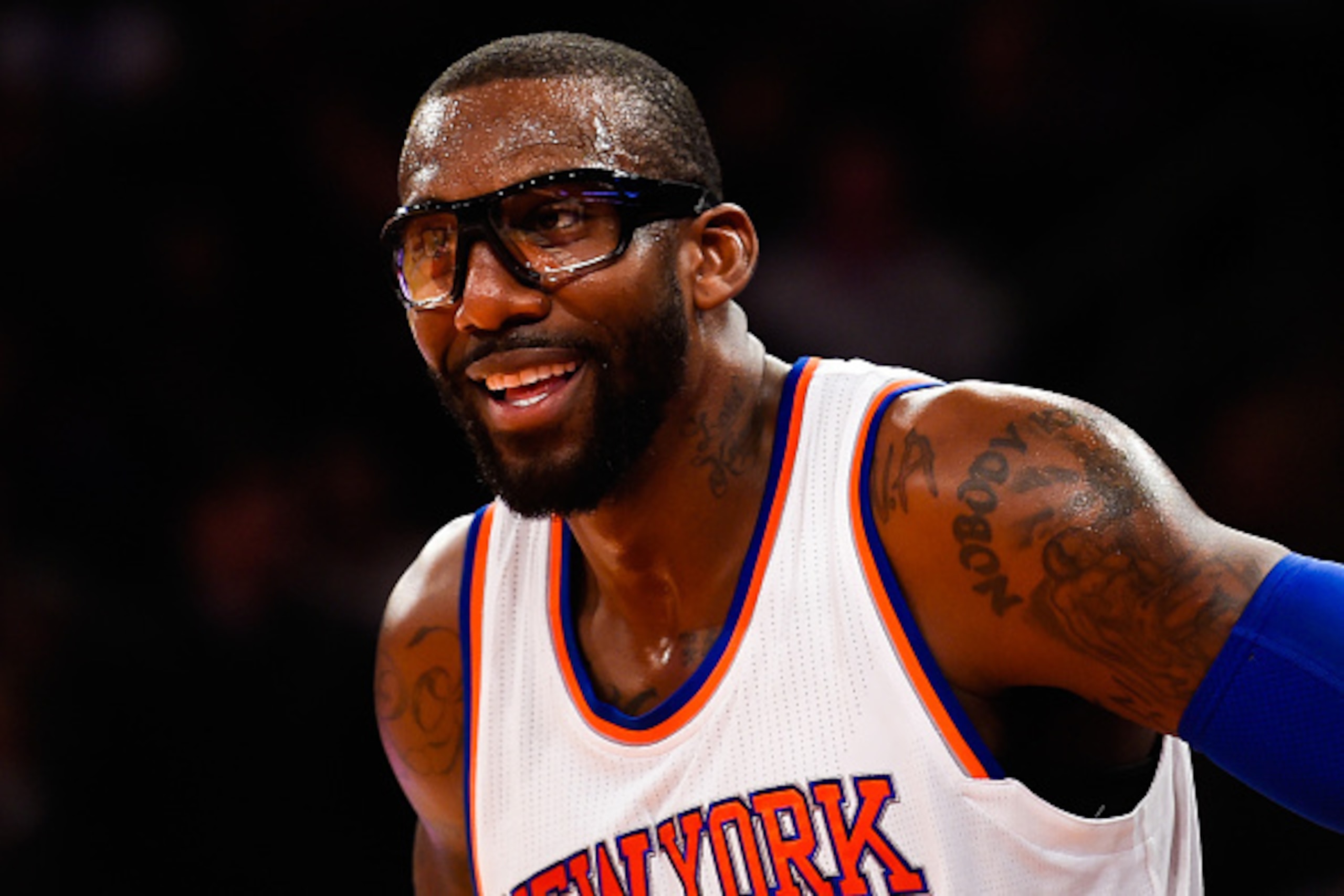
Quincy Acy didn't join the New York Knicks under any ill-considered illusions. He wasn't in town, wearing orange and blue, to compete for a starting job. He was just there as an energetic role player who would scrap and claw for minutes he might not ever see.
Turns out that may have been the illusion.
To the surprise of everyone—including Acy—who doesn't base depth-chart projections off beard length, Acy has emerged as the "leading candidate" to start at power forward for the Knicks, according to the New York Post's Marc Berman.

“No I didn’t plan on coming here to start,’’ Acy said. “I planned on coming here and playing hard to earn minutes. I guess I impressed enough with my defense to earn a spot. I don’t know what coach got going if I’m starting or coming off the bench or not playing, but I’ll be happy.’’
While Acy's busy being happy, the rest of us will sit in limbo somewhere between confused and composed.
Is this for real? Is Acy actually starting? Or are we being punked preseason-style?
Foundation for Truth

This revelation doesn't come completely out of the blue; Acy has started in the Knicks' last three preseason games. It's also not as if the team has a lot of other options.
Andrea Bargnani, who has been nursing a hamstring injury of late, is not the answer to anything. The Knicks would be far better off chaining him to the bench. Amar'e Stoudemire is a former star power forward, but if the Knicks value continuity, starting an injury-prone and minutes-capped player pushing 32 isn't the ideal route.
After Bargnani and Stoudemire, there's—well, there's no one.
Neither Jason Smith nor Cole Aldrich should play power forward, and the Knicks are overrun with wings otherwise. Running smaller lineups will be an option throughout games, but Derek Fisher—and Phil Jackson by extension—appear hellbent on beginning with traditional setups.
Carmelo Anthony has spent the past few months under the guise that he'll primarily play the 3 after two years of small ball, per ESPN New York's Ohm Youngmisuk.
Indirectly naming Acy the starting power forward could be a way of trying to light a fire under Bargnani and Stoudemire, but it seems unlikely. There's little reason to motivate Bargnani when he hasn't even been playing, while the only things Stoudemire has going for him this side of 2010-11 are his work ethic and self-confidence. Plus, he hasn't been given the chance to start yet.
Starting Acy has perhaps always been a more realistic option than most acknowledge given the dearth of alternatives. His endless supply of energy, meanwhile, has taken care of the rest.
There isn't a play Acy takes off. He's been one of the Knicks' most active players during the preseason, running end to end, cleaning up the glass (five rebounds in 25.8 minutes per game), making his presence felt through effort and will.
And to that end, entertaining this idea is a nod to Acy's diligence, like NBC Sports' Kurt Helin argued:
"That has been the key — this feels a lot like how Kenneth Faried ended up a starter and key piece for Team USA at the World Cup. Injuries and defections opened the door for Faried, but his energy and rebounding turned out to be just what that team needed for glue and some inspiration.
Acy is bringing that to the Knicks this preseason —he goes all out every second he’s on the court. It’s not exactly something the Knicks have been known for in recent years. The Knicks traded for Acy this summer in a deal that was really more about dumping Wayne Ellington’s contract. Acy was seen as a slightly more efficient scorer than Jeremy Tyler plus a guy who busts it every time on the court.
"
Maintaing that animalistic work ethic makes Acy easy to like for coaches, players and fans. But the logic—even by the Knicks' fluid, ever-changing standards—stops there.
On-Court Consequences

Standing at 6'7", Acy is undersized for the 4. Anthony is listed as an inch taller, and the Knicks are trying to keep him at the 3.
Playing Acy at power forward further weakens their incompetent defensive attack. They finished 24th in efficiency last season, per NBA.com, and aren't built to improve upon that mark by much, if at all.
Using Acy at the 4 actually pushes them in the wrong direction. The Sacramento Kings—with whom Acy appeared in 56 games last season—were noticeably worse with him on the floor, allowing 109.3 points per 100 possessions, the equivalent of having the league's worst defense.
Being undersized, Acy isn't going to block a lot of shots or protect the rim. Opponents connected on 52.7 percent of their attempts at the iron against him, according to NBA.com. That put him in the bottom half of individual rim protection among players who contested at least one shot per game and made 25 or more appearances.
The 24-year-old tweener is also foul-prone. He has wandering hands when defending isolations and post-ups, and he's not quick enough to defend off the dribble. Guarding stretch forwards will be a problem because of their range; defending conventional bigs will be trying because of their size.
On the bright side, Acy isn't supplanting a defensive sage. Stoudemire and Bargs don't lock it down defensively either. Starting Acy merely reaffirms what's already been suspected: New York isn't going to play much defense.
But the Knicks do plan on scoring. That's what the triangle is all about. For this team specifically it's about promising Anthony the offensive help he's never, ever enjoyed.
"I didn't want to have to do it night in and night out," Anthony said ahead of the preseason, via Youngmisuk. "I wanted some nights when somebody else can pick up the load. Right now, with the way we're playing [in training camp], I don't have to do everything."
Inserting Acy into the starting lineup doesn't keep in theme with the concept of providing help.
Per Berman, Jose Calderon, Samuel Dalembert, Iman Shumpert and Anthony, in addition to Acy, are expected to round out the starting lineup. Only one of those five players is known for his scoring, and—surprise, surprise—it's Anthony.
Dalembert isn't a scorer by any means. Shumpert is a defensive weapon who sometimes scores but often goes stone cold. Calderon is easily the second-best scorer of this bunch, and his first instincts as a pass-first point guard are to defer.
More complicated still, this could-be starting lineup is a floor-spacing nightmare that only accentuates problems Jackson's renowned triangle offense creates organically.
"The triangle is a famously complex offense, with numerous Goldberg-ian variations, and I will not claim to understand it in full," writes Grantland's Jason Concepcion. "Still, it’s clear that in emphasising post-up play, mid-range shots, and offensive rebounding, some tenets of the system are swimming against the tide of recent NBA trends."
Replicating triangle systems of years past has never been an option. Not play-for-play. The modern-day demand for three-point shooting dictates they adjust the triangle's foundation, even if only slightly.
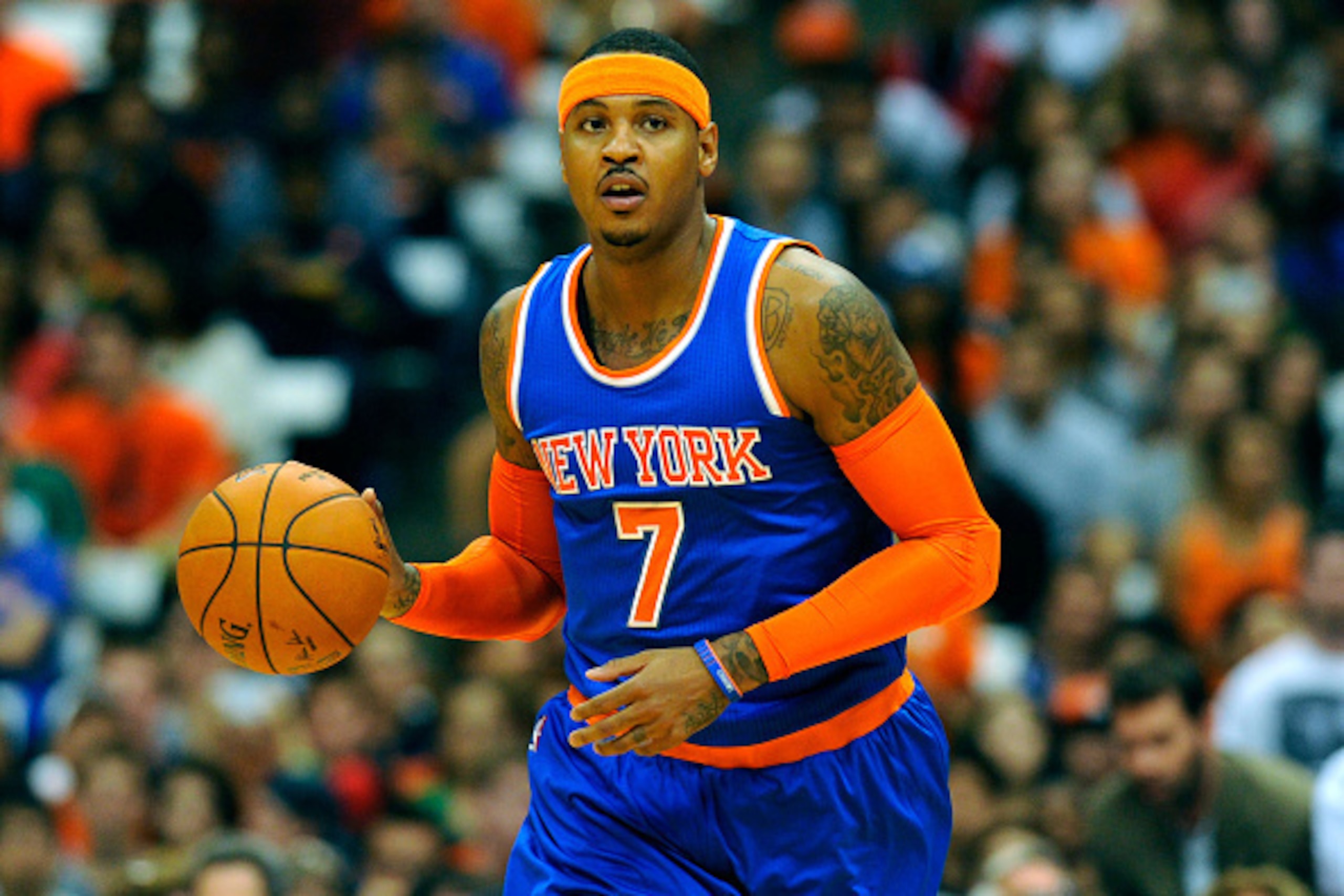
That's what they've done early on. The Knicks are attempting more than 20 threes a night during preseason play. Just three of Jackson's Chicago Bulls and Los Angeles Lakers teams averaged more through their regular-season campaigns.
Catering to this need for distance shooting becomes almost impossible by starting Acy alongside his expected peers. He has three-point range in that he'll shoot, but he's jacked just 17 bombs over the last two seasons, hitting five.
Sense of Shumpert's career three-point splits—30.6/40.2/33.3 percent—is found only by those who mix Robitussin into their mayonnaise. Dalembert will sooner average 35 points per game than develop a dependable three-point stroke.
Anthony and Calderon would be the only reliable shooters, giving the Knicks two. That's not the stuff successful offenses are made of in today's three-point packed NBA.
Even if the Knicks were to focus on post and elbow touches, they would have issues. Most of Acy's and Dalembert's career shot attempts—67.1 and 71.7 percent respectively—have come inside 10 feet. Anthony is the lone member of the predicted starting lineup familiar with scoring from the aforementioned locations.
If the Knicks plan on returning to the playoffs, they'll need an elite offense. Rewarding Acy's tireless spirit with a starting spot, while admirable, doesn't help them create one.
Real or Make Believe?
Pretending that we can read Fisher's mind isn't something worth pretending.
Regular-season basketball is still a ways off. There are still preseason games left to play; there are still questions left to be answered.
One such question still lies at power forward. There's not sufficient evidence to guarantee Acy's role other than his streak of three consecutive starts. That's it.
And while starting him helps bolster the Knicks' second-string offense by (potentially) pinning Stoudemire, J.R. Smith and Tim Hardaway Jr. to the bench unit, it doesn't elevate the ceiling of the opening five. That alone is enough to warrant suspicion to the point of belief—the belief being New York's starting power forward spot remains up for grabs.
*All stats are from Basketball-Reference unless otherwise cited.


.jpg?w=2560 "NFL House in Paris Closes for Protests")
.jpg?w=2560 "Trevon Diggs Cut by Seahawks")