Grading Each Florida State Positional Unit at Halfway Point of the 2014 Season
Less than 48 hours away from a game that will make or break No. 2 Florida State’s 2014 season, let’s look back at how the reigning national champions got here—position by position.
A season after obliterating its competition en route to the third national championship in program history, this year’s FSU squad has had to fight for all six of its wins. With a showdown against Notre Dame set for 8 p.m. ET Saturday at Doak Campbell Stadium, here’s a look at how each spot on the Seminoles’ roster has fared through the first half of the regular season.
Quarterbacks
1 of 9
There aren’t too many people outside the FSU football program who are talking about the Seminoles’ quarterbacks on the field. Instead, the swirling Jameis Winston off-field saga continues to generate headlines for all of the wrong reasons.
In between the hashes, however, Winston is up to his old tricks. The redshirt sophomore quarterback is still undefeated as a collegiate player and is coming off another vintage performance against Syracuse in which he was efficient (30-of-36) and equally opportunistic (three touchdown passes).
Winston has the opportunity to add another signature win to his resume against the Fighting Irish, and his play will, in all likelihood, determine whether or not the ‘Noles emerge victorious late Saturday night.
Entering this weekend’s game, the Bessemer, Alabama native is ranked sixth nationally in completion percentage (70.0), 10th in yards per game (321.0) and 12th in passer rating (159.51). Winston’s rating is down nearly 30 points from last year, when he led the country with a mark of 184.85, but consideration needs to be paid to the fact that Winston has had to break in what is essentially a new roster of receivers.
Rashad Greene is back, but so much of Winston’s success in 2013 was in the hands of Kelvin Benjamin and Kenny Shaw, who are both no longer on the roster. Winston has kept his team atop the college football world despite a continuous work-in-progress relationship with young wide receivers Bobo Wilson, Kermit Whitfield, Travis Rudolph and Ermon Lane.
In addition to Winston, backup Sean Maguire made the first start of his career against Clemson earlier this season and came away victorious. Maguire wasn’t perfect, but he won a highly contested matchup between two conference foes who needed overtime to decide a victor. FSU hopes Winston’s eligibility won't be interrupted, but Maguire showed some ability to step in and lead the team should that change.
Overall, Winston could be better. But all things considered—both on and off the field—the quarterback play at FSU when the lights are on has been impressive once again.
Grade: A-
Running Backs
2 of 9
Perhaps the expectations for the 2014 season were too high for Florida State’s running backs. Despite off-season losses of Devonta Freeman and James Wilder Jr., many preseason projections had the ‘Noles being even better in the run game compared to 2013, when FSU averaged 203.14 yards rushing per game.
Through six games in 2014, though, Florida State is ranked 98th nationally with a less-than-dominant 138.50 yards per game on the ground.
But after mustering a combined 119 yards rushing against FBS opponents Oklahoma State and Clemson to start the season, the ‘Noles have seen an uptick in run-game success over the last three weeks. Against North Carolina State, Wake Forest and Syracuse, FSU rushed for 166, 171 and 165 yards respectively. The Seminoles achieved last weekend’s total despite missing starter Karlos Williams and relying on 5-star freshman Dalvin Cook.
Williams hasn’t proven to be quite the same game-breaker he was a season ago as the team’s third-string tailback, but is still averaging 70.6 yards rushing per game. The real story surrounding FSU’s rushing attack has been the emergence of inexperienced players Cook and Mario Pender. Cook is averaging 5.3 yards per carry with three touchdowns. The redshirt sophomore Pender, who had never played a single down of college football prior to this season, is reeling off a robust 6.2 yards per carry to go along with six total touchdowns.
FSU’s running game has a lot of room to get better moving forward, but the Seminoles have showed consistent improvement over the last several weeks after such a slow start. Still, one can't overlook those early-season struggles when putting a grade on the group's performance so far.
Grade: B-
Wide Receivers
3 of 9
The Seminoles are currently 13th in the country in passing yards per game (324.0) in part because their young wide receiver corps has maintained a steady progression of positive development.
Rashad Greene very well may be the best wide receiver in the country, and after three years of pacing FSU's passing attack, his stellar start to his final season—Greene is averaging 113 yards receiving per game—is no surprise. The real surprise has been the collective impact of youngsters Bobo Wilson, Kermit Whitfield, Travis Rudolph and Ermon Lane.
Wilson has emerged as a legitimate No. 2 wide receiver for Jameis Winston and Whitfield is growing more comfortable as an offensive player and not just a return specialist. True freshmen Rudolph and Lane are getting more and more snaps with the first-team offense.
FSU’s wide receiver depth chart from top to bottom has the chance to be scary good by season’s end. Right now, the ‘Noles’ pass catchers are above average—not bad for a group missing proven players Kelvin Benjamin and Kenny Shaw from a season ago.
Grade: B+
.jpg?w=2560)
Tight Ends
4 of 9
Any grade for the FSU tight end position is simply a grade for star Nick O’Leary.
The Seminoles offense rarely calls for two tight-end sets with so many dangerous wide receivers and running backs on the roster and O’Leary is so durable that he rarely leaves the field. Redshirt senior Kevin Haplea gets occasional repetitions with the offense and has just two catches for 19 yards this season, while third-stringer Jeremy Kerr is primarily a blocker on extra points and field goals.
Meanwhile, O’Leary is coming off a career-best eight-catch game against Syracuse and is undoubtedly one of the best tight ends in the country.
O’Leary is second on the teams with 24 catches for 275 yards and two touchdowns and has already set the record for receptions in a career by an FSU tight end. The redshirt senior is sure-handed, can block with the best of them and rarely makes a mistake.
Grade: A
Offensive Line
5 of 9
The FSU offensive line is coming off a good game against Syracuse—and senior right guard Tre Jackson has been terrific over the past month—but the group as a whole is nowhere near as dominant through six games as it was during the entire 2013 season.
It’s pretty clear that departed center Bryan Stork was the glue up front and his NFL draft selection was followed by a promotion of rising senior Austin Barron, who was average as the team’s new starter before injuring his hand against Wake Forest. Redshirt freshman Ryan Hoefeld has replaced Barron in the middle and appears to have a bright future, even if the sample size of his game-playing experience is just one-and-a-half games so far.
The Seminoles have the experience, size and ability up front with seniors Jackson, Cameron Erving, Josue Matias and Bobby Hart, but they need to regain last year’s form if they want to keep Jameis Winston upright and the running game effective.
In wins over Oklahoma State, Clemson, North Carolina State and Wake Forest, FSU’s opponents posted a combined 29 tackles for loss and 13 sacks. Against Syracuse last week, though, the Orange managed just three tackles for loss and one sack.
FSU’s offensive line needs a repeat performance of that effort Saturday against Notre Dame.
Grade: C
Defensive Line
6 of 9
Mario Edwards Jr. is special, Eddie Goldman has turned into a dominant force in the middle and rookie Lorenzo Featherston has been the surprise of the defense so far this season for FSU.
Florida State took a major hit when Timmy Jernigan left early for the NFL draft and the Seminoles are still feeling the effects of his departure. But Goldman’s emergence—North Carolina State coach Dave Doeren said he considers Goldman the best defensive tackle in the country according to ESPN's David Hale—has helped ease Jernigan’s loss, all while Edwards continues to be a dominant defensive end.
Featherston doesn’t play with much discipline as a raw rookie, but the 6’7” pass-rusher has already proven to be a matchup mismatch as his playing time has increased over the last three games. Chris Casher and DeMarcus Walker have been average to above-average as pass rushers and Derrick Mitchell Jr.—when healthy—has provided an unexpected, but nice, spark to a defensive tackles' depth chart depleted by the season-ending injury to starter Nile Lawrence-Stample.
FSU doesn’t have much depth on its defensive line, but it continues to work successfully with what it had in 2013.
Grade: B
Linebackers
7 of 9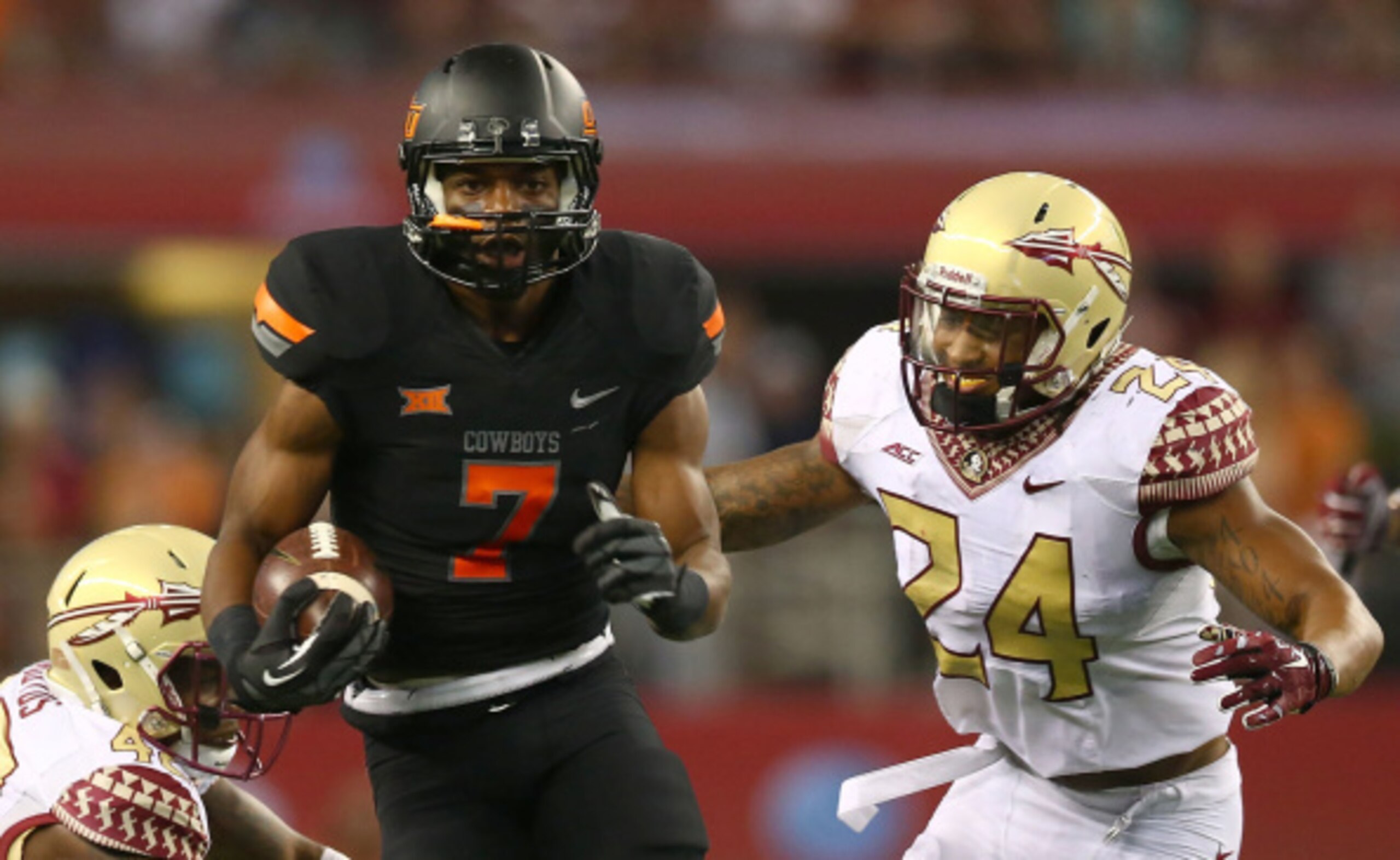
FSU’s linebackers are deep and talented, but so far in 2014 the team has relied on starters Terrance Smith and Reggie Northrup as well as top backup E.J. Levenberry to do the heavy lifting.
This group of linebackers isn’t as opportunistic as last year’s group that featured Telvin Smith and Christian Jones, but they make tackles, play well in space and have great speed to play sideline to sideline.
Terrance Smith currently ranks second in the ACC with an average of 9.8 tackles per game, while Northrup is tied for 10th in the league with 8.33 stops per contest.
The Seminoles boasted perhaps the nation’s best defense in 2013, but so far have been average this season, allowing 358.5 yards per game and nearly six yards per play. The linebacker play, while very good at times, hasn’t featured many splash plays. Of FSU’s 38 tackles for loss this year, linebackers have only accounted for five of them.
Grade: B-
Secondary
8 of 9
Florida State’s secondary players began referring to themselves as the “No Fly Zone” during the offseason, but through the first five games of the season that didn’t prove to be the case. However, after managing just two interceptions in that handful of games, the star-studded group may have regained its form after generating three takeaways alone in the Syracuse game.
Headlined by stars Jalen Ramsey, P.J. Williams and Ronald Darby, FSU’s secondary isn’t short on talent. By season’s end, this group could regain its place as the nation’s best, but the growing pains of losing Terrance Brooks and Lamarcus Joyner to the Baltimore Ravens and St. Louis Rams, respectively, hasn’t been easy.
Ramsey has had to learn a new position in Joyner’s old role as nickel corner after moving from safety, while Williams and Darby have both been hampered by injuries. Nate Andrews continues to be FSU's best ball hawk—he led the Seminoles in interceptions last year as a true freshmen and has a team-high two this year—and Tyler Hunter is slowly regaining his form after missing most of the 2013 season with a neck injury.
The ’Noles are currently 40th nationally with 213.7 yards per game surrendered through the air; last season that average was a nation’s-best 156.6. Considering the elite talent level of this group, FSU's pass defense must improve.
Grade: C+
Special Teams
9 of 9
Is Roberto Aguayo going to go down as the greatest kicker in college football history? It’s not just hyperbole; the redshirt sophomore has a chance.
Aguayo has been perfect this season on extra points and field goals, following up his Lou Groza Award-winning rookie year by averaging 11.0 points per game—a total that ranks fifth among all positions in college football. He has only missed one kick in his entire career.
Punter Cason Beatty was the team’s weakest link a season ago, but has been more consistent this year and is coming off a Syracuse game in which he averaged 46 yards per punt. Whether or not he maintains that consistency is another story.
If there is an area where the Seminoles could show further improvement on special teams, it would be in the return game. FSU has yet to return a punt or kickoff for a touchdown this year and Rashad Greene and Bobo Wilson have both fumbled punts in recent weeks.
Still, it’s hard to knock a unit that boasts the undisputed best player at his respective position in the entire country.
Grade: A
Brandon Mellor is a featured columnist for Bleacher Report. Statistics courtesy of Seminoles.com. All recruiting information courtesy of 247Sports.
Follow @BrandonMellor on Twitter.

.jpg?w=2560 "NFL House in Paris Closes for Protests")
.jpg?w=2560 "Trevon Diggs Cut by Seahawks")