Kawhi Leonard's Emergence Will Force San Antonio Spurs to Evolve Again
SAN ANTONIO — The stability and continuity that characterize the San Antonio Spurs could understandably leave some believing this team is averse to change.
To the contrary, few organizations have committed to such a purposeful evolution—an evolution that may increasingly revolve around the emergence of 2014 Finals MVP Kawhi Leonard.
Just as the team abandoned it's post-heavy preferences for an uptempo scheme that featured heavy doses of Tony Parker and Manu Ginobili, San Antonio is now poised to make the most of a 23-year-old swingman who can change games on both ends of the floor.


At least if he's ready.
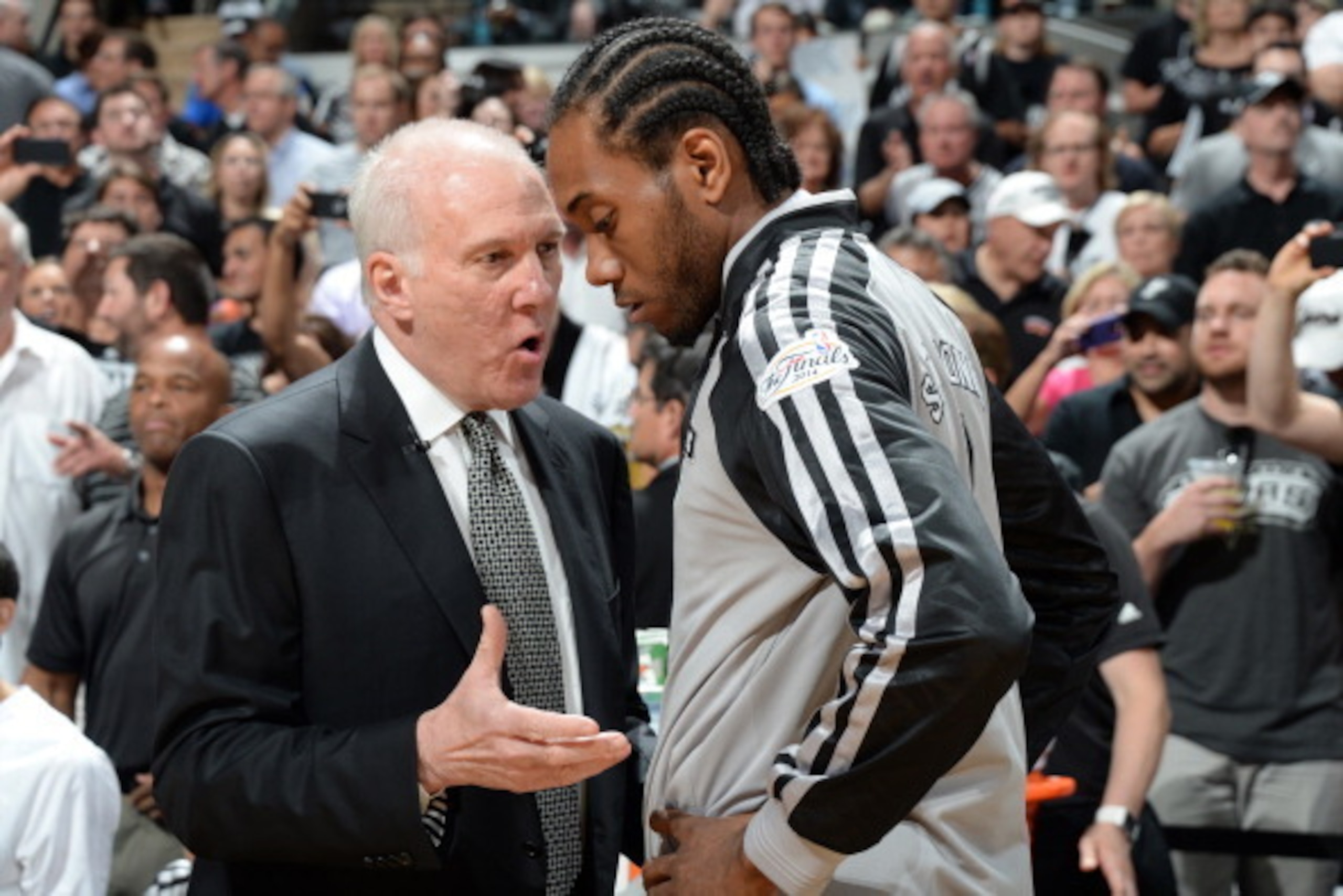
"I'm probably going to talk to him more about consistency now," Popovich told reporters at the team's media day in September. "He's reached a certain level, and if you look at those last three games [of the Finals] he played, they were pretty special.
"But to be in that top echelon of players in our league, it's a huge responsibility to have to come and do that every night. The Duncans, the Durants, the Jameses and all those kinds of guys do it night after night after night, and it's a huge responsibility."

That may sound like unrealistically high hopes, but they're nothing new as far as Popovich is concerned. General manager R.C. Buford parted ways with team-favorite George Hill in order to acquire Leonard—taken by the Indiana Pacers with the 15th overall pick—on draft night in 2011.
After Leonard's rookie campaign, Popovich offered an unusually confident prediction.
"I think he's going to be a star," he said in an NBA.com Q&A with fans in Aug. 2012. "And as time goes on, he'll be the face of the Spurs I think. At both ends of the court, he is really a special player.
"And what makes me be so confident about him is that he wants it so badly. He wants to be a good player, I mean a great player. He comes early, he stays late, and he's coachable, he's just like a sponge."
The work seems to have paid off for Leonard, who's set to become a restricted free agent next summer unless he agrees to an extension by the end of October.
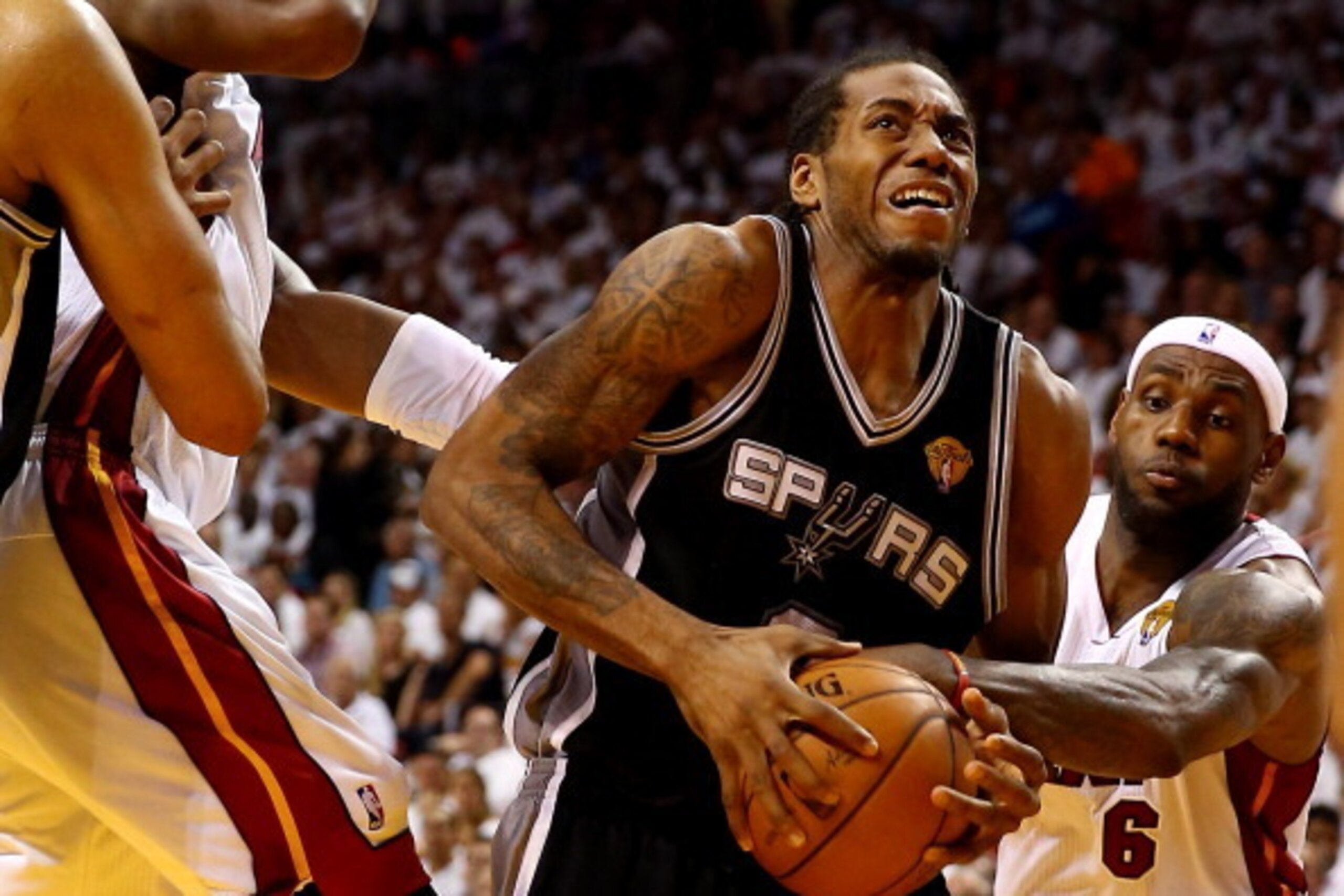
The three-year veteran tallied a combined 71 points, 32 rebounds, six blocks and six steals through the last three games of the Finals, taking over as much as any one player can in San Antonio's relentlessly ensemble attack.
Building upon the breakout series—which included a career-high 29 points in Game 3—may require Popovich and Co. to slightly rethink their commitment to a virtually egalitarian distribution of minutes. The 2013-14 Spurs became the first team in NBA history in which no player averaged 30 or more minutes per game during the regular season.
"It's the way Pop likes to play," Buford told Grantland's Kirk Goldsberry in June. "The way the bench played this year and the number of minutes they got was because [assistant coach] Chip Engelland and Pop have really been pushing our group to trust our bench. They brought us to where we are. We said, 'Let's not shorten the rotation the first time the clouds get dark.'"
But with Leonard primed to become a focal point of San Antonio's offense, an exception to the rule may be in order.
"In the Finals I'm playing 35 minutes a game, so I'm on the floor more and able to score the ball more and get more rebounds," Leonard explained on media day. "So I'm going to have to get consistent minutes to play at a consistent level like that.
"Like I said, if I'm going to get seven more minutes on the floor, that's going to be important. We'll see what happens. I mean, my role was supposed to expand last year, and we played pretty much the same basketball. So we'll see what Coach Pop has."
It's a request Leonard has earned by now.
The San Diego State product has steadily diversified his offensive game after impressing out of the gate with three-point range he never displayed at the NCAA level. Leonard now has a mid-range game, an improved handle and—perhaps most importantly—the confidence to look for his own shot.
He's even expanding his repertoire of moves used to get that off.
"Particularly interesting is the go-to move he seems to have picked up over the summer, a mid-range fadeaway that he looks extremely comfortable taking," the San Antonio Express-News' Dan McCarney noted after the team's preseason loss to Alba Berlin. "After picking his spots for most of his three seasons, the reigning Finals MVP might be ready to pursue a larger role in the offense."
The salient question is the one McCarney broached next: "How will that fit with the Spurs' performance as a whole?"
Long averse to half-court sets premised on isolation, San Antonio may have to sacrifice some of its vaunted ball movement in order to get Leonard touches. Excepting the occasional willingness to let Parker go to work on his own, the Spurs are generally committed to a habit of passing up good shots in order to find great ones.
It's a habit that doesn't fit with the notion of force-feeding the ball to a particular player, regardless of said player's star-like credentials.
Slowly but surely, however, both the Spurs and Leonard appear headed in that direction.
Project Spurs' Paul Garcia charted the regularity (and success) of Leonard's different scoring plays through his first three seasons, courtesy of Synergy Sports. The most revealing finding is that Leonard's use in isolation and pick-and-roll (as the ball handler) situations has steadily increased over that span. Last season even marked the debut of a consistent post-up game.
Put simply, Leonard is no long a complementary piece predisposed to merely spotting up, running the floor and scrapping for offensive rebounds.
He's learning how to create his own offense.
In turn, the Spurs will learn how to utilize that offense.
Stubborn as Popovich may seem to the untrained eye, this is a man who all but abandoned his team's borderline dependency on Tim Duncan's back-to-the-basket magic. It wasn't an overnight transition, and it didn't mean the end of Duncan as we know him.
San Antonio gradually replaced its post-heavy attack with constant motion and ball movement—less a passing of the baton, more an attempt to share it.
The dawn of the Leonard era may be similarly slow to take shape.
But that makes it no less essential. With Duncan (age 38) and Ginobili (37) at the back-ends of their careers, it's time for the franchise to adapt.
Even if it means changing a formula that's worked until now.


.jpg?w=2560 "NFL House in Paris Closes for Protests")
.jpg?w=2560 "Trevon Diggs Cut by Seahawks")