Minnesota Vikings Defense Suffering Breakdowns Within the Secondary
The retooled Minnesota Vikings defense has earned mixed reviews after five weeks, with ups and downs at all three levels. Its secondary has been the culprit behind a number of costly gaffes that have given up points in a hurry in recent weeks.
Turnover between the 2013 and 2014 versions of the Minnesota secondary was a cause for a concern entering the season.
Captain Munnerlyn signed over the offseason and was plugged directly into the starting lineup. Then Robert Blanton won the starting safety job opposite Harrison Smith, so two new starters had to be integrated. Miscommunication has played a part in multiple coverage breakdowns. Lack of familiarity within the secondary may be one of the causes.
.jpg?w=2560 "Texans Jaguars Football")
.jpg?w=2560 "Jets Saints Football")
.jpg?w=2560 "Saints Giants Football")
New schemes have impacted the secondary as well. Xavier Rhodes, Josh Robinson, Smith and Blanton were all developed within a specific system, the Tampa 2. Mike Zimmer’s scheme differs greatly, so an adjustment period is to be expected.
These young players are now being asked to play various types of coverage they are much less familiar with. Zimmer’s defense increases the usage of man coverage and other specific techniques.
Techniques such as pattern matching, which compares to a matchup zone in basketball, were relatively uncommon in the previous scheme. Zimmer has integrated pattern matching and the mixing of coverages within single defensive calls, asking more of players in terms of coverage variety and overall mental processing.
The transition has yielded mixed results to this point. From a wider perspective, the Minnesota defense has held up. Statistics help paint the picture of how Minnesota’s pass defense has had trouble limiting big plays, though.
| 20+ yards | 30+ yards | TD | |
| Percent | 9.6% | 2.4% | 5.4% |
| Ranking | 23 | 11 | 26 |
Thus far, the Minnesota defense has given up too many passing plays of 20 yards or more. Its ability to limit plays of more than 30 yards is a slight consolation. The touchdown percentage given up ranks near the bottom of the league, which closely relates to Minnesota’s low ranking in red-zone defense.
The big-play problem goes beyond simple stats. An inexcusable trend has emerged for the Vikings in pass coverage, and it's partly to blame for those disappointing numbers. In each of the last three games, an opposing receiver has scored a touchdown of 20 yards of more. A schematic breakdown was behind each of them. In fact, each occurred in the first quarter, when players should be at their sharpest mentally.
Let’s look at what went wrong on three high-profile slip-ups, one from each of the previous three weeks. The first was a 34-yard connection from Drew Brees to tight end Josh Hill, giving the New Orleans Saints a 14-0 lead in the first quarter.

The pre-snap alignment indicates Cover 1 with man coverage across the board and a single-high safety. That doesn’t turn out to be the case.
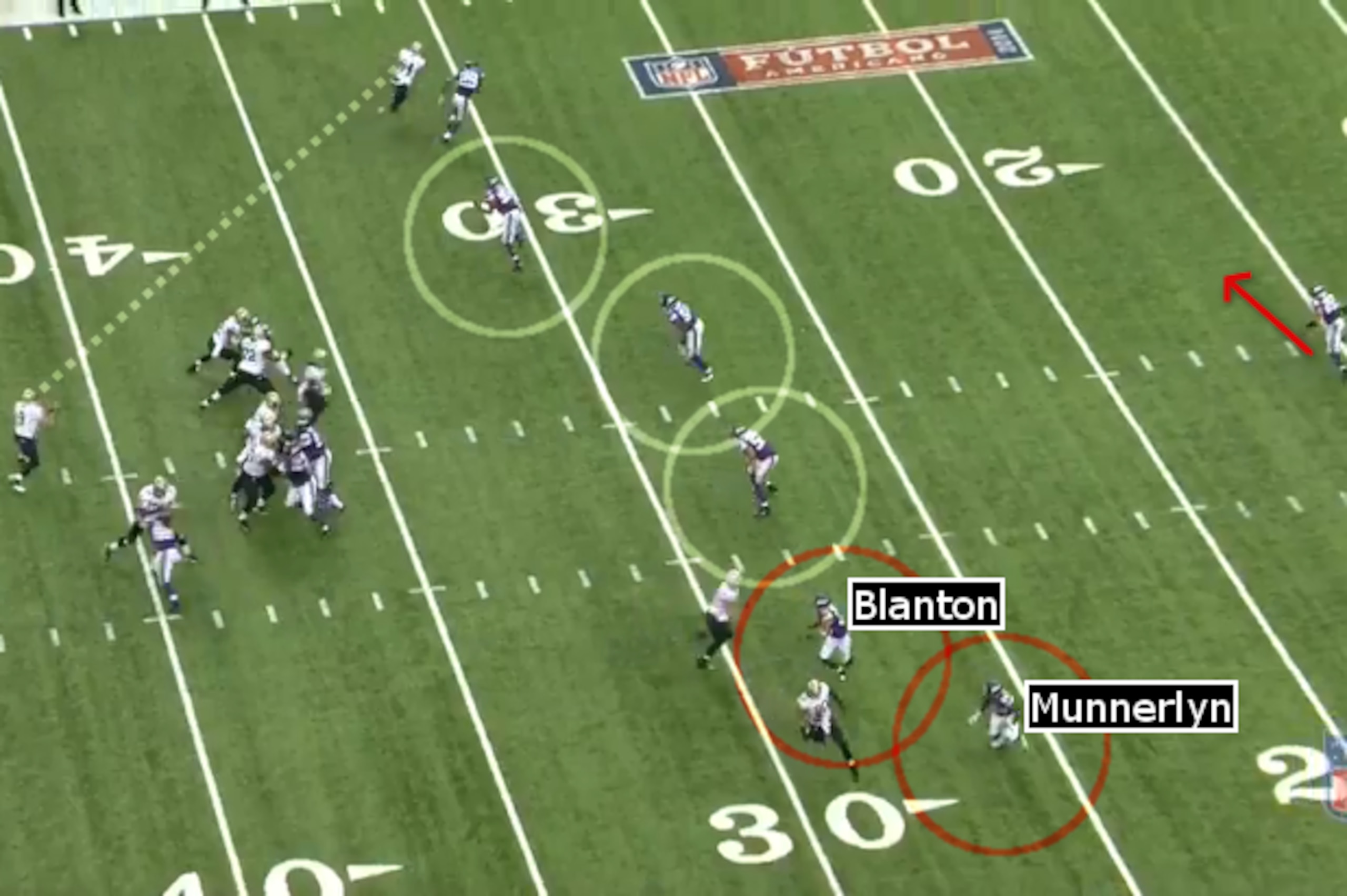
Instead, the linebackers sink into underneath zones. Rhodes trails his receiver in man coverage on the far side. The near-side route combination gives the Vikings fits. Jimmy Graham runs an out route, while Hill runs down the seam.
Neither Blanton nor Munnerlyn carries the seam route, passing Hill off to Smith, who has too much ground to cover against a cerebral quarterback. Brees manipulates Smith by staring down the receiver to the safety’s right and pumping once, creating space for the downfield throw.

Brees finds a wide-open Hill in the seam for six points, taking advantage of a clear miscommunication from the Vikings secondary. A botched coverage design could be to blame. Negligence from Blanton and Munnerlyn in identifying the vertical threat the tight end posed with pre-snap communication could be to blame as well.
No matter the exact coverage call, Blanton must either trail the tight end into the seam or at least disrupt the route to give Smith a chance. Instead, Graham gets a double-team, while Hill runs free down the field.
The Vikings fail to properly match the Saints routes, which may come down to the issue of unfamiliarity with each other and the overall scheme. Both Munnerlyn and Blanton are new starters in Minnesota, and it showed on this play.
Munnerlyn was fully at fault on a crucial touchdown given up to Atlanta in Week 4.
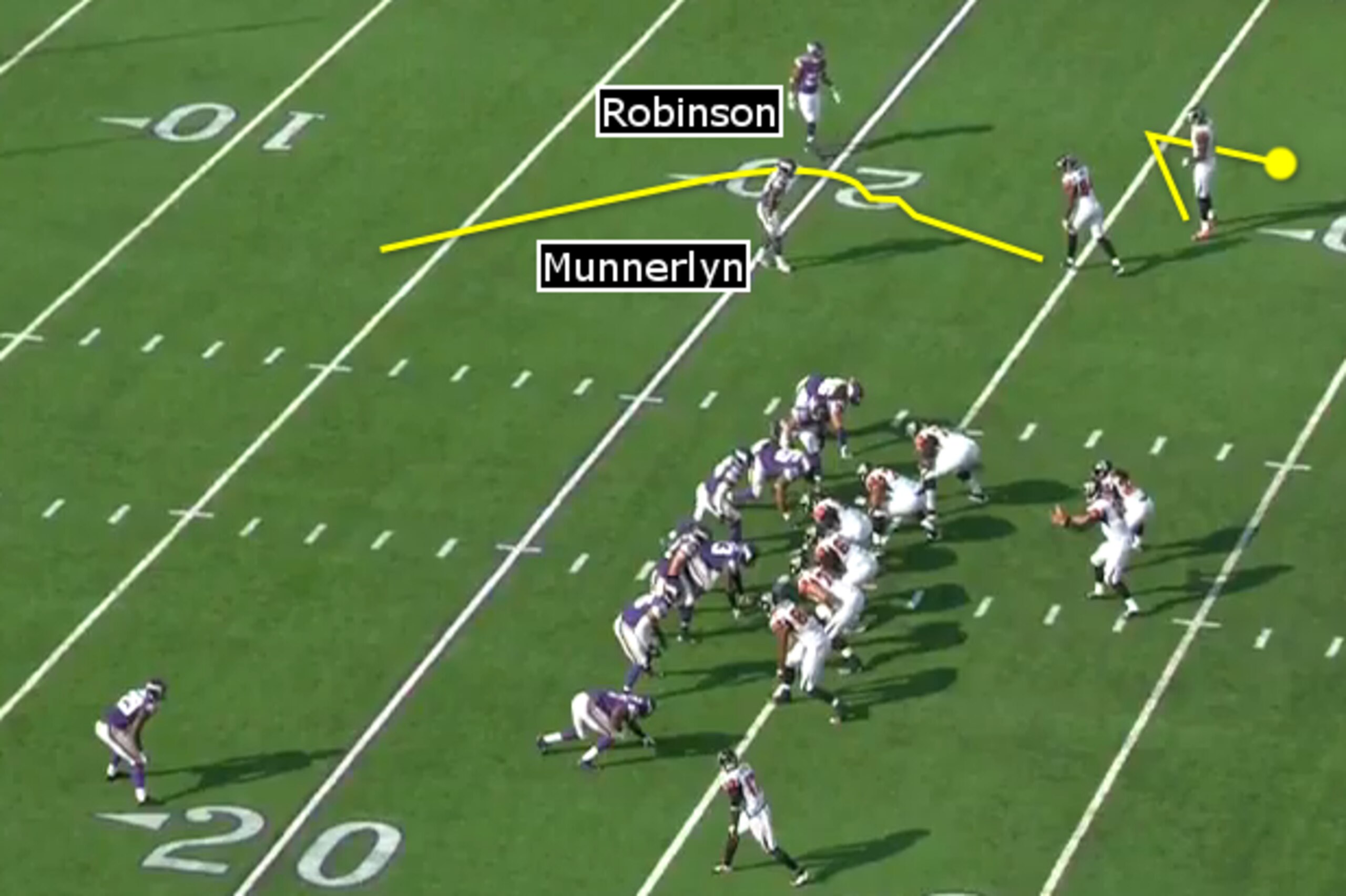
Julio Jones and Roddy White team up on the far side of the field. With the Vikings in an aggressive zero-coverage blitz, meaning no safety help, the pair of cornerbacks are isolated in acres of space. Munnerlyn and Robinson are trying to match the patterns of Jones and White after the two receivers show their hands.
Alabama head coach Nick Saban explained the concept of pattern matching in the 2010 Coach of the Year Clinics Football Manual:
"Pattern-match man is a coverage that plays the pattern after the pattern distribution. That means you pick up in man coverage after the receivers make their initial breaks and cuts.
We number receivers from the outside going inside. If the number-one receiver crosses with the number-two receiver, we do not pick up the man coverage until they define where they are going.
"
As the cornerback aligned on the inside, Munnerlyn does not pick up Jones, the outside receiver, unless his route crosses with White’s. Jones stops at the line of scrimmage as a hot receiver, so his route does not cross White’s. In fact, his route doesn’t carry inside at all. And yet, Munnerlyn bites.

That leaves White to dash free for as easy a touchdown as he has probably scored.
Not a single ounce of the blame should fall on Robinson, outside of improper communication before the snap. Even so, with an all-out blitz called, cornerbacks must defend against in-breaking routes. Robinson could not possibly do that from his initial alignment if covering White was his duty. This was a total bust from Munnerlyn, who came to Minnesota with a reputation for reliable work in the slot.
Both of these first two examples occur with the Vikings defense deeper in its own territory. The next is an even costlier blunder, resulting in a much bigger gain and another touchdown.
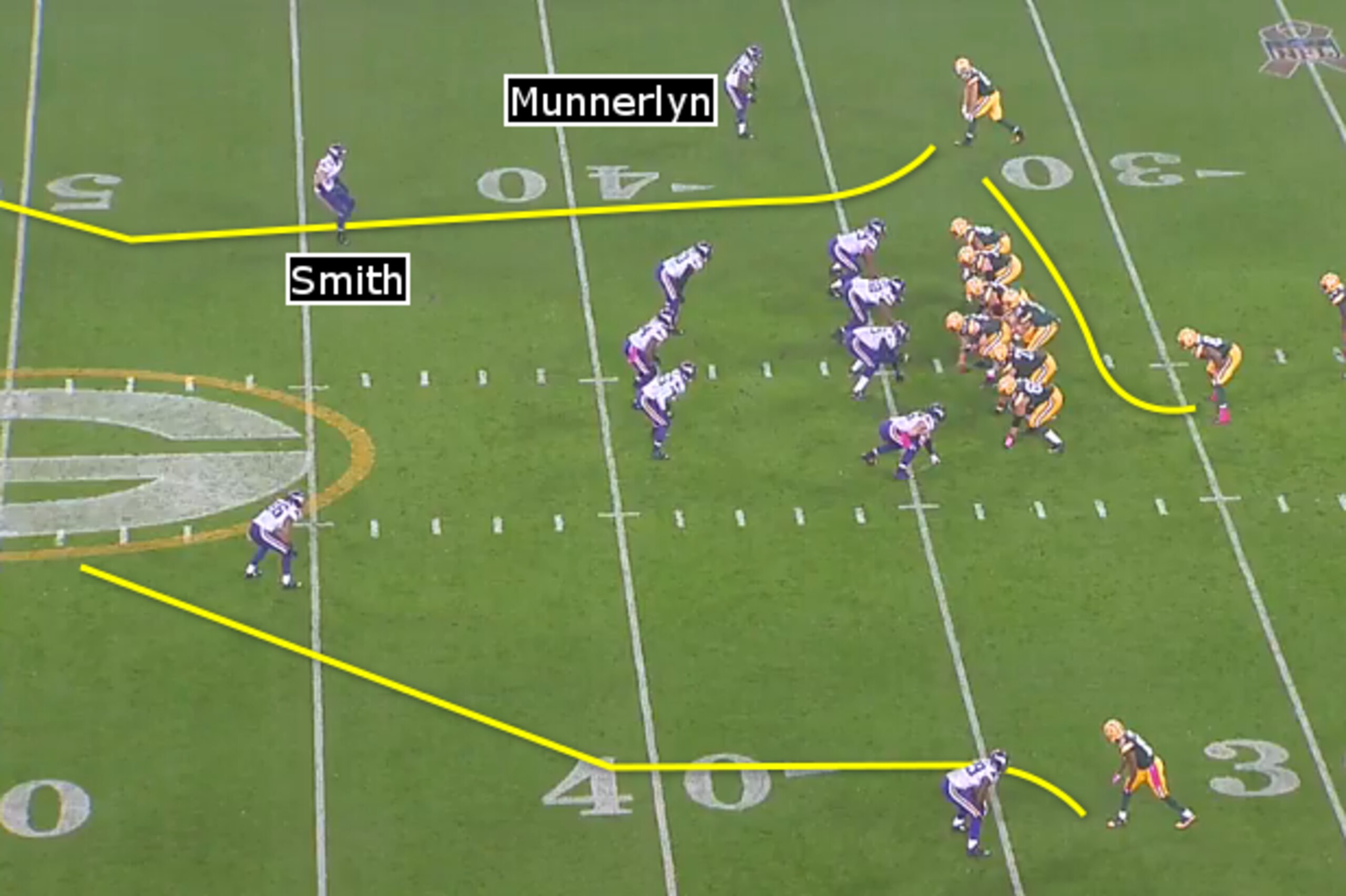
Green Bay has a play-action pass on with a pair of deep routes, both crossing the middle of the field. Jordy Nelson is the receiver on the far side of the field. He sells his route to the outside before breaking back to the middle.

This play is trouble from the beginning when Munnerlyn fails to delay Nelson’s route. He and Smith are essentially bracketing the Packers' No. 1 target, and Munnerlyn should have been more aggressive early in the route. Instead, he leaves Smith on an island with one of the league’s best receivers.
The results were unkind as Nelson broke his route to the corner and then back inside, spinning Smith like a top. Bleacher Report Lead Writer Matt Bowen shared an assessment of the play:
""Sting" route (stem to corner, break to post) vs. Cover 2. Tough for the safety to stay square. Beat when he opens the hips.
— Matt Bowen (@MattBowen41) October 3, 2014"
Aaron Rodgers also has far too much time to throw in the pocket, which gives him the freedom to launch a deep ball with pinpoint accuracy.
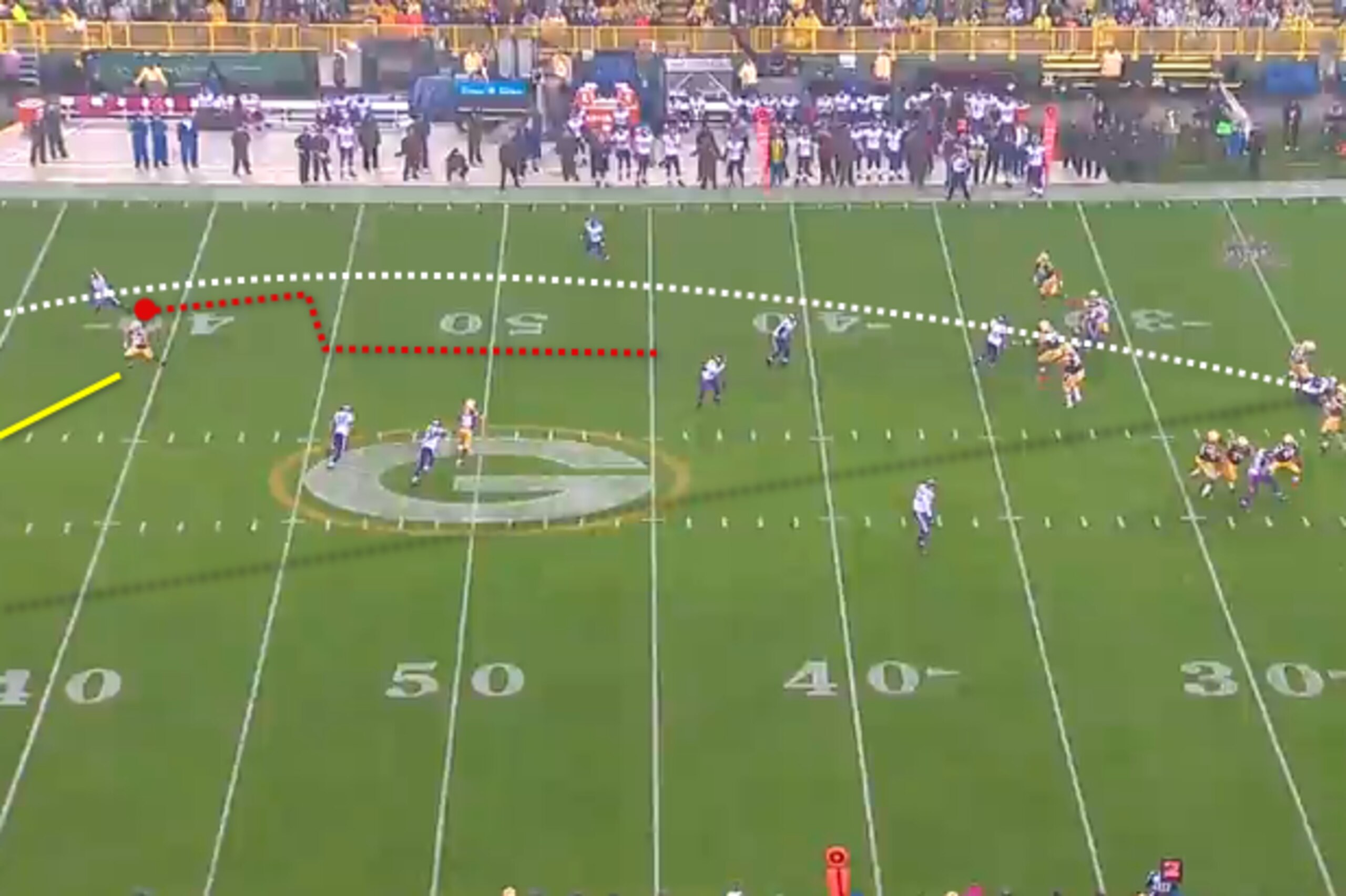
Even an athlete of Smith’s quality can be exposed in space with schematic and technical breakdowns. He was partially to blame for his footwork in space and being overly aggressive. The rest of the defense was also at fault for giving Rodgers too much time to set and throw and letting Nelson run up on Smith with no resistance early in the route.
The troubling trend of coverage lapses must be reversed for the Vikings secondary to take the next step. At this point in the season, the pass rush still hasn’t come along without the help of blitzes. That only increases the load carried by the back seven.
In order for the defense to improve, the secondary needs to start holding up its end of the bargain. A string of successful plays can be undone by a single breakdown in coverage. As the group continues to build a rapport after five weeks on the field together, the expectations must rise. That means improvements across the board in pass coverage in order to limit big plays and get off the field on crucial downs.
.jpg?w=2560 "Texans Jaguars Football")
.jpg?w=2560 "McCarthy Injured During Game")
.jpg?w=2560 "Updates from EVERY NFL Game 🏈")