Denver Broncos Develop New Ways to Dominate with Demaryius Thomas
The Denver Broncos had trouble getting their high-flying offense off the ground prior to their Week 4 bye. Part of the problem was an intentional effort to try to run the ball, but the other was that wide receiver Demaryius Thomas was seemingly struggling.
Opposing defenses adjusted to the screens and other quick passes that made Thomas so dangerous in 2013. The Broncos realized there was a problem and made some adjustments, but quarterback Peyton Manning and Thomas had trouble connecting for various reasons.
The effort to develop a few new ways to use Thomas’ skills to dominate defenses paid off in a big way in Week 5 against the Arizona Cardinals. After two weeks of preparation, Thomas tallied a prolific 226 yards receiving and two touchdowns against the Arizona Cardinals. The officials rightly nullified another 77-yard touchdown due to a penalty, but that wasn’t his fault.
TOP NEWS
.jpg?w=2560 "NFL Paris Football")
NFL House in Paris Closes for Protests
.jpg?w=2560 "Seahawks Chiefs Football")
Trevon Diggs Cut by Seahawks
.jpg?w=2560 "Colts Football")
Jonathan Taylor Landing Spots
For the most part, the screens and quick passes to Thomas were still ineffective Sunday against the Cardinals. Instead of Thomas having trouble finding much running room on those plays, he and Manning finally started connecting on intermediate and deep passes.
Many people blamed the struggles on Thomas for dropping too many passes. According to Pro Football Focus (subscription required), Thomas had three drops over the first three weeks. Manning getting the ball out of his hands significantly—and perhaps unnecessarily— faster than any other quarterback in the league was also a likely factor.
"I had the most drops in these first three games that I've had my entire career," Thomas said via Mark Kizla of The Denver Post. "I don't know what it is. I don't know if I'm thinking too much."
Thomas dropped another pass in Week 5, but Manning had more time in the pocket and used it wisely. The shift in both Manning’s time in the pocket and the usage of Thomas contributed more to his big day than a lack of drops. Thomas is usually good for roughly a drop per game, but he more than offsets that with his yardage output.
| 1 | 19 | 18 | Left | Out | |
| 2 | Incomplete | 10 | Left | Comeback | Route a yard too deep |
| 3 | 24 | 13 | Left | Fade | Fake Screen |
| 4 | 5 | -4 | Right | Screen | |
| 5 | Incomplete | 17 | Middle | Slant | Overthrown |
| 6 | Incomplete | 10 | Left | Post | Ball Too Earl/Thomas Turns Late |
| 7 | 31 | 3 | Right | Slant | Touchdown |
| 8 | Incomplete | 5 | Right | Out | Good coverage |
| 9 | 86 | 25 | Left | Fade | Touchdown |
| P | 77 | 27 | Right | Corner | Touchdown Nullified by Penalty |
| 10 | Incomplete | 18 | Right | Fade | Ran into defender |
| 11 | Incomplete | 28 | Right | Post | Manning overthrown into double coverage |
| 12 | Incomplete | 35 | Right | Fade | Manning overthrown |
| 13 | Incomplete | 0 | Right | Screen | Deflected by unblocked edge rusher |
| 14 | 28 | 1 | Middle | Shallow Cross | |
| 15 | 20 | 13 | Left | Comeback | |
| 16 | 13 | 3 | Right | Quick In |
Manning targeted Thomas 16 times Sunday, so the Broncos clearly made an effort to get their No. 1 wide receiver going. The only time Manning has targeted Thomas more was in the Super Bowl, when he threw in his direction 18 times.
In the Super Bowl, Thomas’ longest reception was 23 yards. He averaged 28.3 yards per reception Sunday, but he caught just eight of the 15 passes thrown his way. The lower catch percentage is another reflection of how the Broncos changed how they utilize Thomas as an offensive weapon Sunday.
Manning’s passes traveled an average of nine yards in the air before ending up in Thomas’ hands against the Cardinals. Most quarterbacks struggle to average 9.0 yards per attempt including yards after the catch, so Manning's average air yards to Thomas should not go unnoticed.
Of the 16 times Manning threw to Thomas, 10 were 10 yards or further down the field and seven of those were 15 or more yards down the field. Add another if you include the 77-yard touchdown that was called back.
Thomas caught all of his short passes, but only one was a screen. The screen was also for just five yards, his shortest gain of the day. The Broncos tried to throw him another screen, but as has been the case in recent weeks, the opposing defense was ready for it. An Arizona defender burst upfield and batted it down.
Manning targeted Thomas on four fade routes, two posts, two comebacks, a corner and an out route. The fades opened up the comebacks. The screens, or the threat of them from previous weeks, set up at least one of the fade routes.
In the first quarter, the Broncos used a fake bubble screen and Thomas was able to shake free from cornerback Antonio Cromartie for a 24-yard gain on 2nd-and-10. Thomas faked as if he was going to block at the line and waited for Cromartie to peek in the backfield before sprinting down the left sideline.
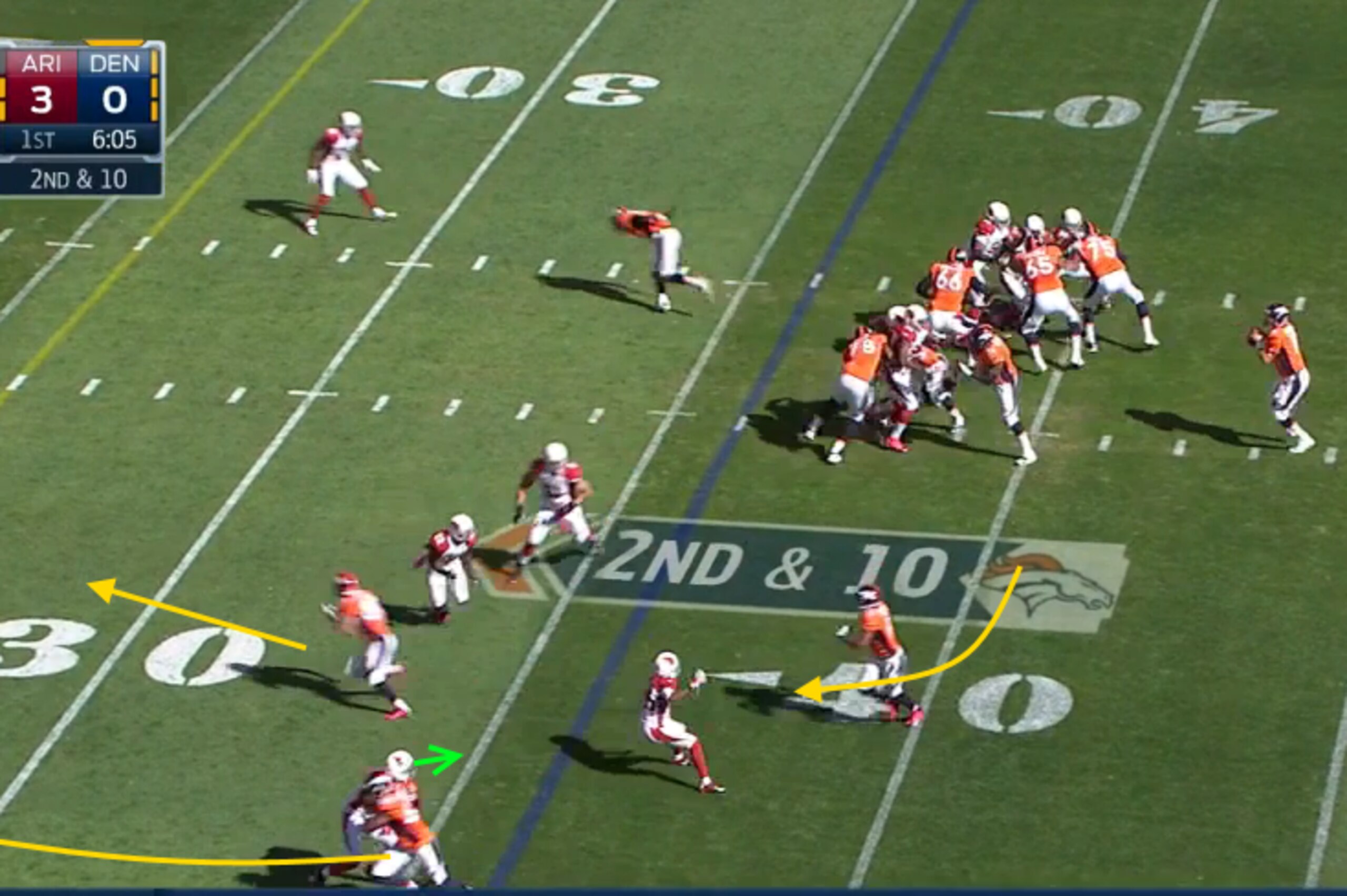
On Thomas’ 86-yard touchdown reception, the Broncos simply exploited press-man coverage with no safety help over the top. Thomas had the entire boundary to work with and separated from the defensive back while the ball was in the air.

Thomas is such a weapon after the catch, forcing him to run deeper routes may seem counterproductive. As Thomas proved Sunday, he can be just as dangerous when running vertical routes as he is on screens and slants.
As teams have keyed in on Denver’s short stuff, getting him to run vertical routes is the way to get him involved. What’s good for Thomas is usually good for the entire offense, and it will be extremely difficult for opposing teams to scheme against him going forward.
Play off, and Thomas and the Broncos will burn you with slants and screens. Play press, and he’ll burn you deep. Put two defenders on him, and Manning will just throw to Emmanuel Sanders, Julius Thomas or Wes Welker.
The scary thing is that there is also plenty of room for improvement for Manning and Thomas to make. Six of the eight passes Thomas didn’t catch were 10 or more yards down the field and four were 18 or more yards down the field.
Thomas isn’t going to be putting up 226 yards on a regular basis just because of these adjustments, but a higher catch percentage on deep and intermediate passes should allow him to continue to produce big numbers when he isn’t getting 16 targets. A productive Thomas should also help the offense looks more like 2013’s unit—especially now that running back Montee Ball is hurt; the Broncos may have no choice but to throw to win.
Unless otherwise noted, all statistics via Pro-Football-Reference.com.
.jpg?w=2560)