Returning to Team Identity Has Been Key to Recent 49ers Success
In Week 3 of the 2014 NFL season, the San Francisco 49ers showed us that they were capable of spreading out the field and utilizing an uptempo, fast-paced offense.
The results?
San Francisco lost that game to the Arizona Cardinals 23-14.
TOP NEWS
.jpg?w=2560 "NFL Paris Football")
NFL House in Paris Closes for Protests
.jpg?w=2560 "Seahawks Chiefs Football")
Trevon Diggs Cut by Seahawks
.jpg?w=2560)
B/R's Expert Week 7 NFL Picks 🔮
A week prior, the 49ers also tried to use a pass-happy offense in the second half against the Chicago Bears. The results were similar: A fourth-quarter collapse gave the Bears a 28-20 victory.
Those back-to-back losses were more than enough to warrant concern and worries for a San Francisco team that has nothing less than a Super Bowl victory in its sights.
The second-half meltdowns in Weeks 2 and 3 signified problems. The vast amount of penalties also created concerns. On top of those issues, there appeared to be a lack of adjustment taking place within the 49ers' play-calling.
Everything seemed to be imploding.
Just when it appeared as if it couldn't get any worse, San Francisco pulled off two wins in a row against the Philadelphia Eagles and Kansas City Chiefs in Weeks 4 and 5, respectively. Each of these opponents had been riding hot streaks, whereas the 49ers appeared to be at a season-low mark.

What happened? What changed?
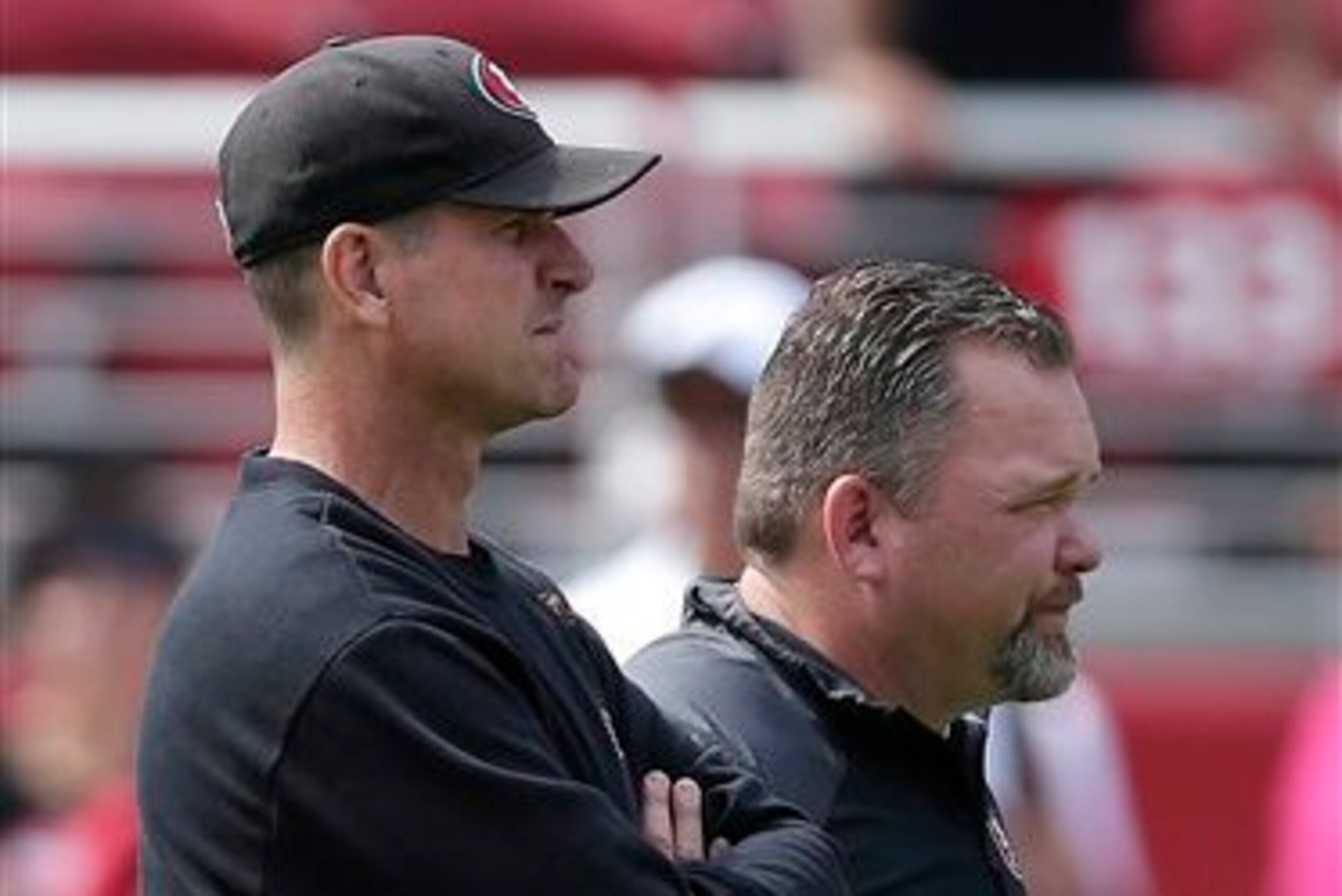
The simple answer is this: San Francisco returned to its roots and focused on showcasing the elements that made it such a successful franchise during the Jim Harbaugh era.
In this article, we break down the rediscovering of the 49ers' identity and how this might be the catalytic change the team needed early on this season.
While many factors have come into play, it boils down to the 49ers doing what they do best: implementing a tough, physical running game and combining this with a stout defense—elements that revealed themselves in each of San Francisco's last two victories.

A Change in Offensive Philosophy?
Coming into the 2014 season, we should have expected offensive coordinator Greg Roman and the 49ers offense to open things up a bit.
After all, San Francisco ranked No. 30 in 2013 at moving the ball through the air (2,979 yards). Much of the passing game was hindered by the lack of depth at wide receiver. Wideouts Michael Crabtree and Quinton Patton missed the majority of the regular season, leaving veterans Anquan Boldin and Vernon Davis as the primary receiving targets.
During the offseason, the 49ers revamped their receiving corps. Added to the fray were wideouts Brandon Lloyd, Stevie Johnson and rookie Bruce Ellington. Suddenly, San Francisco boasted one of the deepest receiving groups in the league. It would fall upon Roman and the offense to properly utilize it.
As early as June, Roman hinted that the 49ers would "open up the playbook" and unleash a new-look offense, according to peNFL Media's Alex Flanagan (h/t Marc Sessler of NFL.com).
According to ESPN Stats & Information (h/t Bill Williamson of ESPN.com), the 49ers were last in the NFL using three-receiver sets in 2013. Injuries obviously hindered any thought of doing this, but the offensive game plan simply did not feature such utilization.
With the added weapons, one might have theorized that Roman and the 49ers would use heavier doses of the passing game—moving away from the run-first mentality that had generated much of San Francisco's offensive prowess in recent years.
But what of the effects?
As is the case with many teams that use three-, four- and five-wide receiver sets, the running game is often taken out of the picture. While run plays out of three-plus wideout sets are not uncommon, the strength of the 49ers offense is built around running the ball utilizing lead blockers—tight ends and fullbacks, specifically.
| Week 1 | @ Dallas | 192 | 127 | 319 | W, 28-17 |
| Week 2 | vs. Chicago | 232 | 127 | 359 | L, 28-20 |
| Week 3 | @ Arizona | 236 | 82 | 318 | L, 23-14 |
| Week 4 | vs. Philadelphia | 189 | 218 | 407 | W, 26-21 |
| Week 5 | vs. Kansas City | 186 | 171 | 357 | W, 22-17 |
| Total | 1,035 | 725 | 1,760 | 3-2 |
These become inherently absent once multiple receivers are on the field.
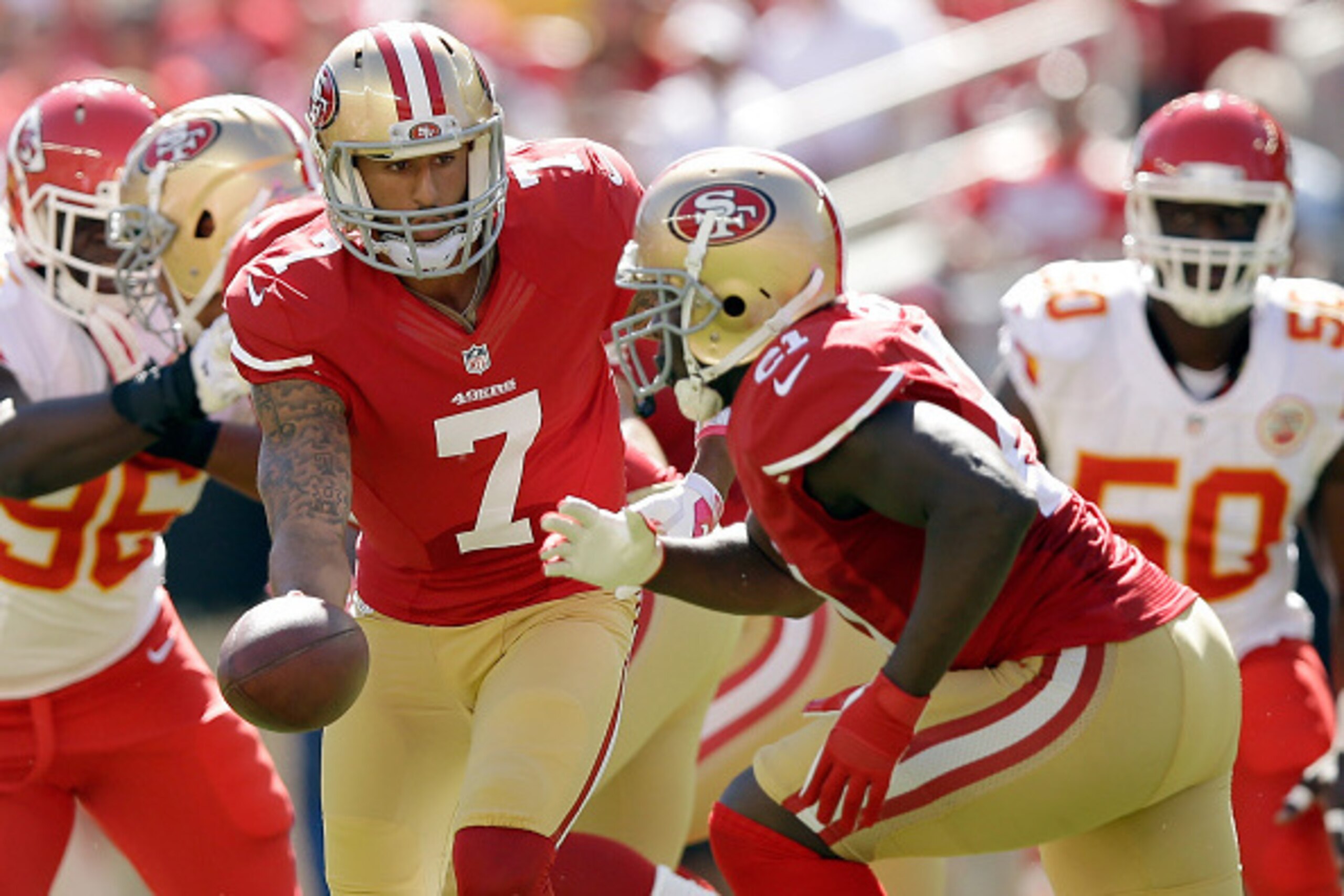
In turn, this forces a quarterback—in this case, Colin Kaepernick—to rely on his arms and potentially legs to supply the majority of offensive production. While some quarterbacks thrive in this approach, the overall game plan stands in stark contrast to what San Francisco's offense is built to do.
Uptempo, faced-paced offenses rarely win the time-of-possession battle. Take a look at the Philadelphia Eagles' approach as a perfect example. While potentially scoring a lot of points is great, the lack of possession time makes for a vulnerable defense.
This is precisely a consequence suffered by the 49ers defense in Weeks 2 and 3—late-game adjustments that simply could not be made.
While it may be refreshing to know San Francisco can employ this sort of offensive philosophy, it is impossible to overlook the strengths of this team without recognizing that this shift essentially led the 49ers away from their identity.

Getting Back to Basics
San Francisco is a run-driven team that utilizes its power-running game to eat up the clock and tire out opposing defenses.
Implementing an offense that features running back Frank Gore—and hopefully rookie Carlos Hyde—is the staple that makes a tough, physical offense so potent.
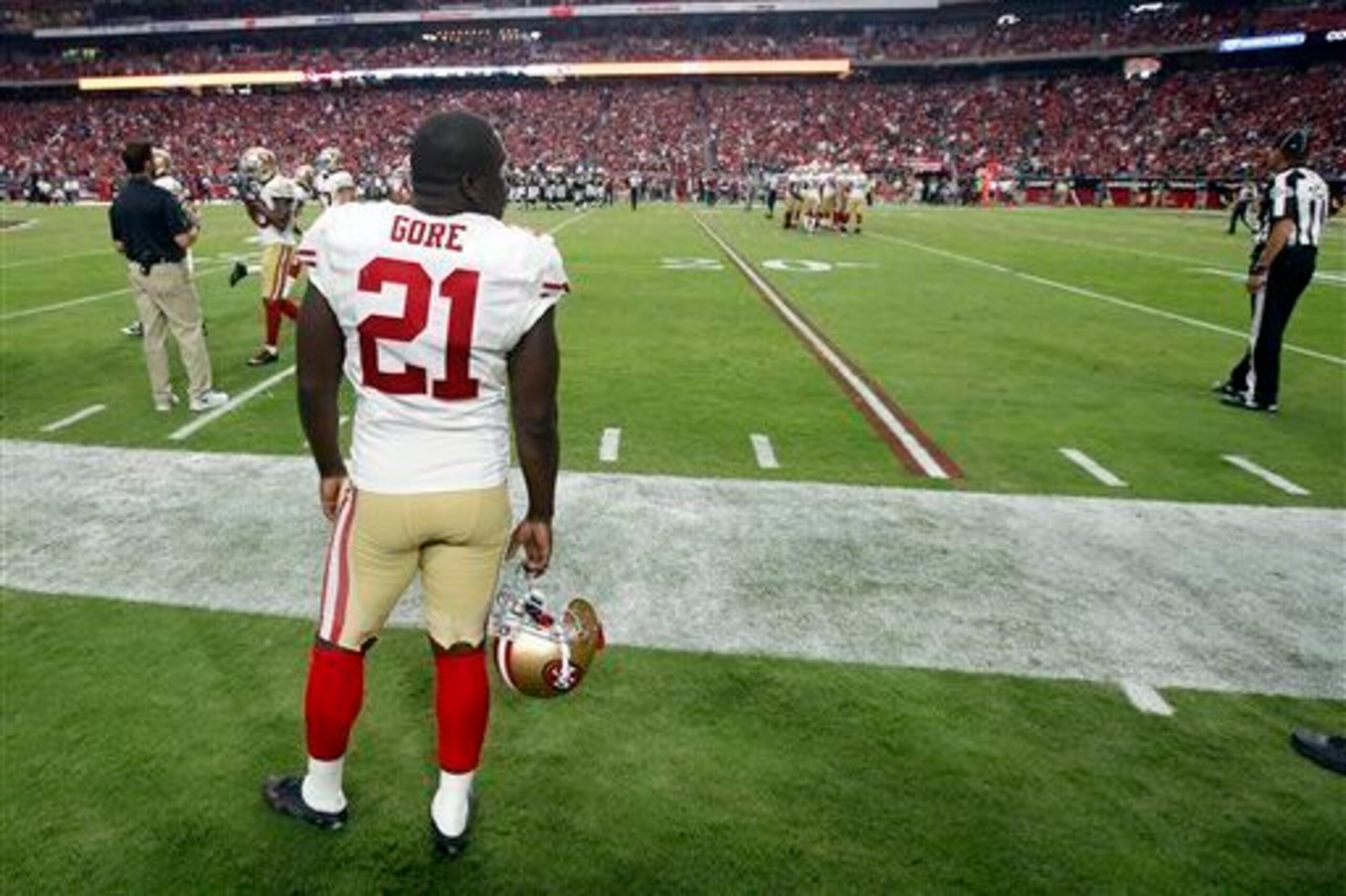
The 49ers got away from this philosophy in Week 3 against Arizona. Gore rushed just six times for 10 yards. Instead of using the running game to wear down the Cardinals defense, San Francisco attempted to "air it out."
This approach was evident to Eric Branch of SFGate.com, who wrote: "That, to put it mildly, was out of character for a team that had the fewest passing attempts in the NFL from 2011 to 2013. As a result, the game plan resulted in numbers not seen previously in the Harbaugh era and, in some cases, long before."
After the loss, Gore was clearly frustrated at the results.
"I can’t talk right now," Gore told reporters. "Sorry."
Gore later clarified that he was upset not at his role but with how the game turned out.
“Whatever works, I’m with it,” said Gore to the media. “If it’s passing, it’s passing. We pass the ball. If it’s running, we run the ball. I’m willing to do whatever it takes to win, and if we have to go out there and do the spread again, I’m with it. That’s just the type of player I am. I just want to win.”
But the results had spoken for themselves. San Francisco needed to get back to what it does best—moving the ball on the ground and with authority.
Such was the case in Week 4 against the undefeated Eagles.
Chip Kelly's fast-paced offense presented a challenge to San Francisco's defense. But the best way to prevent Philadelphia's offense from hurting the 49ers was to not let them take the field.
Instead, the 49ers mastered the art of controlling the clock—dominating the possession game 42:17 to 17:43.
Gore rushed for 119 yards on 24 carries—an average of 5.0 yards per attempt. Additionally, Gore grabbed a 55-yard touchdown pass from Kaepernick on a broken play.
This, combined with the rest of San Francisco's offense, gave the defense plenty of rest. In turn, this unit gave up just 213 yards to the Eagles, forcing four turnovers in the process.
In fact, all of Philadelphia's 21 points came off its defense or special teams.
The game was a throwback performance from the 49ers. They had returned to their roots, and the results paid off nicely.
San Francisco answered with a similar performance against Alex Smith and the Kansas City Chiefs in Week 5.
While much of the focus centered on Kaepernick and the quarterback he replaced, Alex Smith, it was Gore and the running game that drove the 49ers' offensive prowess.
Gore rushed for 107 yards on 18 attempts—good for 5.94 yards per carry.

Keeping the Chiefs defense on the field was a crucial element to the 49ers' victory. With in-game temperatures soaring into the low 90s, defensive rest proved to be a factor. San Francisco again won the time-of-possession battle—36:04 to 23:56.
Seventy of Gore’s 107 yards came after halftime, according to Matt Barrows of The Sacramento Bee.
This approach gave the 49ers defense a chance to make plays in the second half. While Kansas City had some momentum in the first, the defense was able to clamp down and eventually force the game's only turnover—a Perrish Cox interception off Smith that sealed the victory.
The return to basics—along with a well-timed fake punt—showcased the fact that the 49ers have rediscovered their identity.
It could not have come at a better time given all that has transpired with this franchise in the opening weeks of this season.
Moving Forward
While it is nice to think that the 31-year-old Gore will be able to rush for 100-plus yards in each and every game remaining on the schedule, the reality is that the 49ers will have to continuously make adjustments and changes with each subsequent week.
Gore may or may not be a part of the principal offensive scheme employed by Roman and the 49ers coaching staff. There may be times where Gore and the running game simply aren't generating the results desired. Or perhaps San Francisco will come out with some well-timed, uptempo drives to catch opponents' defenses off balance.
But Branch lends some insight as to how frequently we might see the latter approach moving forward:
"It’s possible, however, that the air-it-out game plan won’t be replicated soon. Harbaugh said the 49ers implemented the uncharacteristic attack [in Week 3] because tight ends Vernon Davis and Vance McDonald were sidelined with injuries. The 49ers’ running game features a heavy dose of two-tight-end formations, and the Cardinals’ defense gave them another reason to change tactics. ... Still, the 49ers finally have the personnel at least to sprinkle in wide-receiver-heavy formations.
"
Branch's point is essentially this: The 49ers have the option of utilizing this multiple-receiver approach at times and when needed, but the primary offensive attack will still center on the run-heavy ground game perfected over the years.
It's kind of like having a really cool tool in your workshop that can be used on very special circumstances, but the tool cannot replace the age-old versatility of a hard-hitting hammer.
That hammer has been the 49ers' identity for years.
It's good to know they have pulled it back out once again.
All statistics, records and accolades courtesy of Pro-Football-Reference.com and ESPN.com unless otherwise indicated.
Peter Panacy is a featured columnist for Bleacher Report, covering the San Francisco 49ers. Be sure to check out his entire archive on 49ers' news, insight and analysis.
Follow him @PeterMcShots on Twitter.
.jpg?w=2560 "Titans Colts Football")