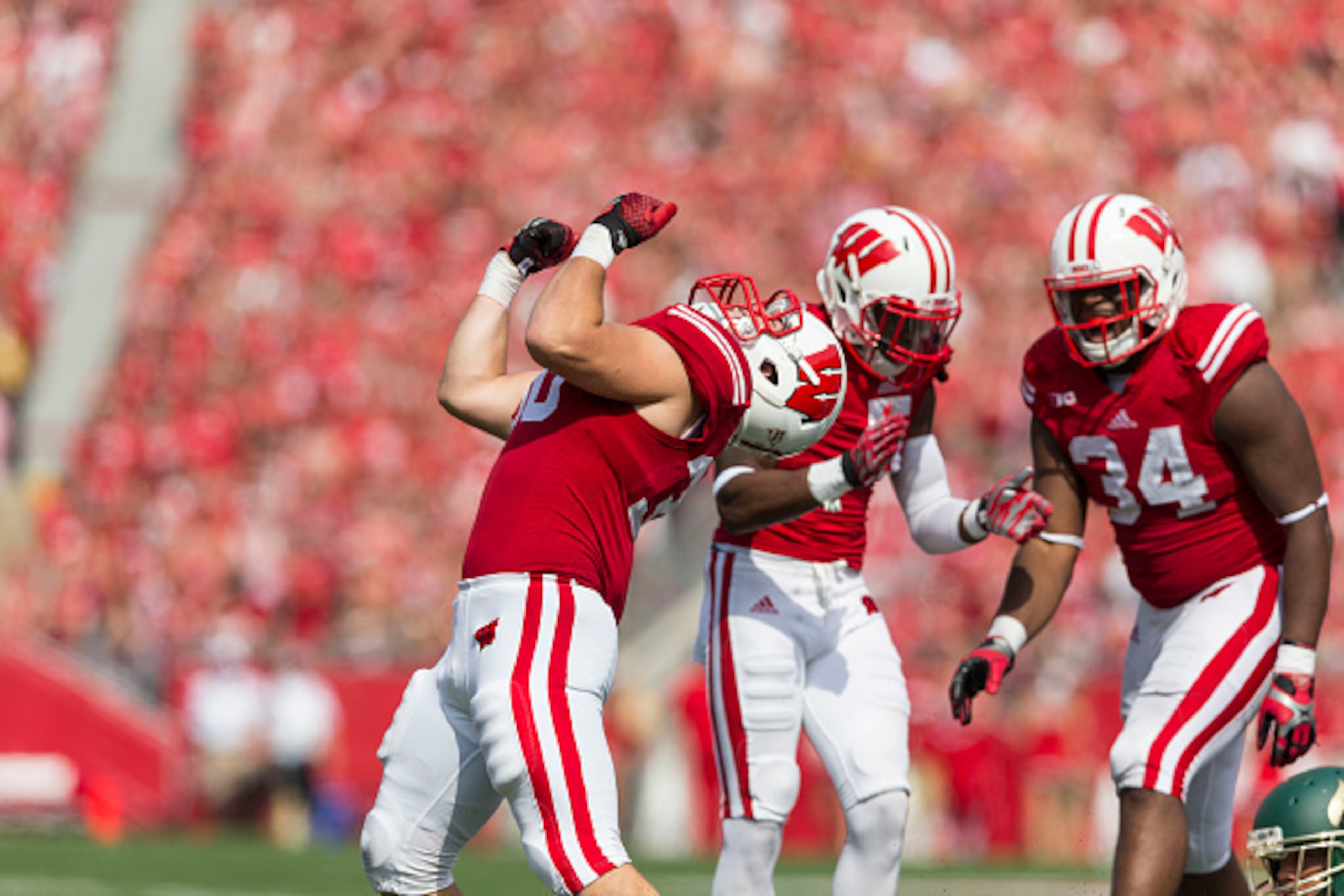

Wisconsin Football: 5 Startling Statistics Through 6 Weeks
Coming into the 2014 season, there was no consensus on how the Wisconsin football team would do. With uncertainty at the quarterback position and a completely rebuilt front seven, expectations were tempered a bit, despite having one of the easier schedules in the Big Ten and a Heisman candidate at running back.
Through the first six weeks of the season, those who were a bit more tepid in their predictions have seen their reservations come to light, just in a slightly different manner than might have been expected.
In Week 1, a pivotal non-conference tilt against LSU, the Badgers saw themselves up 24-7 in the third quarter before ineffectiveness at the quarterback position (Tanner McEvoy went 8-of-24 for 50 yards) and injuries along the defensive line (both Konrad Zagzebski and Warren Herring went down) caused their ultimate demise.
After a well-timed bye week that allowed for Zagzebski to somehow return for the next game, the Badgers coasted in their next three games, but it wasn't always as easy as the scoreline showed. In fact, the Badgers had quite a bit of trouble playing a full game at a high level.
At halftime against FCS Western Illinois, the Badgers were up 9-3 and had trouble doing much of anything on offense. Against South Florida, which went 2-10 the previous season, the Badgers were tied 3-3 at halftime.
These slow starts plagued the team in last week's loss to Northwestern when the team went down 10-0 at halftime. This turned out to be an insurmountable deficit as they fell 20-14 and couldn't get anything going in the passing game while struggling to tackle, which comes back to the original two flaws coming into the season.
But in these opening six weeks, five statistics have stuck out as startling, surprising or amazing. Whether it's the impotence of much of the Badgers receiving corps, the cream of the secondary struggling to make even basic plays and some incredible numbers from the Badger backs, let's look at five of the most eye-popping stats.
9: Receptions by Wide Receivers Not Named Alex Erickson
1 of 5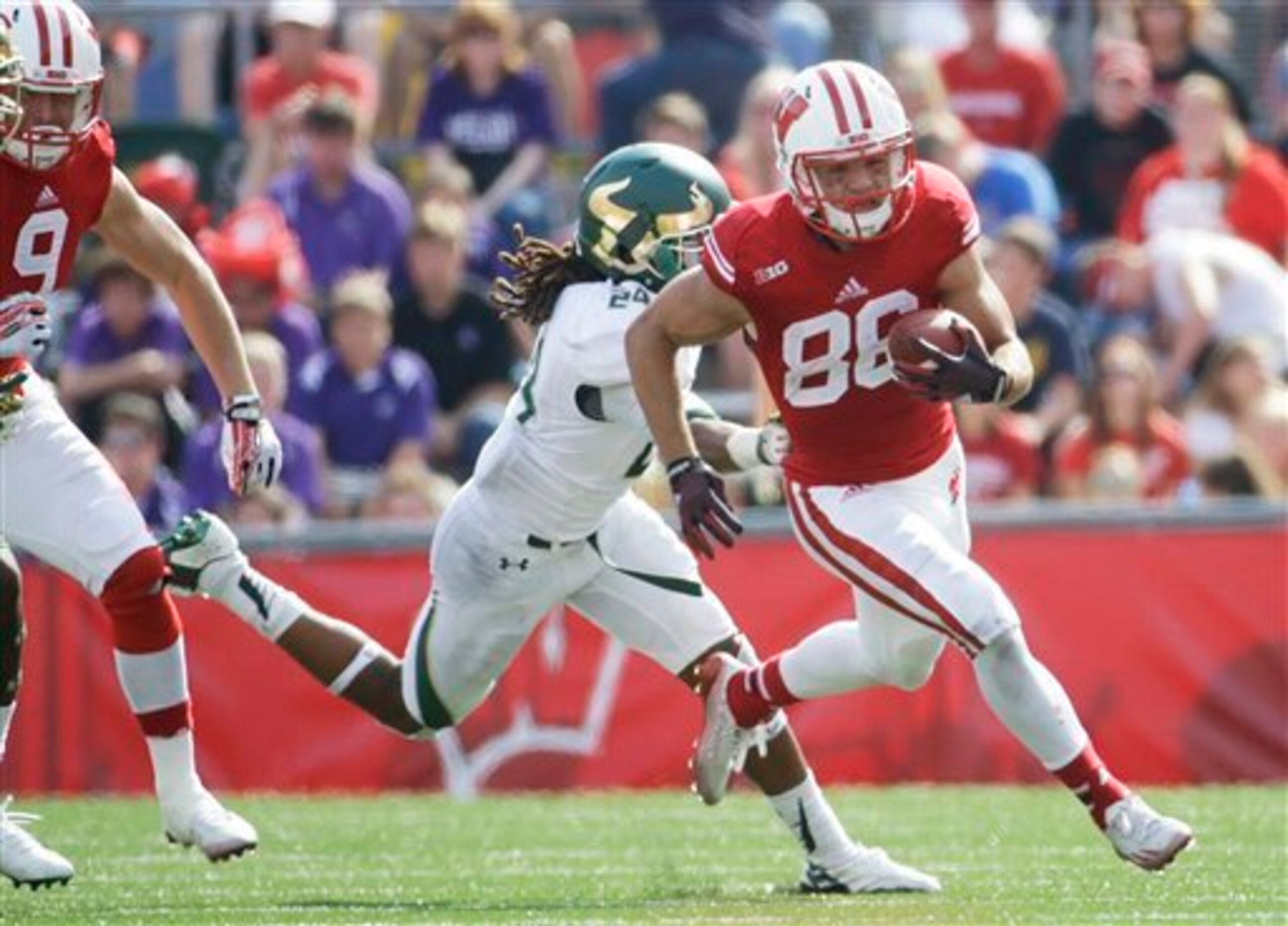
Last season, Jared Abbrederis had 78 receptions for 1,081 yards. Outside of Abbrederis, the rest of the receiving corps had 40 receptions with no other receiver hauling in more than 12 balls—the now-graduated Wisconsin hero Jeff Duckworth being the one with 12.
Coming into this season, head coach Gary Andersen said in the Big Ten coaches teleconference, "We’re going to be wide receiver by committee this year. We’re not going to be receiver by Jared Abbrederis.” Even though Abbrederis is gone, they are still not wide receiver by committee.
Alex Erickson is having an enormous year, hauling in 25 passes for 301 yards. Other than him, no one is averaging more than one reception a game.
Kenzel Doe has five receptions for 43 yards. Jordan Fredrick has two receptions for 23 yards. George Rushing has one reception for 10 yards, and Reggie Love rounds out the group with one catch for two yards.
While the Badgers passing attack has been anemic—and that may be putting it lightly—when the third tight end on the depth chart has more receiving yards than every receiver but one, you know you have a balance problem.
In each of the team's last two games, running back Melvin Gordon logged more carries than he did in either of his first two seasons on campus, including 32 against a sub-par South Florida team due to an inability to get anything going through the air.
With Joel Stave under center, it's likely that a second receiver emerges. Doe will probably be that guy, as the pair linked up for a beautiful 19-yard fade in the end zone. But that is to say that there will be a second receiver.
History shows that unless a team is truly special—the 2011 iteration of the Badgers comes to mind with Abbrederis and Nick Toon, but they also had Russell Wilson under center—having two receivers that make plays is a seemingly unattainable luxury for the team.
While the run-first offense of the Badgers is partially to blame for the lack of reliable targets for more than one receiver, they will really need production out of more than just Erickson if they are to achieve their goals and take a shot at the Big Ten Championship—something still attainable due to the vulnerability of every team in the West.
0: Interceptions by Sojourn Shelton
2 of 5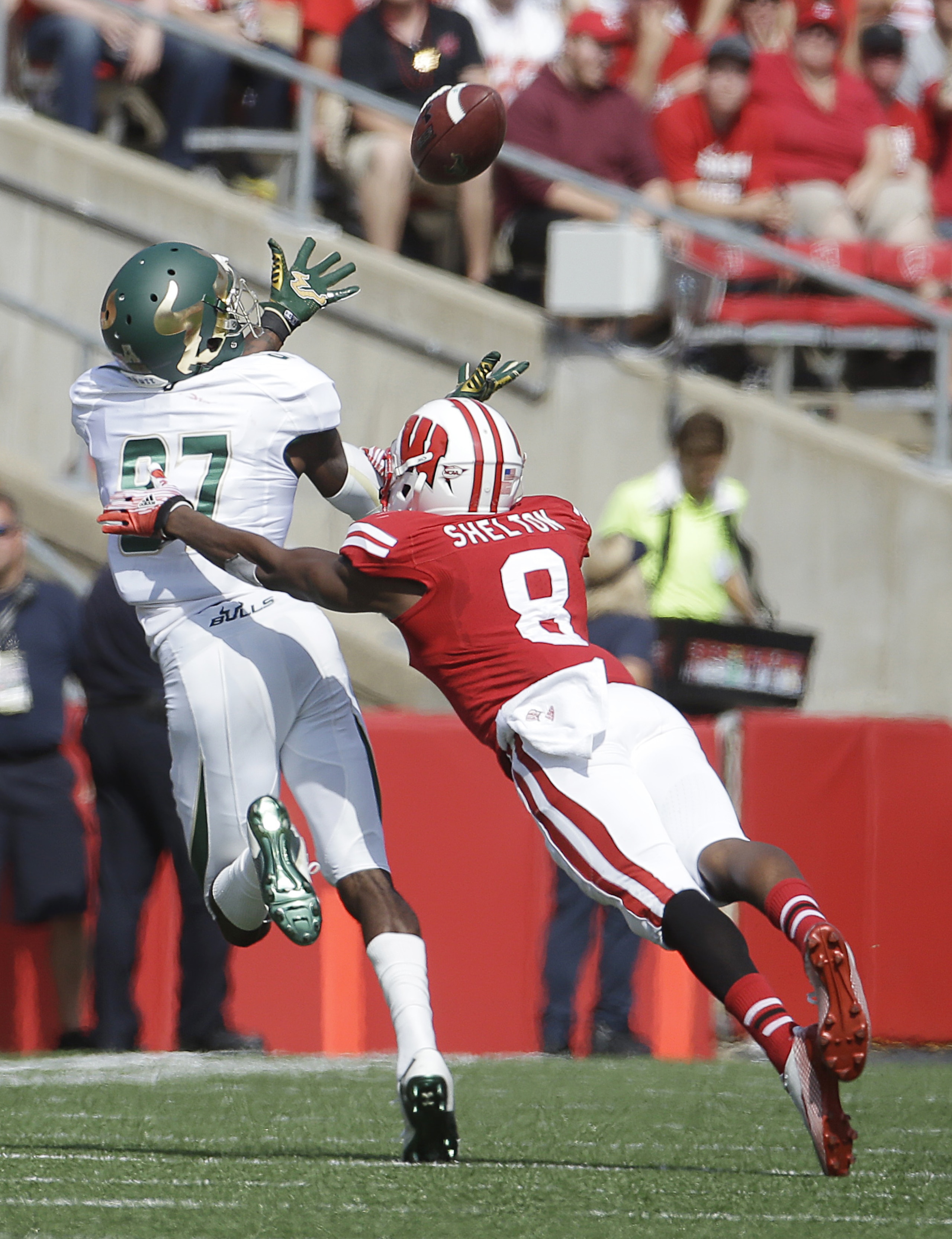
In 2010, Darrelle Revis was one of the best corners in the NFL, yet in the 16 games he played that season between the regular season and the postseason, he did not record an interception.
In 2014, in five games—an admittedly small sample size—Sojourn Shelton, easily the best corner on the team last season, has no interceptions.
While in Revis' case, teams were downright afraid of throwing to wherever he was covering, in Shelton's, that is far from the case. In fact, teams seem to be picking on the diminutive (he stands at just 5'9") cornerback despite his success last season.
In 2013, Shelton led the team with four interceptions and, despite a high-profile drop against Ohio State that ended up costing the Badgers a touchdown on the ensuing play, looked every bit the shutdown corner the Badgers had been searching for.
Fast-forward to this season, and Shelton has been a shell of himself, dropping multiple interceptions including one against Northwestern that would've kept points off the board. Furthermore, last season, Shelton was a reliable tackler, but this season, that hasn't been the case.
Shelton will probably be able to snare an interception one of these weeks as a player with the ball skills he displayed last year doesn't forget how to play cornerback—though the same could be said about a quarterback and their ability to throw the ball, but I digress—and Shelton will hopefully pick up where he left off last season.
62: Carries by Corey Clement
3 of 5
When a backup running back is averaging double-digit carries, it seems odd that the coaching staff is being asked why they are under-using him, but that is exactly the case.
Coming into the season, offensive coordinator Andy Ludwig said to Jeff Potrykus of the Milwaukee Journal Sentinel, "I hope it is extremely similar," when asked about using a similar split of carries as James White and Melvin Gordon had last season.
"That's what we're counting on," Ludwig said. "That's the way we want to roll, keep both backs fresh through the course of the game and healthy through the course of the season."
But so far, the balance between the two backs has been gravely out of sync.
Last season, White had 221 carries to Gordon's 206, an average of about one more carry per game for the senior starter. With the two evenly sharing carries, both reaped the benefits, with White totaling 1,444 yards on the ground (and 300 more as a receiver) while Gordon picked up 1,609 on the ground.
This season, Gordon has 105 carries to Clement's 62, or 8.6 more carries per game. While you want your starting running back to see more touches than the backup, particularly when the starter is a Heisman candidate, the averages don't tell the whole story.
In the opening game, Gordon saw one more carry than Clement, which was due to the hip flexor Gordon suffered during the game. In the next game, an ineffective Gordon carried the ball eight more times than Clement, though it wasn't until McEvoy started completing passes that the team found any room to run.
In a rout against Bowling Green, Clement saw three more carries, though fans can hardly complain when Gordon picks up 253 yards on just 13 carries. Giving him much of the second half off seemed like the only reasonable thing to do in a 68-17 victory.
In the last two games, Gordon has seen a noticeable uptick in the amount of carries he's gotten. Against South Florida, Gordon had 32 carries to Clement's 16. While 16 carries is hardly a shabby total for Clement—in fact, it's his career high to date—giving 32 carries to Gordon is irresponsible.
To Potrykus before the season, head coach Gary Andersen said, "We need to make sure that Melvin is getting his touches. But to say we're going to hand the ball to Melvin 30 times a game would be a mistake. That's not smart. There is a balance there."
Against Northwestern, the lack of balance was even more apparent as Gordon saw 27 carries to Clement's six. While Gordon was the only one able to do much of anything against an inspired Northwestern defense, running for a career high 259 yards, the team will need to utilize Clement more if they want a fresh Gordon in November.
I'm hardly advocating for an even split, but, as Andersen said, Gordon can't take the ball 30 times a game if the Badgers want a chance to play in Indianapolis for the Big Ten Championship. It will take a concerted effort out of both Ludwig and Clement to find creative ways of getting him the ball in space to give Gordon a break.
.jpg?w=2560)
42.8: Yards Melvin Gordon Is Averaging in First Carry After Halftime
4 of 5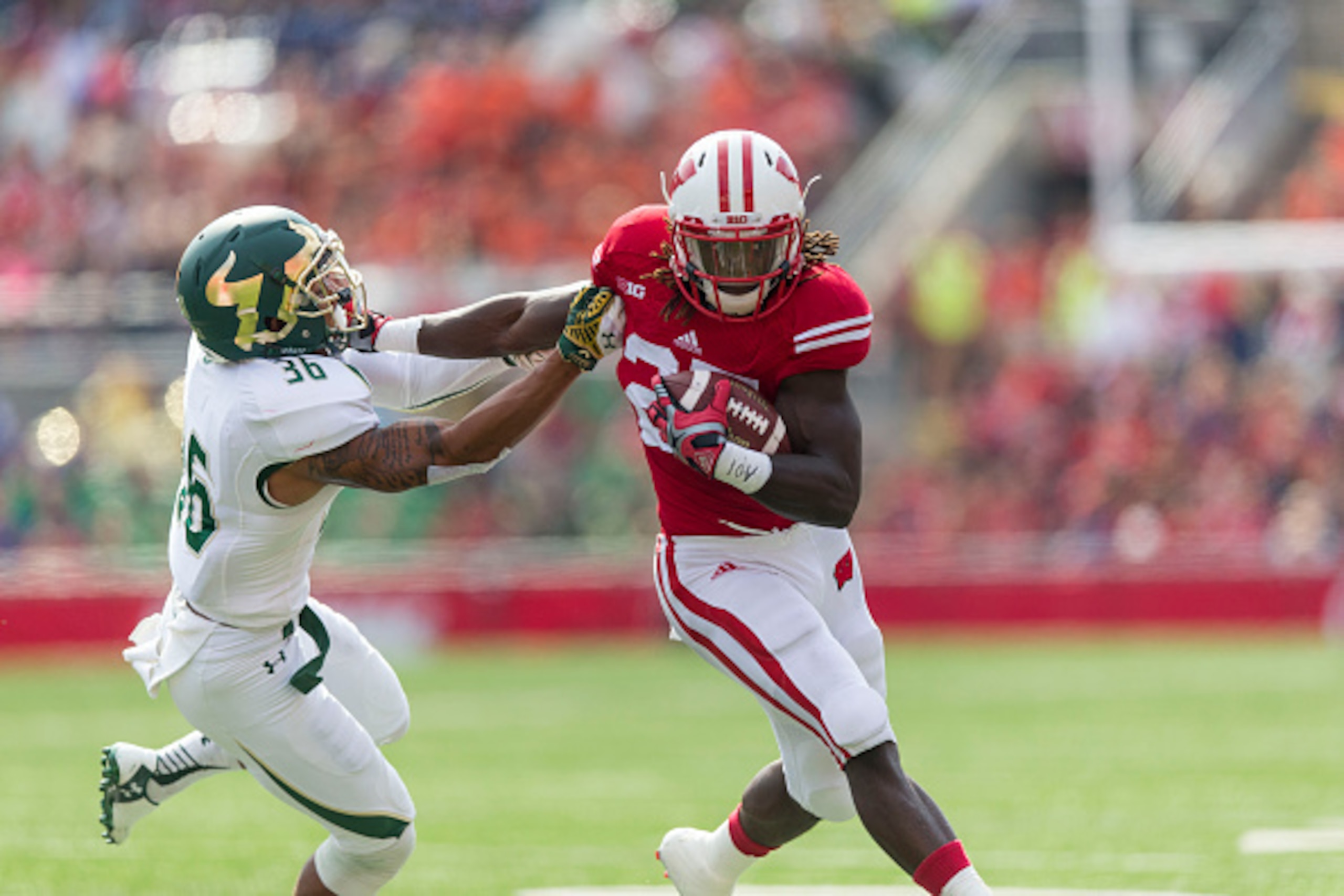
While I wrote quite a bit on Gordon in the last slide, this next stat is absolutely mind-blowing. On his first carry coming out of halftime, Gordon is averaging a whopping 42.8 yards per carry.
Against LSU, with the Badgers holding a 17-7 lead, Gordon took the ball 63 yards on his first carry of the half, setting up a Badgers touchdown, which ended up being their final points of the game in a dreadful second half that saw Gordon barely touch the ball due to an injury.
Against Bowling Green, Gordon scampered 69 yards on his first carry after the break for a touchdown. Against South Florida, Gordon ripped off a 22-yard run to start the third quarter. And last but not least, against Northwestern, down 10-0, Gordon put the team on his back with an impressive 61-yard run on his first carry.
Five games may be a small sample size, but even with his negative-one-yard carry against Western Illinois in the mix, Gordon's 214 yards gained on his first carry after halftime is startling. If Gordon is able to keep up this gaudy average for the whole season including the bowl game, Gordon will finish with more yards (556) than Clement did in 67 carries all of last season (547).
Some may call this a statistical anomaly, but I'll chalk this up to a running back on a mission with a unique combination of skill, determination and breakaway speed to break off a big one right out of the gate in the second half. Heck, one could make an item just about how he has three 60-yard carries this season, regardless of when they came.
22: Runs of 20-Plus Yards
5 of 5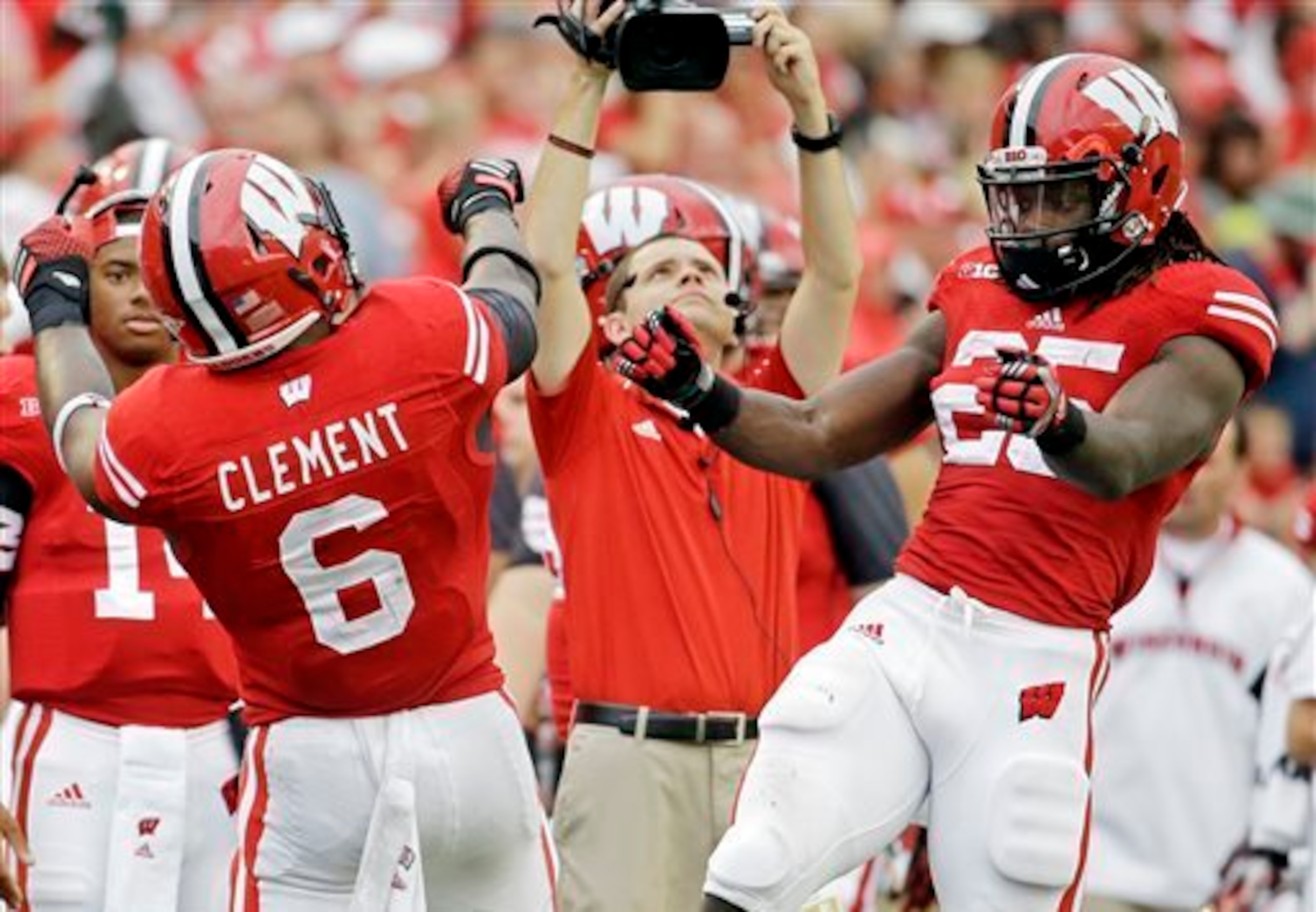
In just five games, the Badgers have ripped off an astounding 22 runs of 20 or more yards, which ties them for the national lead in that category. The team is also tied or leading 40-yard runs with nine, 50-yard runs with six and 60-yard runs with four.
Five different players have a run for 20 or more yards including 13 by Melvin Gordon. Also on the list is a quarterback, a little-used wide receiver and someone who came into fall camp not even on the running back depth chart.
| Player | Runs of 20-Plus Yards |
| Melvin Gordon | 13 |
| Tanner McEvoy | 4 |
| Corey Clement | 3 |
| Reggie Love | 1 |
| Dare Ogunbowale | 1 |
While the Badgers downfield passing attack may be feeble at best in a post-Abbrederis world, with Gordon and Clement in the backfield and McEvoy under center in some capacity—hopefully just as an option quarterback who can keep teams honest with his arm if he rolls out—the Badgers have a lethal rushing attack.
Gordon struggled against Western Illinois when that team completely sold out against the run, putting eight, nine and even 10 men in the box to stop the Heisman candidate. But even without much threat of a quarterback hurting them, opponents have still struggled to contain the Badgers backfield.

.jpg?w=2560 "NFL House in Paris Closes for Protests")

.jpg?w=2560 "Trevon Diggs Cut by Seahawks")