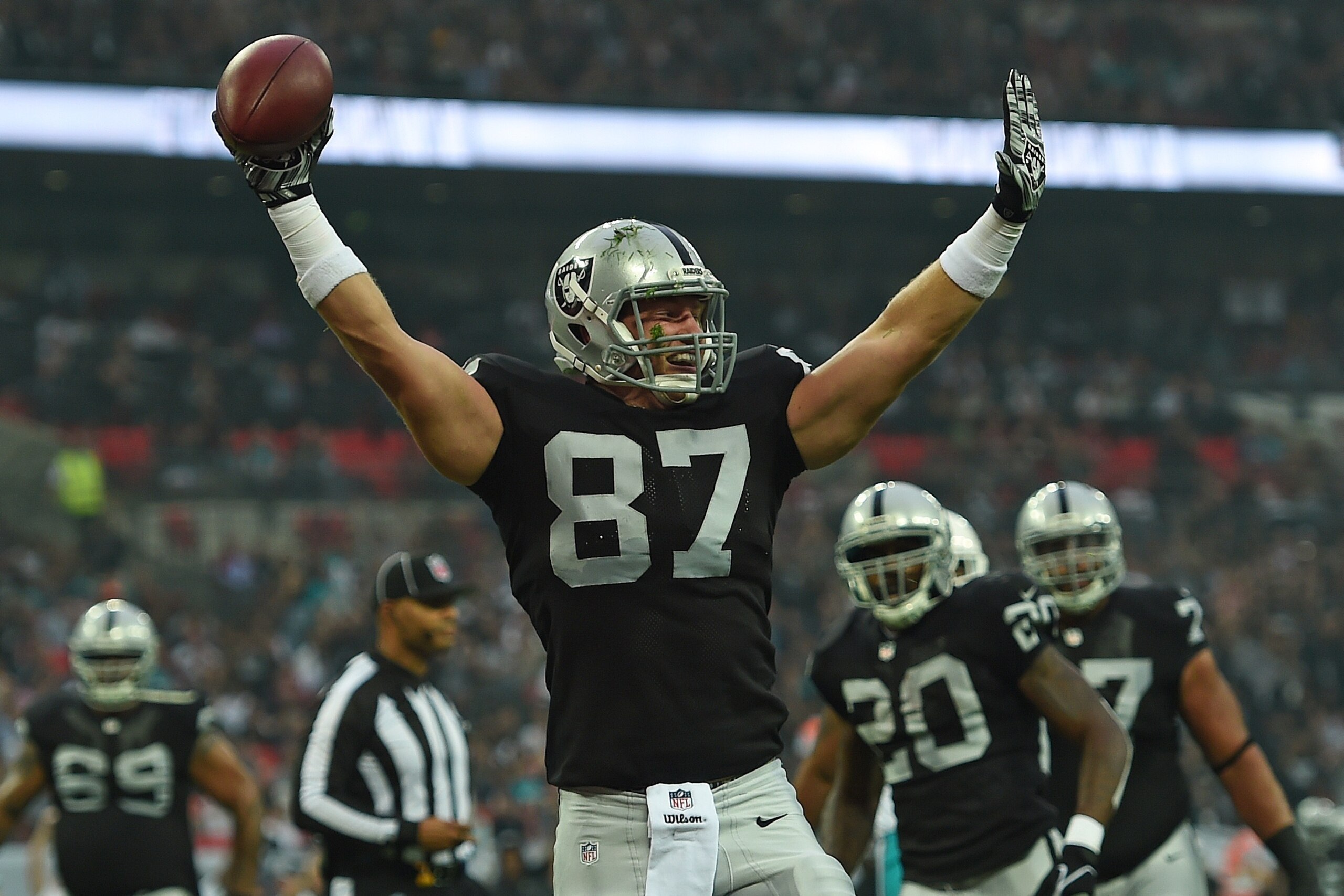


After going through a major overhaul of the roster this past off-season, the Oakland Raiders looked like a team that might finally be able to end more than a decade of futility.
The playoffs were always a long shot, but the new additions to the roster would certainly have this version of the Raiders playing better than the ones that went 4-12 in both of the last two seasons. At the very least, Oakland would be competitive and look like a team trending up, finally on its way out of NFL purgatory.
Four games into the season, none of that has come even close to happening.
The Raiders have begun the season 0-4, and they have almost nothing to be happy about as they head into their Week 5 bye. The offense has been ineffective, the defense has put about as much resistant as a wet napkin, and there's no obvious solution to the problems. The team hasn't been the victim of some bad calls or unlucky bounces—it has just been outplayed in every facet.
Oakland now has two weeks to try and figure out how to salvage the rest of the season, and it will do so with a new head coach. Tony Sparano is now the leader of this team, and if it's any consolation to him, he knows that there's nowhere for this team to go but up.
Here are the grades for each position group as the team heads into its bye week.
Quarterback
1 of 12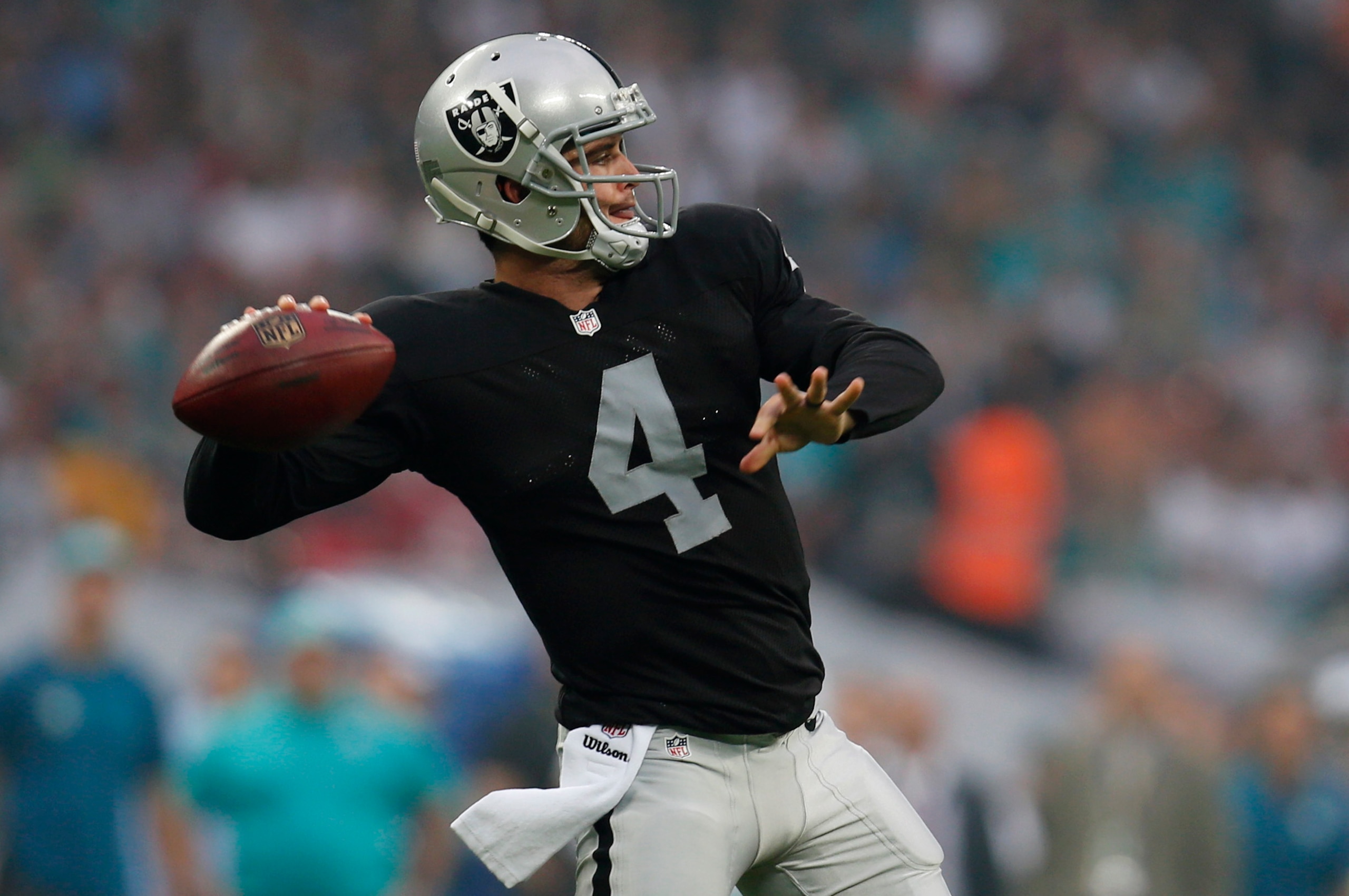
Derek Carr hasn't put up exceptional numbers, but he hasn't played poorly. He's done enough to keep the Raiders in games and has generally avoided committing costly turnovers.
The biggest issue has been the lack of support he's received from the rest of the offense.
Most rookies are protected, but that hasn't happened with Carr. He's currently ranked 14th in the league in pass attempts—ahead of more high-profile passers like Aaron Rodgers, Tony Romo and Peyton Manning—despite leaving the last game early. The burden that he's been asked to assume has gone unnoticed, but it still reflects just how much of the offense he's been asked to carry.
This responsibility has been made more difficult given the lack of a No. 1 receiver and conservative play-calling. These factors have forced Carr to throw short a lot. He's currently averaging 5.52 yards per attempt, the lowest average in the league.
The absence of a running game has also been an issue as it has made the Oakland offense one-dimensional and has put even more pressure on the rookie.
Carr has thrown as many interceptions (four) as touchdowns (four), and this is an obvious area that needs improvement. With as tough a time as the Raiders are having putting up points, they certainly can't afford turnovers, especially from the quarterback.
Still, given the challenges, Carr has played relatively well. He's completed 63.2 percent of his passes, and the offense has had some success moving the ball, even though the points haven't shown up yet.
Oakland has played poorly through four games, but there have been a few glimmers of hope, including Carr's play. He's shown confidence as a leader and poise under pressure. The stats will eventually catch up to his performance.
Grade: D+
Running Back
2 of 12
The running back situation has been a frustrating enigma. Darren McFadden and Maurice Jones-Drew were expected to combine into one of the more potent running games in the league.
Instead, they've both failed to make an impact.
Oakland is averaging a league-low 61.5 rushing yards per game on only 3.4 yards per carry, fifth-worst in the league. And this number is inflated by Derek Carr's surprise 41-yard run from Week 2. If you look at just McFadden and Jones-Drew, the numbers are discouraging.
| Player | Games | Ave. Carries Per Game | Total Yds. | Avg. YPG | Ave. YPC |
| Darren McFadden | 4 | 11.25 | 151 | 37.75 | 3.4 |
| Maurice Jones-Drew | 2 | 5.5 | 12 | 6 | 1.1 |
McFadden and Jones-Drew were supposed to be a two-headed monster in the backfield, but even considering Jones-Drew's two missed games, they've been completely ineffective. They've combined for only 163 yards while averaging 2.25 yards per carry between them.
But while the production hasn't been there, it's just as telling that they've combined for only 56 carries on the season. No matter who the running backs are, that's not enough touches to establish a running game.
The running backs have failed to produce, but the question remains whether this is because they aren't capable or because they haven't had enough opportunities. The Raiders have to hope that it's latter.
Whichever it is, the fact remains that Oakland has had no running game to speak of so far this season. And that won't have a chance to change until McFadden and Jones-Drew combine for at least 20-25 carries a game.
Grade: D-
Fullback
3 of 12
This was supposed to be the year Marcel Reece finally became a regular part of the Oakland offensive game plan. It was supposed to be the year he finally received consistent touches. It was supposed to be the year the Raiders finally made use of his immense potential, both as a ball-carrier and as a receiver.
Unfortunately, this year has been none of those things.
Reece has two carries for seven yards and seven receptions for 36 yards. He once again disappears for extended periods of time in every game, and the coaches still seem unable to figure out a way to get him involved regularly.
This has been especially frustrating given the struggles of the offense overall. With the offense unable to get anything going elsewhere, it seems as if the coaches would be willing to look at other options, especially one as a dangerous as Reece. But so far, that hasn't happened.
For now, Reece is once again an underused weapon in an offense desperate for playmakers.
Grade: F
.jpg?w=2560 "NFL Paris Football")
.jpg?w=2560 "Seahawks Chiefs Football")
.jpg?w=2560)
Tight End
4 of 12
The Raiders headed into training camp with an intriguing group of tight ends. David Ausberry was healthy and was expected to finally exploit his tremendous talent. Mychal Rivera was coming off of a surprisingly productive rookie season and was primed to have an even bigger impact. Even Nick Kasa was showing surprising potential.
But all of that promise quickly disappeared. Ausberry went down with injury again and hasn't had an impact since his return, and Kasa was lost for the year with a knee injury.
That left only Rivera, who has been a disappointment. He's averaging 6.9 yards per catch on 12 receptions, and he's yet to get into the end zone.
Brian Leonhardt has had to fill in at tight end, but he's accounted for only three receptions.
This had the potential to be one of Oakland's breakout units, but it has instead been mostly ineffective. This lack of performance has been especially detrimental because tight ends are supposed to consistently provide an outlet for quarterbacks, particularly a rookie. But Rivera and Leonhardt have been unable to get open and make plays on a regular basis.
While the tight ends have been serviceable as blockers, they've been nonexistent in the passing game. They're going to have to become a much bigger contibutors if the Oakland offense is going to develop any consistency.
Grade: D-
Wide Receiver
5 of 12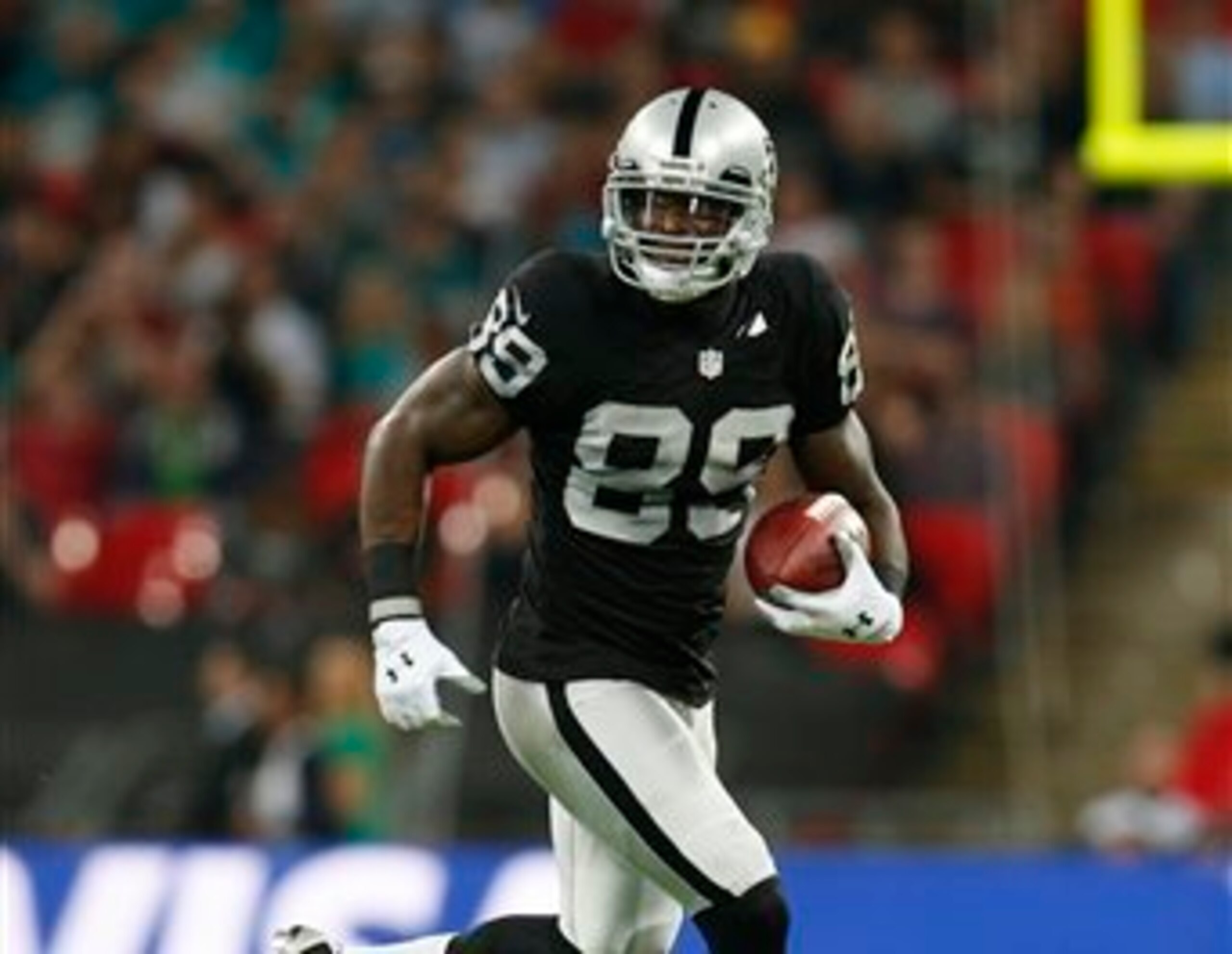
Despite the struggles in the passing game, the Raiders actually have a decent group of wide receivers. The problem is that the depth chart is filled with No. 2 and No. 3 receivers, but no true No. 1. This lack of a legitimate playmaker has been evident in every game this season.
Oakland had hope that this role could be filled by someone on the roster, but that hasn't been the case. Rod Streater was the top option, but he's currently on the injured reserve/designated to return list with a broken foot. According to his agent (via ESPN.com's Bill Williamson), Streater is out until at least Nov. 8.
Denarius Moore was another possibility, but he seems to be playing his way out of Oakland. Despite being healthy and the injury to Streater, Moore was still left off of the active roster in Week 4. It's not a good sign that a team already thin on talent at the position would still rather go without him.
That leaves James Jones, Andre Holmes, Brice Butler and new addition Vincent Brown. These are are good receivers, but not one of them is a true deep threat, which has allowed the opposing defenses to crowd the line and challenge short and intermediate throws. Brown could potentially fill this role, but he's yet to show that he can play at the same level he did with the San Diego Chargers before falling to injuries.
Whether there's a true No. 1 in the group or not, the unit still has to produce. It has at times, but it has more often been unable to get key first downs or make plays to keep drives alive.
Even if the big plays aren't there, this group can still be effective. It needs to produce more frequently than it has to this point.
Grade: D+
Offensive Line
6 of 12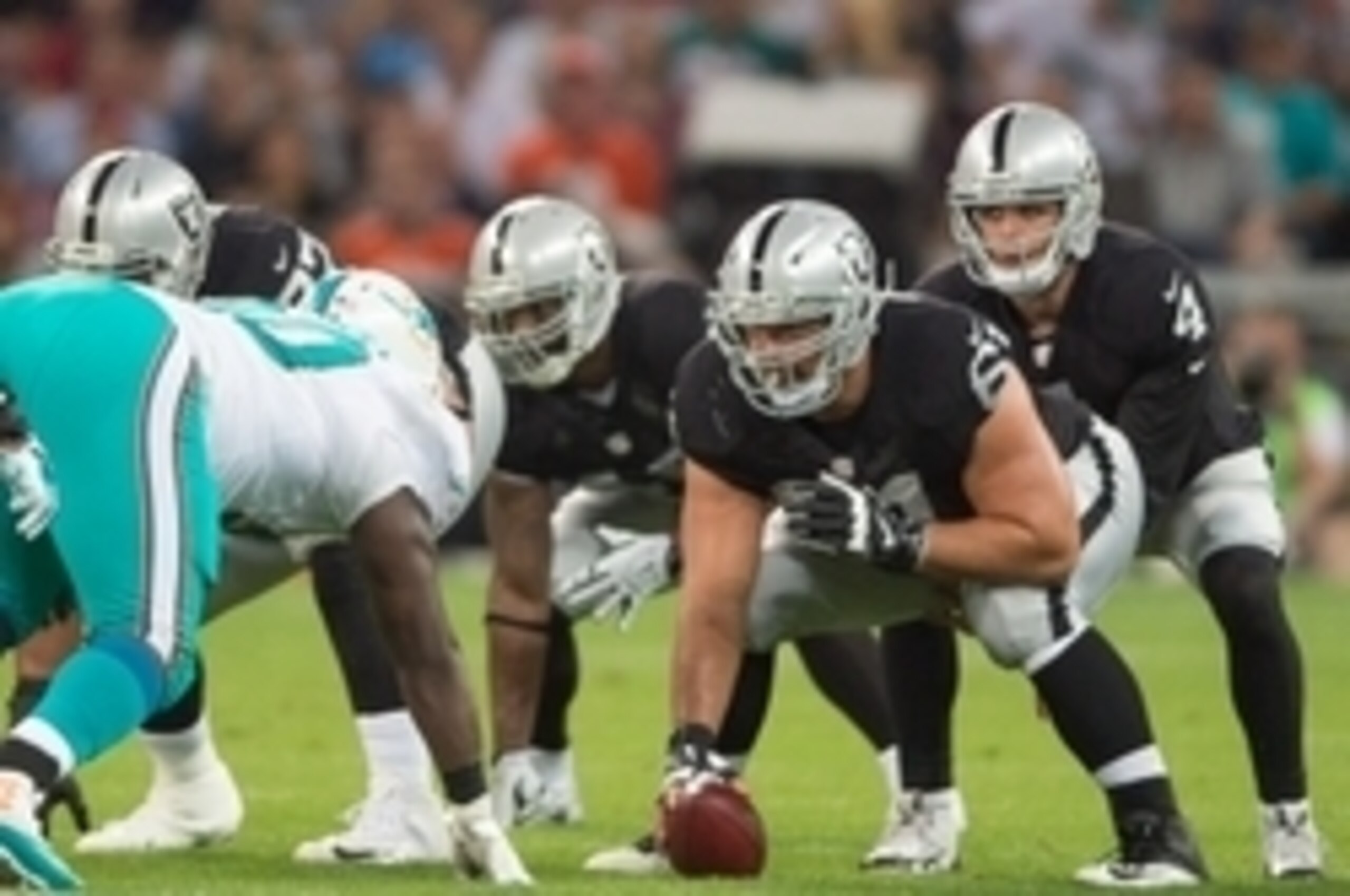
The offensive line has been the most effective unit on the roster. The group has allowed only four sacks and has generally been able to provide enough time for the quarterback.
Carr usually has had enough time to throw, but he's mostly had to settle for shorter completions that make it difficult to sustain drives and put points on the board. This has been due to the wide receivers' inability to stretch the field, something the offensive line can't do anything about.
While pass protection has been solid, the exact opposite has been true in the running game. The Raiders have the second-worst running attack in the NFL, and the offensive line's inability to open up lanes has been a major reason for this.
When this group was put together, one of its major positives was its size, and the expectations were that the group would be able to physically dominate the line of scrimmage. Instead, the line has held up in pass protection but has been unable to get any push on running plays.
The success of the offense will increase with an improved running game, and that won't happen until the offensive line is able to impose its will and be physically dominant.
Grade: C-
Defensive Line
7 of 12
The defensive line has been the single most disappointing unit on the entire Oakland roster. With how bad the team has performed across the board, that's really saying something.
With the addition of three new starters to the four-man front, no unit on the roster went through as much change this past offseason. New signings Justin Tuck, LaMarr Woodley and Antonio Smith, along with the returning Pat Sims, were expected to provide consistent, reliable production, but that hasn't happened.
The four starters have accounted for only 34 tackles and a single sack this season. The pass rush has been nonexistent, and the unit has been terrible against the run, allowing 158.3 yards per game on the ground, second-worst in the league.
In a group of underperformers, Woodley has been the biggest disappointment. He has yet to record a sack, and he's totaled a mere three tackles through four games, including two games in which he recorded none.
Given how bad the unit has performed, it's possible that there will be new faces in the starting lineup in Week 6. With how poorly he's played, Woodley is the prime candidate to head to the bench.
The defense as a whole has struggled, but the problems all begin up front. Until the defensive line starts to play better, the Raiders will continue to put up little resistance against opposing offenses.
Grade: F
Linebacker
8 of 12
This grade comes with a disclaimer: the Oakland linebacker corps has been decimated by injuries.
Starting middle linebacker Nick Roach has yet to play this season, and Sio Moore has been out with an ankle injury since Week 2. In Roach, the defense lost its leader and play-caller, and Moore's absence has left the defense without its most consistent performer.
This has forced Oakland to make due with Miles Burris and Kaluka Maiava. Both players can contribute in spot duty, but neither should be starting. Unfortunately, injuries have forced them into this role, and they've both been exposed because of it. They simply don't have the speed or the tackling ability to be every-down defenders.
The one bright spot has been Khalil Mack. Although he hasn't provided any highlight plays and he's yet to record a sack, he continues to be one of the NFL's top-rated linebackers. His performances have been lost in the overall poor play of the defense, but he's been solid against the run and is starting to get a feel for pass coverage.
More importantly, he's beginning to figure out how to consistently get in the backfield. He doesn't have a sack yet, but once he gets his first one, he'll start to get them in bunches.
The linebackers have struggled, but they also haven't been anywhere near full strength. This group's true form won't be known until Roach, Moore and Mack are all on the field at the same time.
Grade: D+
Secondary
9 of 12
While the Raiders are currently ranked fourth in the league against the pass, giving up only 207 yards per game, this stat is misleading. The truth is that opposing offenses have had so much success running the ball against Oakland that they haven't had to rely on the passing game.
But when teams do throw on Oakland, the secondary is exposed for what it truly is.
If you're a struggling quarterback, the Oakland secondary is what you want to face on game day. The proof is in the opposing quarterbacks' performances against Oakland versus their overall performances this season.
| Opposing QB | QBR vs. OAK | Overall QBR | +/- | Comp. % vs. OAK | Overall Comp. % | +/- |
| Geno Smith | 96.6 | 75.1 | +21.5 | 82.1 | 60.3 | +21.8 |
| Ryan Fitzpatrick | 129.1 | 86.2 | +42.9 | 73.3 | 65.2 | +8.1 |
| Tom Brady | 91.5 | 79.1 | +12.4 | 64.9 | 59.1 | +5.8 |
| Ryan Tannehill | 109.3 | 81.2 | +28.1 | 74.2 | 60.0 | +14.2 |
| Average | 106.6 | 80.4 | +26.2 | 73.6 | 61.2 | +12.4 |
Smith is still inconsistent, Brady looks like an over-the-hill quarterback, and Fitzpatrick and Tannehill have no job security beyond their next game. Yet all four had good to great performances against the Raiders.
Carlos Rogers and Tarell Brown were supposed to add veteran leadership to the unit, but they've mostly just looked a step slow, and D.J. Hayden is once again sidelined with an injury. Chimdi Chekwa has looked bad when given opportunities, and TJ Carrie has shown promise but remains inconsistent.
The group's top performer has been Charles Woodson, who looks sharper and quicker than the rest despite being 37 years old.
With how easily the secondary has been picked apart, it's going to take a combination of accountability and creative scheming from the coaches to get it to at least be serviceable.
Grade: F
Special Teams
10 of 12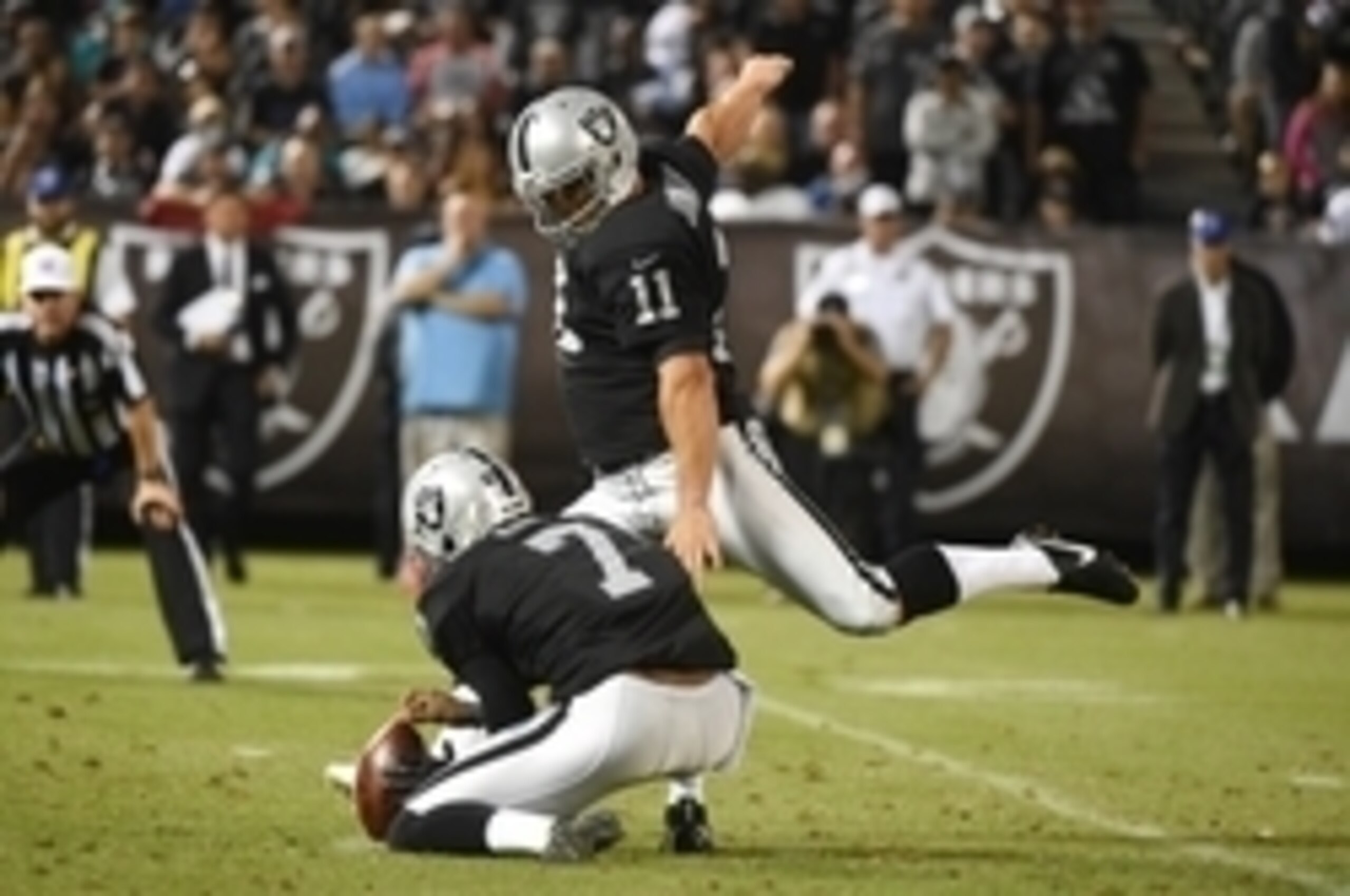
Marquette King has arguably been the Raiders' MVP so far this season. This is both an indictment of the team's overall performance and a testament to King's consistency. He's been busy all season, beginning with nine punts in Week 1. He has a total of 23 punts, tied for most in the league.
He's averaging 44.7 yards per punt, down from the league-high 48.9 yards per punt he averaged last season. But opponents have averaged only 6.7 yards per punt return, good for 12th in the league.
Sebastian Janikowski seems to be as strong as ever. The biggest issue has been the lack of field-goal opportunities. Janikowski has kicked only three this season, and all of them were in Week 3 against New England. He went 3-for-3 in the game, but the team continues to not take advantage of one of the strongest legs in the league.
It says a lot about the offense's inability to move the ball that even with a leg as strong as Janikowski's, the team has managed to get in field-goal range only three times this season.
Latavius Murray is averaging 23.5 yards per kick return (17th in the league), and TJ Carrie is averaging nine yards per punt return (12th in the league). Although there haven't been any returns for touchdowns, Murray and Carrie have consistently provided at least solid returns.
Special teams coverage hasn't been outstanding, but it hasn't given up any returns for touchdowns. It's generally been mistake free, and it hasn't forced the team into difficult situations.
Overall, Oakland's special teams have been solid. It might not be much, but the team has at least this to not worry about.
Grade: C-
Coaching
11 of 12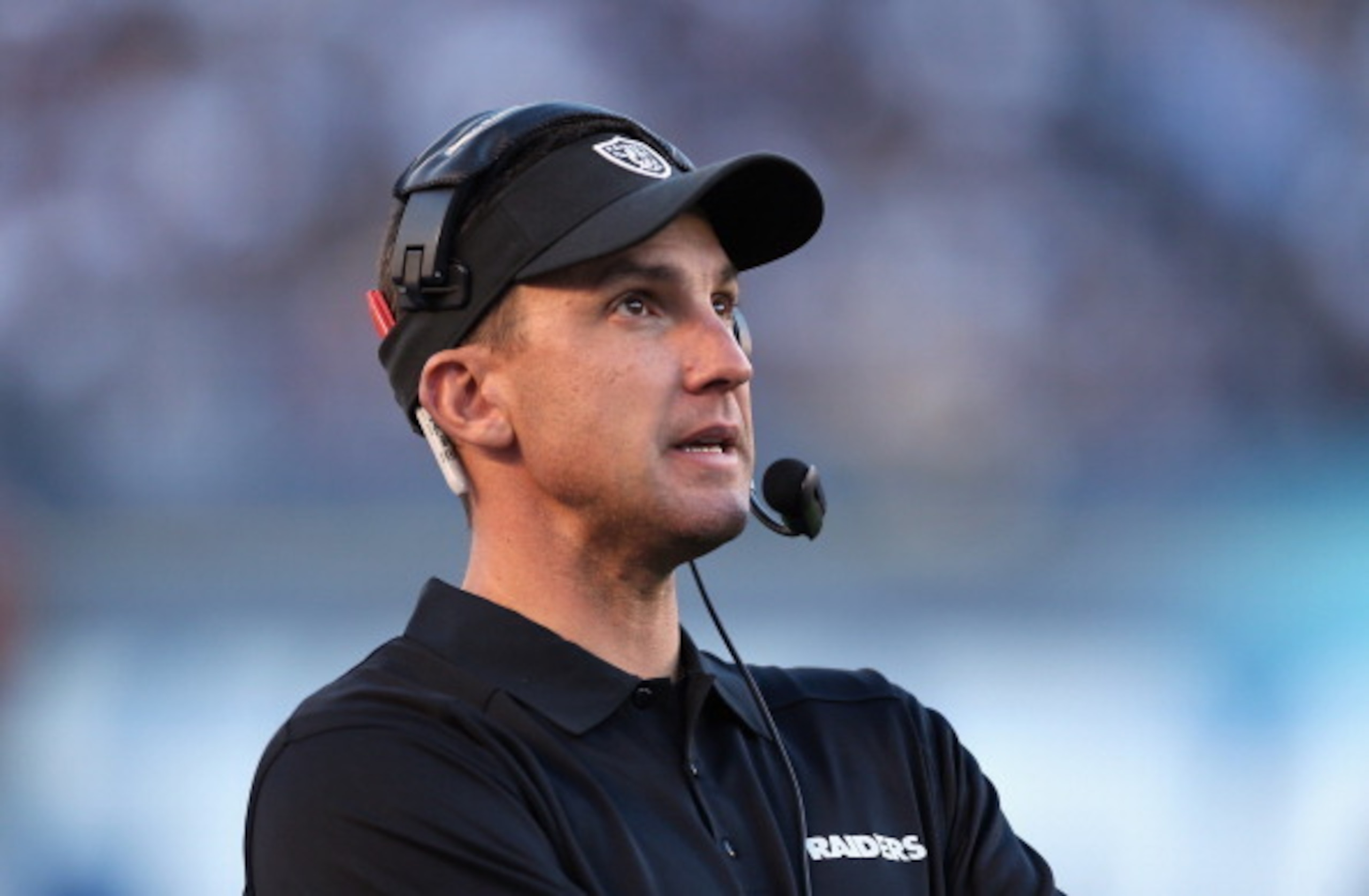
When the head coach is fired after just four games, there's really only one grade that can be given.
The Dennis Allen era came to an inglorious end on Monday, following their Week 4 blowout loss to the Miami Dolphins, when the now-former Oakland head coach was fired upon the team returning from London. The firing could be seen as a knee-jerk reaction, a desperate move by a failing franchise looking for a scapegoat for its most recent season of ineptitude.
Those things might be true, but it doesn't mean that the team didn't make the right decision.
You can blame the overall shortage of top-tier talent—or shortage of talent overall—for Oakland's struggles, or you can blame the ineffective play-calling and game-planning by the coordinators, but the responsibility for the team's success or failure falls on the head coach.
Here are the facts: Allen accumulated a record of 8-28 in his time in Oakland, and the team has not only not shown improvement from season to season. Rather, the team has actually regressed. That's been painfully obvious this season as Oakland is off to an 0-4 start and has looked embarrassingly bad in the process. It may not seem like much of a difference—a loss is a loss, right?—but Oakland hasn't even been competitive.
Now Allen is gone, and defensive coordinator Jason Tarver and offensive coordinator Greg Olson will have to prove that they haven't been as much a part of the problem as many suspect. Right now, they look like two coaches in over their heads, game-planners and play-callers who don't have the creativity or the savvy to turn things around. They'll both spend the rest of this season trying to prove that they deserve to keep their jobs.
Now, the responsibility for all of this belongs to interim head coach Tony Sparano, who achieved mixed results while leading the Miami Dolphins to a 29-32 record over three-plus years before being fired 13 games into his final season.
At the very least, he seems to have the personality to light a fire under the Raiders roster. He'll be able to get this group to play hard. Even in a loss, that'll be an improvement.
Grade: F
Overall Team Grade
12 of 12
| Position Unit | Overall Grade |
| QB | D+ |
| RB | D- |
| FB | F |
| TE | D- |
| WR | D+ |
| OL | C- |
| DL | F |
| LB | D+ |
| Secondary | F |
| Special Teams | C- |
| Coaching | F |
| Cumulative Grade | D |
The Raiders had few games considered winnable heading into the season. Three of those—Week 1, Week 2 and Week 4—have already passed. Oakland lost all three and was embarrassed in two of them. The one decent performance came in Week 3 in New England, but with how bad the Patriots have looked, that performance could lose more and more significance with each passing week.
The defense hasn't been able to stop anyone this season. Whether it's through the air or on the ground, offenses have been able to move the ball up and down the field at will. The solution has to start up front. If the defensive line can generate consistent pressure on the quarterback, it'll make the job easier for the rest of the defense.
The offense has had sporadic success moving the ball, but it hasn't produced enough points. Oakland is yet to score more than 14 points in any game. No matter what the defense does, wins are going to be hard to come by unless Carr can lead the team to more points.
As bad as Oakland has looked, it certainly has the talent to play better than it has so far. The players and coaches have until their Week 6 matchup at home against the San Diego Chargers to figure out how to finally tap into that potential and earn the first win of the season.
Unless otherwise noted, stats provided by from ESPN.com.
Share your thoughts and opinions on Twitter @BrianJ_Flores.
.jpg?w=2560 "Colts Football")