The One Thing Holding Andre Drummond Back from Reaching His Full Potential
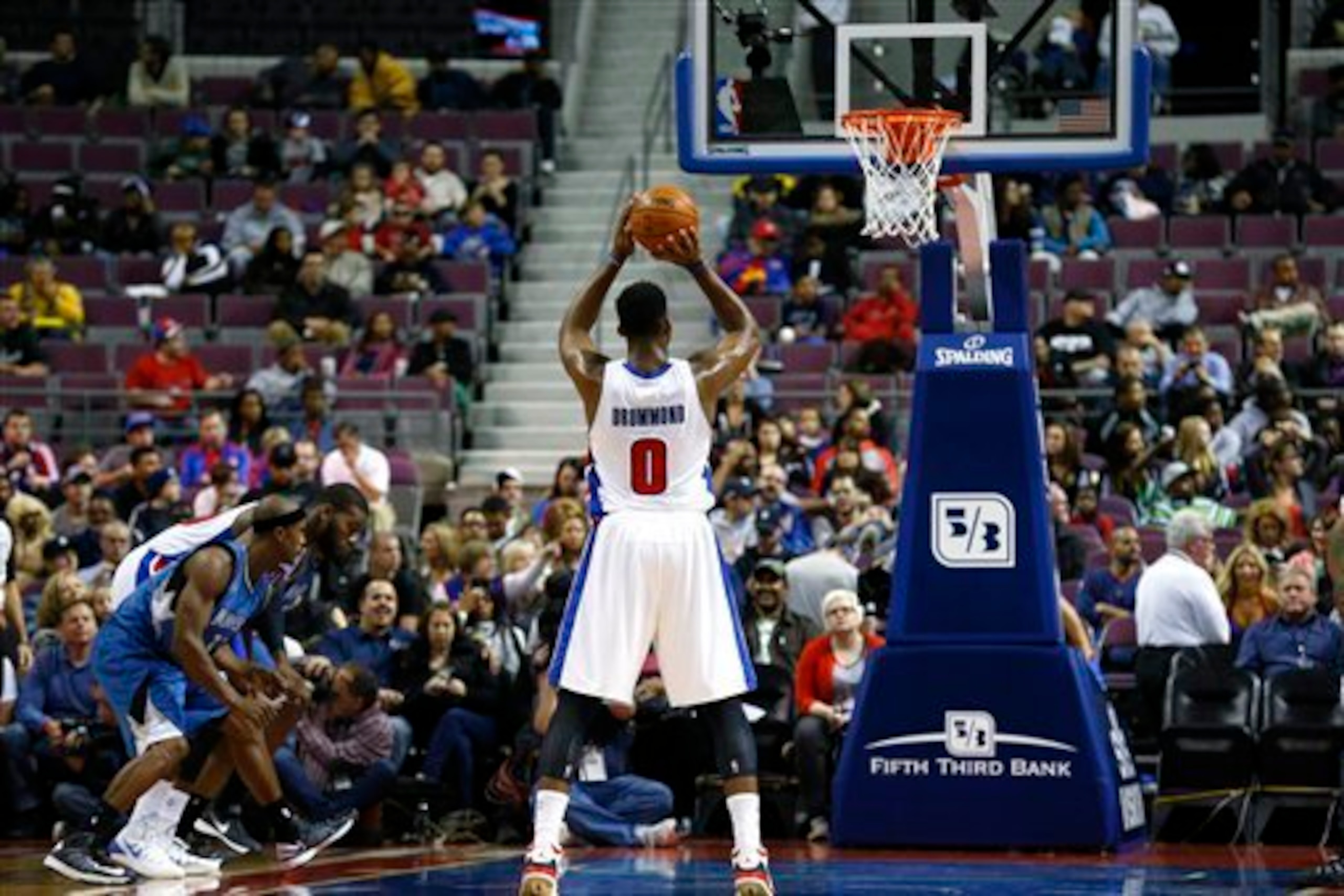
Andre Drummond is far from a finished product, but there is one hole in his game that dwarfs all others—free-throw shooting.
Drummond made 41.8 percent of his free throws last season. Only one player in NBA history has posted a worse mark in a season with at least 300 free-throw attempts—Wilt Chamberlain.
Drummond's free-throw shooting was similarly bad as a rookie, bad enough to inspire Truehoop's Ethan Sherwood Strauss to write Drummond a somewhat embarrassing open letter, encouraging him to try shooting free throws underhanded:

"We both know your free throw efficiency factors into the intentional fouls. It’s easy to see why defenders would avoid your 60.8 percent field goal shooting in favor of your 37.1 percent free throw shooting. Until the league addresses "hack-a" strategies, you’ll also have to deal with teams fouling you before the play even starts.
"
Drummond only averaged four free-throw attempts per game last season. That is a small total and means the difference between his free-throw percentage and a league-average player only cost his team about 1.3 points per game last season.
For a player who does so many things well, and inhabits such a small role on offense, free-throw shooting may seem like a small flaw to be focused on. Drummond was among the best rebounders in the league last season—offensively and defensively. He rarely turned the ball over, was among the best finishers in the league and is well on his way to becoming a defensive force.
However, this small flaw is an enormous factor in his overall impact.
According to the NBA's SportVU Player Tracking statistics, Drummond touched the ball 3,266 times last season. He was fouled 259 times over the course of the season, which works out to being fouled on about eight percent of his touches. If we filtered those touches and fouls to only include ones which occurred in the frontcourt, the number would probably be much higher.
Knowing you are going to be fouled regularly, undoubtedly changes the way you play. That fact is especially true when you've had experiences like this:
Going back to the SportVU statistics, we see that Drummond touched the ball 40.3 times per game on average last season. But on average, he actually had the ball in his hands for just 0.8 minutes per game. That means his average touch lasted about 1.2 seconds before he passed the ball, shot the ball or—about eight percent of the time—was fouled.
Those short touches are partially a function of how he is used in the offense—primarily as a screener and finisher around the basket. On one hand they are a good thing, as many of those short touches led directly to easy baskets. However, they also show what a small window he has for developing a comfort level with the ball in his hands, a prerequisite for developing new facets to his offensive game.
The fear of being fouled has both Drummond and his team working in concert to make sure that the vast majority of his touches are brief and end with a dunk. It's a noble goal, but it also lowers his ceiling and solidifies him as the player he is right now. This semi-intentional limiting of Drummond also can be seen in different ways during the course of a game.
The table below shows Drummond's offensive involvement throughout the game, measured as possessions used per-36 minutes in each quarter. It also shows what percentage of his offensive possessions ended in trips to the free-throw line in each quarter.
| Quarter | Poss. per-36 Minutes | % of Poss. from FTA |
|---|---|---|
| 1st | 15.0 | 7.9% |
| 2nd | 15.3 | 13.8% |
| 3rd | 13.4 | 17.7% |
| 4th | 12.5 | 19.3% |
You can see that Drummond's offensive involvement shrinks as the game goes on. More than twice as many of his offensive possessions in the fourth quarter end in shooting fouls than in the first quarter.
We can't attribute the entirety of this trend to Drummond's poor free-throw shooting, but it's likely a fairly significant factor. Teams are more prone to foul him quickly down the stretch of games and his teammates, aware of this fact, seem less likely to involve him.
If his poor foul shooting is drawing a noose around both his involvement and his development, then clearly improvement from the line is the key to improvement in other places. However, the statistical track record is not good.
Research by Kevin Pelton at Basketball Prospectus found that, on average, players improve their free-throw shooting by a modest 0.7 percentage points per season up through age 27. At that rate of improvement, Drummond would hit his free-throw percentage peak at 46.7 percent. However, Pelton's research is looking at all players not just those who start near the bottom of the barrel.
In the three-point era, 10 players besides Drummond have shot less than 60.0 percent from the line on at least 450 free-throw attempts, across their first two seasons. Of those 10, six eventually pushed their free-throw percentage past 65.0 percent in a season. That group includes some players who actually become respectable from the line—Karl Malone, Rony Seikaly and Blake Griffin.
However, the average rate of improvement for the entire group was about 1.7 percentage points per season. That rate of growth would put Drummond at 53.7 percent by age 27, a huge improvement, but still far from respectability.
Ten players is an extremely small sample, far too small to draw any realistically reliable conclusions about Drummond's potential for growth. The small sample size may actually be even more telling here—just 10 other players were as unreliable at the stripe during their first two seasons as Drummond has been, and his numbers are even at the bottom of this group.
It is important to note that despite Drummond's poor free-throw shooting, the rest of his game undoubtedly makes him a net positive to have on the floor. His combination of ferocious offensive rebounding and high-efficiency (albeit low-usage) scoring has ESPN's Real Plus-Minus estimating him as the fourth most effective offensive center in the league last season.
That's not enough. From the ill-fitting trio of Drummond, Josh Smith and Greg Monroe, Drummond has by far the most potential. He is the center of the Pistons' present and they would very much like him to be the center of their future as well. Those optimistic visions of the future show a player who is much more dynamic and versatile at the offensive end, one who can elevate the group instead of needing to be compensated for at the end of games.
Making that dream a reality means making free throws at a respectable percentage.
Statistical support for this story came from NBA.com/stats, unless otherwise stated.

.jpg?w=2560 "NFL House in Paris Closes for Protests")
.jpg?w=2560 "Trevon Diggs Cut by Seahawks")