Missed Throws and Missed Receivers Highlight Aaron Rodgers' Early Struggles
After years of Aaron Rodgers making the most difficult position in sports look so easy, it can be jarring to the optics when the Green Bay Packers quarterback goes through a taxing period like he has to start the 2014 season.
Through three games, Rodgers is on pace for new career lows (since 2008, when he became the starter, excluding 2013, which was shortened due to injury) in completion percentage, yards per attempt, touchdown passes and passing yards.
He's thrown just one interception and still has a passer rating of 95.1, but missed throws and missed open receivers have highlighted his uncharacteristically sluggish start to this season.
.jpg?w=2560 "Commanders Eagles Football")


"I haven't been as sharp," Rodgers said after Sunday's 19-7 loss in Detroit, via the team's official site. "It may be the standard I've set, but we all have to do better."
| at SEA | 23/33 | 189 | 5.7 | 1/1 | 81.5 |
| vs. NYJ | 25/42 | 346 | 8.2 | 3/0 | 109.8 |
| at DET | 16/27 | 162 | 6.0 | 1/0 | 88.8 |
| TOTAL | 64/102 | 697 | 6.8 | 5/1 | 95.1 |
The NFL's beacon of consistency on offense since Rodgers took over as the team's starting quarterback, the Packers will enter Week 4 averaging just 18.0 points (27th in the NFL) and 289.3 yards (28th) per game. Green Bay has never finished outside the top 10 in points scored since '08, and only once has the offense not been in the top 10 for yards (2012, 13th).
Last season, the Packers ranked eighth in points (26.1) and third in yards (400.2) despite Rodgers missing the better part of nine games.
To be fair, three weeks represent nothing more than a fraction of a 16-game schedule. Over 80 percent of the 2014 season remains. But the Packers offense has looked off in 10 of the first 12 quarters, and Rodgers is at least partly to blame.
Two issues stick out from the rest: Rodgers is missing throws he typically makes in his sleep, and he's also missing open receivers while locking on to receiver Jordy Nelson.
The poor throws have come in big spots.
In the opener in Seattle, the Packers came out of the half down just seven points and forced a punt. Rodgers and the offense took over at the 14-yard line with a chance to drive 86 yards and tie the game.
Instead, the first play of the series was also the last, as Rodgers' throw ended up too far in front of Nelson, who stretched for the football but couldn't come down with the catch. The resulting deflection was easily intercepted by cornerback Byron Maxwell, and the Seahawks later kicked a short field goal to go up 10 points in the third quarter.
Here's a look at Nelson's attempt to make the reception:

Nelson has made more difficult catches in his decorated career, but Rodgers has also hit Nelson between the eight and the seven numerous times on this same route. There was little pressure, and the window to make the throw was not at all squeezed by the linebacker to the inside or the cornerback underneath. Rodgers makes this throw and moves the chains 99 out of 100 times.
The one miss began an ugly turn of events for the Packers offense—including a sack on fourth down and a safety on the next—that essentially gave the game to the Seahawks.
Two weeks later, Rodgers missed on a similar throw and in another big situation.
Down 19-7 to Detroit with roughly seven minutes left, the Packers faced fourth down from the Lions' 20-yard line.
While everyone in the stadium likely believed Rodgers would look for Nelson, the Packers actually got what they wanted on the play. Nelson was aligned in the slot to the right of a four-wide formation. The Lions stayed in their nickel defense, choosing instead to task linebacker DeAndre Levy with playing underneath technique in Detroit's Cover 2 shell.
Levy did a decent job of riding Nelson up the seam. But when Nelson got behind and turned inside on the post, he was essentially wide open. Glover Quin, the safety on the play, drifted too far outside on his bracket coverage. All Rodgers needed to do was lead Nelson slightly to the inside, and the Packers would have closed the deficit to five points with seven minutes to play.
Instead, Rodgers' throw was well behind Nelson, who needed to stop and contort his body backward to even get a hand on the football. The attempt fell incomplete, and the game was essentially over.
"I missed him," Rodgers said. "I missed a throw I've made many times. He ran a great route."
Two poor throws, two game-changing moments.
Rodgers is human, making him prone to mistakes of even the most common of quarterbacks. Still, neither throw is one Rodgers would be expected to miss, especially considering the gravity of the two game situations.
Possibly more concerning is the number of big plays Rodgers has missed down the field this season.
Again, no quarterback has the superhuman ability to see everything on a given play. But on more than one occasion, Rodgers has locked on to Nelson and missed open receivers.
Rewind back to Green Bay's first series of the second half Sunday. The Packers faced a manageable third down as the offense neared midfield.
However, Tim Masthay was brought on to punt a play later, in large part because Rodgers didn't come off Nelson in time to find an open Randall Cobb.
Here is the screenshot of the play as Rodgers hit the top of his dropback:
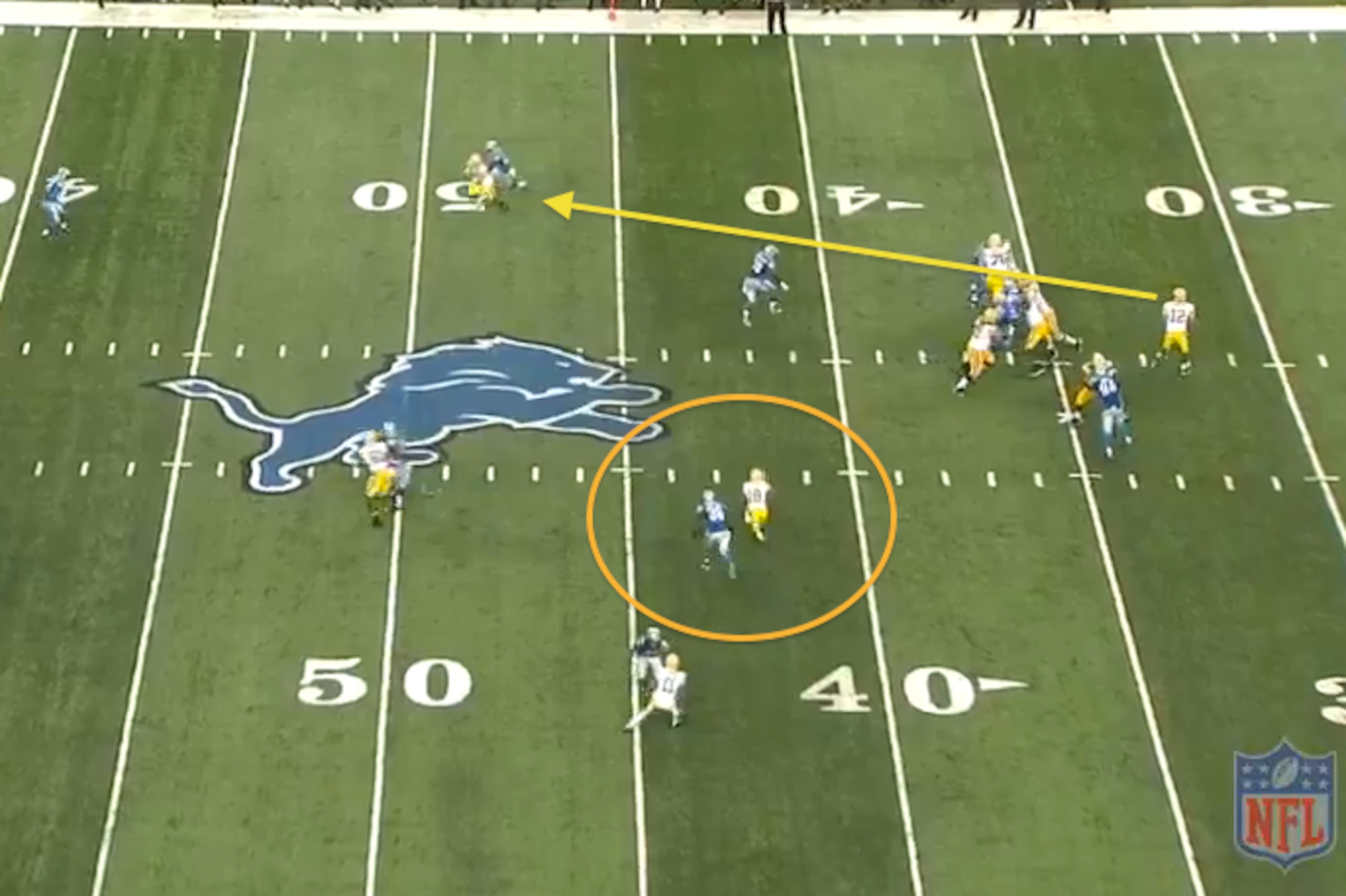
Nelson is clearly bracketed by a cornerback and safety, much like the Lions accomplished for most of the contest. But look over the middle at Cobb, who had run a quick angle route to the inside and created more than enough space against slot cornerback Danny Gorrer. The Lions had no help to the middle of the field.
But because Rodgers spent so much time on his first read, Cobb was missed. He eventually scrambled to his right and then tried to squeeze a throw into Cobb as he motored to the sideline, but it was too late. The drive stalled, and the Packers were forced to punt.
Missing a third-down conversion isn't the end of the world. However, a series later, the same problem erased what should have been a walk-in touchdown for Cobb.
The Packers faced another third down. Head coach Mike McCarthy attacked the situation with four receivers, placing Cobb in the slot to the right and Nelson in the slot to the left.
While the Lions played Cover 2 for most of the game, this happened to be one play where Rodgers received a single-high safety look. Quin played high, while Isa Abdul-Quddus came down and lined up man-to-man against Cobb.
All this information should have been very clear to Rodgers in the pre-snap phase. While Nelson was a still a good matchup against Gorrer to the left, Cobb had the perfect route to beat this coverage for a big play.
Nelson attempted to run an out-and-up but was tripped up (drawing a penalty). Quin shaded his way, leaving Cobb—who ran a perfect stop-and-go against Abdul-Quddus—wide open down the middle of the field.
Here's the field just after Rodgers finishes his dropback:
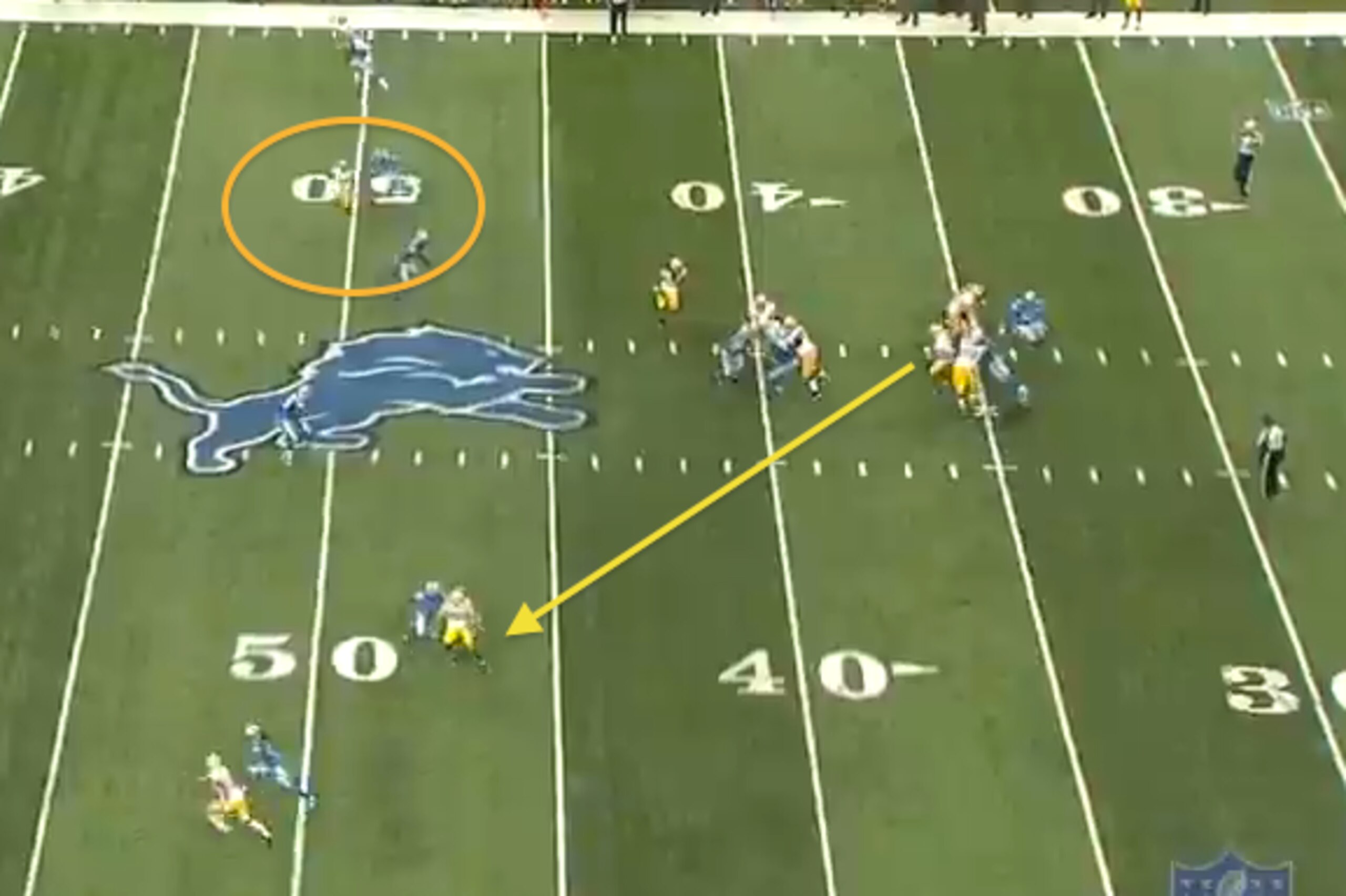
This would have been an easier lob to Cobb than in Chicago last January. But again, Rodgers is locked in on Nelson and never even looks to his right. It's possible the edge pressure or contact with Nelson threw Rodgers off. But the read should have been simple: quick to Nelson, back to Cobb. Touchdown.
In fact, one could argue Cobb should have been Rodgers' first read from the get-go. Quin was clearly favoring Nelson's side before the snap, and Rodgers must have known that Cobb was being single-covered by a safety.
The drive still continued via the penalty on Gorrer, but the Packers were forced to punt four plays later. Opportunity missed.
One final miss to prove this problem isn't limited to Sunday in Detroit:
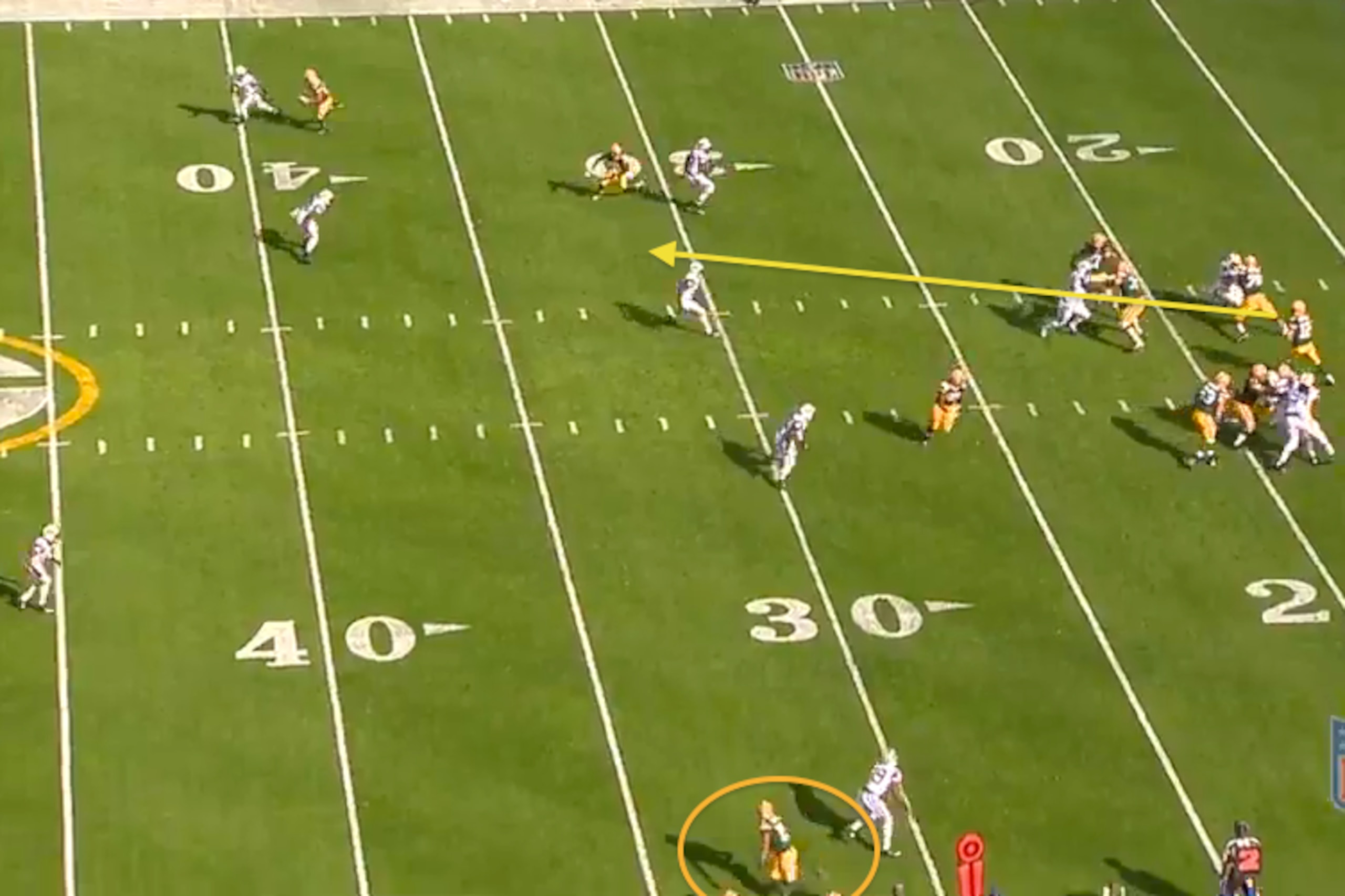
The favored route combination on this play against the New York Jets is clearly to Rodgers' right. But if a quarterback doesn't work his whole progression, open receivers like Jarrett Boykin—who here is streaking down the sideline wide open between the corner and safety—can be missed.
The reliance on Nelson is a double-edged sword. He is without any doubt the Packers' most dangerous receiver, and Rodgers' unwavering confidence in getting him the football has produced some highlight-reel plays.
But the remnants of that reliance can trickle into games like Sunday's, when the Lions focused their efforts on taking away Nelson and making other receivers beat them. The Packers wasted many of those opportunities.
The cumulative effect of a few missed throws here and few missed open receivers there has certainly played a role in the Packers starting the 2014 season 1-2.
Again, Rodgers' difficult days at the office are the best for most quarterbacks. He's still on pace to throw for 27 touchdowns and almost 4,000 yards, which well over three-quarters of the league would take from the quarterback position without hesitation.
That said, Rodgers and the Packers offense have set a high standard over the last six seasons. Mistakes are magnified. Struggles are more perceptible. His ability to make the game look so easy so often makes the turbulent times seem all the more rocky.
Rodgers is not playing sharp football right now, but he's too good not to right the ship. Cleaning up the misses would be a fine place to start the corrections.
Zach Kruse covers the NFC North for Bleacher Report.
.jpg?w=2560 "Chiefs Dolphins Football")
.jpg?w=2560 "Cardinals Giants Football")


.jpg?w=2560 "Injury-stricken Seahawks signing veteran RB")