

Tiger Woods Absence Hardly Noticed as Teams Adjust to Ryder Cup Role Reversal
GLENEAGLES, SCOTLAND — Approximately 250,000 fans are expected to walk through the gates this week at the Ryder Cup, with 7,500 staff—a mixture of paid workers and volunteers—ensuring everything runs as smoothly as possible as those passionate spectators follow the 24 participating players around the 18 holes of Gleneagles' PGA Centenary Course.
Against that backdrop, only one man is conspicuous by his absence, although in truth no-one is really batting an eyelid.
Tiger Woods is absent, injured once more, but the Ryder Cup expects to continue to thrive.

.jpg?w=2560)

Woods' enforced omission is most significant on paper; this week the two warring teams hold 19 major wins between them (11 on the U.S. side), yet Woods alone famously has 14 to his credit.
But the 38-year-old has never really got on with the competition's team-oriented format, being on the winning side just once in his six appearances (in 1999) on the way to compiling a mediocre individual record of 13-14-2 (W-L-D).
This is actually the third time he has missed the biennial event in the last four (in 2008 he was also injured, having won the U.S. Open on a broken leg months earlier, while in 2010 he was infamously in disgrace following revelations about his private life).
Both teams have become as used to his absence as his presence, and so for them it remains business as usual.

U.S. captain Tom Watson was saved a potentially awkward decision when Woods, who had struggled for form and fitness throughout 2014 and would have needed a wild card to make the team this week, ultimately withdrew himself from consideration after another setback in his recovery from a back injury.
"I said right from the beginning, I would love to have Tiger on the team," Watson said on Tuesday, at a clear but chilly Gleneagles. "Even though he’s not on the team, he’s here in spirit."
Is he, though? Watson went on to play up the attributes commonly attributed to the greatest player of his generation—"He brings an element of intimidation...an element of great play and competitive spirit"—but those valuable qualities have never really made a decisive impact on the final scoreline.
Having said that, Woods' slide from pre-eminence seems to have made the hosts more confident than ever about their chances—even if they would not dream of speaking so bullishly in public.
"With the exception of maybe one [the Masters], all the big tournaments this year have been won by Europeans, and people on this team," as Lee Westwood noted, declining to add that four of the top six in the current world rankings are on the European team.
"We are in a pretty good position. We’re confident without being complacent."
After years of the U.S. team playing the role of Goliath, now it is Europe trying that designation on for size. In Woods, the U.S. team may have lost its totem, but perhaps his absence is a symbolic one; in the vacuum created by his absence, the U.S. must forge a new identity, a proverbial sling to suit their new underdog designation.
It is an opportunity for others to step up and foster a different atmosphere, perhaps one more conducive to winning a team competition that has frustrated them deeply in recent times.
Phil Mickelson is the team's lead man now, able to end any playful sparring by making mention of one detail at the top of his CV—and set the tone by the same means.
"Phil can say, well I've won so many majors—so suck on that," as Matt Kuchar jokingly revealed. "But he can only say that when Tiger is not around! He has to kind of look over his shoulder and check."
That subtle change might have more profound effects.
"Chemistry is extremely important," Jim Furyk, the highest-ranked player in the U.S. side at No. 4, acknowledged. "How the players mix together, how those personalities and styles match up."

In the build-up to this event Watson has "targeted" Rory McIlroy and Ian Poulter, the two Europeans he believes will lead the charge for the home side.
McIlroy's two major wins this year have cemented his place as the dominant force in the game, while Poulter's talismanic display at Medinah two years ago—where he birdied five holes in a row in the Saturday afternoon fourballs to give Europe a glimmer of hope going into that Sunday finale—underlined his credentials as the emotional cornerstone of the side.
As Tuesday's array of press conferences got underway, world No. 5 Henrik Stenson was asked who the most annoying player on the American team is, their Poulter.
"I wouldn't say [he's] on the team," the Swede joked knowingly. "Possibly someone in close proximity."
A few Americans might share that sentiment, although the consensus is that Woods has done a better job of integrating himself with the other members of golf's professional fraternity in recent years.
Nevertheless, without Woods around, it appears the American dressing room might have a different vibe; a more convivial council of veterans is setting the tone, and some of the younger players are better able to express themselves—Rickie Fowler touching down in Scotland with "USA" already shaved into his head was perhaps a sign of that.
"They played a sixsome yesterday [Monday]," Watson revealed. "They came back laughing. Everybody is in good health... they are in very good spirits right now.
"You go with the veterans, people that have been there. Phil [will have] played 10 times, Jim Furyk nine times. The players look up to them. They have the platform a lot, and that's a really good thing."
If McIlroy and Poulter are the main men for Europe then, who does Watson think fills that role for the United States in the absence of you-know-who?
"I think Bubba [Watson] would be a target," the captain, who also called Jordan Spieth an "A-1 player," said. "If I just had to pull a name, he would probably be the guy that people would be looking to defeat."
On that assertion there appeared to be disagreement.
"I think there's about 12 of them," Stenson added, when asked if any of the U.S. players would be a bigger scalp than the others. "A point is a point.
"Out of a personal satisfaction, I'm sure if you beat Phil, you feel like that's a good match to win. Rickie has played great this year, and I’m sure you feel good about yourself if you manage to get a point out of him.
"But it's minor. It's really about getting the points and winning your matches."
That is something Woods often failed to do, for all the "intimidation" and "competitiveness" he offered on the course. A solid singles record covers a consistently poor foursomes and fourballs history; having made a concerted effort to mark himself out as a lone wolf to help dominate golf's individual landscape for decades, the reintegration into a team environment proved something he was often unwilling, or unable, to fully achieve.
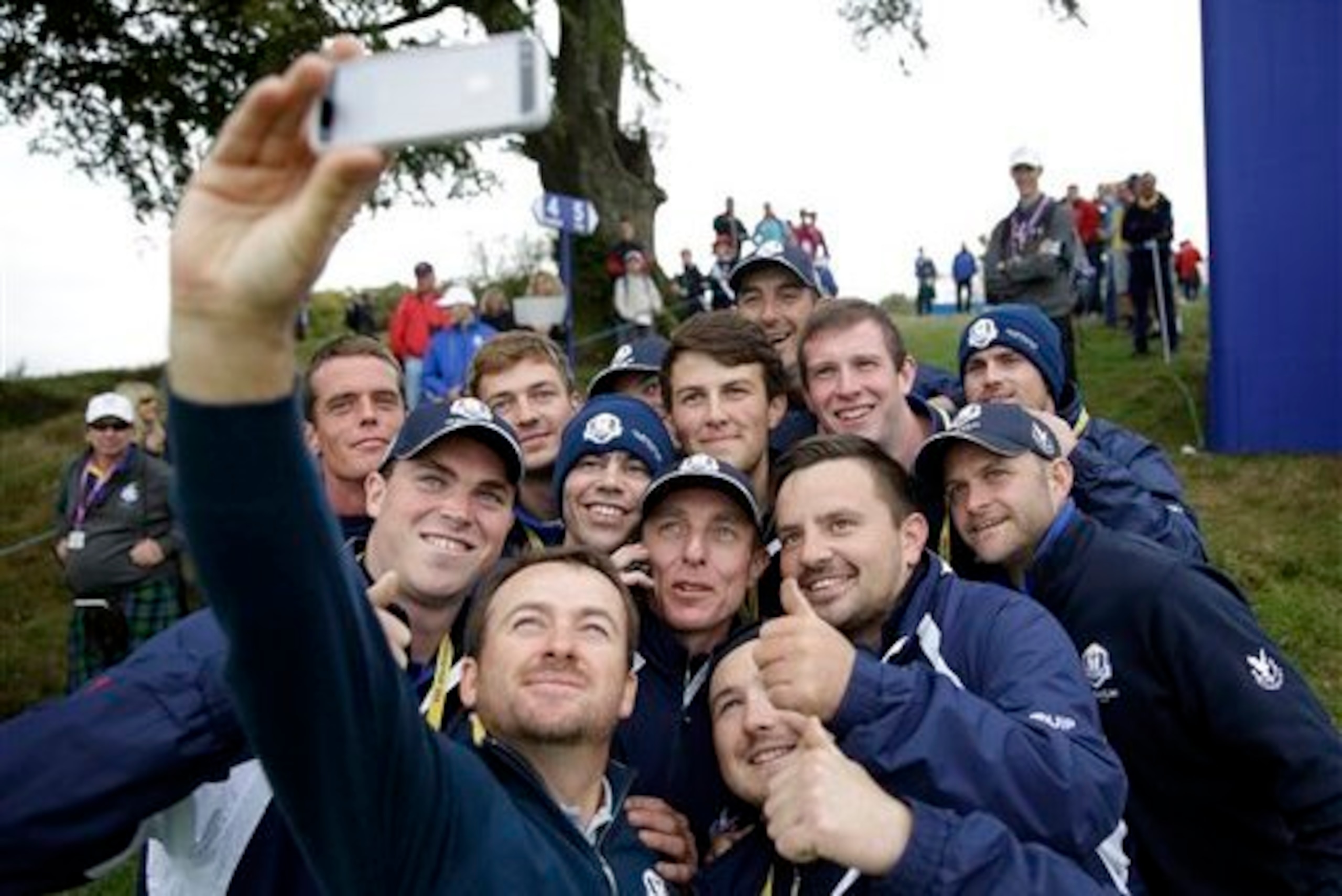
While there remains a measure of disappointment that Woods will not be playing this week—for all his exploits, the Scots have never taken Woods to their hearts in the same way as captain Watson—it is the nationalism and passion of the format that makes it a transcendent event in golf's calendar, rather than the presence of any one player.
For Woods, too, his absence is probably not the huge blow it might seem. He may be a student of the game's lore and aware of the competition's place within that (his poor record probably causes him more angst than some might imagine), but a week filled with corporate, media and competitive engagements is far from ideal for a player who clearly needs a sustained period away from the glare to rediscover his form and fitness.
His absence, however, has helped cement the notion that this American travelling party is a firm underdog. It would be an upset if the home side lost, but the Ryder Cup rarely follows such pre-event prognostications.
For evidence of that, you just need to look back to 2002, when an unfancied but united European team beat a U.S. squad widely thought to be one of the most talented in years.
It was a performance that would set the tone for the next decade in the event.
"I still think to this day, it was probably the Ryder Cup that's one of the biggest surprises that we won, when we look at how the two teams were set up," Danish veteran Thomas Bjorn, making his first appearance in the competition since that win at the Belfry, recalled.
"It came down to what we believe in.
"We believe in each other, 12 becomes one, and I think that's the importance of the European team; that we have a strong belief in each other. We stand by each other all the way through the week."
Without Woods, replicating that successful formula might just be a little bit easier for the tourists. Whether that will be enough to change the final result, of course, remains to be seen.
"The underdog role is kinda fun, to be honest with you," Furyk noted. "Everything to win and nothing to lose. It’s not intimidating, it’s a great opportunity."
All quotes obtained first-hand unless otherwise stated.
.jpg?w=2560 "Rams Eagles Football")

.jpg?w=2560 "Injury-stricken Seahawks signing veteran RB")

.jpg?w=2560 "Bijan's INSANE 1st Half 🤩")
