

Denver Broncos Play-Calling Might Be Holding the Offense Back in 2014
The Denver Broncos have a 2-1 record three weeks into the 2014 NFL season. Their offense has not looked quite as dangerous as it did last year, when they scored a single-season record of 606 points.
Currently, the Broncos rank 17th in the NFL with 339.3 yards gained per game. They are only eighth in the NFL in passing yards per game (264.0) and only 28th in rushing yards per game (75.3).
The team needs to be more consistent in order to take the next step, according to Broncos head coach John Fox.

.jpg?w=2560 "Rams Eagles Football")
.jpg?w=2560 "Falcons Saints Football")
“I think looking at the tape, there were some communication errors. That is a loud environment. That’s not an excuse, it’s just a reality.” Fox said, “I mentioned yesterday, as I told the team, it was good but we’re looking for great and we’re not there yet, so that’s something we’ll have to continue to work on.”
Is the play-calling for the Broncos holding the offense back? Let’s take a look.
Early-Down Running
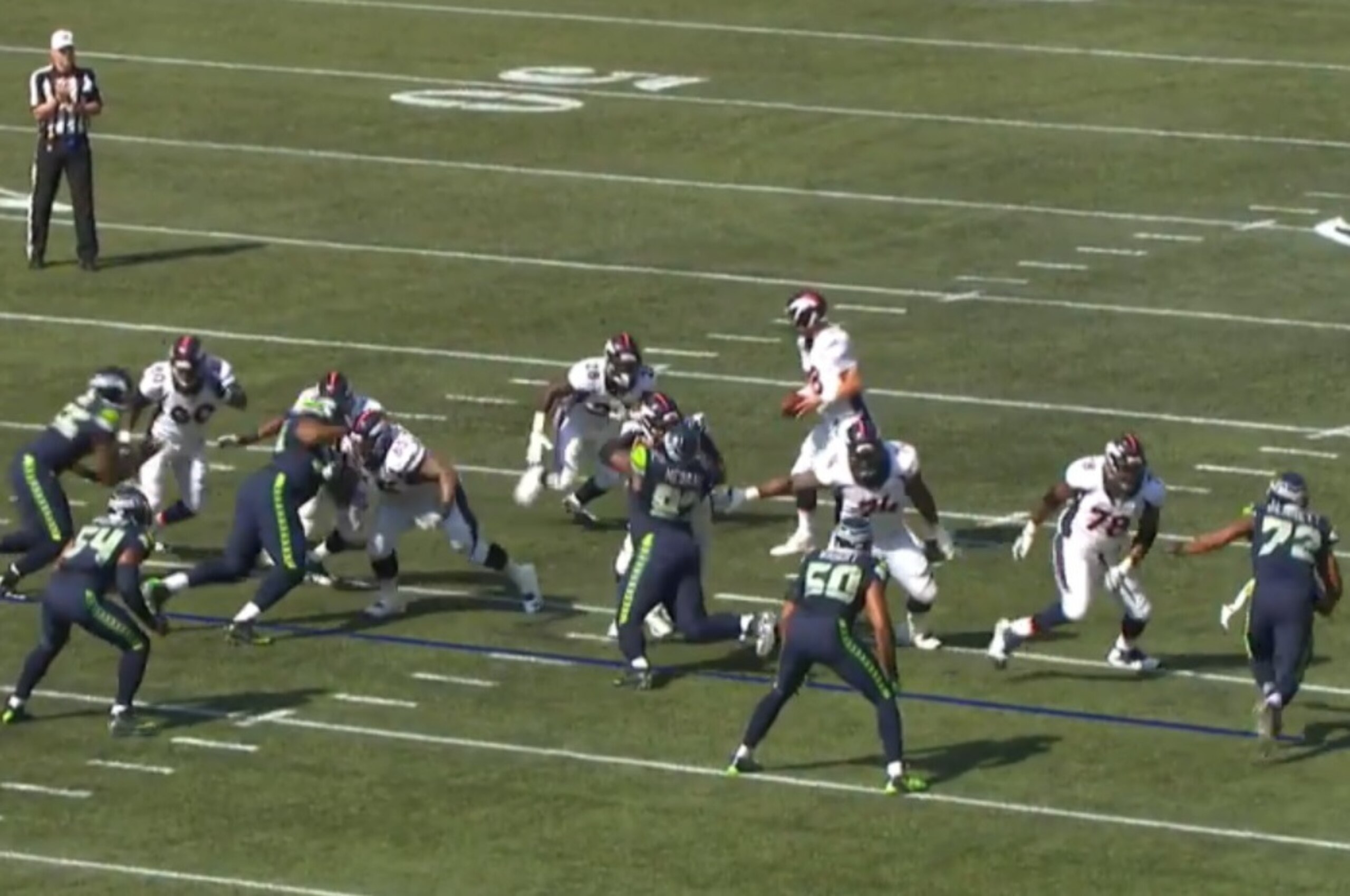
The Broncos had a commitment to the ground game early on against the Seattle Seahawks. The team finished the game with 20 carries, but 14 of those came in the first half.
In the play above, we see Montee Ball pick up five yards on a well-blocked play. The Broncos were facing six defenders in the box, and Ball was able to get to the second level of the defense with ease.
Fox commented on Monday what the running backs could do to be more productive.
“It’s like everything. It’s like saying, ‘Is there anything the quarterback can do to pass it better?’ You’re talking about a lot of moving parts in both those areas. Like I said to begin with, we’ve done a lot of good things, but we’re not great yet.” Fox concluded, “That’s what we’re striving for whether passing, running, playing defense, any of that stuff.”
The Broncos can get the ground game jump-started, but they have to pick and choose where/when to carry the rock.
Short-Yardage Running
The Broncos have to get better running the ball in short-yardage situations. Against the Seahawks, the Broncos went 6-of-16 on third downs. These shortcomings cost the team valuable time of possession, and it also caused their defense to play more snaps as the game went on.
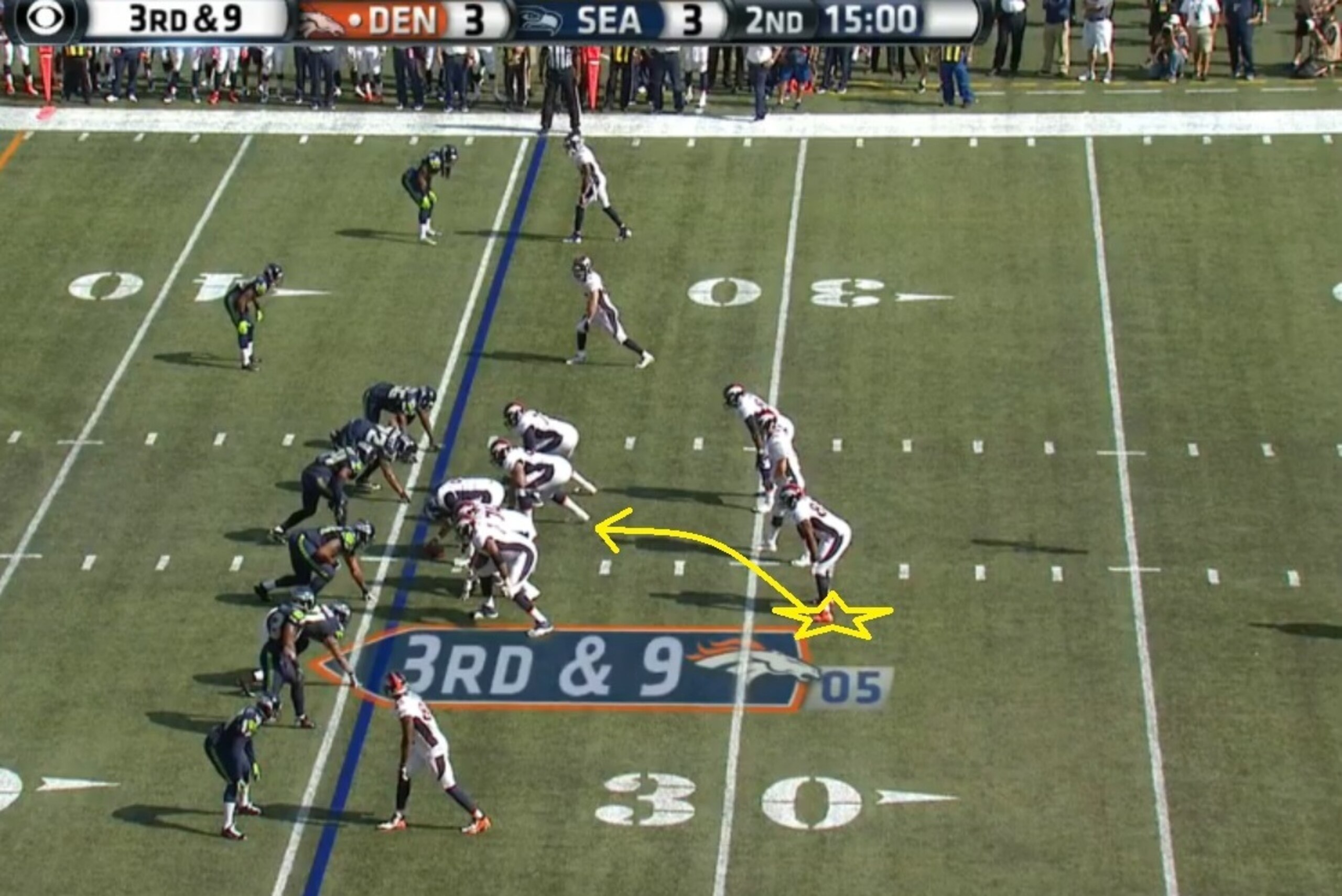
One play that Broncos fans are complaining about (even though it's not a short-yardage situation) is the 3rd-and-8 carry by tight end Virgil Green. Not only did the play not pick up any yards, Green was also concussed as he was getting tackled. The offense looked like the “Keystone Kops” on this play, and the entire line looked confused after the snap.
Fox commented on the miscommunication that led to the run with Green. “Those were things that—without giving away too much—were communication problems I was talking about. One of them was we ran a trap with our tight end. We probably didn’t practice it a lot.”
Here we see a 2nd-and-goal situation for the Broncos. Ball is going to get the rock running to the right side of the formation.
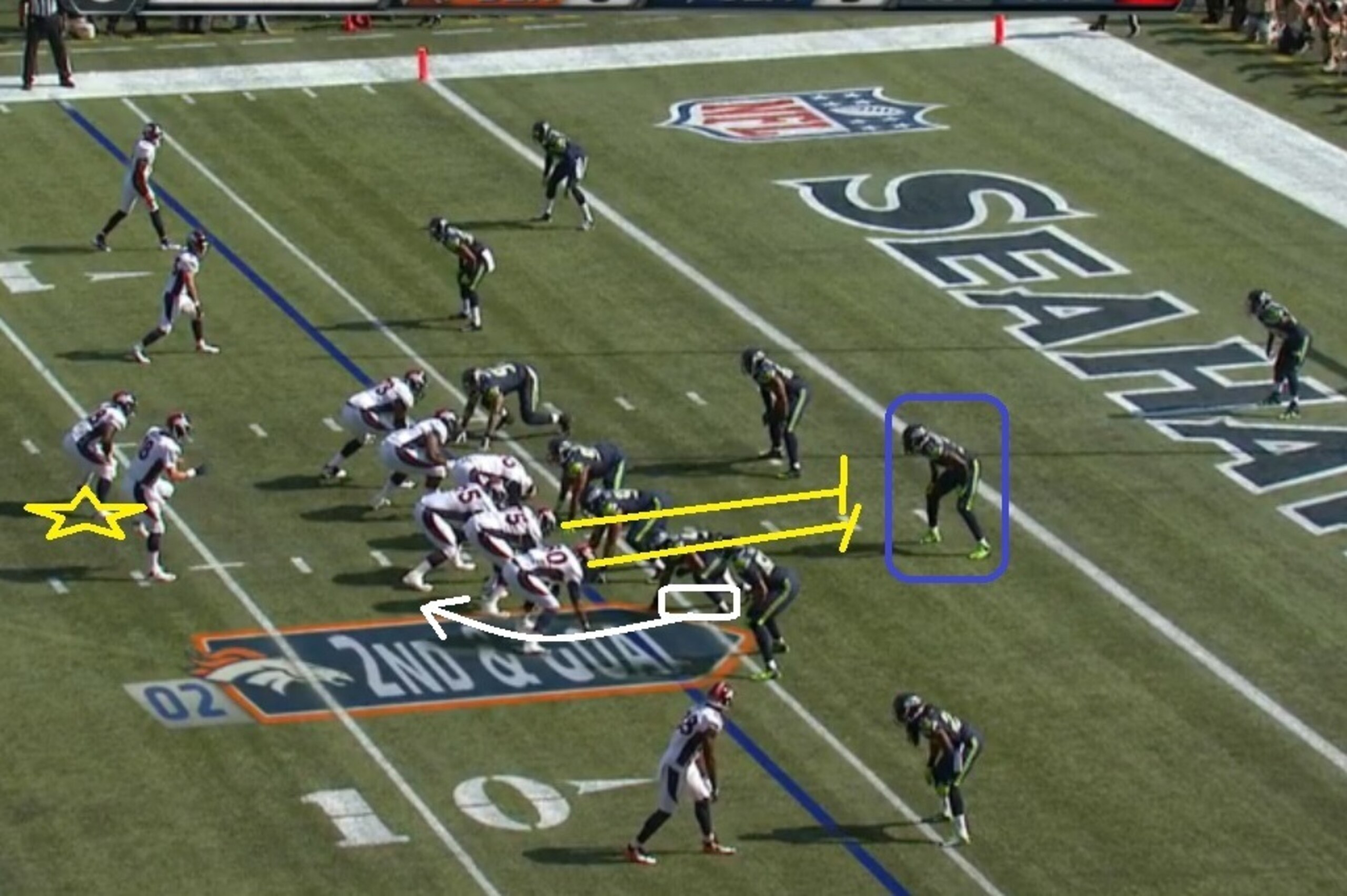
Both tight end Julius Thomas and right tackle Chris Clark fail to block defensive end O’Brien Schofield. Instead, Thomas and Clark move to quickly block strong safety Kam Chancellor. Schofield then easily crashes in on the play unblocked. Ball should have been downed for a three-yard loss, but somehow he manages to get back to the line of scrimmage for a minimal gain.
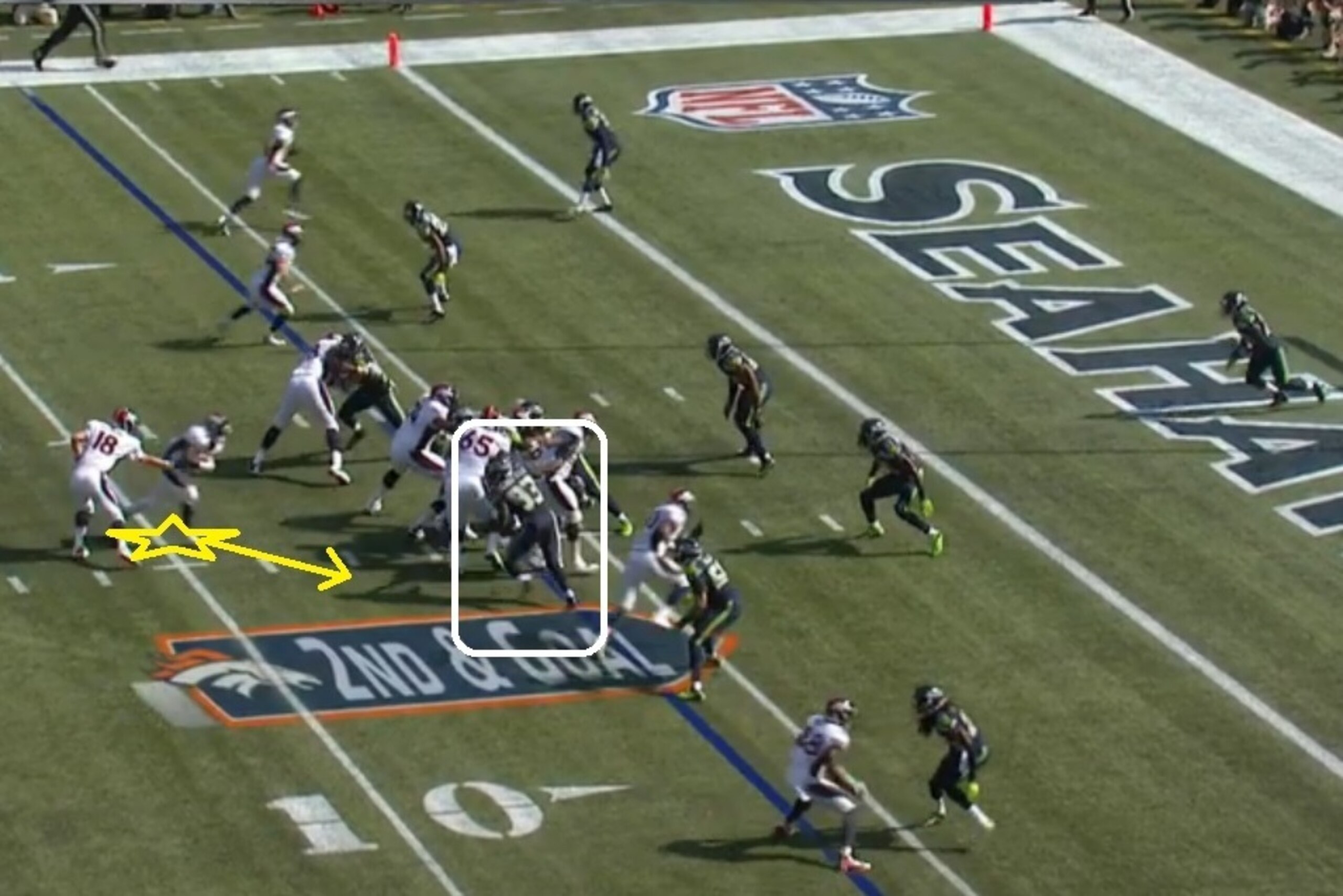
We saw Ronnie Hillman for the first time this year in the game against Seattle. The team wanted more explosiveness from the backfield, and that’s why Hillman came into the game in the second half. For some mysterious reason, Hillman received the rock on this 3rd-and-1 situation.
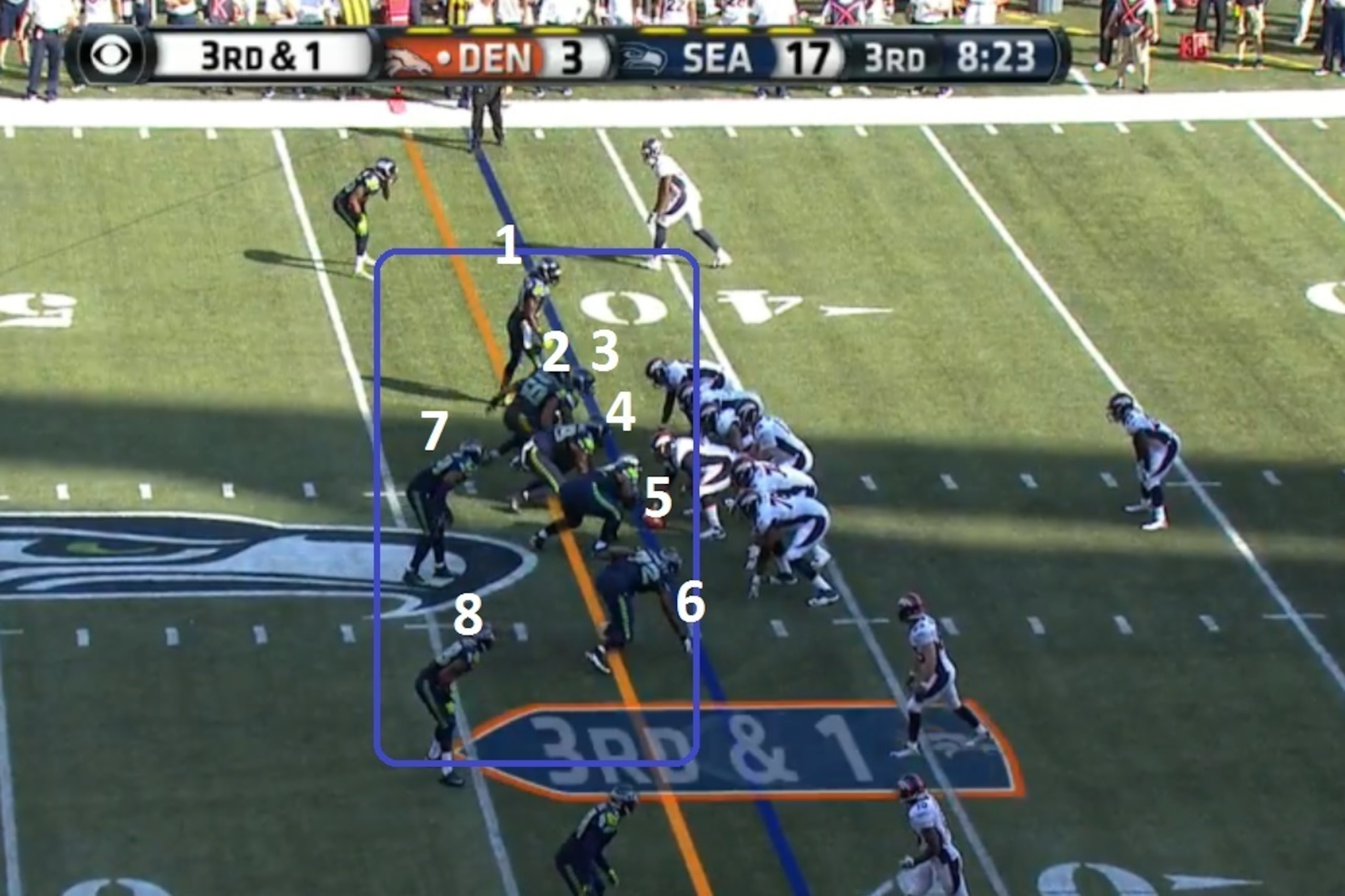
Hillman is the lightest back on the team, and he’s running against an eight-man front on this play. He’s not a pile pusher, and running against eight defenders in the box is a recipe for disaster.
Yes, linebacker K.J. Wright is across the line of scrimmage. No encroachment penalty was called, and Hillman sees the right side of the line collapse due to Wright’s alignment as the ball was snapped.
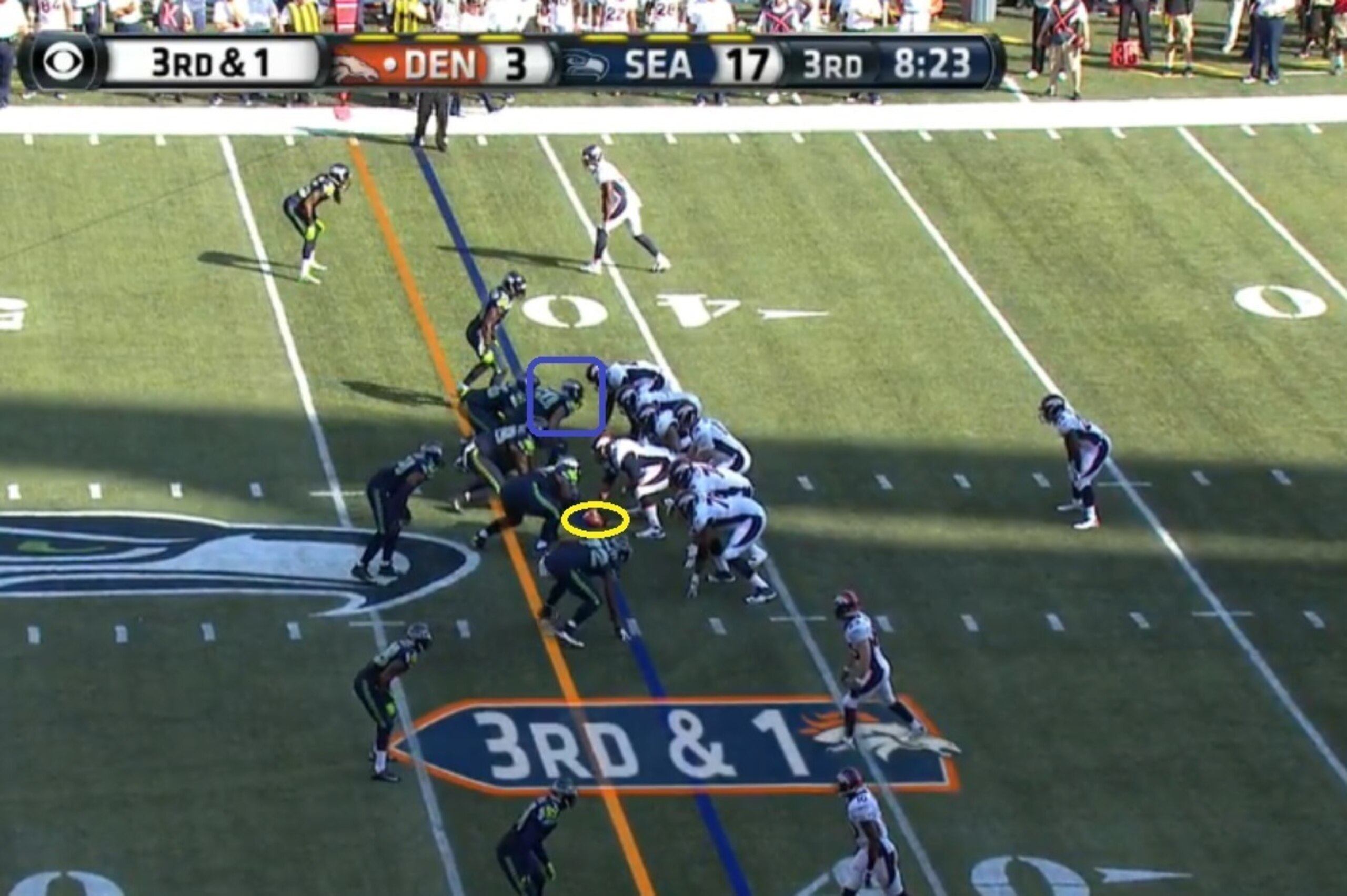
It makes no sense for Hillman to receive these types of carries.

The offensive line has been struggling to get proper push up front in short-yardage situations. Fox left the door open for making changes to the offensive line in order to boost production. “We evaluate everybody every day. So those are all options at any position.”
Short Passing
Multiple pages in the Adam Gase playbook are likely to be dedicated to screen passes. They have a varied group of weapons in the passing game that can make this type of play work incredibly well.
Against the Seahawks—one of the most laterally agile and quick defenses in the league—this play style is folly.
In the play below, we see the Broncos lined up in the shotgun. Manning is going to fake handing the ball off to the running back in an effort to make the opponents move to the defensive right. Demaryius Thomas is moving in motion to catch a screen pass behind Wes Welker as he blocks for him.
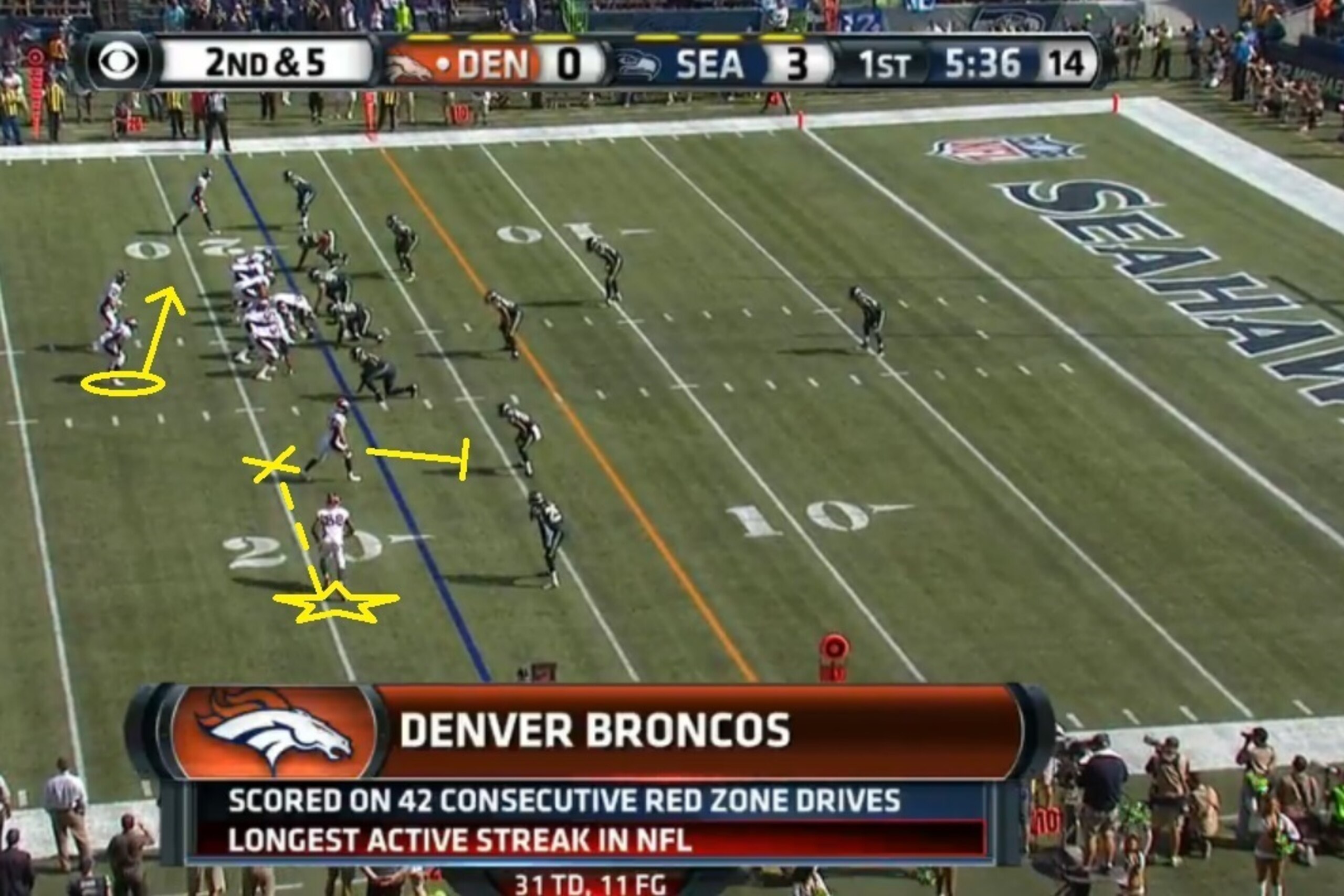
As Manning opens up to throw, you can see the Seahawks defense stays disciplined and does not bite on the play fake. Thomas waits for the screen, but the Seattle defense is going to be able to close quickly. This play went for no gain.
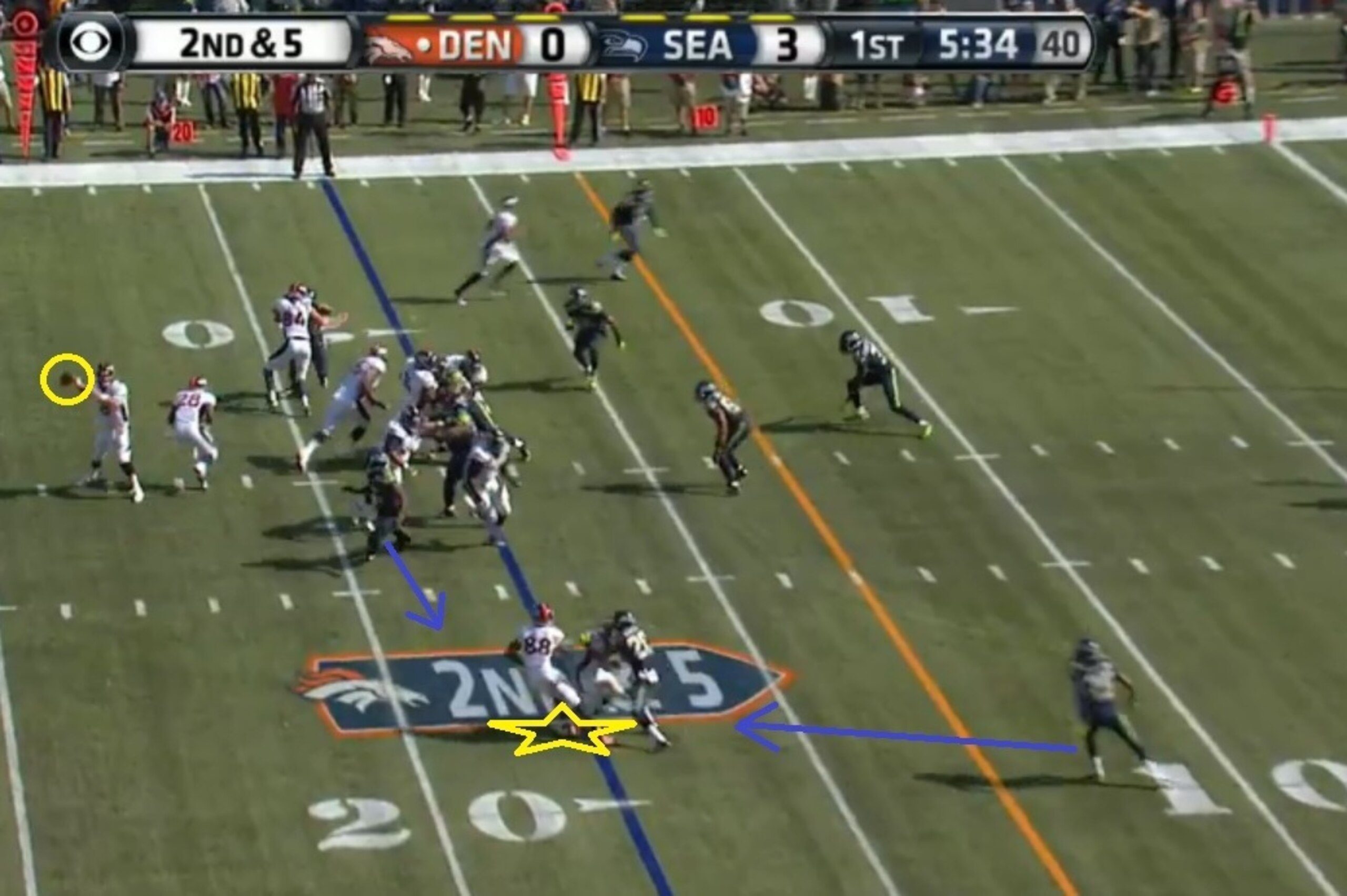
The execution is suspect on this play, but the Broncos should not be running this style of wide receiver screen against a fast and physical defense like Seattle.
Intermediate Passing
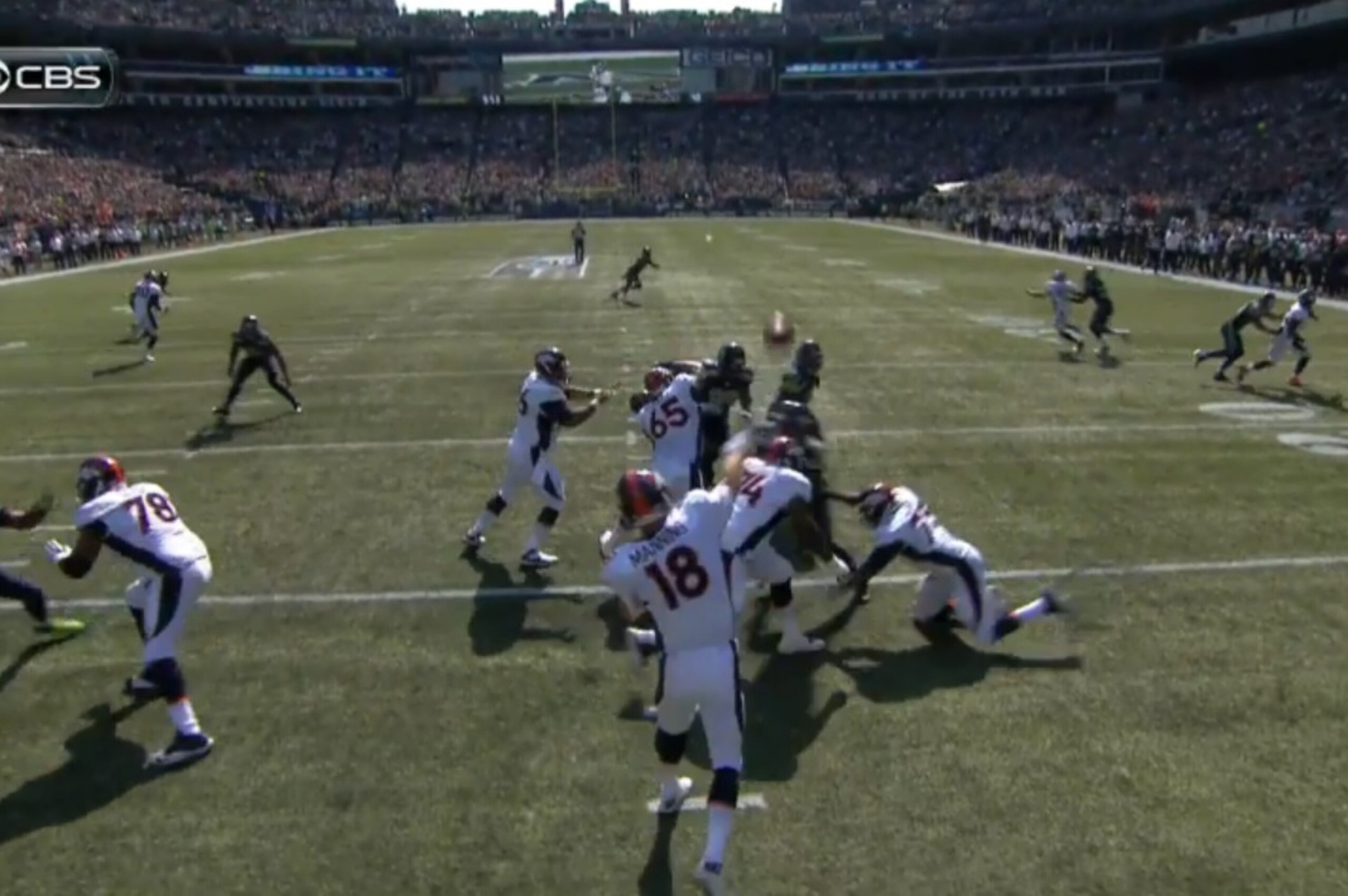
Manning had no problem going after cornerback Richard Sherman in Week 3. In the play featured below, we see Manning passing the ball to a soft spot in the Seahawks coverage. He throws the ball before Emmanuel Sanders makes his break. The pass travels about 15 yards in the air.
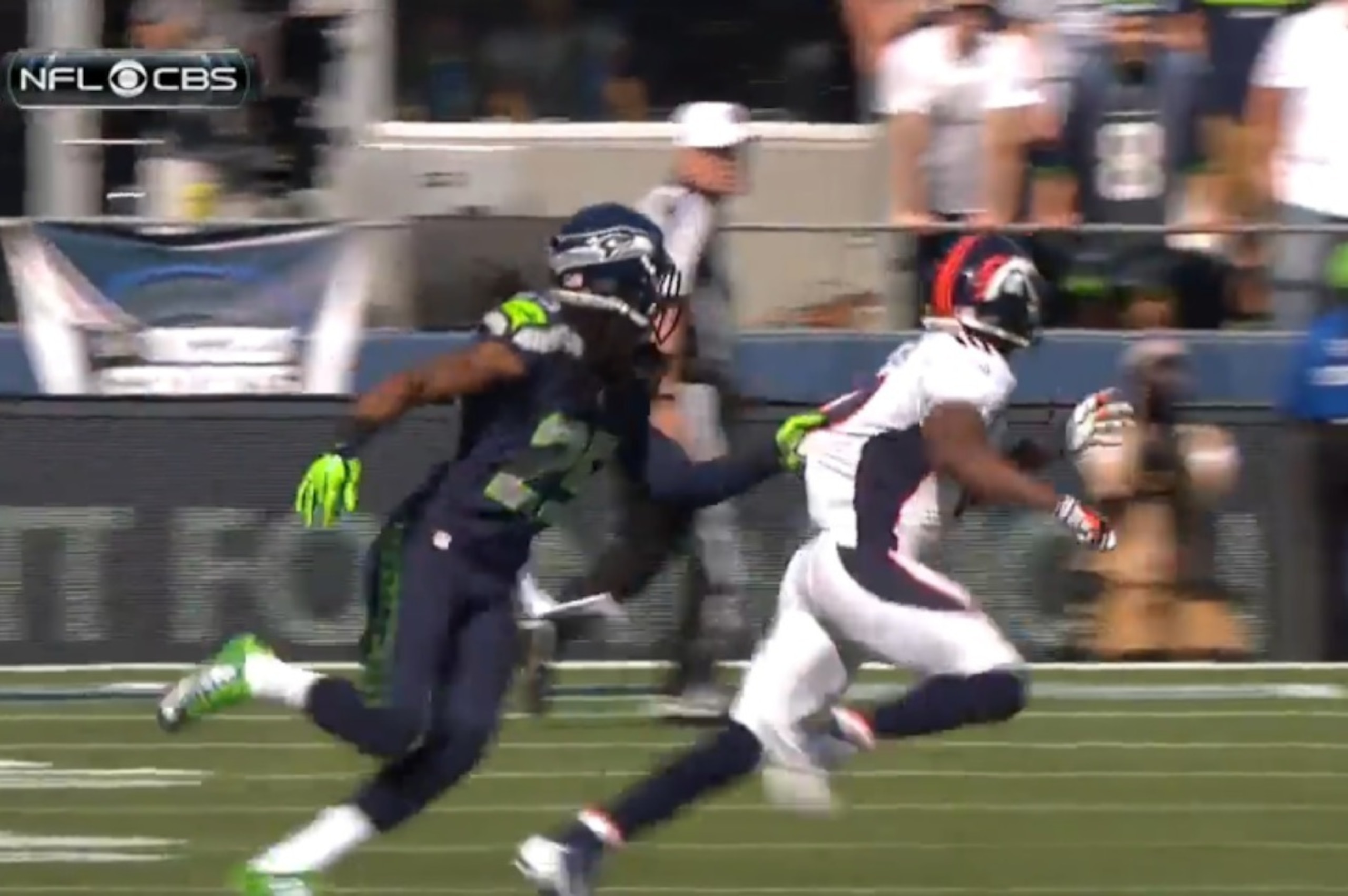
As you can see here, Sanders’ jersey is getting tugged on by Sherman. It doesn’t stop Sanders from gathering the catch for a 12-yard gain.
The Broncos can effectively work the middle of the field using slants to get open. The offense has also shown an ability of working sideline routes at the intermediate level. Rub routes and jerk routes can be used to set up defenders when looking for this depth on the field.
Long Passing
The Broncos have a more vertical element to the offense this year. That’s one of the reasons why they let Eric Decker walk in free agency so they could pick up Sanders.
There are some fans and analysts (foolishly) claiming that Manning’s arm strength is dwindling. This sentiment goes against what guys like Demaryius Thomas and Jacob Tamme have said earlier this offseason. His upper body is stronger this year, and it’s apparent when watching Manning throw downfield.
In fact, Manning has above-average air yards per passing attempt. This isn’t yards per attempt, this is the distance each pass travels in the air. The league average is 7.96 air yards traveled per passing attempt. Manning has an average of 8.06 air yards traveled per passing attempt this year, almost a full yard higher than his average last season (7.16).
In the play below, we see Manning getting ready to fire a deep pass to Sanders on the team’s final drive in the fourth quarter. As you can see, Manning’s throwing from about his own 17-yard line.

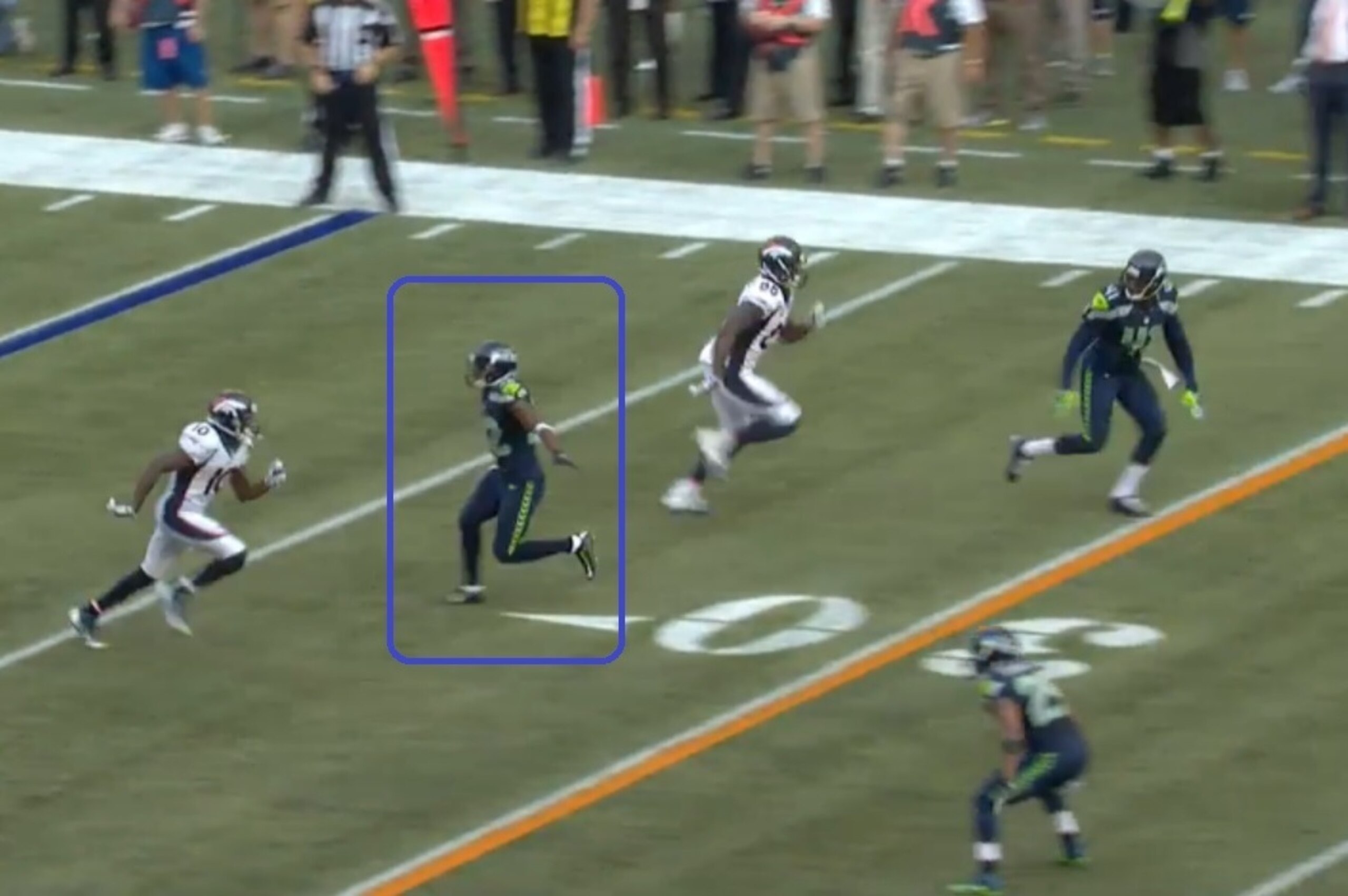
This picture shows that Sanders is pressing the corner charged with covering him in the short zone. The corner opens his hips to the inside, and Sanders sells that he’s running to the first-down marker at the 30-yard line.
In this snapshot, we see how Sanders sells the sideline route. Free safety Earl Thomas sees Sanders in his peripheral vision but stays put as the wide receiver has turned his hips to the outside on the break. At the same time, Demaryius Thomas is clearing out the defense with a “go” route.
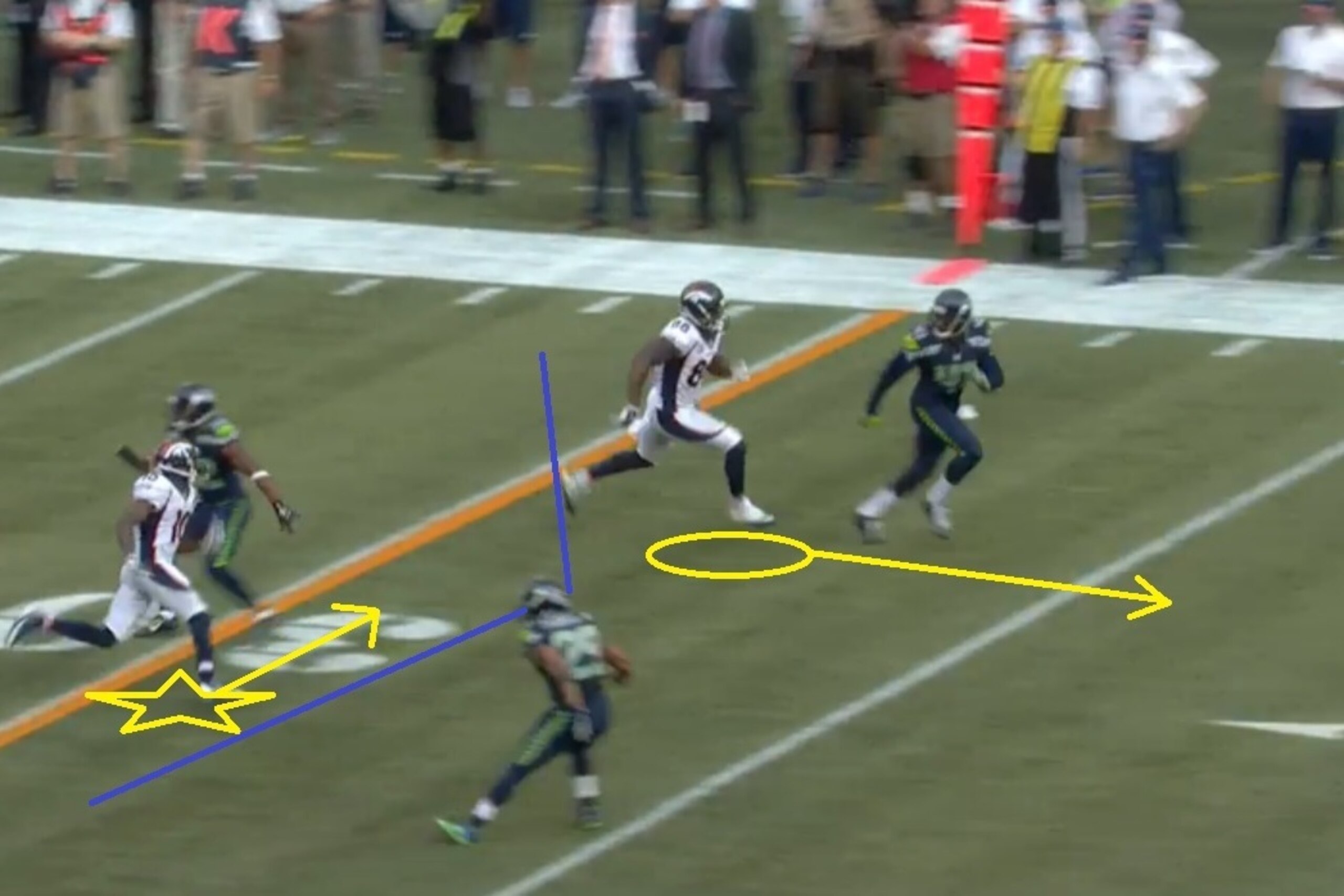
This picture shows that Sanders instead turned upfield down the sideline behind Demaryius Thomas. At this point, Manning has fired the ball downfield, drawing the attention of corner Byron Maxwell.
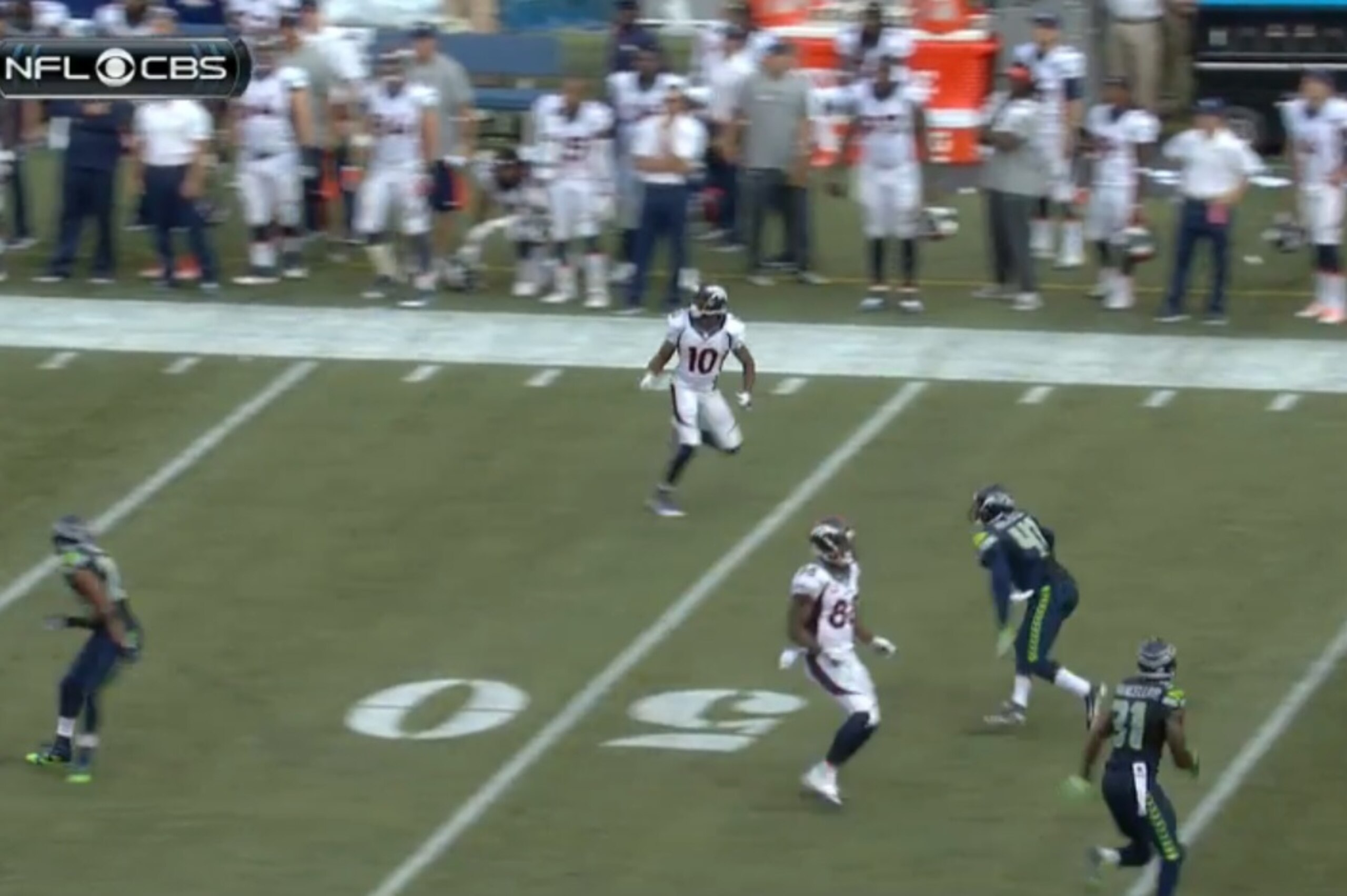
As Sanders secures a pass that traveled about 40 yards in the air, Maxwell is unable to get to the play in time.

Here’s another deep target from the team’s final drive against the Seahawks. Tamme cuts outside, selling the sideline route before turning upfield and into the end zone.
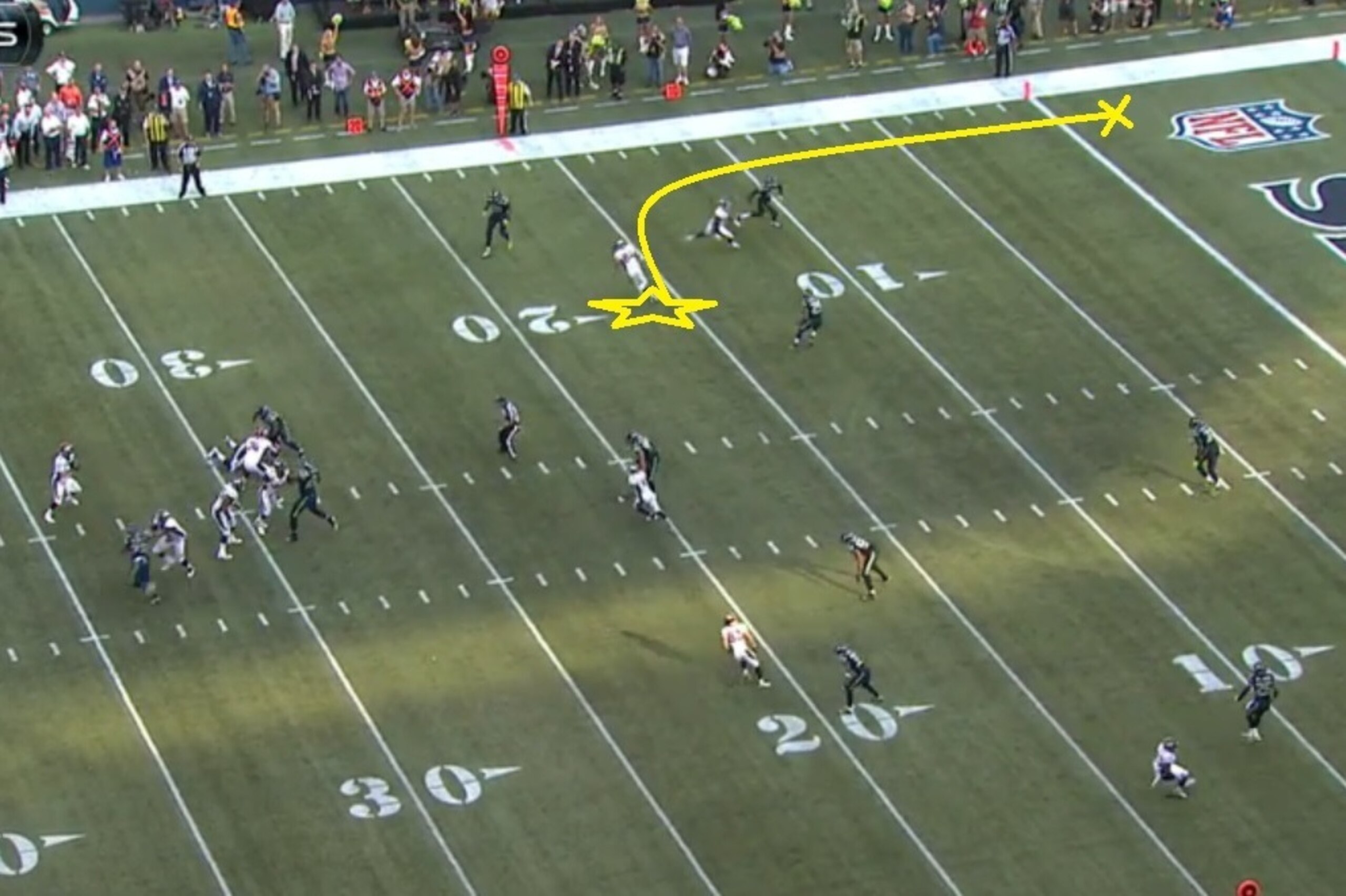
The pass travels about 40 yards in the air accurately, and Manning’s throw is placed perfectly between two defenders.
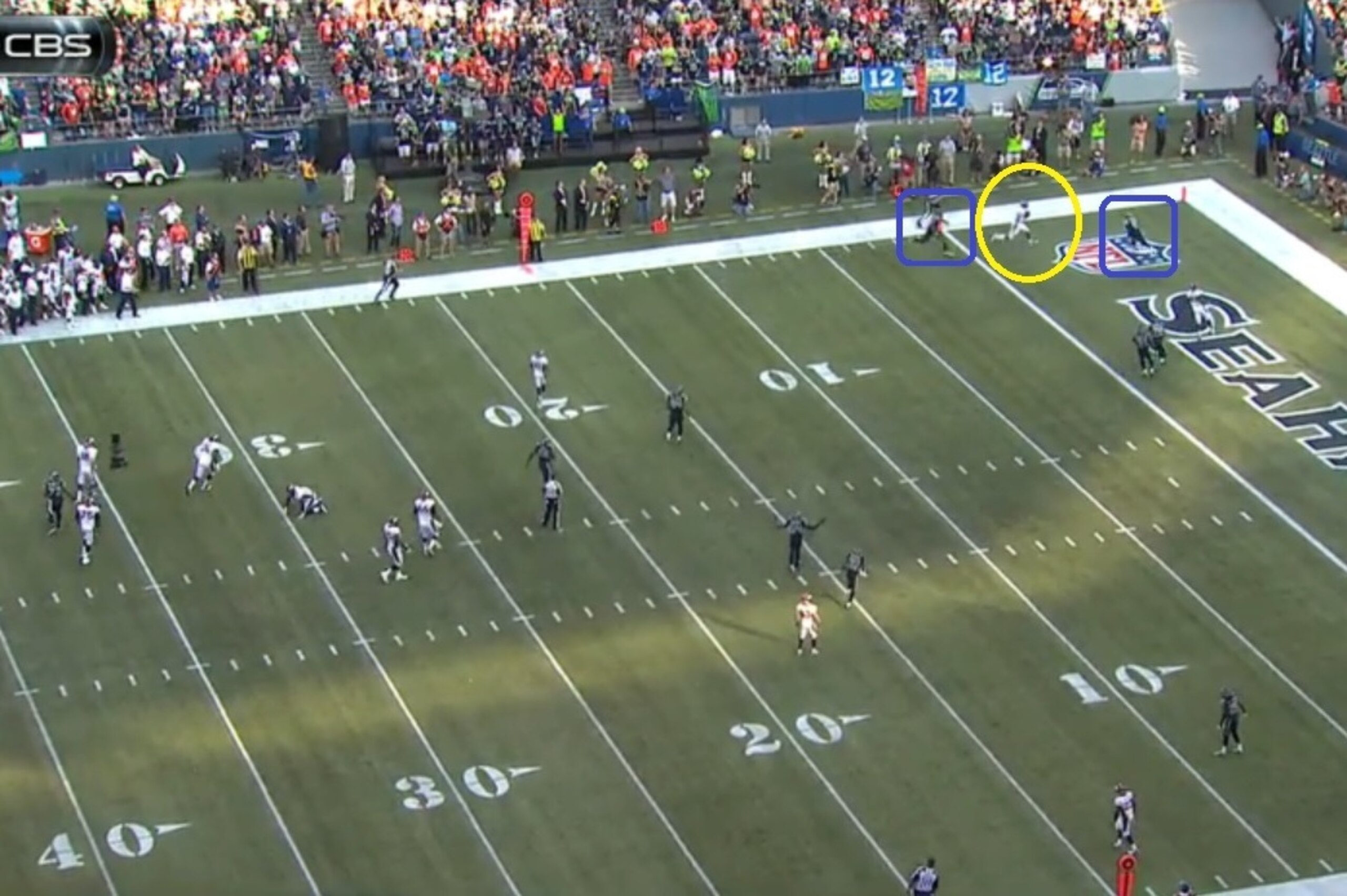
Does Manning throw the tightest spiral? No—he never has. However, there is something to be noted about his vertical throwing this year compared to last year. The Broncos have no problem taking shots deep if the time is right.
Summary
The Broncos offense is striving for more balance this year. Fox doesn’t believe opponents are playing the team differently in 2014.
“I don’t know that it’s really people doing a lot of things differently. I think it’s fair to say that we might be more balanced now. That’s really kind of how I’d say it. I think it’s important in football to have that balance and not be one-dimensional.” Fox continued, “That’s what I’d say up to this point. I don’t think our offense has been lacking. We’re just trying to win games. Right now, we’re 2-1.”
Balanced play-calling has gotten this team into trouble over the first three weeks of the season. In the first two games, the Broncos built big leads in the first half only to see them slip away in the second half. In Week 3 against the Seahawks, the Broncos struggled to move the ball in the second and third quarters, but they started to produce near the end of the fourth.
Denver can effectively run on early downs. The passing game will naturally spread defensive fronts out, and the Broncos can take advantage of that.
They need to use the screen game sparingly—especially against laterally agile defenses. The screen game will not be eliminated from the offense, but it doesn’t need to be used as much.
The Broncos need to continue working the intermediate and deep routes. Manning’s arm is not getting weaker—in fact, quite the opposite is true. The passes we see from Manning today are more crisp and traveling at longer distances than they have in the previous two seasons with the Broncos.
Every team has an identity. It seems like at times, the Broncos have an identity crisis.
Balance is a nice goal to set for this offense, but the reality is they’re best at moving the ball through the air. The Broncos need to get back to the pass-happy offense they were in 2013—and the play-calling needs to stop holding them back.
All quotes and injury/practice observations obtained firsthand. Record/statistical information provided via email from the Denver Broncos unless otherwise noted.

.jpg?w=2560 "Texans-Mixon Released Football")
.jpg?w=2560 "Grading WWE Raw 🔠")


.jpg?w=2560 "2 NFL Officials Suspended")
