Without Offensive Balance, Aaron Rodgers and Green Bay Packers Proving Beatable

With the run game a non-factor for the third week in a row, Aaron Rodgers and the Green Bay Packers were unable to make offensive adjustments that would allow them to score more than seven points on the Detroit Lions, losing 19-7.
Rodgers passed for just 162 yards, the fewest in a game he has finished since November 2008, when he threw for 142 yards against the Minnesota Vikings, per Pro-Football-Reference.com.
It was their lowest-scoring result under Rodgers since he became the starter in 2008.
.jpg?w=2560 "Rams Raiders Football")

.jpg?w=2560 "Steelers Saints Football")
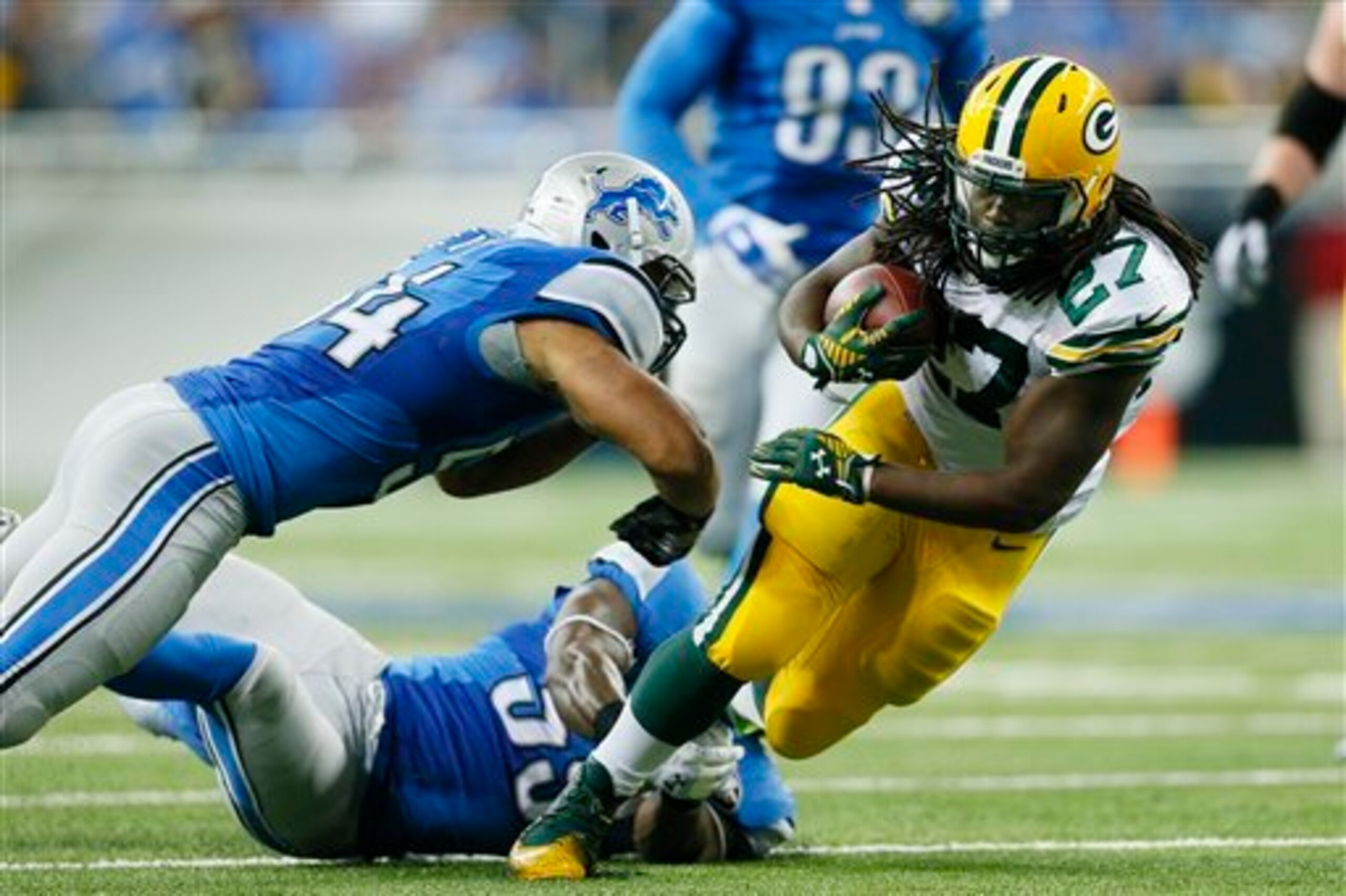
Meanwhile, Eddie Lacy has totaled fewer carries than the 11 he had Sunday just one other time in the 18 games he's played in his career, and that was on Thanksgiving Day, also against the Lions at Ford Field, when he had 10.
Heading into Week 3, Green Bay's first three opponents—the Seattle Seahawks, New York Jets and Lions—had run defenses ranked in the top 10, with New York and Detroit Nos. 1 and 2 respectively. Each team's stout defensive front managed to shut down Green Bay's run game.
Lacy, who averaged 18.9 carries per game in 2013, has been kept to just 12 a game through three weeks this season. He averaged just 3.3 yards per carry against Detroit's front seven.
He also fumbled the ball for the first time since Week 1 of last season, which Don Carey took back for a score. Though the Packers also got James Starks involved, alternating him and Lacy on drives, the Packers only had 22 rushing attempts on the day. They averaged 28.6 per game in 2013, per Pro-Football-Reference.com.
In Week 2, the Jets took away the run for the Packers by keeping the box loaded rather than run defensive sub-packages with extra defensive backs on the field. That allowed Rodgers to find Jordy Nelson for a career-high 209 yards in one-on-one coverage, while Randall Cobb was able to find the end zone twice.
Against Detroit, the No. 2 run defense in the league, the Packers' aerial attack should have been potent. The Lions secondary was decimated heading into the game, with safety James Ihedigbo and cornerback Cassius Vaughn inactive and slot corners Bill Bentley and Nevin Lawson placed on season-ending injured reserve.
It should have been a prime opportunity for Green Bay to take advantage of favorable matchups not only for Nelson on the outside, but also in the slot for Cobb, where the Lions are down to undrafted rookie Mohammed Seisay after Carey was injured as well.
However, after seeing last week's film against the Jets, the Lions kept just six players in the box to stop the run and kept the coverage on Nelson while going two-high safety, which forced Mike McCarthy to continue to run the ball even though the ground game wasn't producing much.
But rather than close the playbook in favor of rushing, including on an ill-advised 1st-and-10 from Green Bay's own 1-yard line that, predictably, ended in a safety when Lacy was tackled in the end zone, Green Bay needed to get the ball to Cobb or Jarrett Boykin underneath.
When the Packers did take to the air, Rodgers looked off, holding on to the ball too long or looking to the sidelines rather than searching for short-yardage gains. Since losing Jermichael Finley, Green Bay has struggled to replace his production from the seam. But in the face of a persistent pass rush that pressured Rodgers all day, the Packers didn't even attempt to beat that by running some screens.
Rodgers acknowledged the lack of balance in his postgame presser.
Rodgers' time in the pocket has hurt the passing attack so far this season. Heading into Sunday's game, Rodgers was taking 2.77 seconds to throw on average according to Pro Football Focus (subscription required), tied for the eighth-longest in the league among quarterbacks with at least 60 dropbacks.
The difference in his completion percentage, illustrated in the table below, is significant.
| Attempts | 45 | 30 |
| Completions | 33 | 15 |
| Completion % | 73.3 | 50 |
| Sacks | 1 | 5 |
Of course, in the first two weeks of the season, those sacks from holding the ball also fall on the shoulders of the offensive line. In the snaps Derek Sherrod played in place of the injured Bryan Bulaga in Weeks 1 and 2, he alone was responsible for three sacks on Rodgers.
But with Bulaga back in at right tackle Sunday, the line's play should have been better. Rodgers should not have taken two sacks, both of which came on third downs on important drives when Green Bay was within one score of Detroit.
Another reason Rodgers took too long to throw the ball was inability to gain separation and drops on the part of Green Bay's pass-catchers. Jarrett Boykin, Randall Cobb and James Starks each had a drop. Cobb's came while streaking down the sideline on 3rd-and-3 on the first drive after Lacy lost the fumble.
"I have to look myself in the mirror and do a better job of creating separation and getting open and giving Aaron somewhere to throw the ball," Cobb said after the game, per Tom Silverstein of the Milwaukee Journal Sentinel.
Detroit killed Green Bay in time of possession, winning 38:13 to 21:47. And it's not hard to see why; the offense had five drives of five plays or less and gained less than 10 yards on four different drives. This despite the defense putting the ball back in their hands three times after Ha Ha Clinton-Dix and Davon House intercepted Matthew Stafford passes and Julius Peppers recovered a fumble.
| QTR | Poss. | Yard | Plays | Yards | Result |
| 1 | 0:35 | GB 37 | 2 | 3 | Fumble |
| 1 | 1:16 | GB 20 | 3 | 2 | Punt |
| 1 | 2:08 | GB 22 | 5 | 8 | Punt |
| 1 | 3:07 | GB 41 | 9 | 59 | TD |
| 2 | 0:05 | GB 1 | 1 | -1 | Safety |
| 2 | 4:23 | GB 19 | 9 | 35 | Punt |
| 3 | 2:20 | GB 20 | 5 | 20 | Punt |
| 3 | 4:07 | GB 13 | 8 | 32 | Punt |
| 4 | 3:46 | GB 10 | 9 | 70 | Downs |
Just as Green Bay's defense has started to get it together, the offense has devolved into inefficiency. Ranked 25th in the league in total offense with 645 yards heading into Week 3, after facing the Lions, it now has just 878 yards.
That puts it on pace for 4,682 total yards for the 2014 season, which would be the fewest since Rodgers became the starter in 2008.
How do Rodgers and the offense correct these issues—holding onto the ball too long, the dropped passes, the stifled run game and the lack of offensive balance—before this season gets away from them?
As mentioned, balance is key, and if the Packers can't get it going on the ground with Lacy or Starks, Rodgers won't be able to progress through his reads once defenses start showing two-high safety looks like Detroit did. Lacy should get some room to run against a Chicago Bears run defense ranked 25th in the league.
But Rodgers and his pass-catchers need to get on the same page. Veterans like Cobb should be able to bring in crucial third-down catches, and if Boykin, who has had three drops in two games, can't hang onto the ball, perhaps it's time to give Davante Adams more opportunities.
Most importantly, Green Bay needs to move away from the vanilla play-calling and start mixing it up in the medium-to-long game. The Packers didn't have a single play of more than 20 yards against the Lions, and after teams saw him gash the Jets secondary for 209 yards, Nelson isn't going to be open on every play.
Balance is key to getting this offense back to form, and it has been virtually nonexistent through three games this season.
.jpg?w=2560 "Cowboys Packers Football")



.jpg?w=2560 "🚨 Week 8 AP Top 25 Poll")