

Have the Indianapolis Colts Fixed Trent Richardson and the Run Game?
For the last two seasons, the Indianapolis Colts have preached a desire to run the ball effectively, but with few actual examples.
The run game had its moments. In 2013, the Colts ran all over the San Francisco 49ers, beating them at their own game with a powerful running game and a stout defense. Later that season, the Colts used Donald Brown and the power-run game to close out games against the Tennessee Titans.
But make no mistake, the team still revolved around Andrew Luck in 2013, as evidenced by the playoffs, in which Luck threw 86 times while his running backs finished with 32 rushing attempts.
TOP NEWS

Geno Explains Wilson Exchange
.jpg?w=2560 "Chiefs Giants Football")
Mahomes Told Teammate to Leave Meeting
.jpg?w=2560 "Steelers Saints Football")
Rodgers Iced Out on Plane 💎
Even in those games where the run game was notable, it wasn't Trent Richardson, the back who cost Ryan Grigson a first-round pick, who was having success. It was Ahmad Bradshaw against the 49ers (19 carries for 95 yards and a touchdown) and Donald Brown against the Titans (line from two games: 28/134/3) that carried the bulk of the load and had success.
Richardson ran for a combined 76 yards on 26 carries in those games, an abysmal 2.92 yards per carry (wait...that was right at his average for the season...carry on).
While the run game has had occasional success, it was sparing and came with backs not named Richardson. For the Colts to run an offense with their philosophy, that needed to change. On Monday night against Philadelphia, it did.
In the first half, Richardson ran for 57 yards on 13 carries, a healthy 4.4-yard average. Richardson ran for gains of 15 yards twice, something he did twice in 16 games last season (playoffs included). Overall, Richardson ran for 79 yards, his career high with Indianapolis. His average of 3.8 wasn't great, but it was something you can live with, especially considering his paltry average last season.
Was this a sign of things to come? Can the Colts continue to bolster their offense with a strong, or even average, running game?
For that, we look to the All-22 tape.
Widening the Gap
The first thing that sticks out from this game is just how big the running lanes were. Richardson had a few lanes that he could have driven a whole fleet of trucks through.
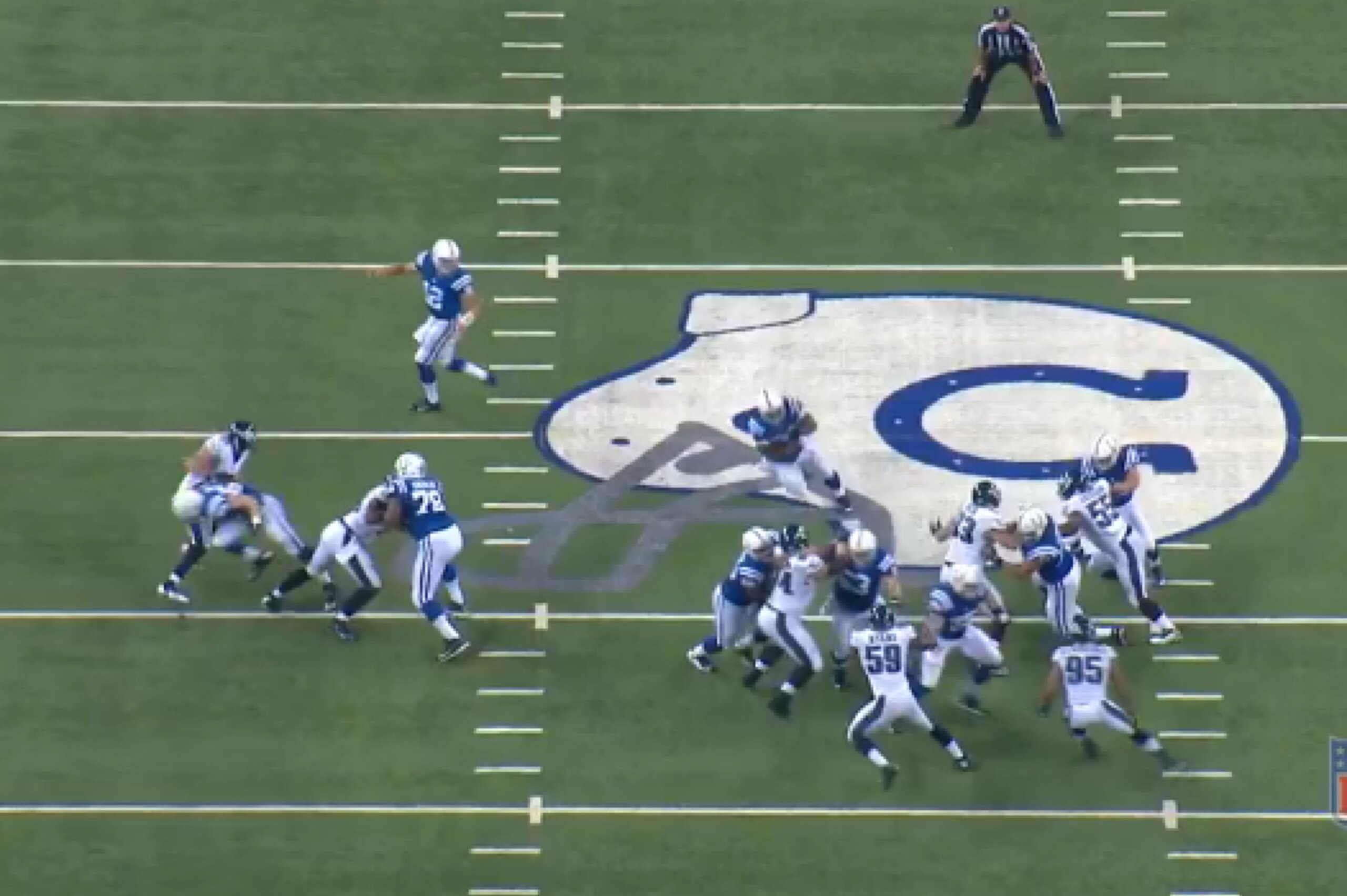
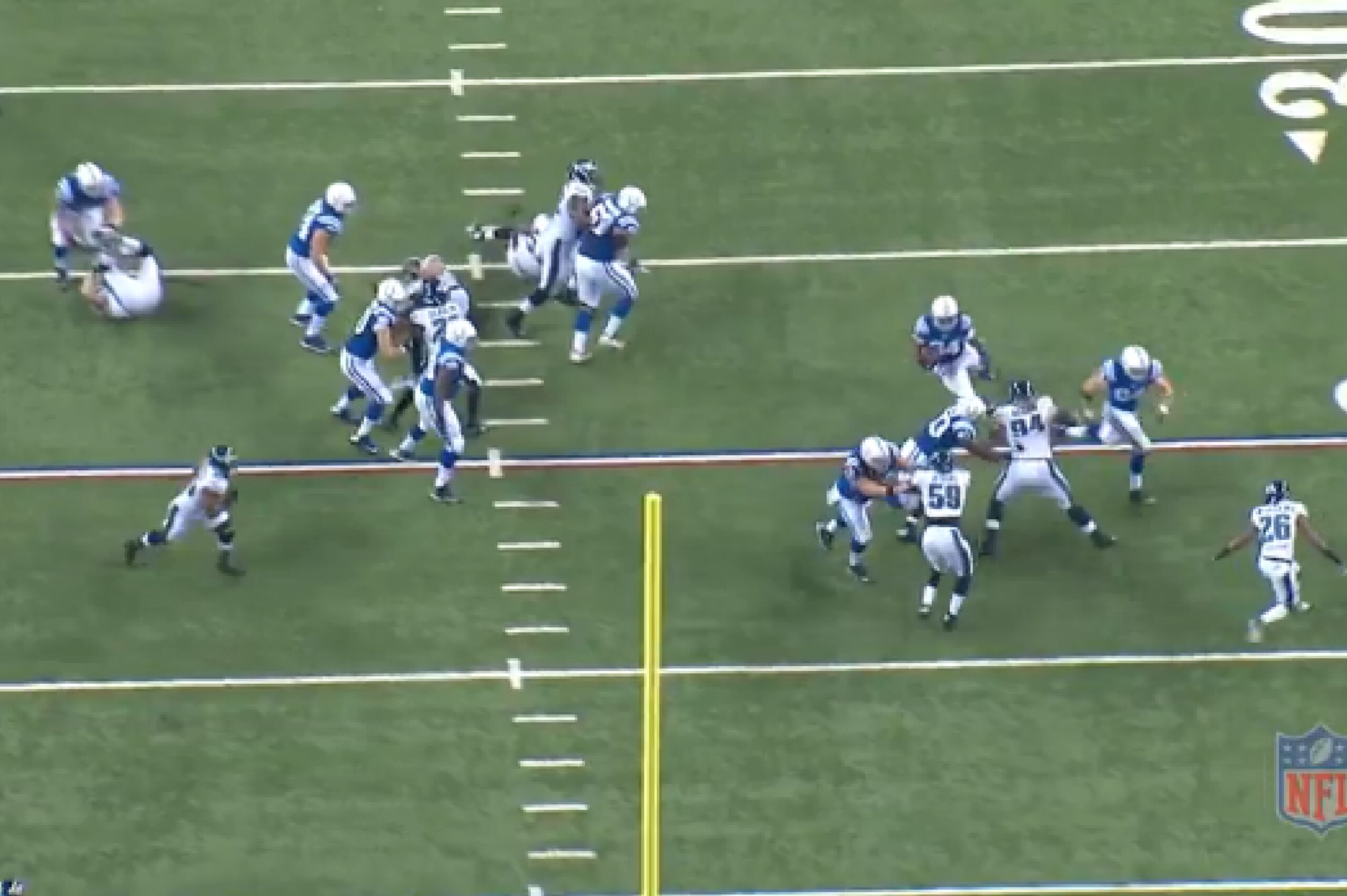
This wasn't just a one-time thing, either. Richardson (and Bradshaw) saw more daylight in front of him than a Colts running back has seen in years. With that kind of running room, Richardson should be expected to get chunk yards, anything else would be a massive failure.
Don't get me wrong, Richardson certainly displayed some impressive traits. He drug defenders for a few extra yards on just about every other run, finishing with 53 yards after contact, per Pro Football Focus (subscription required). Richardson also had a great spin move on a defender in the backfield on one three-yard run in the fourth quarter, turning a loss into a gain.
Unfortunately, I didn't see any real improvements from Richardson in the areas that plagued him most last season: vision, instinct in using his blockers' momentum and burst through creases. For the most part, Richardson simply took what the offensive line gave him and left yards on the field by making his cuts a half-second too slowly.
If Richardson bounces a few runs outside (something he's extremely hesitant to do), he'd have an opportunity for bigger plays. Take this 15-yard run, for example.
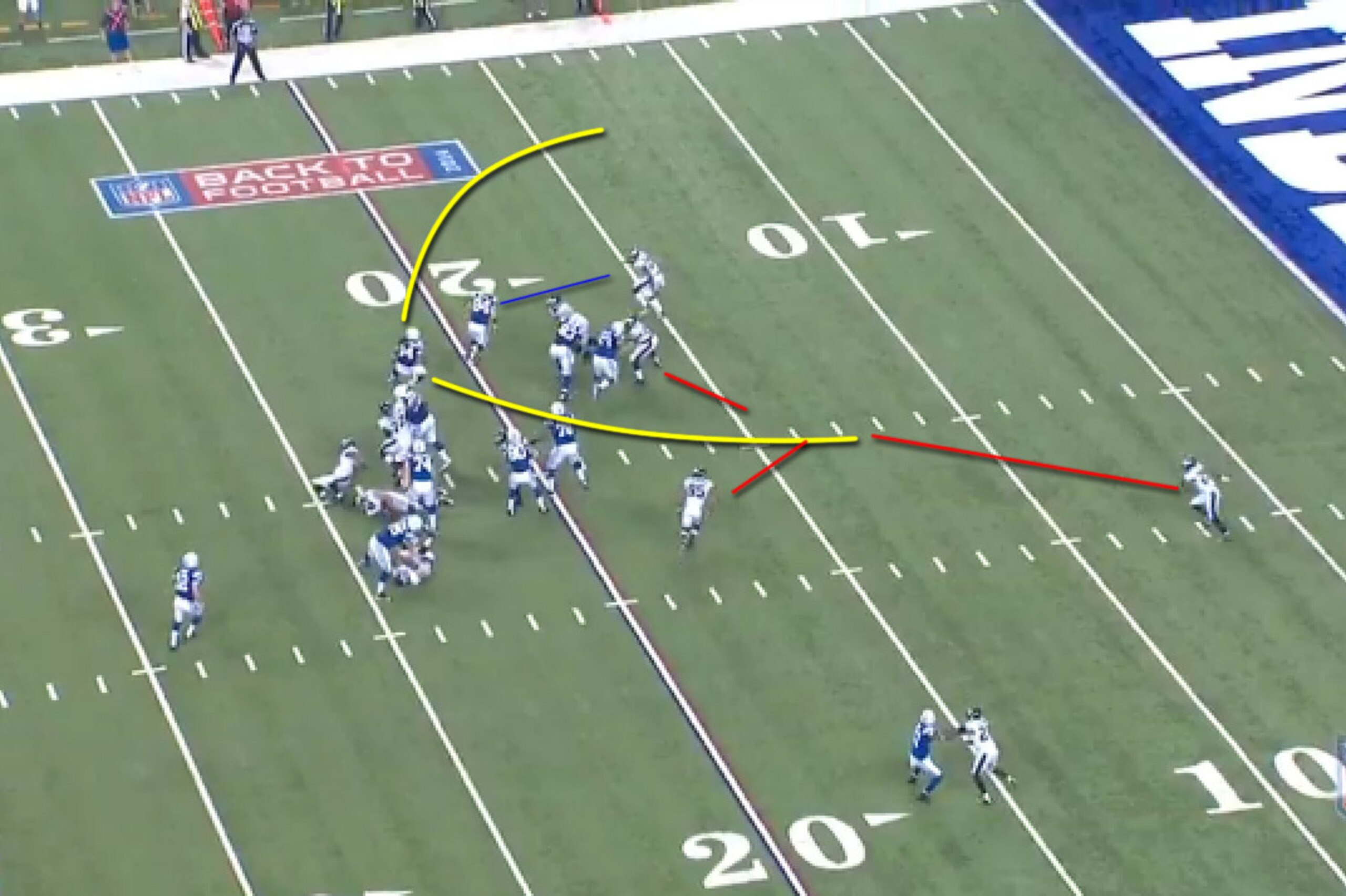
The Colts open up a huge lane for a cutback, and Richardson gets 15, but he has an opportunity for 20-plus and a touchdown if he follows Jack Doyle outside. Or if he recognizes that lane opening up earlier, rather than waiting for it to rival the size of Peyton Manning's forehead, he'd have a shot at getting the safety one-on-one. Instead, his slow cut allows the linebacker to come across the formation and catch up.
Why Richardson did what he did was understandable, it was the timing of it all that was off. A good cutback should have come earlier; by the time he cut back, he would have been better off beating the defender to the edge. It's a small thing, and it likely will get overlooked by many since it nets 15 yards, but it's a missed opportunity.
This all, of course, is moot if Richardson continues to fumble the ball, the biggest no-no for an NFL running back.
When I watch Richardson, I see a similar back to last season. On the positive side, he'll often get you two or three extra yards because of his strength and tendency to drag defenders. There's no questioning his power when he gets a head of steam (running wide, however, tends to fail).
But he's rarely going to get you big plays because he simply doesn't anticipate well or cut and burst particularly suddenly. So yards get left on the field. He can certainly be productive, but he needs the line to be dominating the line of scrimmage in order to do so.
So the question is can the Colts do that with any consistency?
Scheming Power
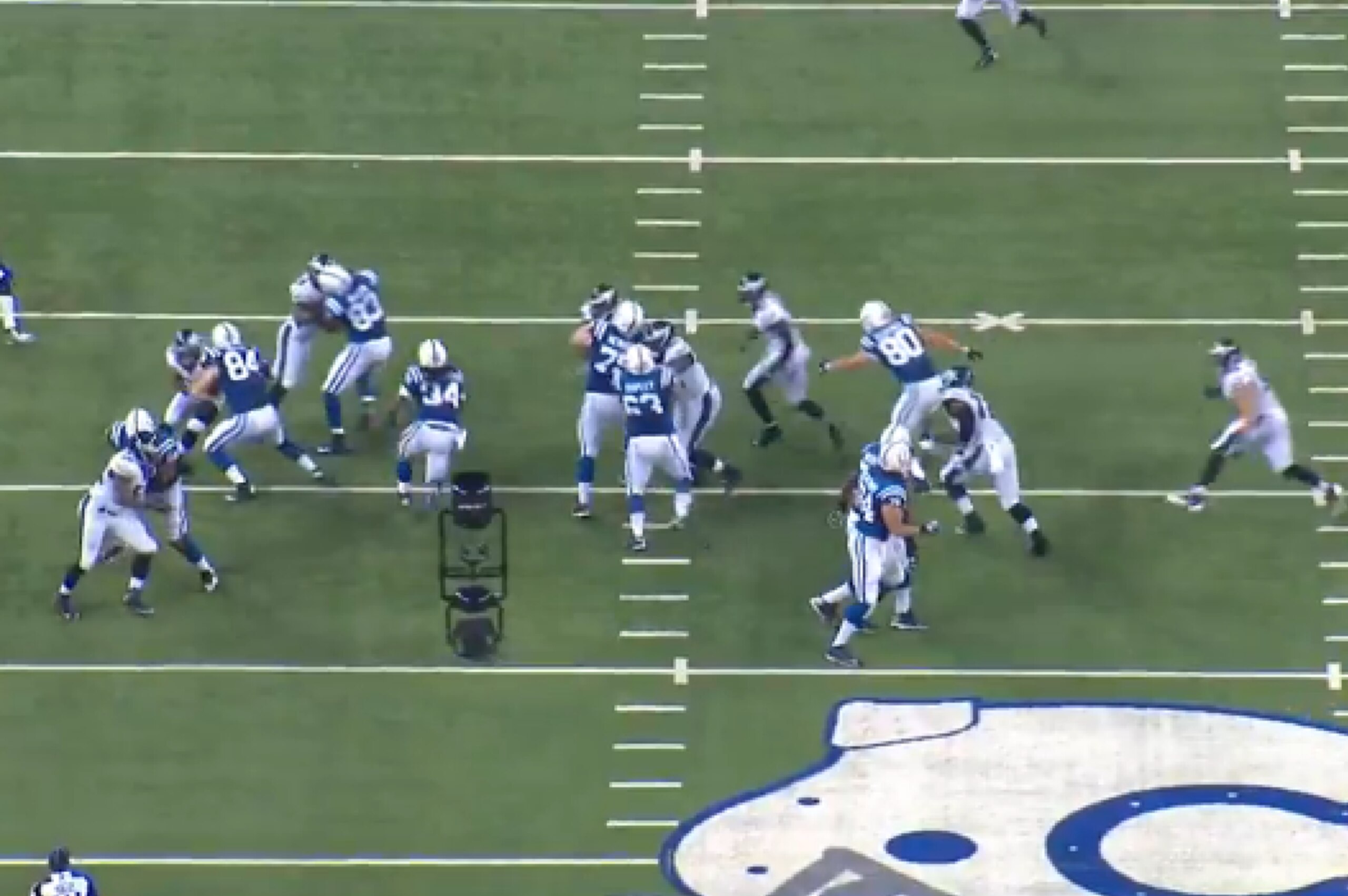
As Jon Gruden pointed out on Sunday, the bulk of the Colts' success on the ground came behind unbalanced lines, something that looked like this.
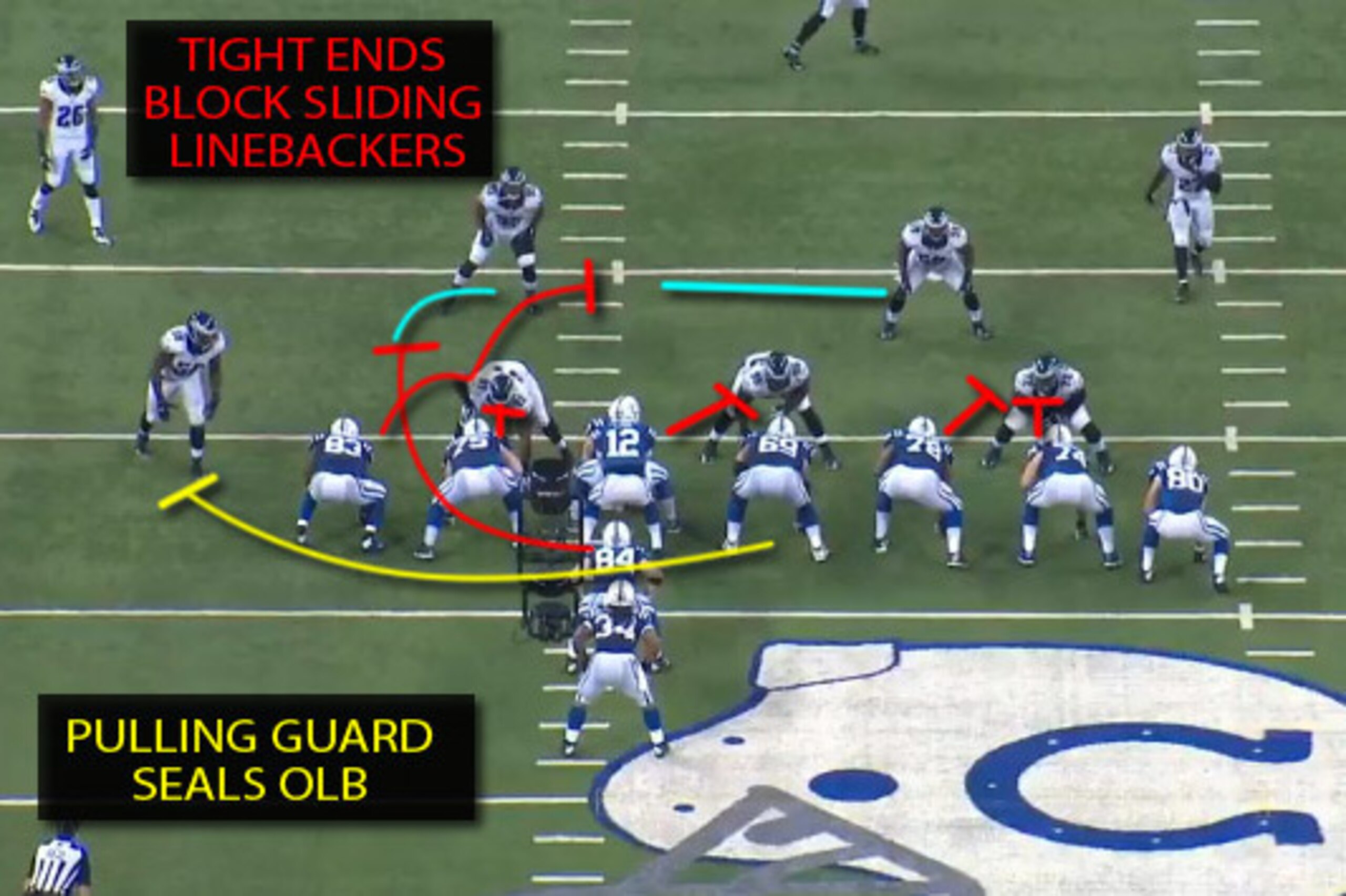
The Colts' biggest runs came on counter plays off of this look after setting them up with power runs to the right side. The charting team at Colts Academy counted 10 counter plays for 60 yards on Monday, including both of Richardson's 15-yard runs.
With the right side so loaded, the defense loads up with five men in the box on the center's right, with just three on the left.
The key is tight ends Dwayne Allen and Jack Doyle. In the Colts' unbalanced sets, Allen was used as the left tackle, while Doyle motioned into the fullback position. Allen was the biggest key, chipping the 3-4 end to help left guard Jack Mewhort get an angle to seal the hole, and then moving out to the "Mike" linebacker who is flowing toward the hole. Doyle takes a step to the right like a power run, then comes back across and attacks the "Will".
Meanwhile, RG Hugh Thornton (arguably the Colts' most athletic lineman) comes across and seals the outside of the hole by blocking the outside linebacker, who is momentarily put on skates because of the counter movement. With all three of the key "move" blockers holding their blocks, Richardson has an open highway in front of him.
But can the Colts expect this to work consistently?
I have my doubts. Like we mentioned in discussing the Colts' downfield passing, the power sets severely limits the Colts' passing effectiveness. Three tight ends on the field doesn't exactly scream downfield separation, especially the Colts' tight ends.
There's also the matter of sustainability. The offensive line as a whole received largely negative feedback in run blocking from Pro Football Focus, grading at negative-3.3 cumulatively. Allen and Doyle, however, combined for a positive-2.3 mark in run blocking. The line is still a below-average group, and basing an entire run game on the blocking of your tight ends isn't a recipe for success.
The effectiveness of this scheme will decrease as defenses see it, the Eagles were prepared for it in the second half, limiting the Colts to less than three yards per carry in the second half. Better defenses will rotate heavier personnel into the game, and none of the Colts tight ends have proved their ability to take advantage of those mismatches in the passing game.
But this kind of running attack should be something that the Colts pull out at least a few times per game. Pep Hamilton's misuse of his weapons in the passing game is well-documented, but these sets utilize their personnel very effectively in the running game. As long as they don't try to force the heavy sets for an entire game, like they did against Philadelphia, it can be effective.
The Colts still need to become more varied in their running success for me to become a full-on believer. The Colts still struggle to run out of passing sets, which is something that may also be linked to Luck's pre-snap adjustments. Ahmad Bradshaw will be key here, as he's quicker to holes than Richardson, and the Colts have shown a preference toward him in hurry-up situations.
The Colts run game, in the end, will be best utilized as an appetizing complement to Andrew Luck and the passing offense, not as the main course. There were some positive signs on Monday night, but a more sophisticated sample is still needed before the run game can be considered dependable.
All statistics and snap counts come from Pro Football Focus (subscription required) and Pro Football Reference unless otherwise noted. All training camp observations were obtained firsthand by the reporter unless otherwise noted.
Kyle is an NFL and Indianapolis Colts analyst for Bleacher Report and the editor-in-chief of Colts Authority. Follow Kyle on Twitter for more stats, analysis and general NFL analysis.

.jpg?w=2560 "🚨 Week 8 AP Top 25 Poll")

.jpg?w=2560 "Lamar Being Out Shocked Ravens")
.jpg?w=2560 "Raiders Could Start Mendoza")