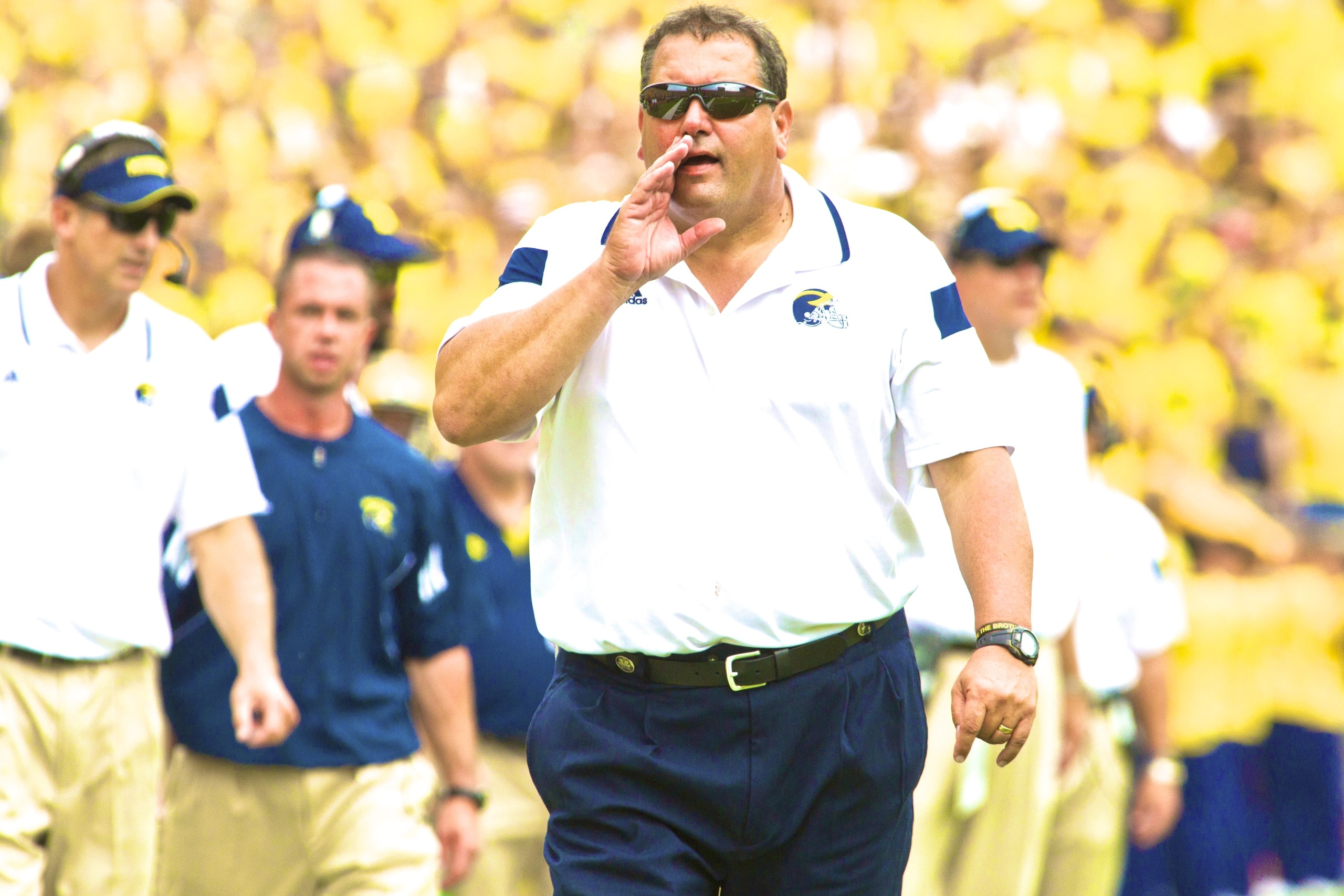

Blueprint for Brady Hoke to Save Michigan's Season and His Job
Brady Hoke lost a game he could not afford to lose in a way he could not afford to lose at Notre Dame last weekend, falling to the Irish 31-0. It was the first time Michigan failed to score a point since October 1984, two months before LeBron James was born and the same year Apple unveiled the Mac.
To say the embarrassment was ill-timed would be an understatement, and a massive one at that. Hoke was on the hot seat well before the trip to South Bend, needing to avoid even minor indignities to save his job. That's what happens when you guide the winningest program in college football history to a 15-11 record over two seasons—especially when that record coincides with your in-state rival, Michigan State, burgeoning into a power. Your margin for error starts to thin.
TOP NEWS

Updated CFP Bracket Projections 🔮

Week 5 AP Top 25 Poll 🔢
Top Overreactions after Week 5 of CFB Season 😧
Even losing 42-30 or 21-10 would have been problematic.
Thirty-one to nil is a catastrophe.
But that doesn't mean that Hoke is a goner, necessarily. Nor does it mean that the season is a loss. There's a way for Michigan to get this campaign back on the rails, and even though it might require radical adjustments, it isn't altogether far-fetched.
Let's examine.
Get the Ball Out of the Quarterback's Hands…And Fast
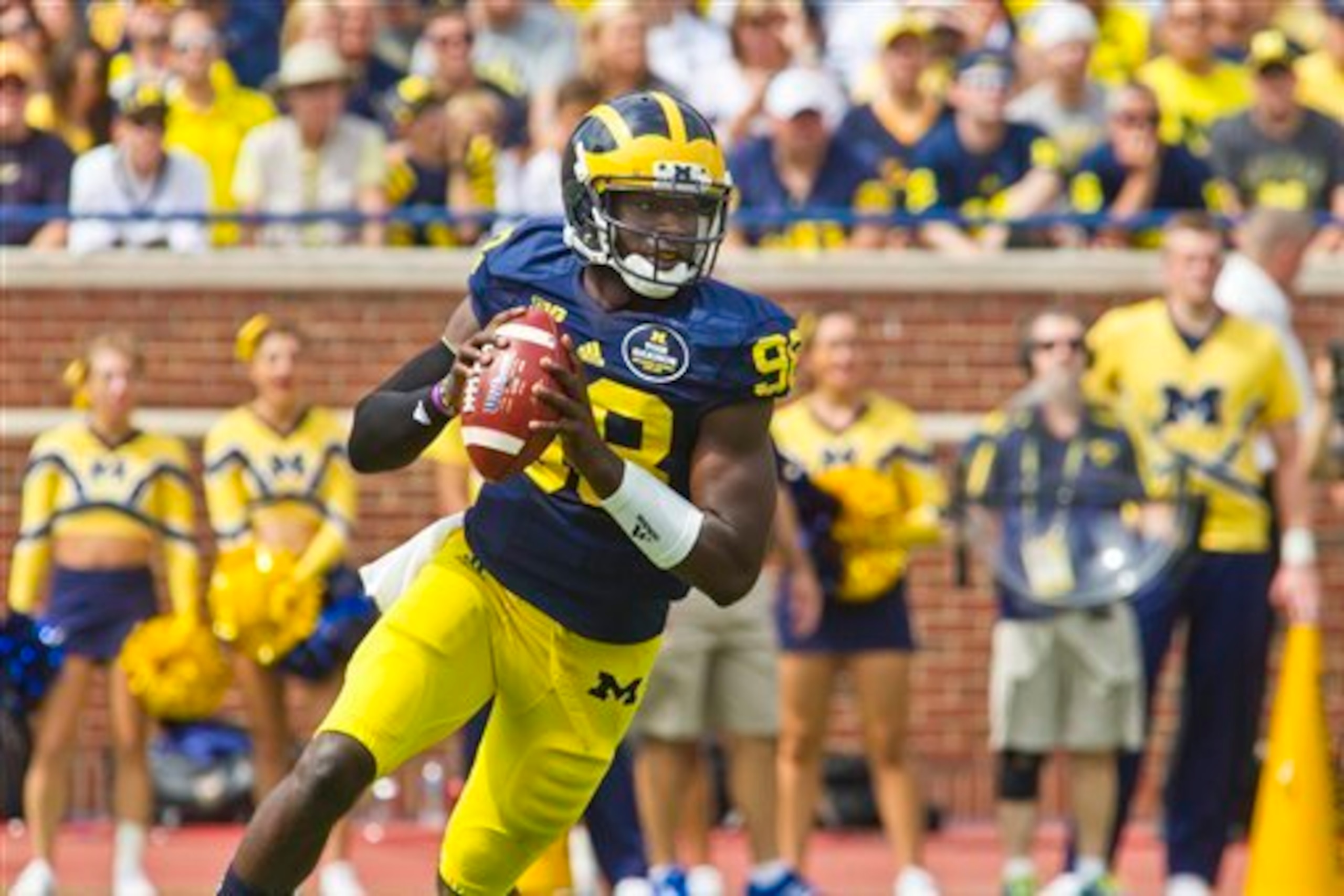
At this point, developing the offensive line for immediate improvement is a lost cause. If Hoke were able to do that, it would be done by now. First-year offensive coordinator Doug Nussmeier is capable of developing an offensive line—it's one of the main reasons he was brought in from Alabama—but it appears one offseason was not enough time to indoctrinate the players on the roster.
This unit will not be good in 2014.
Period.
Is all of that actually true? Maybe yes and maybe no. But for all intents and purposes, it's an assumption that Michigan should act upon. It can't try to play a vertical, attacking style of offense with a group of blockers that can't protect its quarterback—especially when that quarterback, Devin Gardner, relies so much on protection.
According to Phil Callihan of Bleacher Report, Nussmeier blamed Gardner's struggles against Notre Dame "on him still learning the system." But that is only half of the truth.
Yes, Gardner needs to be better and more confident in the system, but Nussmeier also must recognize what Gardner is and isn't.
What he is is a strong-armed QB who does best when he hits his first or second read.
What he isn't is someone who should ever be trusted to improvise.
Ever.
Ideally, the offensive line could be trusted to protect Gardner for more than two or three seconds. Ideally, he could drop back and scan the the whole field, read the defense, make a decision, contemplate that decision, scan the field again, consider the ramifications of his throw, then unwind. Ideally, the potential for disaster wouldn't rise by an exponent of 10 with every step Gardner takes in the pocket.
But none of those things are the case.
Instead, Gardner needs to get the ball out of his hands early and often. He must mitigate his potential to provoke the game-changing turnover. Michigan, for those who didn't know, outgained Notre Dame by nine yards in Saturday's loss. It was turnovers that dictated the outcome; Michigan had three and forced zero.
Hoke and Nussmeier can run the same old offense against Miami (Ohio) this weekend and probably do well. The same way the offensive line looked good against Appalachian State, it can probably look good against the Red Hawks. After the game, everyone can talk about how the system—when implemented properly—works.
Or, instead of that, Hoke and Nussmeier can acknowledge the futility of the offensive line, admit that posting hollow stats against inferior defensive lines means nothing and use the Miami (Ohio) game as a testing ground for a quick-read game plan. Instead of a steadfast commitment to Nussmeier's system—a system I have no problem with, but which necessitates a competent offensive line—they can pivot based on the cards they are holding.
It's a bit of a long shot breaking away from what you spent all spring and fall planning, but a long shot is what Hoke needs to save his job. This offense will get flattened against Michigan State and Ohio State if it doesn't adapt the scheme to the personnel. Nussmeier doesn't have the horses to do what he wants to do, and Hoke doesn't have the luxury of letting players develop during a lost year, of wetting Shane Morris' feet over the next 10 games.
He needs this ship to turn around now.
Turn Jabrill Peppers Loose

Whether or not Jabrill Peppers is actually ready for his close-up, Hoke needs to treat him like he is. Assuming Peppers is healthy enough to play (he missed the Notre Dame game with a bum ankle), he needs to be a focal point instead of an ancillary piece.
Before the Notre Dame loss, that wasn't necessarily the case. Before the first shutout in the post-Reagan era of Michigan football, Hoke could afford to ease Peppers along. Before the most embarrassing defeat since "Appalachian State 34, Michigan 32," it was all about the little things that Peppers could contribute.
But now? Hoke has to see what he has.
And he has to do it fast.
Getting Peppers on the field as often as possible is the best (only?) way for Hoke to semi-endear himself to the Michigan faithful. They might not forgive him after what happened against Notre Dame, but seeing Peppers touch the ball will help them forget. The luster of their prized recruit will distract them from the Hoke problem, like Soma.
Out of everything Hoke has done since arriving in 2011, signing Peppers ranks right up next to winning the Sugar Bowl. It might even rank slightly ahead. Peppers was the No. 3 overall player and top athlete in the 2014 recruiting class, the type of prospect Michigan used to sign with regularity. And now? Here they have one again.
Not turning Peppers loose would be sort of like folding pocket Aces. Closer, it would be like being dealt one ace, then folding before getting your next hole card. You know that the hand will be good, potentially even great, but you don't stick around to see the flop.

We have no idea how good Peppers can be as a true freshman, no clue what position he should play. But in some ways, isn't that the point?
Hoke cannot afford to go down without exhausting every Peppers-related option. Try him out at nickel, at corner, at safety, at running back, at receiver—let him call the plays, if you must. Give him as much to do as possible, a bona fide chance to break out.
A huge season from Peppers would mean huge optimism for the future, even if that future includes Hoke. That holds doubly true if Peppers' huge season is the result of creative usage.
If Hoke unlocks the best way to use Peppers, would it really be prudent to fire him? To allow another coach to step in and try his hand? To give Peppers impetus to…*gasp*…maybe transfer?
I didn't think so, either.
Dominate the Defensive Trenches
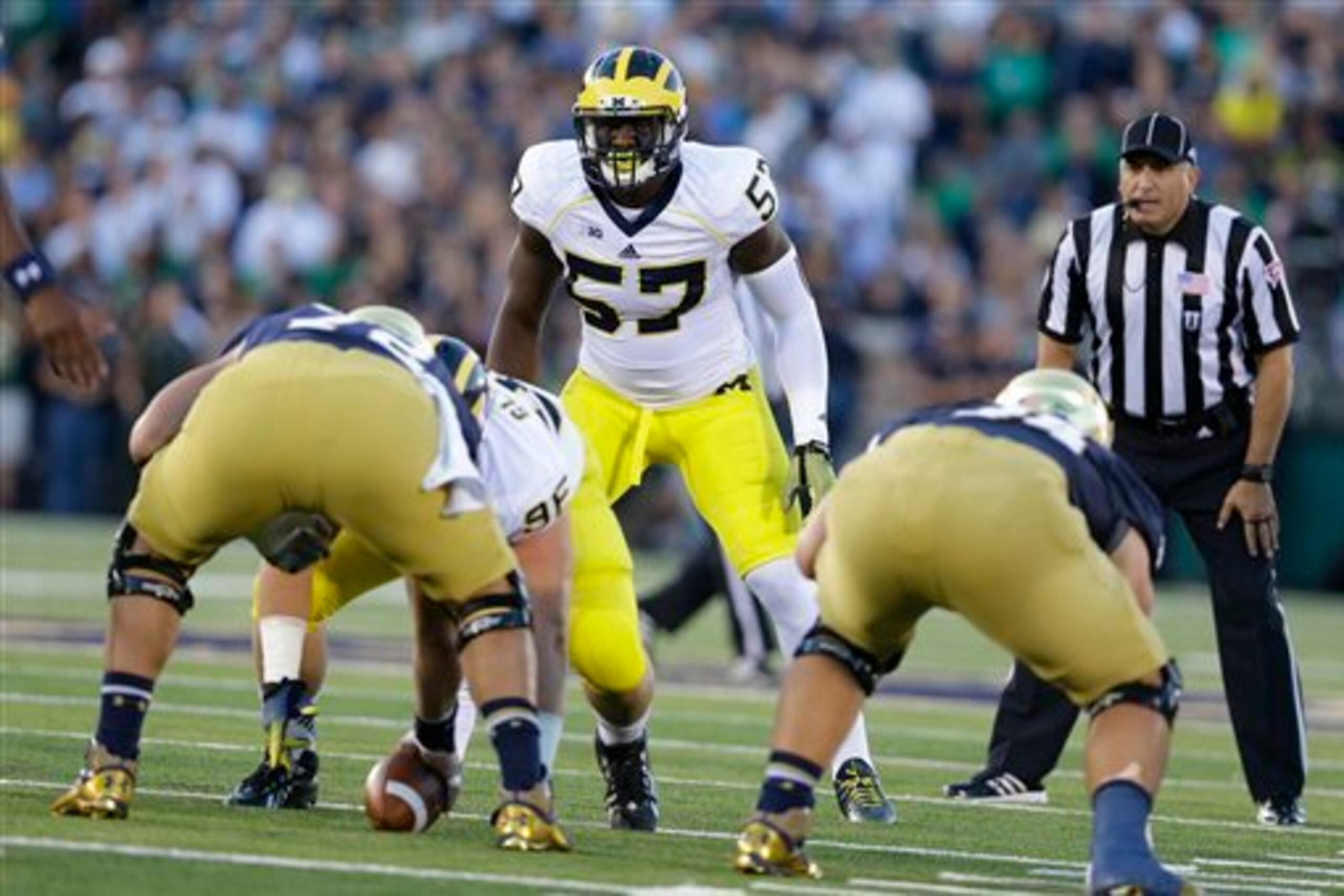
Michigan's strength is on defense, and the strength of its defense is the defensive line and linebackers. If this team is going to contend in the Big Ten East, it will have to own the defensive point of attack.
Fortunately, that strength aligns with the weaknesses of its three primary competitors: Ohio State, Michigan State and Penn State. All three of those teams have questions along the offensive line.
The Buckeyes are breaking in four new starters up front, and the immediate results have been ugly. Michigan State's situation is not as dire, but injuries took their toll in the second half against Oregon, when physical linemen such as Arik Armstead and Deforest Buckner changed the game. And Penn State might be worst of all, averaging 2.76 yards per carry through two games with a unit redolent of last year's Wolverines.
Bleacher Report's Adam Biggers wrote that the pass-rush "didn't fail" against Notre Dame on Saturday; instead, it was beaten by the elusiveness of Everett Golson, who by many accounts (including my own) played the best game of his life.
Players such as Frank Clark, Jake Ryan and Joe Bolden are All-Big Ten talents, and all of them are fully developed. Players such as Willie Henry and Taco Charlton are getting there. Ohio State, Michigan State and Penn State are beatable this season, and beating one or two of them is Hoke's best (only?) chance of salvaging his job.
If he wants to get it done, the front seven has to be the key.
_0.png?w=2560)


.jpg?w=2560 "2 NFL Officials Suspended")


.jpg?w=2560 "Mahomes' Wife Trolls Kubiak 💀")

.jpg?w=2560 "Injury-stricken Seahawks signing veteran RB")
.jpg?w=2560 "Love's Body Already 'Tired'")