Houston Texans vs. Oakland Raiders: Breaking Down Oakland's Game Plan
A strange thing happened to the Oakland Raiders in their Week 1 loss at the New York Jets.
Offensively, the Raiders managed only 176 yards of total offense—73 of them on the team's final drive—and a meager 11 first downs for the entire game.
Defensively, they were pushed around for four quarters. Geno Smith finished 23-of-28 for 221 yards, and the Jets as a team rushed for 212 yards while averaging over six yards per carry. Watching the game, it was obvious that Oakland was dominated in every area.


.jpg?w=2560 "Commanders Eagles Football")
Yet somehow, the Raiders were within a single score of taking the lead the entire game and were a recovered onside kick away from a chance to win it at the end.
Oakland led after one quarter, was down three at halftime and down six after three quarters. And even when Chris Ivory's 71-yard touchdown run with 8:03 left in the game extended the Jets lead to 12 points and seemed to seal the Raiders' fate, the lead didn't last. A late touchdown pass from Derek Carr to James Jones made this a winnable game in the final minutes.
Statistically, Oakland was dominated. Despite that, the team was never out of it. This game was there for the taking, but the Raiders were just never able to take advantage of the opportunity.
So what went wrong?
As Oakland struggled for the better part of four quarters, three things became evident: the defense was unable to generate any pressure on the quarterback, the offense couldn't run the ball and the passing plays were too conservative.
This Raiders team is more talented than it has been in years, but it's still going to struggle to find wins. That makes it even more crucial that opportunities to earn a victory, even if it's stealing one, aren't squandered.
Chances to win a game could be few and far between for Oakland in 2014. When a great opportunity like the one they had in Week 1 arises, the team can't let it slip away.
Going forward, there are some key areas the team needs to improve in strategically, both on offense and on defense. The improvements need to begin this week at home against the Houston Texans for the Raiders to turn this season into a successful one.
The running backs have to be more involved
Heading into the season, one of the most exciting units on the Oakland roster was the running back position. Maurice Jones-Drew and Darren McFadden can be among the league's top running backs, and Latavius Murray has the potential to be extremely effective.
But on Sunday, Jones-Drew and McFadden combined for a grand total of 16 touches—13 rushes and three receptions—for the entire game, totaling only 44 yards of offense. Murray's only action was on kick returns.

Both Jones-Drew and McFadden are supposed to be featured in the offense. Despite this, Jones-Drew had only nine rushes for the game. McFadden finished with four. This is an especially big problem because the plan is for this to be a rush-heavy offense. But against the Jets, this was a rushing offense that couldn't run the ball.
The lack of touches for Jones-Drew and McFadden is symptomatic of a larger problem for the Oakland offense, which is a lack of creativity in the play-calling. Yes, the Jets have a very good defensive front, and it was always going to be a challenge to run the ball. The issue is that nothing was done to get the running backs involved.
Even if the running game couldn't get going, the Raiders could've moved the running backs around. But nothing changed over four quarters. There were no reverses. No motioning the running back out as a receiver. Nothing. Jones-Drew and McFadden were told to run it up the middle, they caught a few screen passes, and then the Oakland coaches seemed to give up on them all together.
The coaches have to be more creative. Against the Texans, the rushing attack will be more effective. But the offense still needs to be more diverse. For the offense to be successful, the running backs should combine for at least 30 touches a game. And these touches need to be a mix of runs and catches.
There's also no excuse for McFadden having only five touches in a game. This'll be even more important now that Jones-Drew's status for Week 2 is doubtful after he underwent what ESPN.com's Bill Williamson referred to as a "minor procedure" to repair a hand injury.
Per Williamson, Jones-Drew was initially listed as day-to-day.
However, while this remains the team's official stance, CSNBayArea.com's Scott Bair reports that Jones-Drew is now likely to miss Sunday's game.
Getting McFadden involved, along with Murray, will be even more important, and the responsibility falls on coaches. The running backs can succeed if given the touches. It's up to the coaches to make this happen.
Let Carr utilize more of his skill set
With a rookie starting quarterback in Derek Carr, it's understandable that the Raiders coaches chose to go with a conservative offensive game plan. You want the young player to succeed, but most of all, what you want to do is avoid having him make any major mistakes that can not only cost a game but also affect his confidence going forward.
However, the coaches have to try and balance out this cautious approach with play-calling that will still allow Carr, and the offense as a whole, to be dangerous and effective. Even with the extremely conservative play-calling in Week 1, Carr was still almost able to lead the team to victory.
It makes sense to be cautious, but his performance should lead to more trust from the coaches.
Per Pro Football Focus (via ESPN.com's Bill Williamson), the passing plays were the definition of conservative: out of Carr's 20 completions, 17 were 10 yards or shorter, and eight were behind the line of scrimmage.
The cautious play-calling in the passing game made sense going into the game. However, it became especially frustrating as the game progressed because the Raiders had a chance to win, but they never tested the Jets' depleted secondary. Even late in the game when Oakland was a touchdown away from taking the lead, the coaches never seemed to make any changes or try anything different.
Against Houston, Oakland needs to open up the playbook. This isn't to say that Carr should be throwing deep passes every other play, but the Raiders need to keep the Texans defense honest. The longer the offense continues to throw short passes, the more comfortable the defense will be in cheating up to the line and really teeing off on the pass rush.
Via Silver and Black Pride's Levi Damien, head coach Dennis Allen believes that Carr isn't "your typical rookie quarterback." If this is true, the play-calling needs to reflect it.
Taking responsible chances downfield will not only create more big-play opportunities, it'll also force the defense to respect the pass and open up more chances for the struggling running game. That in turn will take some pressure off of the offensive line.
The passing game shouldn't be careless. But the coaches do need to let Carr play if the offense is going to have a chance to put up enough points to win.
Manufacture a consistent pass rush
No unit on the Oakland roster saw as big an overhaul this offseason as the defensive line.
High-profile acquisitions such Justin Tuck and LaMarr Woodley were expected to provide a legitimate pass rush for the Raiders. But that wasn't the case against the Jets. Tuck's impact was minimal and Woodley was a non-factor as they combined for only seven tackles, no sacks and no tackles for a loss.

Tuck and Woodley were available this past offseason because many around league suspected that they were both too far past their prime to still be effective. The Raiders signed them with the hope that this wasn't the case. Nothing is decided after a single game, but the lack of impact from both players is enough to at least suspect that the concerns about their deteriorated abilities might be accurate.
The Oakland secondary was able to hold up well enough in Week 1 as the defense allowed only 19 points, keeping the game within reach. But this was against a Jets offense that's average at best. A similar defensive performance against a top-tier offense will lead to a very long day for the Raiders.
The truth is that the secondary remains arguably the weakest unit on the team, and the best way to protect it is with an effective pass rush. If the front four can't do the job on its own, defensive coordinator Jason Tarver is going to have to get creative.
The New York Post's Brian Lewis reports that Tuck believes the defense was just a few plays away from the team getting a much different result:
"I truly believe a couple plays here and there [made the difference]. It’s always like that. It’s not a lot of difference between teams in this league. A few plays here and there, we win that football game and nobody’s talking about same old Raiders.
"
That might be true, but until the front four proves it can do the job, Tarver is going to have to explore other options.
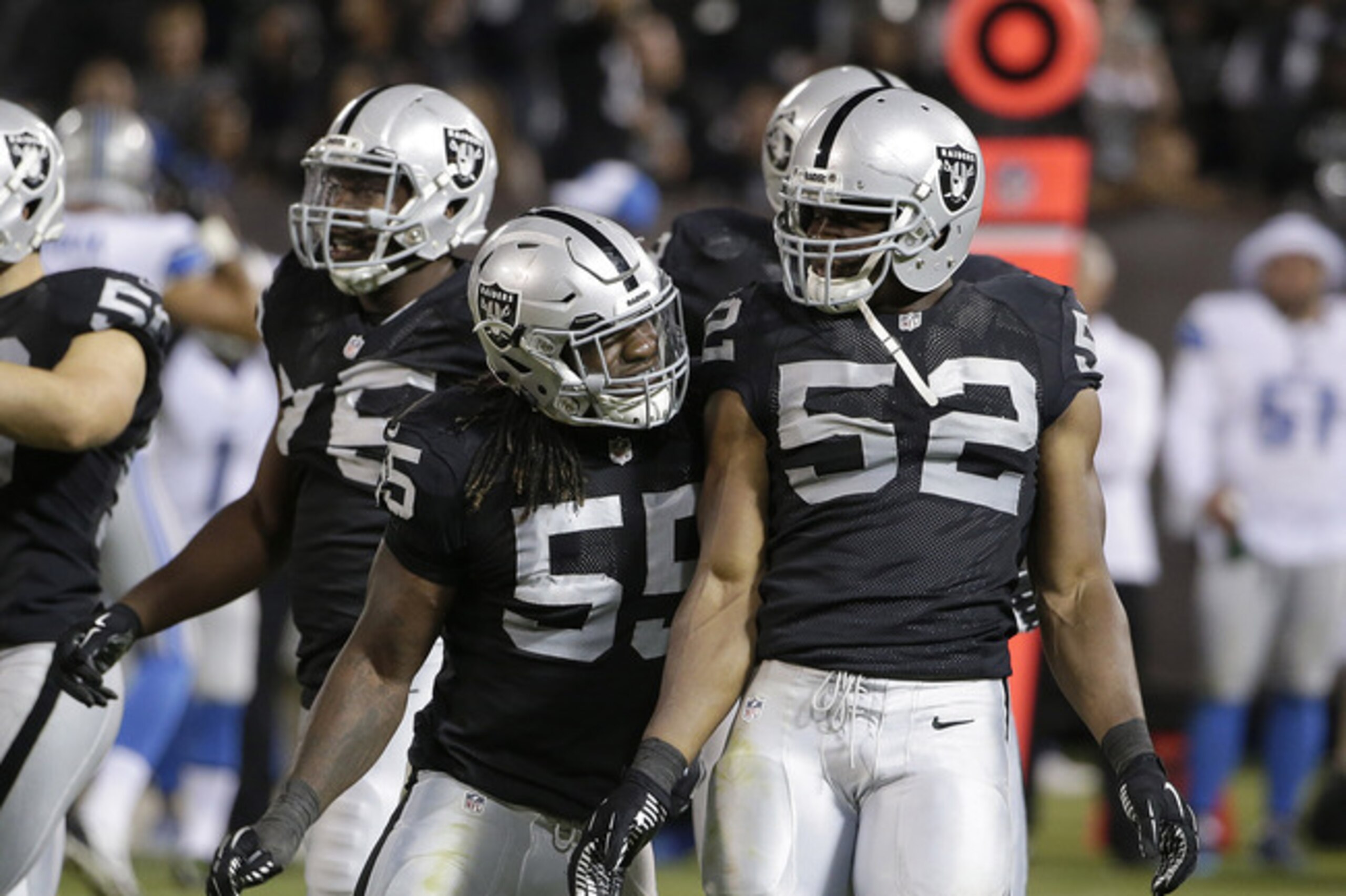
The Raiders' defense has its flaws, but it does have one major strength: youth at outside linebacker. Khalil Mack and Sio Moore need to be incorporated into the pass rush throughout the game against Houston. If this is done regularly, the pass rush will be more successful.
Even if the defense doesn't get a sack, it still needs to get into the backfield to disrupt the passing attack. Based on the defensive line's performance last week, the pressure is going to need to come from rushing with numbers. Whether it's linebackers, corners or safeties, Oakland is going to have to consistently bring numbers to create the necessary pressure up front.
The defense has to stop the run
The game against the Texans is going to match up two units that weren't impressive in Week 1: the Oakland defense and the Houston offense.
The Raiders were gashed on the ground by the Jets, but the Texans managed an average of only 3.5 yards per carry against the Washington Redskins. This is where the Oakland defense needs to make a stand.
In an interview with the Raiders official website, defensive coordinator Tarver identified poor execution on defense as the reason for the Jets' success on the ground. He echoed the sentiment that a few plays here and there were what made the difference. The defense might have played well outside of that, but you can't erase those plays.
"I think there was a 10-yarder where we missed a tackle on the edge where we had two players there unblocked and an 11-yarder. Then there was an 11-yarder to start the second half where we needed a couple guys to do a better job. So there’s two runs over 10 yards, there’s the two quarterback runs where we need better execution on third down in the first half, and then there’s the long one... There’s a couple plays that we have to lock it down and find a way to get the guy on the ground. That’s our job. You take those out[big gains on the ground], of course, but you can’t. That’s how it works.
"
The Oakland defense isn't good enough to completely shut down an opposing offense, but it can still be effective if it picks its poison: stop the run or stop the pass.
Oakland's secondary is not flush with talent, and it's going to struggle throughout the season. Unfortunately, defending the pass is largely a one-on-one challenge, and the cornerbacks and safeties are just going to have to make due.
The team is hoping to see improved performance from the unit with the return of Chimdi Chekwa. CSNBayArea.com's Scott Bair reports that Chekwa has been a full participant in practice, and ESPN.com's Bill Williamson notes that Chekwa is in line to takeover as Oakland's third cornerback.
Bair quotes head coach Allen as saying that the team feels "confident about him him [Chekwa] in the game" against Houston. Still, until Chekwa proves he can be effective on Sundays, his performance can't be counted on.
Against the run, however, a defense can scheme. Even if the talent isn't there, the defense can stack up against the run, send more rushers and establish gap responsibility. With an effective game plan, Oakland can keep the opposing running attack in check and reduce its effectiveness.
On Sunday, the Raiders need to focus on the run, especially given the quarterback they'll be facing. Ryan Fitzpatrick isn't an elite quarterback, and the secondary should be able to be effective enough against him. If the Raiders establish a pass rush and stop the run, they should be able to slow the Houston offense enough to turn this into a winnable game.
Unless otherwise noted, stats provided by from ESPN.com.
Share your thoughts and opinions on Twitter @BrianJ_Flores.
.jpg?w=2560 "Chiefs Dolphins Football")


.jpg?w=2560 "Love's Body Already 'Tired'")