

Examining Vicente Del Bosque's Primary Tactical Systems for the World Cup
The talent at Vicente del Bosque's disposal is unmatched at this year's World Cup in Brazil.
Indeed, when Spain's manager unveiled his provisional 30-man squad back on May 13, opposing managers must have been left drooling at the incredible depth that has defined this glittering La Roja generation.
After claiming two European Championships and a World Cup title in between, Del Bosque's stars could entrench their reputation as the finest footballing dynasty of all time with a fourth consecutive major title this summer.
However, Spain's task won't be straightforward. At a time when many of the nation's heroes are approaching the end of their international careers, Del Bosque's world champions must do what no European team has ever done and overcome the World Cup obstacle that is the continent of South America.
With unique conditions and a volatile atmosphere, Brazil will present a stern test for the Spaniards.
Consequently, Del Bosque will need to utilise the full extent of Spain's fabled depth and versatility if his team are to defend their title.
Below, we look at the three primary tactical systems likely be to used by La Roja's decorated manager.
Spain's Preferred System
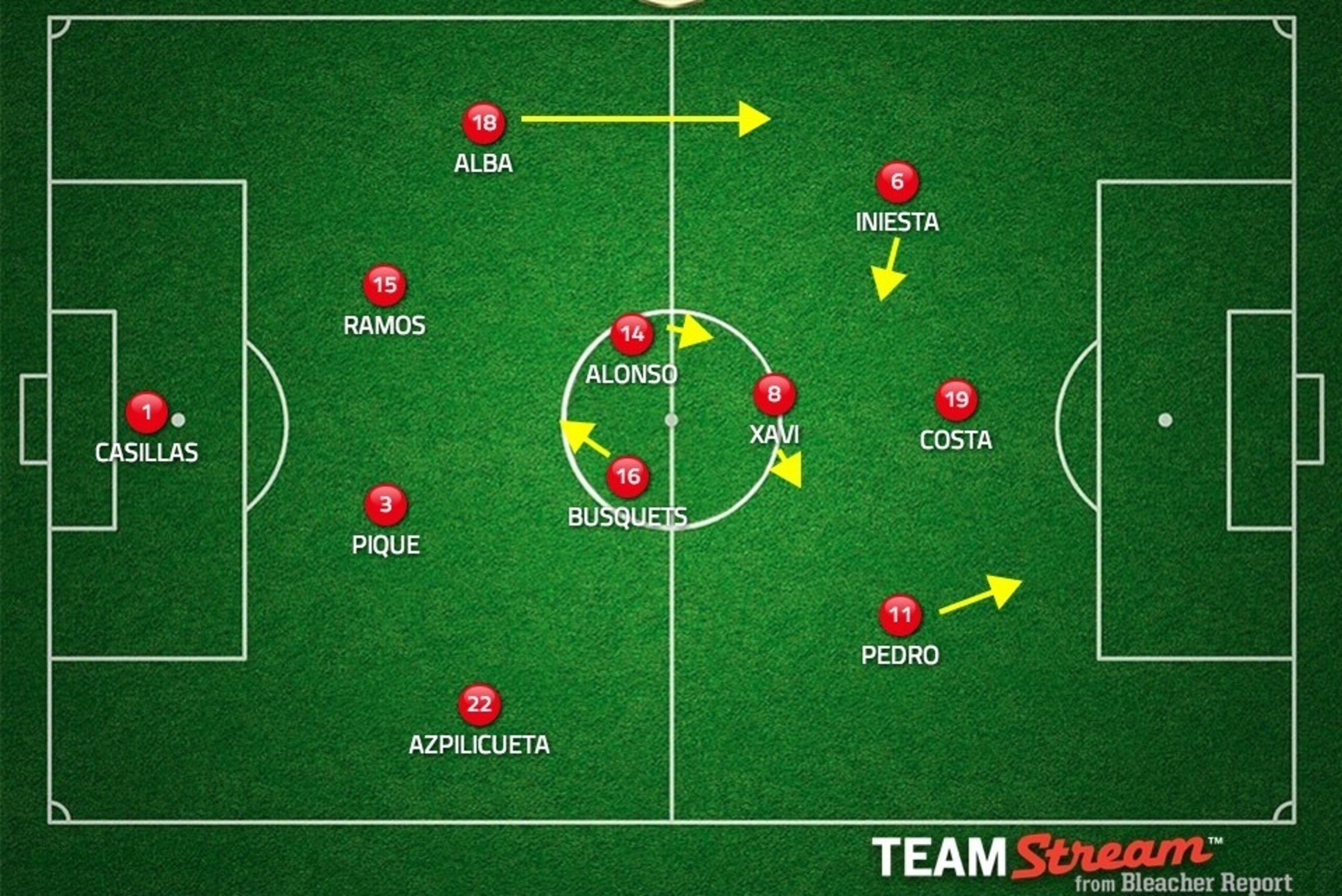
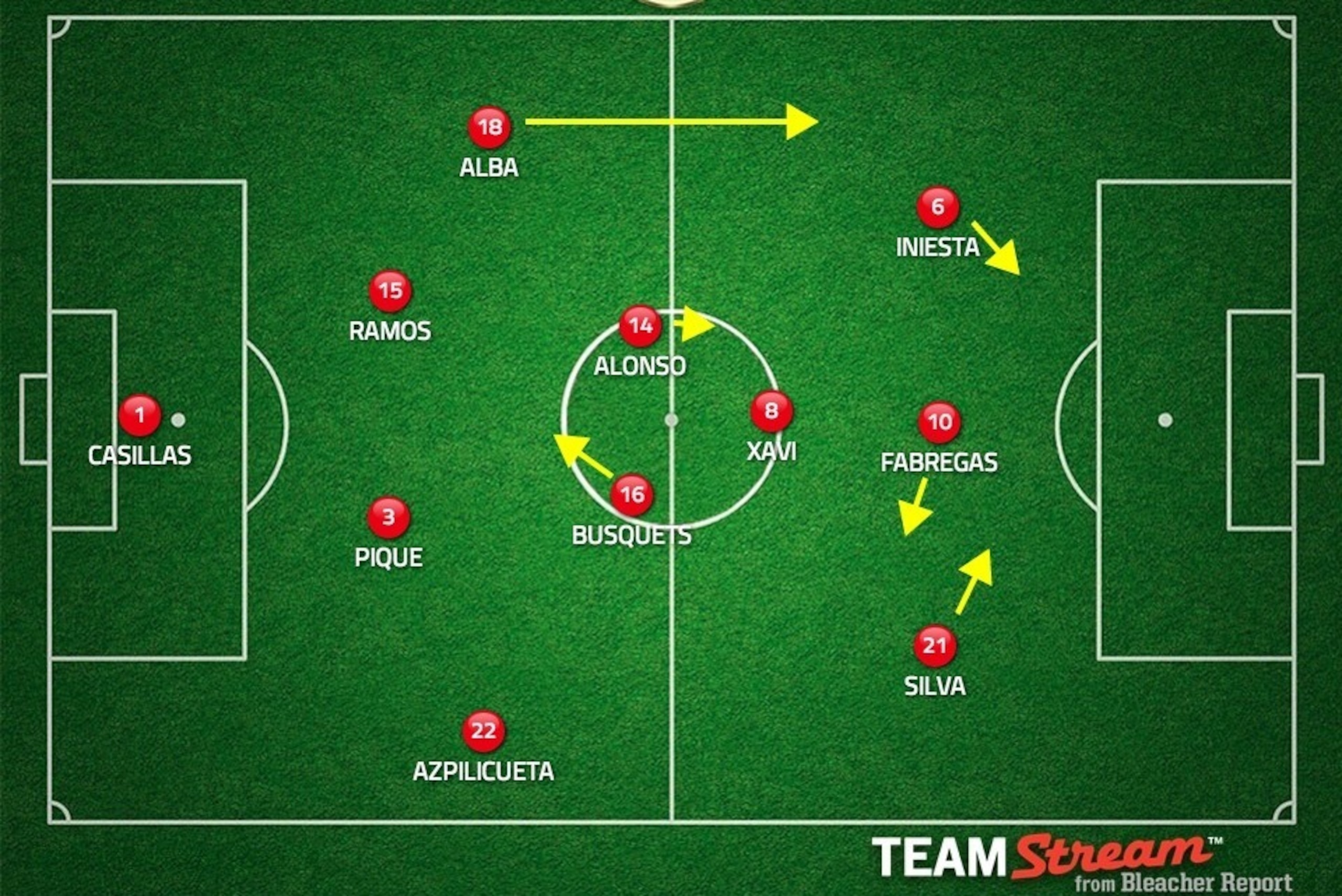
The most notable component of Del Bosque's preferred system is the use of a double pivot.
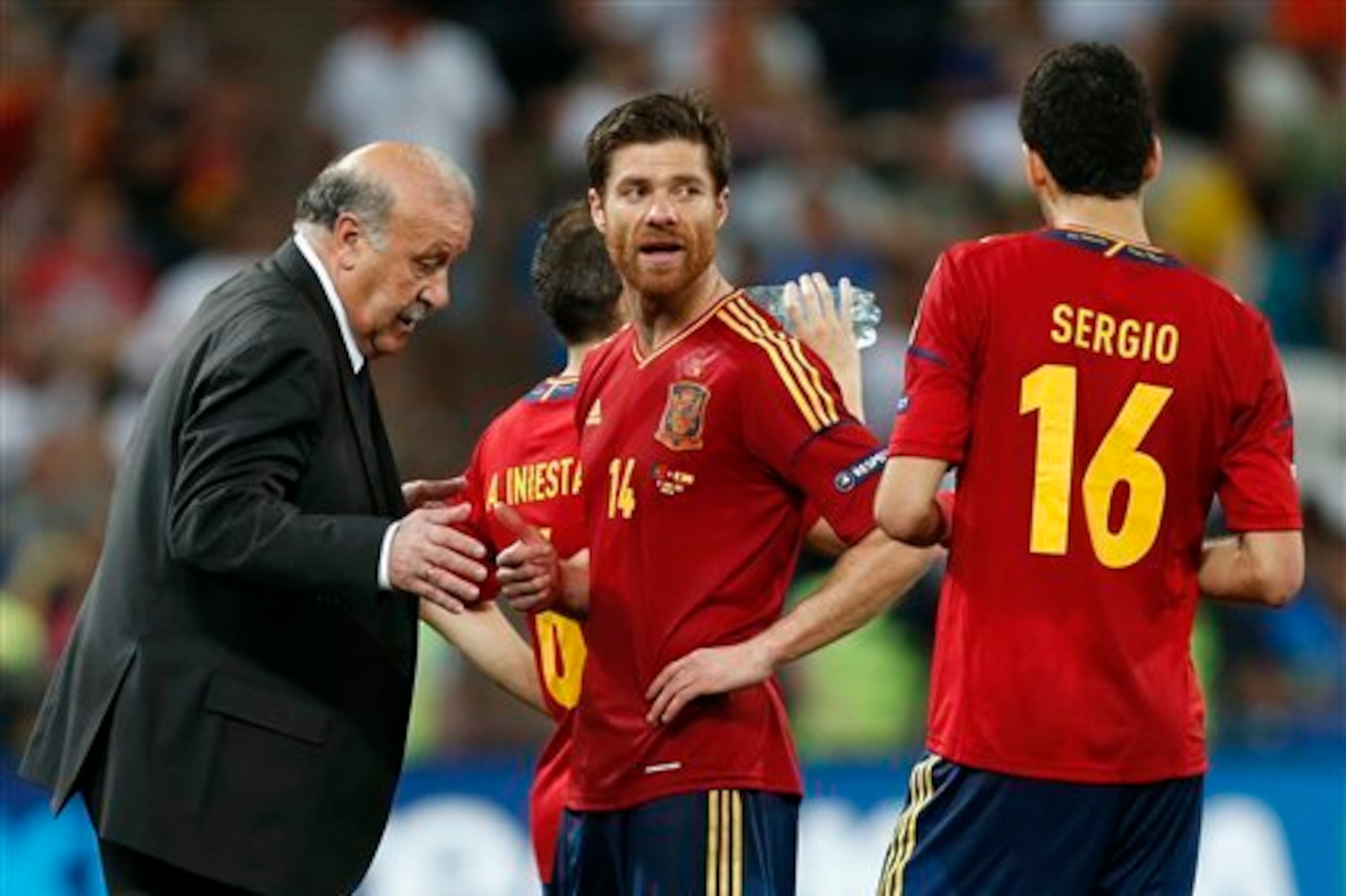
By utilising both Sergio Busquets and Xabi Alonso as holding midfielders, the team's attacking quartet can operate with a large degree of freedom.
Typically, Busquets will play as the deeper of the two, with Alonso pushing slightly ahead to his left. Like his role with Real Madrid, Alonso is the man to play longer passes and push the ball to the flanks to spread out Spain's opponents.
Further up, Xavi is the team's central hub, while Andres Iniesta is regularly deployed on the left flank by Del Bosque, with the Barcelona star afforded the luxury of both pushing forward and dropping back into central midfield during the build-up.
Given Iniesta's inclination to move centrally from his starting position, the pace of left-back Jordi Alba is critical. By operating along the entire length of the left sideline, Alba ensures Spain maintain a splash of width and directness in attack.
On the other flank, Del Bosque can use Pedro or David Silva depending upon the opponent, while Juanfran will fight it out with Cesar Azpilicueta for the starting right-back position.
In Spain's conventional system, Santi Cazorla can also effectively operate as cover for Iniesta, while Pedro is comfortable switching flanks to spice up the team's attacking forays on the left.
Yet, the biggest decision Del Bosque must make when deploying the Spaniards' most used formation is the identity of his striker.
In Diego Costa, Spain have a truly prolific target man possessing the clinical finishing ability lacked by Fernando Torres. Consequently, he's likely to be the manager's first option, with his selection aided by his ability to enhance Spain's pressing game without the ball.
In attack, however, the Brazilian-born star is far more accustomed to Atletico Madrid's direct and robust style, meaning he's not a natural fit for this Spain team.
If the 25-year-old doesn't prove cohesive with his teammates, Del Bosque will look to his trusted sources in Torres and David Villa to fill the void.
Del Bosque's False Nine
As mentioned, Del Bosque has three genuine striking options in his World Cup squad in Costa, Torres and Villa.
However, the former Real Madrid manager is likely to utilise his false nine system at various stages of Spain's campaign in Brazil this summer.
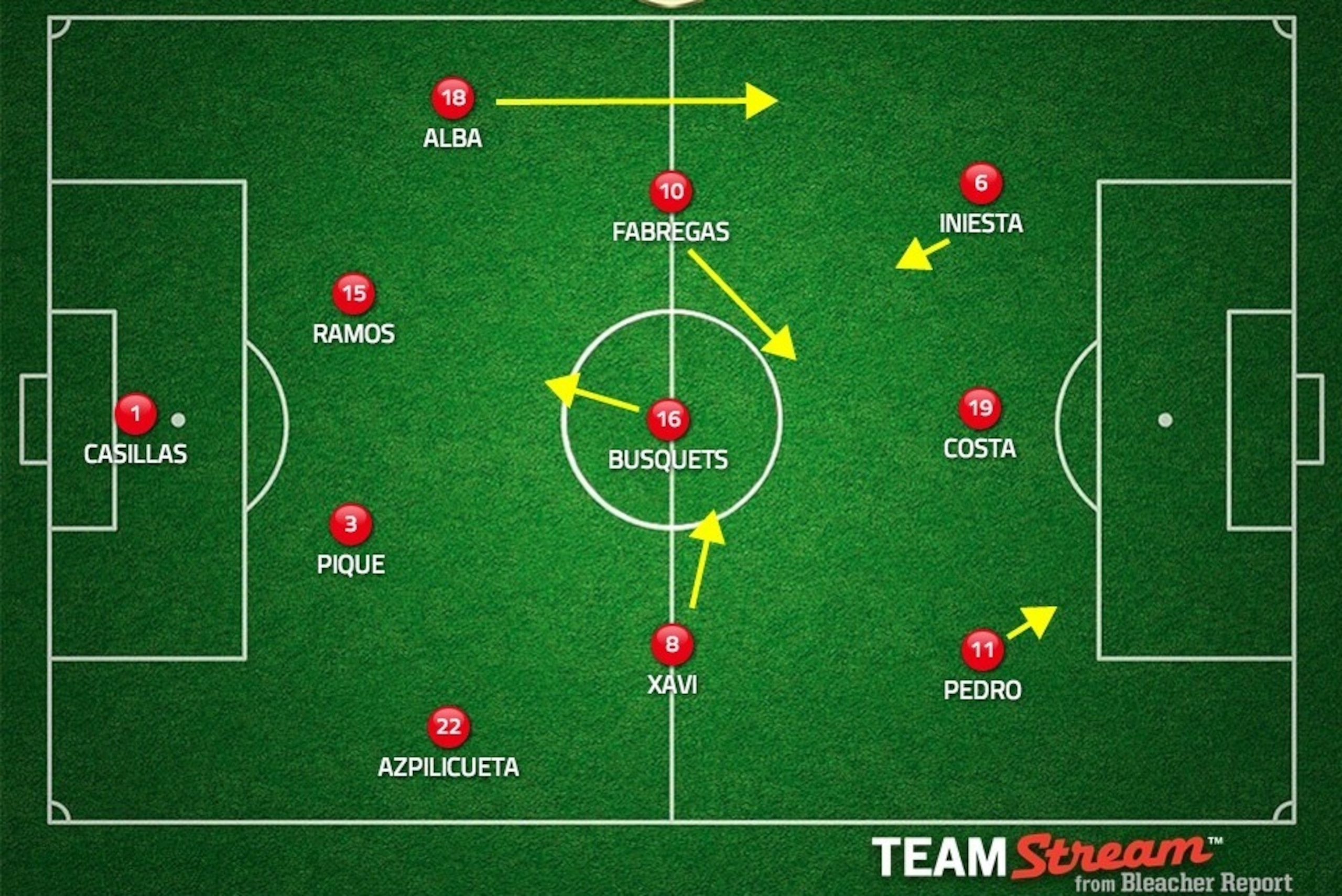
In this setup, Cesc Fabregas replaces the conventional striker in the middle of the front three. From this position, the former Arsenal captain drops in and out of midfield during Spain's build-up play while fluidly exchanging with Iniesta, Silva and Xavi to disrupt the opposition's marking system.
Drifting away from the last line of the defenders, Fabregas will also create chances for his teammates with layoffs, before quickly pivoting to link up with the attack.
In such a system, it would seem logical that Pedro would pose a greater attacking threat for Spain with his ability to run beyond Fabregas and create further issues for the defensive line.
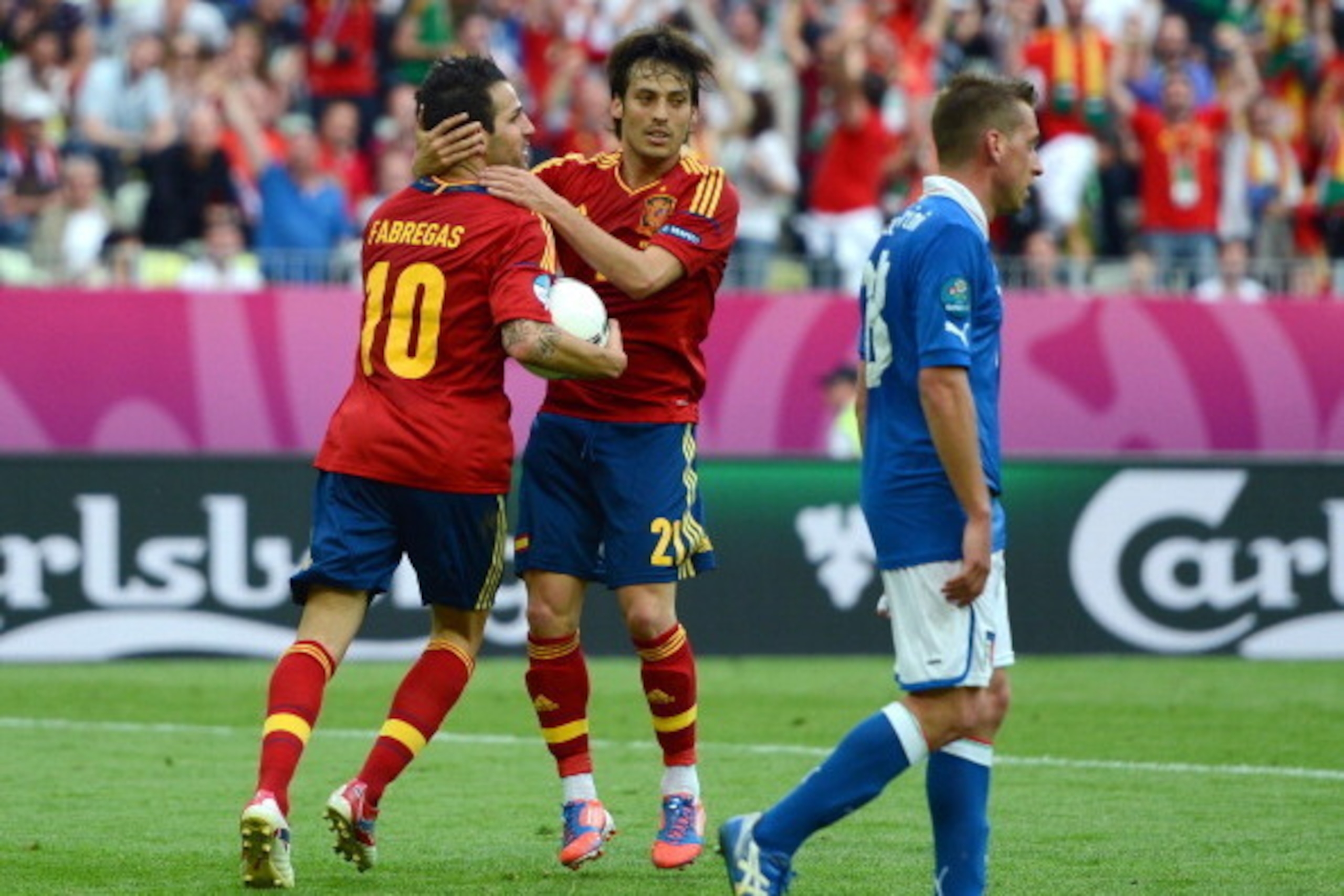
However, Del Bosque typically uses Silva alongside the false nine, as he did against Italy on two occasions at Euro 2012—most notably in the 4-0 victory in the final.
As was witnessed in that memorable final, teams often look to clog up the centre of Spain's midfield to disrupt the seamless flow of La Roja's machine. As pointed out by Michael Cox of Zonal Marking, Cesare Prandelli deployed four central midfielders in that final in an attempt to overwhelm the athletically declining Xavi.
Consequently, the positional fluidity provided by Iniesta and Silva on either side of Fabregas ensures Del Bosque's team can maintain their midfield dominance and allow the system to tick as normal.
Barcelona-based 4-3-3
While Del Bosque holds great faith in his double pivot in midfield with Sergio Busquets and Xabi Alonso, there are times when the Spanish boss will opt for a more aggressive formation.
Against inferior opponents or teams less likely to expose Spain on the counterattack, Del Bosque has the option of switching to the sort of 4-3-3 system once associated with Barcelona.
Generally, La Roja's leader has opted for this system during qualification rounds for major tournaments, but it must be noted that he did test its effectiveness in last year's Confederations Cup against Uruguay, as depicted by WhoScored.com.
To drive a more threatening mentality, one of the holding players (Alonso) is replaced by an attacking midfielder (Fabregas), which leaves Busquets as the only defensive-minded player in the centre of the pitch.

With the extra attacking player in midfield, Pedro makes more sense on the right flank, as the added creativity centrally that is provided by Silva or Juan Mata isn't needed to the same extent.
Again, it's up front where more significant questions lie, as Costa and Torres bring contrasting qualities to this formation.
The former will play harder against the defensive line and provide a greater presence in the box, while the latter is more suited to holding the ball up and distributing it to his midfield teammates.
Interestingly, in the 2-1 victory over Uruguay, it was Roberto Soldado who was used. Given that Soldado is more of a penalty-box poacher than a link-up centre-forward, one could conclude that Torres' ability to bring his teammates into the play isn't necessarily required.
In such a system, Costa might just find his feet in this Spain outfit.




.jpg?w=2560 "Dak to Stroud: Get Some Wins 💯")
.jpg?w=2560 "5 NFL Players Getting Trade Buzz")



.jpg?w=2560 "NFL Won't Fine 'Beverage' Celebrations 🍻")