
New Orleans Saints Mock Draft: Final 7-Round Projections
With the 2014 NFL draft just two days away (starts Thursday at 8 p.m. ET/7 p.m. CT), it is time for one final team-based seven-round mock draft. This one is specific to the New Orleans Saints, who possess seven picks for the first time since 2007.
Those picks are all slotted within the first six rounds. It includes Philadelphia’s fifth-round pick gained in exchange for Darren Sproles in the trade made earlier this offseason.
In selecting players here, primary consideration was given to players who fit the Saints schematically while trying to slot them in a reasonable range based on general consensus for where that particular player could be drafted.
Faulty it may be, since the first pick for instance is a player many consider a second-round pick. In this evaluator's mind, however, he is a first-round talent who almost certainly will be off the board by the time the Saints’ second-round pick is up.
You’ll read this a lot from me over the next few days, but if the Saints do not come out of the first two rounds of the draft with one of the seven or eight "elite" pass-rushers and a top-notch cornerback prospect, they have failed this draft (offensive skill players are overrated in my humble opinion).
Because I’m assuming there will be a significant run on the pass-rushers, before there is on the corners, I went with one of the former first.
1 (27). Marcus Smith, OLB, Louisville
1 of 7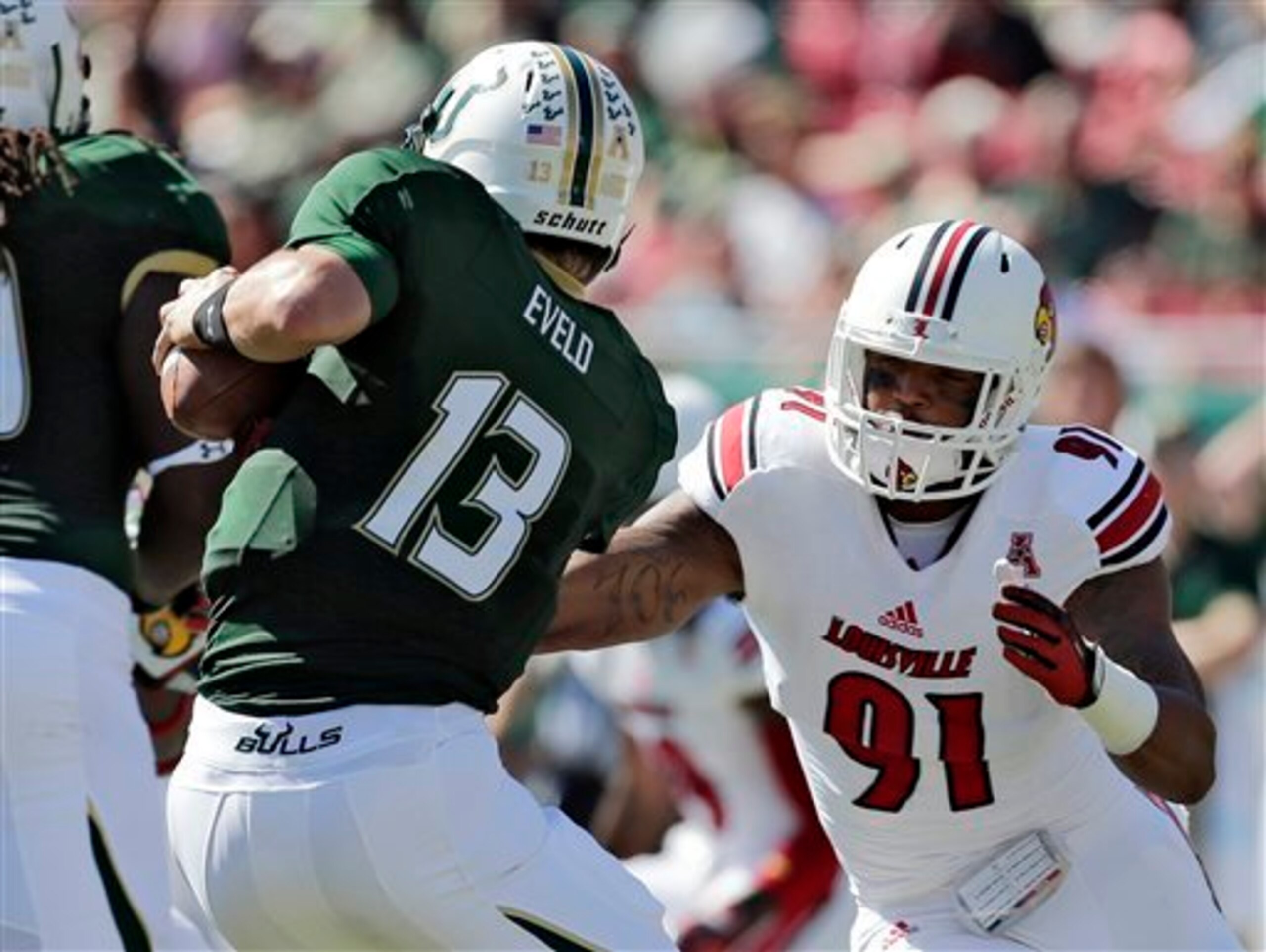
Marcus Smith’s name is one that wasn’t well known in draft circles until recently. It quickly became a go-to name as it became more and more apparent that teams are going to hit on 15 in regard to pass-rushing talent.
In recent film review, Smith stood out with his quick get-off at the snap of the ball. He used that initial burst to record an incredible 14.5 sacks in 2013, in addition to a plethora of quarterback pressures.
Smith made his teammates better in multiple ways, including attracting significant attention from pass-blocking units, standing up to cover backs and tight ends and breaking up passes before they were even in the vicinity of the intended receiver.
The only potential pitfall in his game is a lack of shoulder-dip execution to subtract his distance to the quarterback when flying around the edge. Seemingly, that is a skill that can be taught if recognized by his position coach in the NFL.
Smith would benefit immediately from having Cameron Jordan, Junior Galette and Victor Butler to take attention away from opposing offenses. He can simply use his natural skill set to wreak havoc on quarterbacks, while he fine-tunes his technique—which he’ll eventually need to win one-on-one battles at the NFL level.
2 (58). Pierre Desir, CB, Lindenwood
2 of 7
Grabbing a player from a small school such as Lindenwood always seems like a risky proposition because of the lack of knowledge about that particular player, not to mention the obvious question mark surrounding the level of his competition.
That said, the Saints have never been afraid to draft players with said question marks. Some of the Saints’ best finds in the draft in the Sean Payton-era have come from small schools—Jahri Evans and Marques Colston in 2006, Akiem Hicks in 2012 and Terron Armstead in 2013.
Desir stands 6'1"—plenty tall enough for the corner spot—and weighs a sturdy 191 pounds. He is solid both in man and zone coverage while exhibiting quality ball skills.
According to the Lindenwood Lions’ website, Desir picked off 13 passes the past two seasons and returned one of those for a touchdown. The school also has him down for 34 passes defensed with a forced fumble and fumble recovery.
He is a solid cover corner who also possesses great playmaking ability—a huge part of the Saints’ offseason emphasis to add to Rob Ryan’s already stingy defense.
3 (91). Jarvis Landry, WR, LSU
3 of 7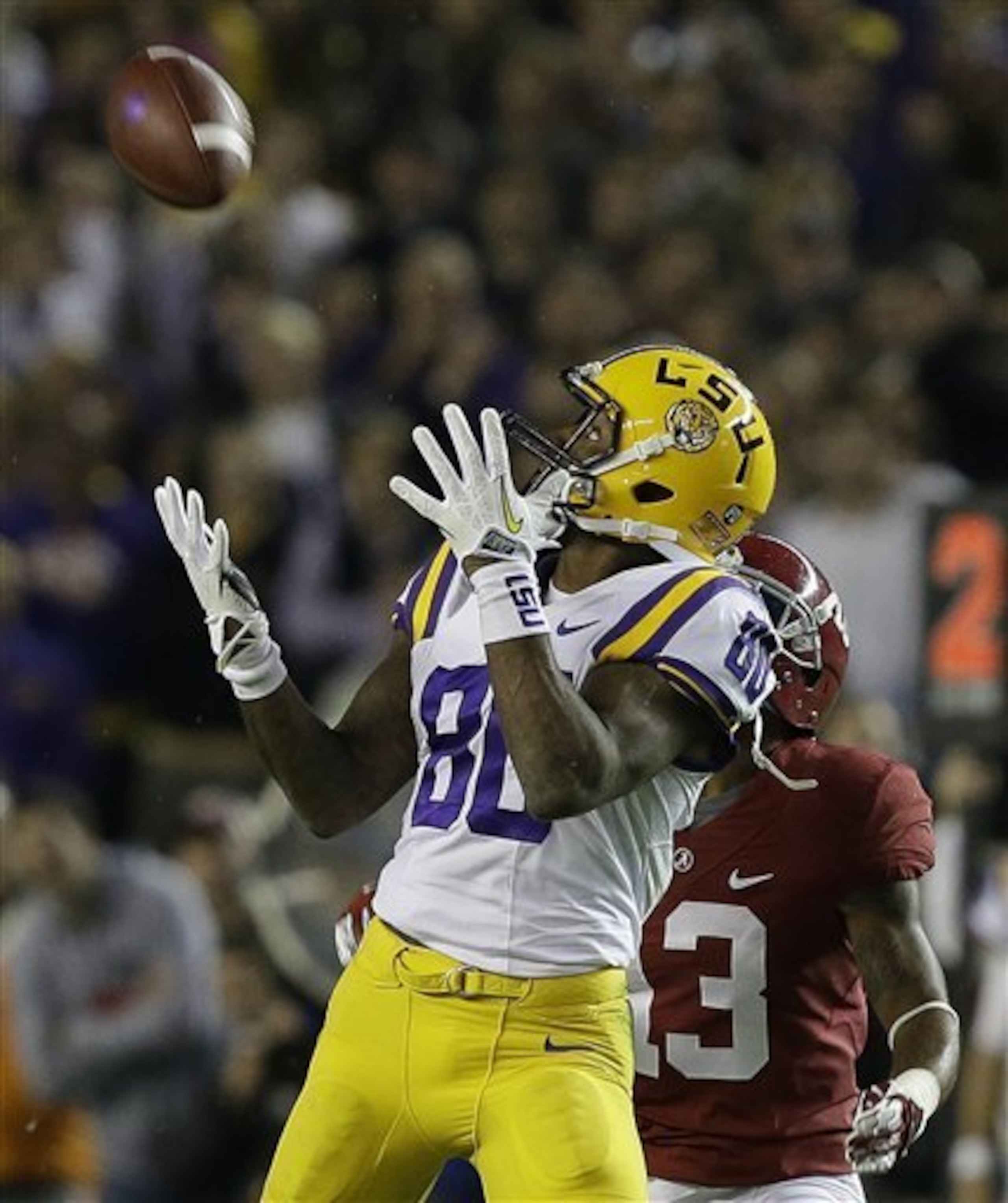
The average Saints fan likely has an idea of not only who Jarvis Landry is but also what kind of football player the team that drafts him is getting. Just in case you don’t know, he was an LSU Tiger the past three seasons.
Despite average quarterback play in 2012, Landry stood out as an intense in-your-face blocking receiver and underrated pass-catcher. When the QB play improved by leaps and bounds in 2013 (thanks Cam Cameron), Landry’s production went off the charts.
Though his combine timing and measurables scream overrated player, the film tells a much different story. Landry excels going over the middle and plays much bigger than his 5’11” frame would indicate. Despite the lack of size, his skill set brings to mind Anquan Boldin—a physical player who excels going over the middle and after the catch.
Landry may not beat a corner deep often, but he will get open and would quickly become a favorite of Drew Brees because of his ability to bring in passes when thrown in traffic.
4 (126). Travis Swanson, OC, Arkansas
4 of 7
Swanson is going to need to improve his core and leg strength along with his lateral quickness and balance to avoid being thrown to the ground as often as he is on film. His technique is good, which means it is certainly a strength issue.
That said, he is a good athlete who can pull, trap and get to the second level. Swanson can be an adequate backup at the other two interior line positions, increasing his value incrementally.
He is best in pass protection, especially executing his role among a five-man unit. The truth is that Swanson fits the Saints’ mindset of what they’re looking for on the interior of their line.
The Saints are looking more for skilled technicians than guys who are maulers. Swanson is not a mauler; he’s a technician, a smart player who wins with technique. He’s a great fit in New Orleans.
5 (167). De'Anthony Thomas, RB/WR/Returner, Oregon
5 of 7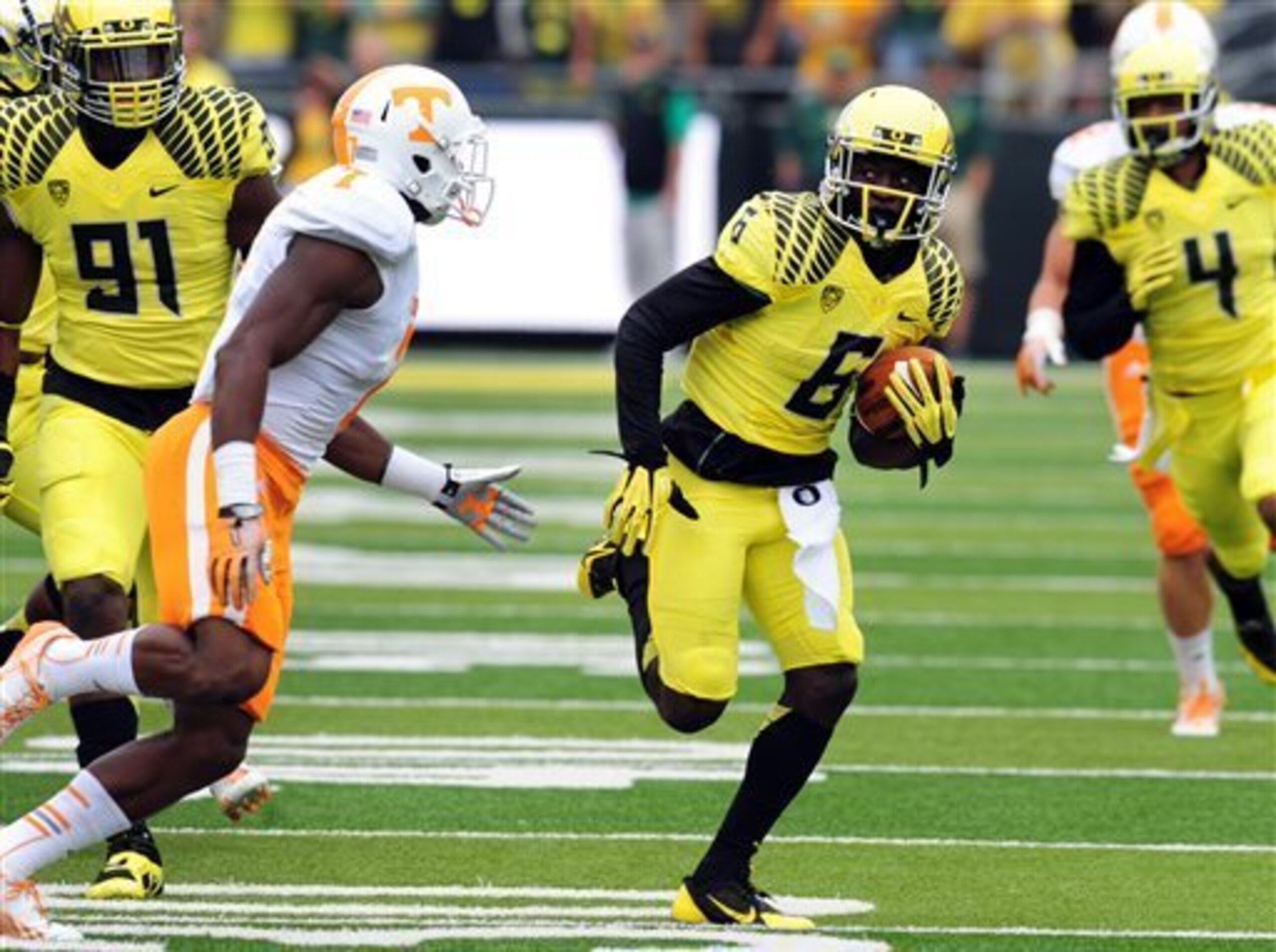
De’Anthony Thomas is an explosive playmaker. Sure he’s small and has missed more than a few college games due to injuries. Don’t mistake that for a lack of toughness. Thomas isn’t afraid to run inside—something he did often at Oregon in what is really a power run game.
However, there’s little doubt that Thomas’ best attribute is his speed and quickness when he’s in the open field. It may take a year for him to get acclimated to the Saints’ system, but once he does, he’ll be the perfect Darren Sproles replacement.
That timing is perfect as the player Sean Payton expects to take Sproles’ spot in 2014, Travaris Cadet, becomes a free agent in the 2015 offseason. In the meantime, Thomas can help improve the Saints’ kick and punt return game, maybe.
Though not statistically putrid, the Saints' return game has lacked some serious pizzazz the past few seasons, even with Darren Sproles slotted as the primary return man in the lineup.
Thomas, if nothing else, has the agility, moves and burst to bring the Saints’ return game back to a respectable place. If that’s all he ever does as a fifth-round pick, he’s worthy of the selection.
5 (169). A.C. Leonard, TE, Tennessee State
6 of 7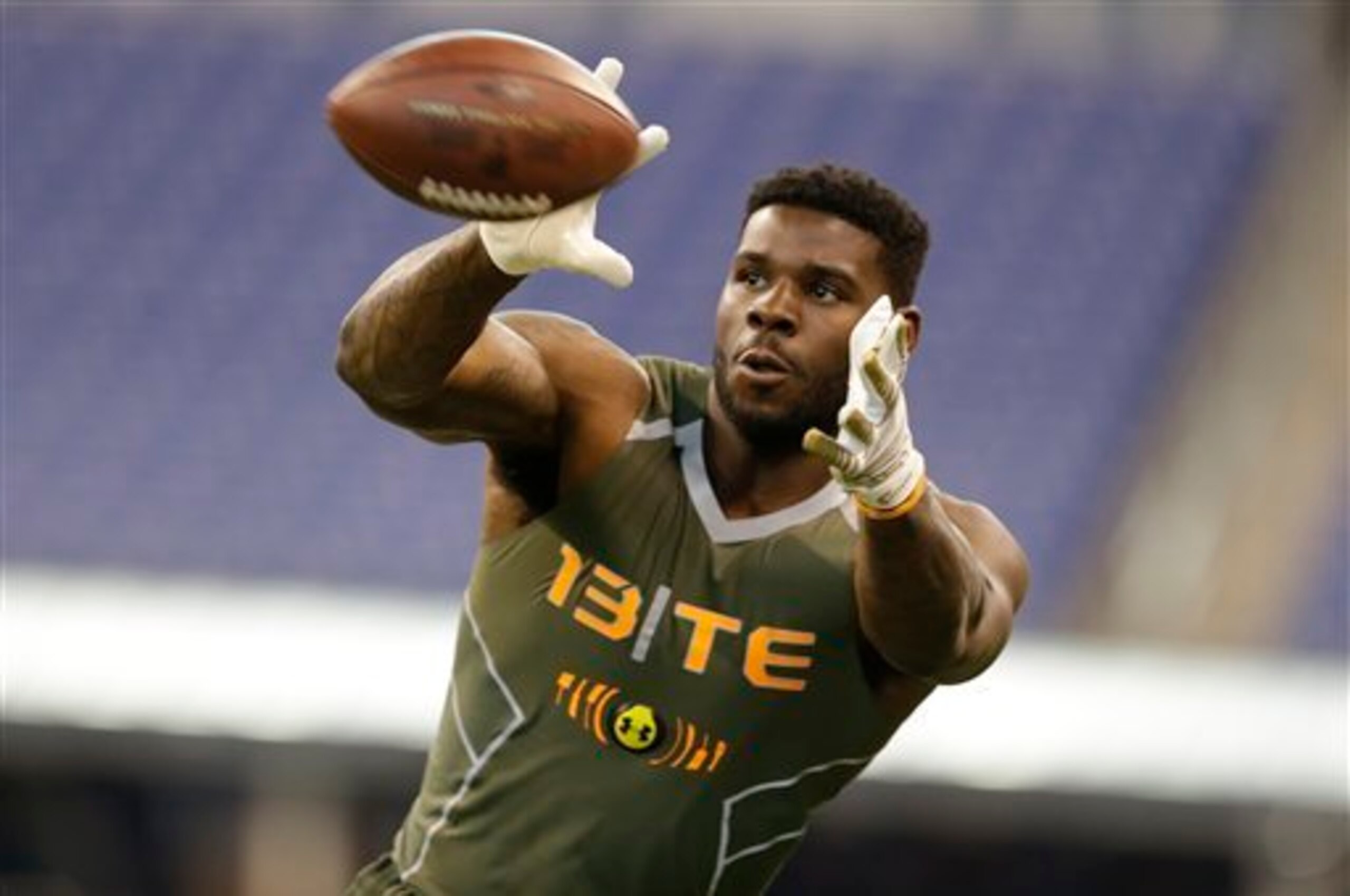
A.C. Leonard is far from a household name. Don’t confuse him with A.C. Green or any other A.C. that comes to mind. Leonard was an early entrant in the draft from the FCS school Tennessee State.
With a large, lanky body, Leonard looks like a cross between a speedy wide receiver—his open-field speed is rare for a tight end—and a basketball power forward. Of course, basketball power forward-turned-tight end has become a bit cliche nowadays.
The cliche doesn’t describe Leonard, though, as he only measured in at 6’2” at the NFL Scouting Combine in Indianapolis in February. Make no mistake, though, he is a big body who can run.
The Saints are looking for future playmakers. Some want to immediately plug a certain kind of player into the mix. That is a mistake, as Payton didn’t have a playmaking tight end until 2008 when he traded for Jeremy Shockey (and one could question just how much of a playmaker Shockey really was).
Now he could have two. Adding a second stretch tight end would make the Saints offense more dynamic than it’s ever been.
6 (202). Andrew Jackson, ILB, Western Kentucky
7 of 7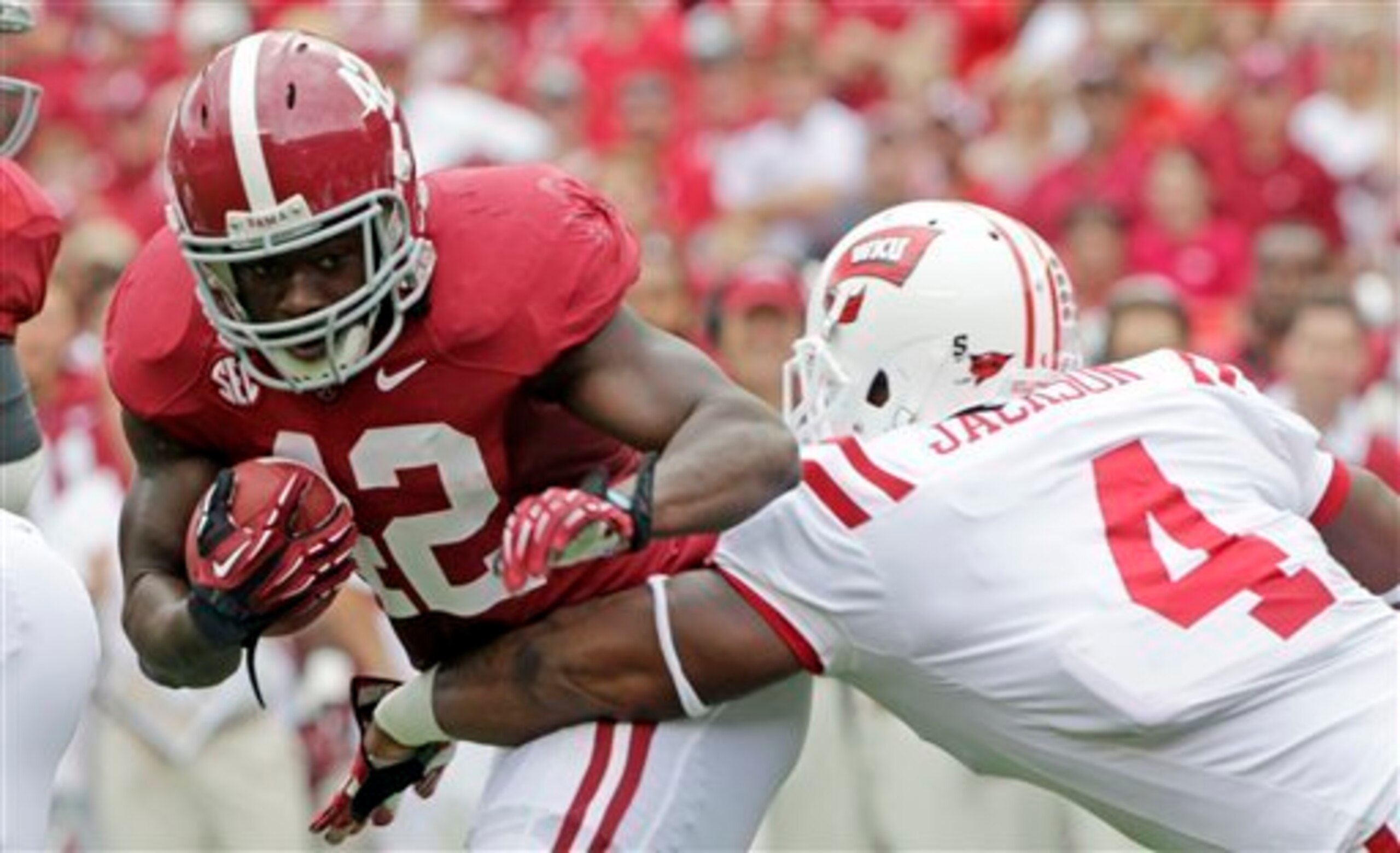
Before getting to Jackson, a few things should be noted. First, Jackson and Leonard—the pick in the previous slide (fifth round, pick 169 overall)—could easily be flipped. Once we get to Rounds 5-7, it’s nearly impossible to slot players.
Second, with a question mark at the placekicker position, that position as well as quarterback, was considered. And third, there are probably a handful of inside linebackers just as worthy of the Saints’ final selection in this draft as Jackson.
So why Jackson?
Jackson was a highly productive player in his time at Western Kentucky. The senior linebacker flies around the football, displaying excellent closing speed to swarm in on all ball-carriers and/or quarterbacks.
He often overpursues plays and struggles to wrap up, often diving at the heels of the player with the football. But he shows great ability to cover the middle of the field in pass coverage and can stick with running backs and tight ends in man-to-man coverage.
Jackson could use some additional weight and strength, but his high motor makes him an ideal fit as a special teams player and someone who could one day be developed to start inside for the Saints because of his versatility and motor.