Breaking Down the NBA's 5 Toughest Contracts to Trade
In the NBA there are some contracts that are extremely difficult to trade. They aren’t impossible, but they’re close.
If the last 14 months has taught us anything, it’s that any contract can be traded. Joe Johnson, Rudy Gay, and Andrea Bargnani have all been traded, and each of those contracts was viewed as untradeable until they were.
These five contracts are the toughest to trade, ranked in order of how difficult they are. In determining the contracts three things were considered:
- What is the cost of the contract? Obviously the higher the cost of the contract, the harder it is to trade.
- How many years remain on the contract? Years can be good or bad, depending on what the team is trading for. Are they trading to get the player, or are they trading to get the expiring contract? For this reason contracts that have two years are given the lowest value, as the team receives neither a long-term assurance of the player, nor the short-term benefit of the cap space.
- What is the present team getting back? The higher the value of the contract, the more the player’s current team has to ask back, by default.
Also, what kind of value is the asking team placing on the player?
Bear in mind the player’s value to the team is also considered. In essence, if the player has more value to the team he’s playing for than the team is likely to get back, it’s a contract that is harder to trade.
Franchise players who are in their prime (26-30) were not considered for this list. Is LeBron James tradeable? Is Kevin Durant or Derrick Rose? The price they would fetch would be high, but there’s no way such stars hit the trading block and don’t get moved.
I also did not consider recently traded players. No matter how insane it is that they were traded, the fact they were traded indicates they were tradeable.
For each player, the remaining years and total cost of the contract is listed.
5. Zach Randolph, Memphis Grizzlies, 2 Years, $34.3 Million
1 of 5
Zach Randolph has two years and $34.3 million left on his contract.
While he has a player option on his second year, it’s not probable that he’ll exercise it. He’s very unlikely to get anything close to the $16.5 million he’s slated to earn on the open market.
Furthermore, he’s in a perfect system in Memphis, where he can play to his strengths. There, his weaknesses are also covered well. He’s a solid inside scorer (310 field goals within six feet of the rim last year) and one of the league’s best rebounders, averaging 11.2 per game.
He struggles defensively, but he has the Defensive Player of the Year, Marc Gasol, to back him up.
Randolph is not a perfect player, and he could easily be exposed in a different system. Contrarily, it’s hard to see the Grizzlies getting better with what they could get back for him. In other words, what team could get more out of him than what Memphis is getting?
Sure, they could upgrade at the power forward, but whom are they going to get? The Grizzlies would have to get an elite power forward (think LaMarcus Aldridge) to achieve that, and Randolph’s trade value isn’t that high.
Thus, Randolph lands on the list because his value to the Grizzles greatly exceeds what his value to any other team would be.
4. Carlos Boozer, Chicago Bulls, 2 Years, $31.3 Million
2 of 5
It’s an interesting debate, and a far closer one than you might expect, as to whether Carlos Boozer or Zach Randolph should be higher on this list.
Here are their respective per-36-minute stats from last season.
Player | MP | FG% | FT% | TRB | AST | STL | BLK | PTS | Pts+Reb+Asts |
Carlos Boozer | 2546 | 0.477 | 073.1 | 10.9 | 25 | 0.9 | 0.4 | 18.1 | 31.5 |
Zach Randolph | 2607 | 0.460 | 075.0 | 11.8 | 15 | 0.8 | 0.4 | 16.1 | 29.4 |
The point here is not that Boozer is “better,” but that the conversation is far closer than one might suppose. At the very least, one has to conclude that Boozer and Randolph are very much on the same level.
They are both in their early 30s. Both are below-average defensively.
However, Randolph makes close to $3 million more over the next two years, so you could argue that Boozer should be listed behind Randolph on these rankings.
So why is he higher?
Perception is a lot of the reason. Randolph is just more popular in Memphis than Boozer is in Chicago. Truth be told, Congress is more popular in Memphis than Boozer is in Chicago.
That makes the Bulls more willing to trade Boozer, and willing to take less back, but the vitriol directed at Boozer by Chicago fans impacts his value league-wide, making his contract virtually untradeable.
3. Pau Gasol, Los Angeles Lakers, 1 Year, 19.2 Million
3 of 5
Pau Gasol has plenty of rumors circulating around him all the time. He doesn’t read the morning paper. He reads the morning trade rumors.
So why is this presumed future Hall of Famer so hard to trade? It stands to reason that if he could have been traded by now, he would have been.
Well technically he actually was, before he wasn’t, two years ago. Back then he was two years closer to his prime and under contract for three more years. Now he’s two years further from his prime and only has one year left on his contract.
Gasol is 33 now, and that’s a little long in the tooth for a team to build a winner around.
His greatest chance to be traded would be to a team that is looking for that extra push to get to the finals and win a title. The problem is, which team is that? The Chicago Bulls are often brought up as a potential trade partner. But there’s no realistic trade to be had. Either the Bulls have to give up too much or the Lakers are required to take too little.
And this is the problem the Lakers are having with Gasol. First, they’re still trying to treat him as though he has the same value he had when they got him (for what was then considered significantly less than they’re asking now). Second, by necessity they have to take back $19 million in players, and he’s just not worth $19 million in players they would want.
Other teams don’t agree on his value. They aren’t itching to shell out that much existing contract space, both in terms of players they’d have to give and in money they’d have to pay, for a player well past his prime, in the final year of his contract, who averaged 13.6 points and 8.6 boards last year.
There would be a faint hope if there were a team looking to create cap space for next year in free agency, but the Lakers aren’t ready to relinquish the space they have with his contract now.
2. Amar’e Stoudemire, New York Knicks, 2 Years, 45.1 Million
4 of 5
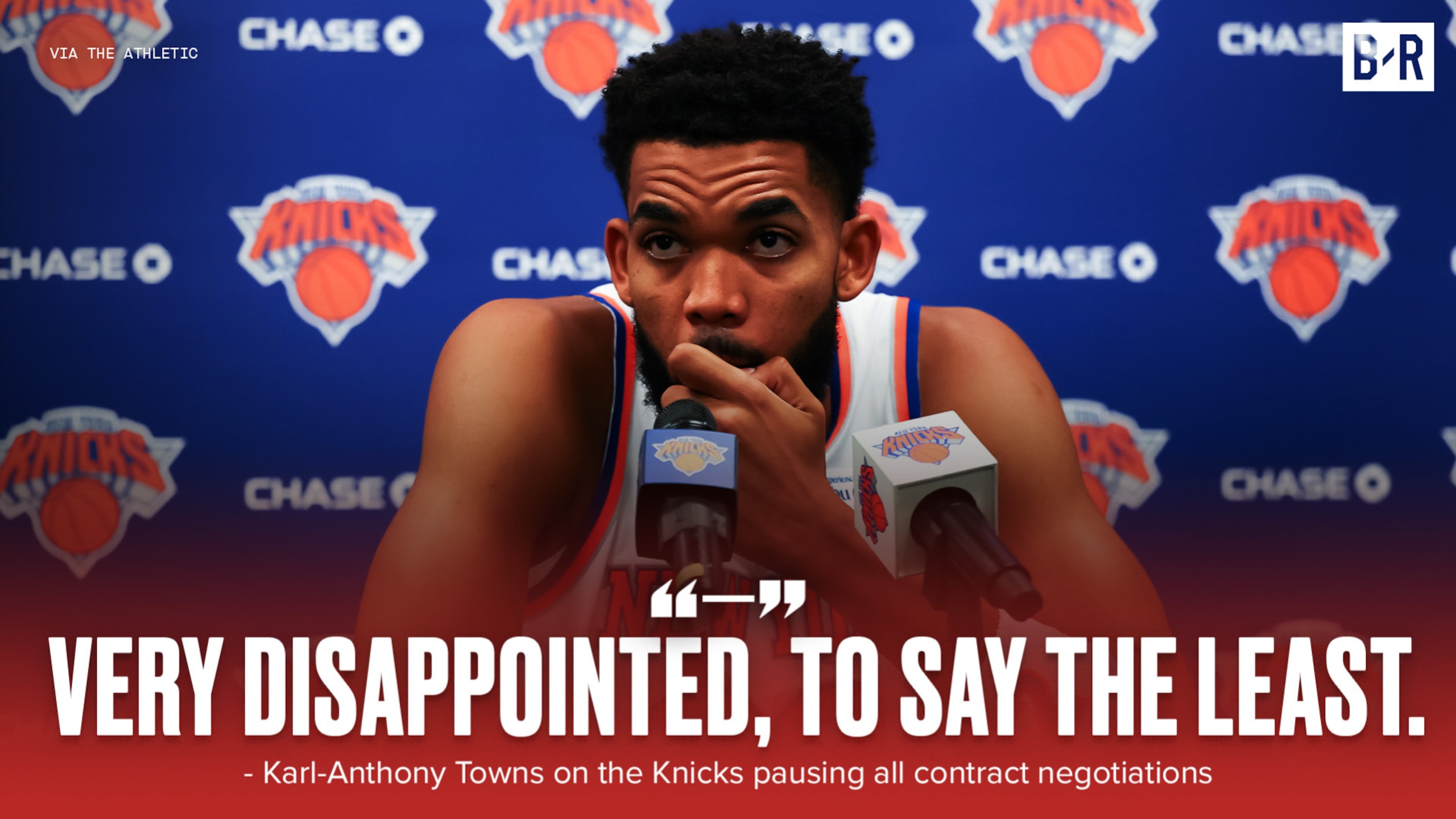
If you want to know why Amar’e Stoudemire’s contract is untradeable, there’s something you “kneed” to know. His contract is uninsurable, too expensive and too risky.
When he initiated his Knicks career, he was doing great, averaging 25.3 points and 8.2 rebounds per game. Over the last two years, he’s tallied just 16.3 and 6.7 respectively.
Furthermore, when he and his co-star are on the court together, they have been a total of minus-74. The Knicks are plus-77 when Stoudemire plays without Anthony and a massive plus-525 with Anthony sans Stoudemire.
More telling is that since Anthony became a Knick, New York is only 45-44 when both players have played. They are 45-15 in games Anthony has played without Stoudemire. They are 3-6 in games with only Stoudemire.
It’s pretty apparent this experiment is not working. Clearly, one of them needs to go, and Anthony is obviously the more valuable of the two.
The Knicks would give up Stoudemire in a New York minute if they could, but who wants him?
He has the third-biggest contract in the NBA right now, making $21.7 million next year and $23.4 million the following year. He has a player option the second year, but unless he has a crisis of conscience for ripping off the Knicks, he’s not going to exercise it. In fact, exercising at all could be hazardous.
Over the last two years Stoudemire has played in just 76 games and missed 72. He’s scored a total of 1,236 points and snared a total of 512 rebounds. There have been 82 players, including the likes of Chris Kaman and Alonzo Gee, who have surpassed those numbers.
Unlike other players who missed significant time due to injury, Stoudemire’s injuries are chronic. His knee issues aren’t new either. They are so bad his contract is uninsured.
His knees are shot. They aren’t getting better, and he’s not going to be making the Knicks any better. New York is stuck with what may be the worst contract in basketball. (Coincidentally, the same can be said for baseball, with the Yankees and Alex Rodriguez, and football, with the Jets and Mark Sanchez.)
1. Kobe Bryant, Los Angeles Lakers, 1 Year, $30.4 Million
5 of 5
Let’s say the Los Angeles Lakers wanted to trade Kobe Bryant, which they don’t. But there are some bloggers who are beginning to advocate such a trade.
For the purpose of this article, I don’t presuppose the team's desire to trade contracts, merely whether the team could move a given player. And Bryant’s contract is easily the most untradeable in the NBA.
First, he’s making $30 million this year. The thing about a $30 million contract is that you have to send back $30 million in players to accommodate that. To give you an idea of what that means, it would mean a trade to Denver of Kobe Bryant for Ty Lawson, JaVale McGee and Danilo Gallinari. That’s a lot of players.
He’s in an era of his career where his legacy is discussed (Sean Sweeney of Dime’s take is the most balanced and thoughtful piece I’ve seen on the subject) with the greatest in the history of the league.
But let’s bear in mind Bryant is making $30 million just this year.
The only reason a team would trade for Bryant is that he’d be the player who could put them over the top, but how does a team get better when they have to send back thirty million dollars’ worth of players.
He has carved out an enormous legacy in Los Angeles, and to the Lakers he’s worth that much money.
But his legacy doesn’t transfer if he’s traded. He brings his rings with him, but not the banners that hang from the rafters in the Staples Center.
Bryant’s contract is untradeable strictly for the reason that there is no possible way for a team to benefit by trading for him. As great as the benefit is, it’s dwarfed by the cost.
He’s a 35-year-old shooting guard coming off an Achilles injury with over 54,000 minutes on his knees. It’s not a long-term deal. The trade would have to be a “win-now” trade, and the sheer volume of players that would have to be sent back would make that impossible.

.jpg?w=2560 "Cam Ward Says He's Not A Loser")
.jpg?w=2560 "Chargers Fall to 0-5 🤢")
.jpg?w=2560 "Viral Dan Campbell Presser 💙")