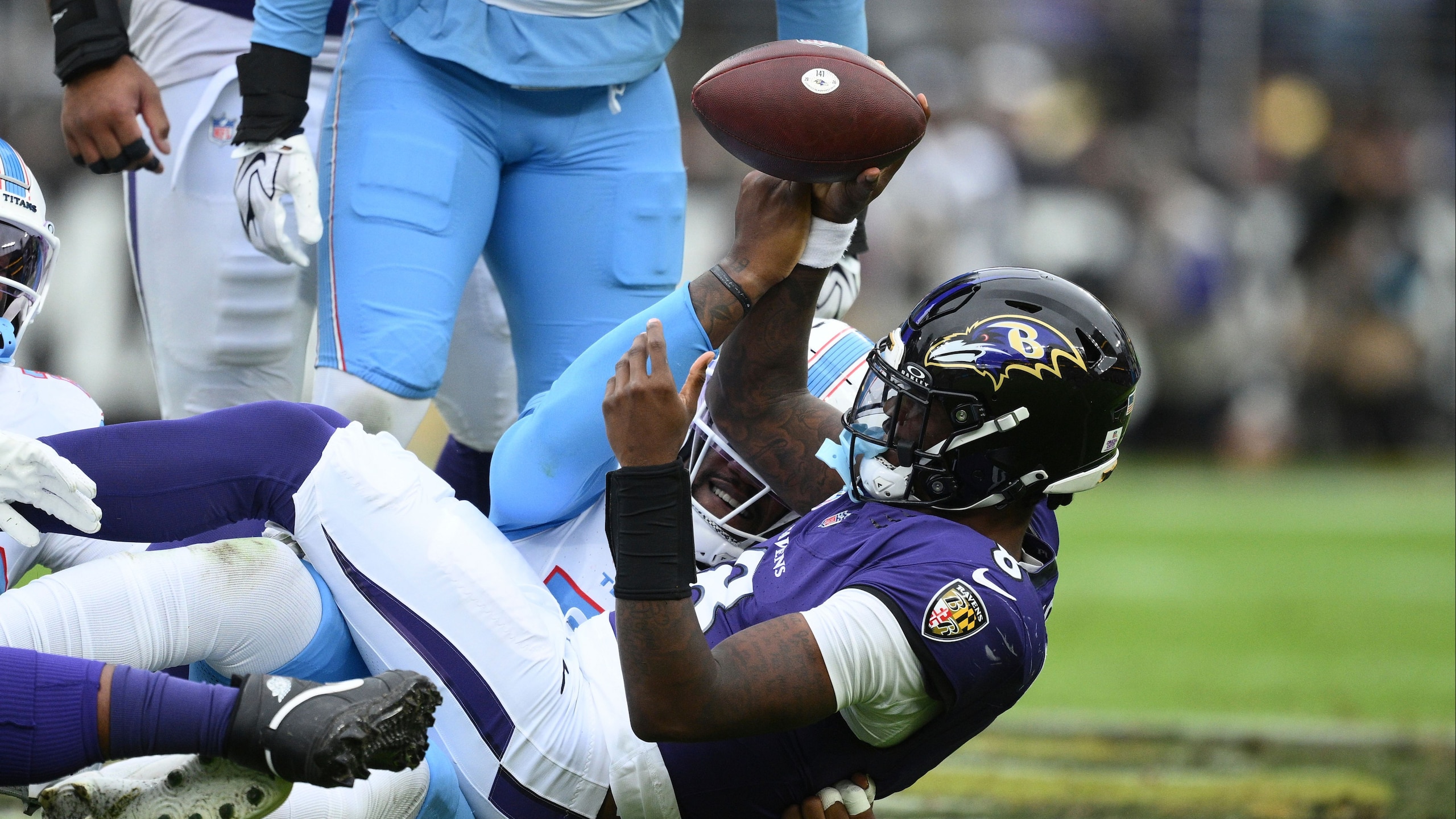
The USC Trojans and the D-Word: Are They for Real?
While a dynasty is fairly easy to define in most sports, whether professional or college, a dynasty eludes definition in BCS-Era Division I College Football. Instead of having a playoff system like other sports, the BCS Title matchups fall somewhere between a beauty pageant and cracking the Da Vinci Code.
Last year, for example, there were four major college teams with the same regular season record. Only two were chosen for the title game. A fifth team, undefeated Utah (12-0), was completely ignored because they were in a non-BCS conference, even though they had beaten BCS conference teams.
Go figure.
TOP NEWS

Report Card for Top 20 CFB QBs 📝
Michigan TE owns up to leaked texts
Urban: U-M a 'Train Wreck' 😬
Or how about the two previous years when Ohio State was picked for the title game? Critics from every other major conference blasted the choice because of a weak Big Ten and an even weaker out-of-conference schedule.
Then there was USC, which was left out of the title game in 2003 and ironically switched places with LSU, which won the BCS Title in 2003 but was left out in 2004 when the Trojans took the title.
Back in 2000, Butch Davis’ Miami Hurricanes were ranked No. 2, but by got passed over for the title contest because of some computer quirk.
While there have been two teams that have lost back-to-back BCS Title games, Oklahoma and Ohio State, no team has ever won back-to-back BCS Titles.
Two teams came close.
Larry Coker won the BCS title at Miami with Butch Davis’ players in 2001 and went 12-0 in 2002 but lost the BCS Title to Ohio State in a double overtime game marred by controversial officiating.
In 2003, USC was the AP winner while LSU held the BCS Title. Then the Trojans won it all in 2004 beating Oklahoma, and nearly won it again the next year, losing in the Rose Bowl to Texas 41-38 on Vince Young’s fourth-down TD run with 16 seconds left.
Since there are no actual back-to-back BCS champions and none of the BCS bowl winners move on to play one another, the only way to determine a dynasty in the BCS era is to look at the overall success of a team.
The last team to win back-to-back national titles was Tom Osborne’s Nebraska Cornhuskers in 1994 and 1995 and a split title in 1997, the year Osborne retired. The Bowl Championship Series (BCS) was initiated the following year.
Overall, Osborne had a 255-49-3 career mark, but an NCAA record 60-3 run during his last five years in Lincoln, including four bowl victories. In those five years, his teams finished no lower than sixth in the polls.
By comparison, after appearing in back-to-back BCS Title games, Larry Coker’s Hurricanes went steadily downhill, dropping out of the Top 10 in Coker’s last two seasons. Coker was fired after a dismal 2006 season, marked by a bench-clearing brawl in Miami’s game with Florida International.
His coaching style and an inability to connect with the players that he recruited led to Coker’s downfall. His record at Miami was 60-15 in six seasons.
Pete Carroll at USC, on the other hand, has been the closest during the BCS era to approach Osborne’s consistency and, in some cases, surpassing it.
Some may not consider Carroll’s USC Trojans a college football dynasty since their recent record has been marred by a few upset losses to unranked teams. Nevertheless, Carroll’s overall success is unquestionable.
In his eight seasons at the helm of USC, Carroll has racked up the highest winning percentage of all active Division I head coaches with at least five years on the job, 88-15. Six of those losses came in Carroll’s first season.
Since 2002, Carroll’s teams have had seven consecutive eleven-win seasons or better, a record. They have won seven consecutive Pac-10 titles, a record. They have gone to seven consecutive BCS Bowls and won six, a record. They have never finished lower than fourth in the BCS standings over seven consecutive seasons, another record.
In fact, Carroll has actually out-performed Osborne for consistency. Prior to Osborne’s last five seasons, his teams finished out of the Top 10 in four consecutive seasons, and from 1987-1993 they lost seven consecutive bowl games.
From 2002-2004, USC had a 34-game winning streak, a school record, and also spent a record 33 consecutive weeks at the top of the AP polls and set an NCAA record of 63 consecutive games scoring 20 points or more that extended into 2007.
Let’s look at how some other BCS era coaches have done.
Urban Meyer’s Florida Gators have won two of the last three BCS titles. However, in 2007, they went 9-3 despite having the Heisman Trophy winner, Tim Tebow, at quarterback and then lost to Michigan in the non-BCS Capital One Bowl. They finished the season ranked 16th in the Coaches Poll.
So far, Meyer’s record at Florida is 45-9. Only time will tell if he can achieve the same consistency as Pete Carroll.
Bob Stoops took the helm at Oklahoma in 1999 and the following year led the Sooners to a 13-0 record and the 2000 BCS Title. But the Sooners became the first team to lose two consecutive BCS title games, one to LSU in 2003 and the other to USC in 2004.
In 2005 they dropped from national prominence with an 8-4 record and were ranked 22nd in the polls. Since then, the Sooners have lost three consecutive BCS bowl games, including this year’s national title match with Florida.
Stoops’ Sooners (109-24) are an offensive powerhouse. But, like most Big-12 teams, they play very little defense. Therefore, his offense is hardly prepared for the stronger defenses they face in bowl games from teams like USC or those from the SEC.
While Jim Tressel’s 2002 Ohio State team upset Miami for the national title, he has not won a second national title despite returning to the BCS Title game in 2007 and 2008, losing to Florida and LSU respectively, both by wide margins. Tressel’s record at Ohio State stands at 83-19.
His conservative style of play calling and playing for field position works well in the Big 10, where teams on the average are slower than those in other conferences. But a philosophy that refers to the punt as the most important play in football is not destined to win many championships against fleeter opponents from the other major conferences.
Nick Saban’s LSU Tigers split the 2003 national title with USC, but suffered the same fate in 2004 as Meyer’s 2007 Gators. They went 9-3 and lost to Iowa in the Capitol One Bowl and were ranked 16th in both polls.
When Saban left LSU for the NFL’s Miami Dolphins in 2005, Les Miles took over and guided the Tigers to two consecutive 11-2 seasons and Top 5 rankings. Then in 2007, his Tigers handily beat Ohio State to win the national championship. But his second tier players could not step up this year and fill the holes left by attrition. The Tigers fell to 8-5 and were unranked. Miles is 42-11 in four years at LSU.
But, so far, Pete Carroll has managed to avoid the drop offs of his BCS rivals. Despite those upset losses, he has made sure that his Trojans always finish strong. What’s more his record against perennial rivals, Notre Dame and UCLA, is 14-2 in eight seasons, a record that has cost coaches at the other two schools their jobs.
But it is more than W's that make Pete Carroll’s Trojans a college football dynasty. They have had a record three Heisman Trophy winners over a four year period. They have managed to bring in four top-five recruiting classes. They have produced 30 first team All-Americans. They have had 53 players drafted by the NFL, enough to man an entire NFL roster.
More players were drafted from USC the last two years than from any other school. Last year NFL teams drafted ten USC players, five in the first round and nine on the first day.
This year the NFL drafted 11 from Pete Carroll’s squad. The New York Jets even traded up for Mark Sanchez, the fifth overall pick, and a short while later the Green Bay Packers traded up to acquire linebacker Clay Matthews, Junior, a former USC walk-on.
They traded up for a walk-on?
Not any walk-on. A USC walk-on. And it was reported that the Kansas Chiefs would pay $36 million for a former USC backup quarterback.
But there is another number that is equally impressive. Ten players will graduate next Friday from USC. Four players graduated this past fall, and 15 more will graduate in December. That makes 29 graduating players in one year.
While top recruits commit to USC because they have dreams of someday playing in the NFL, their parents can relish the fact that USC not only churns out football players but graduates them as well.
So what can stop the Carroll Juggernaut? Attrition?
Probably not. Every year USC loses All-Americans as well as starters on both sides of the ball. Yet, there is never a dearth of quality players ready to step up. In fact, there are actually logjams of four-and-five-star players at some positions.
For example, in 2006, after losing two Heisman trophy winners and starting just four seniors, USC faced the nation’s second-toughest Division I schedule that included nine bowl teams. With 15 freshman seeing significant playing time, the Trojans fought to an 11-2 record, a Rose Bowl win over Michigan and a No. 4 national ranking.
So how does Carroll avoid the attrition pitfalls that have hit rival coaches?
A quality recruiting program is only part of the answer. Competition is the other part.
In this cyber-age of text messaging and internet scouting boards, quite a few schools have quality recruiting programs. But at USC, Pete Carroll’s recruits know they can compete as freshman for a starting role. They also know that they will receive the best conditioning and the best coaching anywhere in Division I.
After a disappointing loss in the Las Vegas Bowl and going 6-6 in his first season, Carroll abandoned the play schemes of Norm Chow, his former offensive coordinator. Consulting with mentors and colleagues from his NFL days, Carroll installed his own version of a pro-style West Coast offense and has stuck with it.
A former defensive back in college and a strong defensive-minded coach, Carroll instituted game-like practices with themes.
Competition Tuesdays reminded starters that they need to earn their spots every day and provided backups an opportunity to gain starting assignments. Tuesdays are usually tougher than anything the players encounter on Saturdays in the fall.
Turnover Wednesdays emphasized Carroll’s favorite mantra, "It’s all about the ball!" The coaches emphasize takeaways, both in position drills and team scrimmages. If a player wants to start on Saturday, he had better not fumble the ball or drop an interception.
As far as the staff is concerned, the NFL’s loss was USC’s gain in more ways than one. During his years in the NFL, Pete Carroll had built up quite a list of contacts and has gone to that list more than once to surround himself with the best football minds in Division I, despite losing coaches from time to time to other programs.
Caoches like Pat Ruel, Jethro Franklin, John Morton, Ken Norton, Jr., Todd McNair and the two latest additions, special teams coach Brian Schneider and quarterbacks coach Jeremy Bates are all NFL graduates.
The staff for the most part has taken on the enthusiasm and energy of its head coach, which allows them to really connect and communicate with the young athletes they oversee.
Furthermore, under the direction of strength and conditioning coach Chris Carlisle, USC recruits have a training program designed specifically for their positions and the skills they will need to compete at those positions. Although voluntary in the off-season, recruits are eager to continue the program all year-round with the intent of finishing strong.
While USC has had a few transfers over the years, most players under Pete Carroll and his staff would rather compete than switch.
Why? Mainly because Pete Carroll has all his bases covered. No loose ends from the coaching staff right down to the equipment managers and video editors.
What about the rest of the Pac-10? You would think that coaches who have faced Carroll’s teams year after year could figure out a way to beat USC.
Actually, they have. Oregon, Cal, Stanford, UCLA, and Oregon State have all beaten USC during the Carroll era. But they can’t seem to do it in the same year.
Oregon’s recently retired Mike Bellotti had the best chance. After Stanford upset USC in 2007, Oregon beat USC when Mark Sanchez, replacing the injured John David Booty, threw a last minute interception. Ironically, Oregon quarterback, Dennis Dixon, suffered a season-ending knee injury against Arizona, and the Ducks lost three straight.
Bellotti’s 2001 Ducks were the last team other than USC to win the Pac-10 title outright. Oregon was 11-1 that year and won the Fiesta Bowl, finishing #2 in the nation.
But Bellotti is gone now, and it is up to former offensive coordinator Chip Kelly to see what he can do against USC.
Mike Riley’s Oregon State Beavers have beaten USC twice up in Corvallis. However, like Oregon the year before, the Beavers faded in the final two weeks last season, and USC took the title with a strong finish.
This year, the Beavers head to the Coliseum where they have not won during the Carroll era.
Cal’s Jeff Tedford, known as a groomer of NFL quarterbacks, beat USC in triple overtime to hand the Trojans their only defeat back in 2003. That was his one and only win against Pete Carroll. No doubt Tedford would love to coach any one of the quarterbacks currently at USC.
UCLA under Rick Neuheisel and Stanford under Jim Harbaugh are in the midst of rebuilding and recruiting for the future. Both Washington, led by two of Carroll’s assistants, Steve Sarkisian and Nick Holt, and Washington State have a long way to go in recruiting athletes to the Pacific Northwest.
That leaves the two Arizona schools. Dennis Erickson took over at Arizona State in 2007 and led the Sun Devils to a 10-2 season and then lost in the Liberty Bowl. But this year, it is back to the drawing boards after a disastrous 5-7 season in 2008.
The Arizona Wildcats under Mike Stoops were 8-5 last year including a win in the Las Vegas Bowl against BYU. It was Stoops’ best year. Like his brother Bob at Oklahoma, his Wildcat teams have shown a wide-open offense but little defense and an inability to hold onto a lead once they get it.
With USC returning nine starters on offense including a fast stable of wideouts and running backs as well as three quarterbacks that any Pac-10 coach would lick his chops to have, the Trojans will have plenty of fire power to throw at rival Pac-10 defenses.
As for the USC defense, where the Trojans lost most of their starters, Carroll is simply reloading and cocking the trigger. They will have arguably the best defensive backfield in the country, led by All-American safety Taylor Mays. The front seven, which is even quicker than last year’s, will surely pose problems for those spread offenses.
So, isn’t there anything that can knock USC from the top echelons of the BCS era?
Mistakes.
Like those upset losses to unranked teams, the only thing that can beat USC is USC.
On the gridiron they can get too full of themselves and take an opponent too lightly. But with Carroll and his staff on top of things, that isn’t likely to happen two weeks in a row.
Carroll will remind his four-and-five star recruits as well as his walk-ons that "it isn’t the best players who win, but the players who play the best."
Off the field, however, that’s a different story.
A lax attitude toward recruiting violations and booster-related activities can result in severe penalties. A reduction in scholarships, a prohibition on bowl appearances, a rescinding of the national and conference titles, and recruits as well as coaches will soon look elsewhere.
In fact, the ongoing NCAA investigation into allegations against Reggie Bush and his family, if proven, is the probably best chance the rest of the Pac-10 has of unseating the Trojans.
However, the Bush allegations as well as those aimed at former USC basketball star, O.J. Mayo, which the NCAA is investigating jointly, have served as a wake up call to both the football and basketball staffs as well as the entire athletic department.
If the NCAA investigation does not find USC guilty of any improprieties, there is little on the horizon that can stop the Trojans from rolling on except the Trojans themselves.
Of course, excessive partying and rowdy behavior whether on or off campus could lead to suspensions and even expulsions. But as long as the Trojans take care of business on and off the field, they look to continue their run at the top of the Pac-10 and the national rankings.
So, just how long can their dynasty last?
Well, as Pete Carroll likes to say, "Win forever!"



.jpg?w=2560 "Weather Channel Trolls Texans-Titans 💀")