
Why David Moyes Will Fail to Live Up to the Hype at Manchester United
Around 24 hours after Sir Alex Ferguson announced his retirement as Manchester United manager, Everton’s David Moyes was confirmed to be the next man to lead the Red Devils Thursday (BBC Sport).
Talk about a smooth transition: There wasn’t even enough time (or interest) to see a plethora articles speculating on other potential candidates (such as, perhaps, Jose Mourinho or Jurgen Klopp), given the apparent surety of Moyes taking over the Old Trafford reins.
The Manchester United boardroom seem sure of its choice. Sir Alex appears confident. Players, pundits and commentators talk about the inevitability of Moyes ascending to the United throne. But how astute is it, really—and on a six-year deal, no less?
In this article, we take a look at the potential downsides to the Moyes appointment. Here are five reasons that Manchester United should be wary that David Moyes will fail to live up to the hype at Manchester United. Let the debate begin.
Reputation: “Playing for David Moyes”
1 of 5There are few footballing institutions in the world whose name and prestige automatically command respect, attention and aspiration. Manchester United, Real Madrid, Barcelona, FC Bayern Munich and AC Milan (perhaps even Liverpool) belong in a unique category of historic football clubs that will attract players simply based on their names.
United had already enjoyed some success on the English domestic scene under Sir Matt Busby, but it is undeniable that the mythology has been exponentially multiplied under the legendary trophy-laden reign of Sir Alex.
For years (26, to be exact), playing for Manchester United meant playing for Sir Alex Ferguson. Rivals like Liverpool, Arsenal, later Chelsea and most recently Manchester City have all experienced player targets opting for the United allure, simply to play for a legendary manager.
In the modern Premier League era, where most up-and-coming players now will have grown up in, United and Ferguson are one and the same. If there ever were an exception to the “no individual is bigger than the club” rule, Sir Alex and Manchester United would be it.
After May 19, playing for Manchester United will mean playing for David Moyes.
Hardly has the same ring to it.
Especially when Moyes is competing against a host of more internationally established names and reputations that players will be intrigued at playing for. The likes of Arsene Wenger at Arsenal, Roberto Mancini at Manchester City and Andre Villas-Boas at Tottenham Hotspur. And, if rumors are to be believed, perhaps, soon, Jose Mourinho at Chelsea and maybe even Manuel Pellegrini at City.
Only time will tell if the United name will outlast the Ferguson name, especially if the Moyes name doesn’t happen to deliver the same kind of success at Old Trafford.
Management Style: Big-Club Novice
2 of 5David Moyes has won major plaudits for the way he handles his players. He is a no-nonsense manager, they say, who does not indulge unprofessional behavior and rewards (and targets) work ethic and teamwork.
Perhaps that was behind the high-profile falling-out between Moyes and ex-Everton prodigy Wayne Rooney, who incidentally will become a member of his playing staff again in just a couple of months’ time.
Rooney might save Moyes the tricky situation of having such an explosive character in his dressing room yet again, as the striker is reportedly seeking a summer move away from Old Trafford (BBC Sport), but he will not be the only big ego and established world-class name that will demand the Sir Alex treatment.
The step up from Everton, a perennial Europe-chasing, middle-to-upper side with limited resources, to Manchester United, a European giant and title contender, is not insignificant, and equally the man management required to develop (and ultimately sell) burgeoning talents and to motivate and challenge international superstars is vastly different.
Moyes has done admirably to keep the likes of Leighton Baines and Marouane Fellaini interested enough in the Everton cause to have stayed put at Goodison Park and get the best financial return for a talent like Rooney—this reflects well on Moyes’ management style.
But it does not say anything about him managing at a club with considerable commercial clout and vast financial resources. The caliber of player that comes with such an impressive reach means that the pressure will be on from before day one.
It will be all the more difficult if United intend to keep the manager-decides-all approach under Sir Alex Ferguson. To ask Moyes to step seamlessly into such enormous shoes without changing the club structure—adding a director of football, for example—would be borderline unreasonable, and we all know the perils of having a legend just upstairs and too easily accessible.
Playing Style: Changes Required
3 of 5Manchester United have never been as pure a passing club as Barcelona or Liverpool. That much is clear. Ferguson molded them into a team with strengths in almost any kind of approach; devastating counterattacks, impressive wing play and effective central attacking have all been on show at Old Trafford throughout the years.
Formations like 4-4-2, 4-2-3-1, 4-1-4-1, 4-1-2-1-2 have all been used by Sir Alex to great effect on different stages, and the United DNA has duly incorporated a certain completeness to it; after all, “winning” is the most commonly used word in conjunction with the Red Devils, not any particular brand of football.
What of David Moyes’ current club Everton?
There is the Steven Gerrard school of thought—that Everton play a long-ball approach just like Stoke City (BBC Sport)—and there are the Moyes proponents that insist his brand of football is attacking and pleasing to watch.
The answer probably lies somewhere in between. There is the silky smooth passing and creativity of Steven Pienaar, and the exciting, direct dribbling of Kevin Mirallas. There was the metronomic dictating of midfield play and tidy passing of Mikel Arteta. All have rightly been made the face of Everton and indeed the loudest defence whenever “long ball” has been used to describe the Toffees.
But it is undeniable that the aerial approach has always reigned king at Goodison Park. Their most recent striking star was Nikica Jelavic, famed for his aerial ability, and even in his off-form absence, the bulky Victor Anichebe has been used of late. As the attacking midfielder, Marouane Fellaini has been effective but all too physical (see his prolific use of the elbow), and his predecessor was Tim Cahill.
Michael Cox’s brief but excellent summary of Moyes’ tactics (via the Guardian) at Everton will be a more accurate guide toward his traditional approach.
Our conclusion? The "two banks of four” will require significant changes to accommodate the drifting likes of Shinji Kagawa and Robin van Persie, and that is merely scratching the surface.


Results: Steep Hill to Climb
4 of 5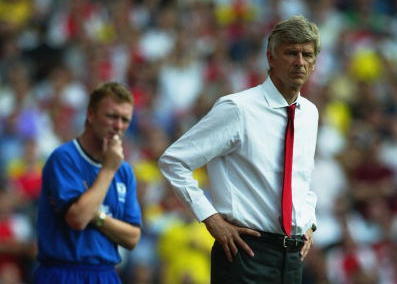
Even if the package and image associated with David Moyes is impeccable (just as it mostly has been for his rumored successor at Everton, Roberto Martinez), there is the stumbling obstacle in that his results have just not been good enough for the job (just as they are not for Martinez).
Consider Moyes’ record away at United, Liverpool, Chelsea and Arsenal—the erstwhile top four of the Premier League—played 45, won 0, drawn 18 and lost 27—a meager total of 18 points gained from a possible 135.
No surprise, then, that when it comes to getting results off top teams, it is the likes of Stoke City (in previous years, anyway), Swansea City and Liverpool (an indication of their recent decline) that are mentioned. Everton are merely a difficult fixture, not a potential banana skin.
Cox’s article mentioned in the previous slide touched on the frequent use of scouting and reactive tinkering that has been prevalent throughout Moyes’ tenure at Goodison Park. The meticulous planning will no doubt have sat well with the United hierarchy, and possibly Sir Alex himself, but when Manchester United are concerned, it is dominance, not reactiveness, that should be the order of the day.
When it comes to Europe—and Everton have not really been a true Champions League club—Moyes exited the competition in the pre-group stage qualifiers having finished fourth in the 2004-2005 season, ahead of Liverpool. A league finish ahead of their crosstown rivals was repeated last season and looks odds-on to be replicated again this term, but this is during a period where Liverpool have fallen dramatically.
So the reputation Moyes has enjoyed—that he has done exceedingly well for a club with such limited resources—is all well and good and may indeed hold true, but there will no longer be any context come July.
He will need to start delivering silverware, something he has never done in his 11 years with Everton.
Context: Continuing the Manchester United Mythology
5 of 5What makes Manchester United so alluring and the Manchester United mythology so enduring?
No one can really point a finger to the exact ingredients, but the right answer is probably a combination of silverware, historic triumphs (see Champions League win over FC Bayern Munich), iconic football figures, exciting attacking football, winning at all costs and Sir Alex Ferguson himself.
While United romped to the Premier League title this season and nothing should be taken away from such an impressive achievement, it is common consensus that this is a United team still in development and not at its peak. It is also far from Ferguson’s strongest squad as United manager.
Any manager taking charge of a young team in transition and still finding its tactical identity will have a task on his hands. Any manager taking charge of a team expected to win trophies while striking a fine balance between world-class stars and promising youth graduates will have an even bigger challenge. Any manager who isn’t Sir Alex Ferguson doing all this at Manchester United will face a task of the biggest magnitude.
The logical choice that fit the above requirements to continue the United story would perhaps have been Jurgen Klopp, who has achieved so much with an unfancied Borussia Dortmund team. He could have brought a philosophy, an affableness and a continental reputation to Old Trafford.
But it wasn’t to be, and in David Moyes, Manchester United have made a significant statement of their faith in young British managers. They did it with Sir Alex, they will claim, so why not with Moyes as well?
For this, the Red Devils should take massive credit. It is a bold move, a risky move and, if it pays off, will be one of the greatest success stories of managerial talent moving seamlessly from the lower English leagues to the upper echelons of European football.
But if it doesn’t, the six-year deal will backfire, and then, though nobody would want it to, the individual would once again be bigger than the club.
.jpg?w=2560 "Rams Raiders Football")


.jpg?w=2560 "Rodgers Iced Out on Plane 💎")
.jpg?w=2560 "Packers Safety Slams Refs 🤬")

.jpg?w=2560 "🚨 Week 8 AP Top 25 Poll")
