
Martin St. Louis and the 10 Best Recent NHL Players That Went Undrafted
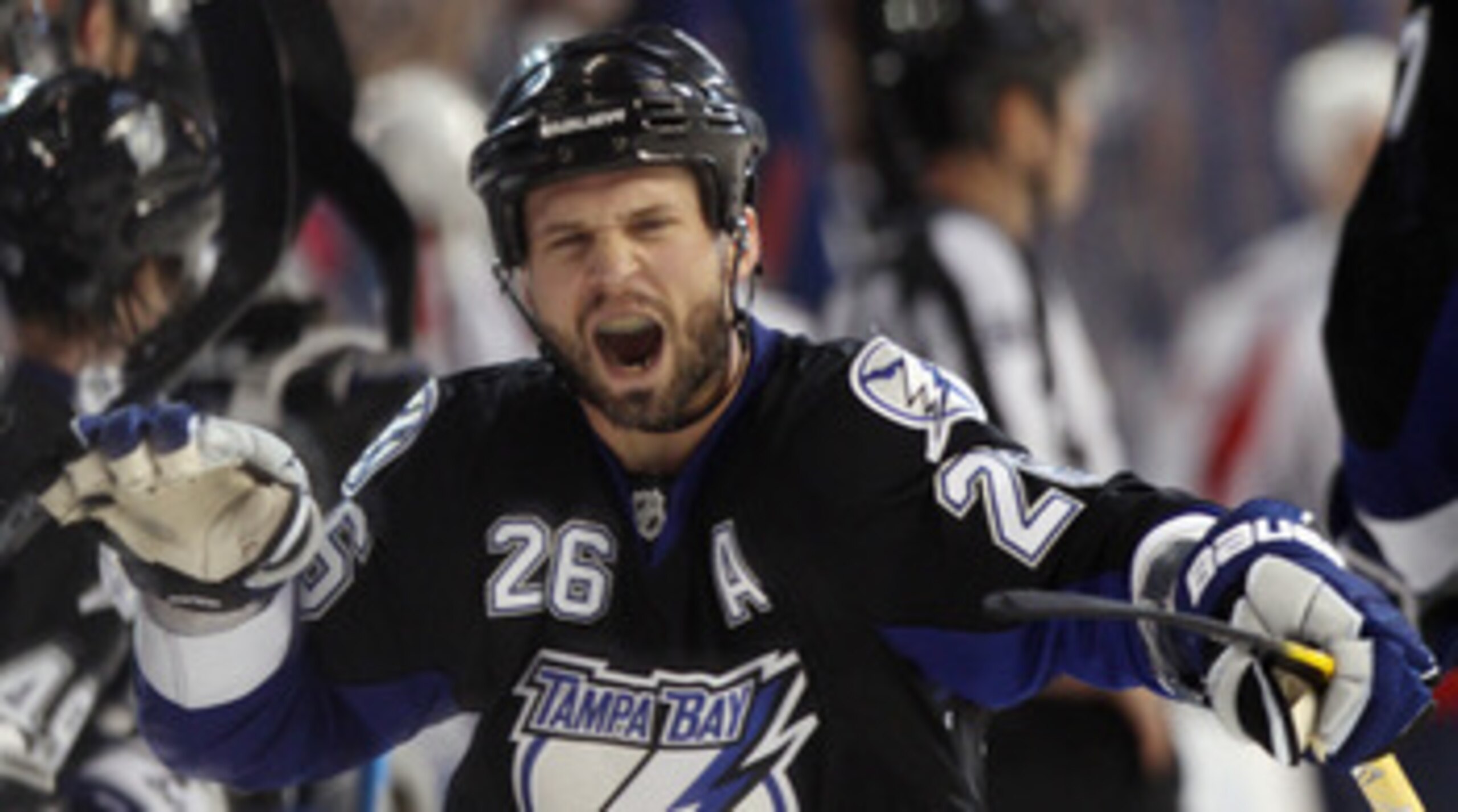
The Tampa Bay Lightning player flying around the ice this postseason with the yellow stick that seems longer than he is tall is 5'9", 177-pound Laval, Quebec native, Martin St. Louis.
In case you did not already know, St. Louis, who will turn 37 in June, is one of the best players in the NHL.
What you may not know is an NHL team never drafted St. Louis after a stellar college career at the University of Vermont.
In a bit of irony, St. Louis played on the Catamounts with a player that he is currently trying to beat for a chance to play for the Stanley Cup—Boston Bruins goalie, Tim Thomas.
While at Vermont, St. Louis was an NCAA All-Star and three-time Hobey Baker Award finalist for college Player of the Year.
He still ranks first amongst all Vermont scorers in career points (267) and assists (176), and ranks third in career goals (91).
Despite his impressive numbers with the Catamounts, St. Louis was undrafted by the NHL after completing his college career in 1997.
Instead, St. Louis had to settle for a training camp invite from the Ottawa Senators, a franchise that had yet to produce a winning season since returning to play in the NHL in 1992.
Training camps start the first week in September in the NHL and by the middle of the month, St. Louis was released. He was out of the NHL until signing a free-agent contract with the Calgary Flames in February of 1998.
After kicking around in the minor leagues and despite scoring 114 points in 95 games over three seasons with Calgary’s top minor league affiliate, he was released.
On July 31 of 2000, St. Louis signed a free-agent contract with the Tampa Bay Lightning, a franchise that had just one winning season up to that point.
St. Louis did not have the lightning-quick start he had hoped for in Tampa.
During his first two seasons, he had just 75 points in 135 games. However, after showing signs of the point-scoring machine he would become during the '01-'02 season, a broken leg ended his year after 53 games.
St. Louis would return the following season from his broken leg healthy and ready to go.
Over the course of the next eight seasons, St. Louis would become a six-time All-Star and would lead the NHL in scoring with 94 points in 2004.
The Lightning built a successful franchise with St. Louis and went on to play in the 2004 Stanley Cup Finals.
St. Louis scored the biggest goal of his career during those Finals while also serving up a dish of cold revenge against the team that released him just a few years prior.
With his team trailing in the Stanley Cup Finals 3-2 against the Calgary Flames and playing in the second overtime of Game 6, St. Louis scored the game-winner.
The third game-winning goal of the '04 playoffs for St. Louis forced Game 7 back in Tampa, where the Lightning went on to defeat the Flames and win the Stanley Cup.
Following the '04 season, St. Louis would win the Hart Memorial Trophy as the most valuable player to his team and the Lester B. Pearson Award (now the Ted Lindsay Award) as league MVP, voted on by his peers.
St. Louis became the first player since Wayne Gretzky and only the eighth in NHL history to win the Art Ross Trophy, the Stanley Cup and the Hart Memorial Trophy all in one season.
This past season, St. Louis finished second in the NHL in points (99) and assists (68). Since 2004, he has averaged almost 88 points per season and has ranked in the top 10 in scoring in four of those seasons.
St. Louis is just one of many players to go undrafted and have a stellar career in the NHL.
Here is a list of 10 such players. This list will be slightly different from some of the other lists of undrafted players you may have seen here on Bleacher Report. I have decided to include players from the '80s and '90s.
This video slideshow is not a “best of all time” list; it is merely a group of players that excelled in the NHL after not being drafted. If I have missed one, please feel free to include them in your comments.
Dino Ciccarelli (Old-Time Hockey)
1 of 10Passed over in two NHL entry drafts, Dino Ciccarelli went on to have a stellar 19-year career.
Controversial as he and his time in the NHL were, the 5'10", 180-pound crease agitator, was inducted into the Hockey Hall of Fame in 2010.
Ciccarelli almost never made it beyond juniors. He suffered a badly broken leg in his second year of junior hockey and many doctors told Ciccarelli he would never be able to play again.
Lou Nanne of the Minnesota North Stars took a chance after Ciccarelli went undrafted for the second time and signed him to a free-agent contract in 1981.
After being called up in late in 1981, Dino scored 18 goals and 30 points. However, what happened that spring would cement Dino in the NHL for the next 19 years.
Behind an incredible rookie playoff run by Ciccarelli, the North Stars would make it to the Stanley Cup Finals.
Although his team lost to the Islanders, Ciccarelli's 14 goals and 21 points in 19 games set a record for most playoff goals and points by a rookie in the postseason.
The goals record still stands while the points record for a rookie stood until last year. Flyers rookie Ville Leino tied Ciccarelli with 21 points in Philly's run during the last postseason.
Dino ranks 17th all time in goals scored and his 608 goals are the most by any player never drafted into the NHL.
One of the best players in league history never to have won a Stanley Cup, Ciccarelli was no angel on or off the ice.
In 1988, Dino got into a fight with Toronto Maple Leafs rookie defenseman Luke Richardson. Instead of dropping the gloves, the smaller Ciccarelli hit Richardson in the head with his stick.
The highly publicized incident made it to court where Dino was charged with assault and sentenced to one day in jail.
After 10 years in Minnesota and with his lack of maturity off the ice becoming an issue, including being charged with indecent exposure in 1987, he was traded to the Washington Capitals at the deadline in 1989.
In parts of four seasons in Washington he scored 119 regular-season goals and added 21 more in the playoffs. However, another off-ice incident marred Ciccarelli’s time in D.C.
In May of 1990, Ciccarelli and three other teammates (Scott Stevens, Geoff Courtnall and Neil Sheehy) were accused of sexually assaulting a 17-year-old girl in the back of a limousine outside of a Georgetown nightclub.
That offseason Scott Stevens and Geoff Courtnall were gone to St. Louis and Neil Sheehy, the team’s enforcer, disappeared from hockey for a year. Two years later Ciccarelli was traded to Detroit.
His first season in Detroit was the third best of his career, scoring 41 goals with 97 points.
However, age and the depth the Red Wings were accumulating eventually forced Detroit’s hand and in summer of 1996, Ciccarelli was shipped off to the lowly Tampa Bay Lightning.
He managed one more 35-goal season before being traded in state to another lowly franchise, the Florida Panthers.
Years of aggressive play in front of opposing nets and being one of the league’s best ever garbage men caught up with Ciccarelli in South Florida. Back and ankle problems forced him to miss a lot of time and after playing in just 14 games in 1999, he retired.
In 19 seasons in the National Hockey League, Ciccarelli finished with 608 goals, 598 assists and 1,200 points in 1232 games.
He scored 50 goals in a season twice and had nine 30-goal seasons. Dino Ciccarelli is more than worthy of being on this list and in the Hockey Hall of Fame.
Dan Boyle and Antti Niemi
2 of 10This is sort of a bonus since both play on the same team (San Jose Sharks), and were recently ousted in the Western Conference finals by the Vancouver Canucks.
Antti Niemi
The 27-year-old Finnish goaltender was never drafted and after playing seven years in Finland was signed as a free agent by the Chicago Blackhawks in 2008
Niemi spent his first professional season in the American Hockey League where he appeared in 38 games for the Rockledge Ice Hogs. He did make three appearances for Chicago late in the '09 season where he allowed eight goals on just 59 shots.
The following season, Niemi was slated to back up the Hawks' big-money goalie, Christobal Huet, whom Chicago had brought in the season before,
However, Niemi would win almost 70 percent of the games he started and took over for Chicago in the playoffs between the pipes.
He started in all but one postseason game and helped lead the Blackhawks to their first Stanley Cup title in almost 50 years.
While Niemi was the third Finnish goalie to make it to the Cup Finals, he was the first one to win the Stanley Cup.
Niemi filed for arbitration during the offseason, and was eventually awarded $2.75 million. Because of salary cap restraints, the Hawks could not afford the awarded price and instead signed veteran goaltender Marty Turco from the Dallas Stars for $1.3 million.
Niemi signed with the San Jose Sharks and had a great season. He was 35-18-6 with a save percentage of .920 and a goals-against average of 2.38.
Dan Boyle
Teammate and defenseman Dan Boyle was also never drafted by an NHL team. The Florida Panthers signed him as a free agent after playing at Miami University in Oxford, Ohio.
Following his final game as a Red Hawk, the Florida Panthers inked Boyle to a free-agent contract. His first 117 games were spent in the farm system of the Panthers before finally playing full-time for Florida in the 2000-01 season
After playing in 25 games with the Panthers during the '01-'02 season, he was traded 180 miles northwest to the Tampa Bay Lightning.
It was in Tampa where Boyle began to blossom. He would set a career high in points in 2003 with 53.
Boyle would prove to be a major player for head coach John Tortorella, as the 2004 Lightning went on to win the Stanley Cup.
Boyle led all Bolts defensemen with 10 points during the Cup run.
He was traded to San Jose following the '08 season and has progressed into one of the better defensemen in the game.
Since joining the Sharks, Boyle has made two All-Star appearances and has 165 points in three seasons.
"Slippery Rock" Joey Mullen
3 of 10Like Martin St. Louis and Dino Ciccarelli, Joey Mullen was not a big guy standing just 5'9".
However, Mullen's place in hockey history will always be cemented, as he was the first American player to score 500 goals and 1,000 points in the NHL.
A native of New York City's tough streets, Mullen learned to play the game on roller skates using a roll of electrical tape as a puck.
He starred in the local amateur league with the 14th precinct and the West Siders.
In 1974-75, he dominated the New York Metropolitan Junior Hockey League. After Mullen averaged 4.5 points per game in the city, he was offered a partial scholarship to attend Boston College.
Mullen had to pay $700 out of his own pocket to attend as a freshman but he was offered a full ride the second year.
As a junior and senior at BC, Mullen was named to the Eastern Collegiate Athletic Conference First All-Star Team and the NCAA East First All-America Team.
Following his senior year of college, Mullen represented the United States at the 1979 World Championships in Moscow.
It was there that scouts began to notice Mullen. He scored seven goals in eight games and averaged a point per game against a very tough field of Eastern Bloc countries.
Just prior to the 1979-80 season and after turning down a chance to play for the 1980 Miracle on Ice gold medal team, the St. Louis Blues signed him as a free agent.
Mullen’s family was desperate for the money, as Joey’s father had fallen very ill.
Mullen was a hard-nosed player and had no problems adjusting to the pro game. He was named the Central Hockey League's top rookie in 1979-80, and after scoring 237 points in just 182 games Mullen was called up to play for the Blues in 1981.
In 1983-84, Mullen scored 41 goals and started gaining league-wide recognition as a bona fide scorer. He scored a personal high of 92 points in 1984-85, but during this period the Blues were not very successful in the postseason.
St. Louis traded Mullen to the Calgary Flames during the 1985-86 season.
Mullen quickly helped his team in Calgary accomplish what he could not do in St. Louis—reach the Stanley Cup Finals.
While the Flames were making their first trip the Finals the Canadiens were not and defeated the Flames soundly in five games.
Mullen’s run in Calgary was a successful one as twice he made the All-Star team and was twice voted as the Lady Byng Trophy winner.
In the 1987-88 season, Mullen helped the Flames finish with the league’s best record.
The following season he registered his first 50-goal year and in 1989 Mullen led all players in the 1989 playoffs with 16 goals as Calgary defeated the Canadiens to win its first Stanley Cup.
In 1990, he was traded to Pittsburgh where he would finish his career, but not before helping Mario Lemieux win two Stanley Cups.
He did play one season in Boston before returning to Pittsburgh in 1996.
According to the Legends of Hockey, Mullen is considered one of the deans of American-born NHL players. When he stepped away from the game after the 1996-97 season, Mullen stood as the top-scoring American of all time.

Dwayne Roloson
4 of 10Dwayne Roloson has been the talk of these Stanley Cup playoffs. At 41 years old, Roloson has been amazing.
Undrafted out of the University of Massachusetts Lowell, Roloson was a Hobey Baker Award nominee and NCAA All-American while playing goal for the Chiefs (now the River Hawks) from 1990 through 1994.
The Calgary Flames signed him as a free agent in 1994.
Roloson spent the first couple of years splitting time between the Flames and their American Hockey League counterpart, the Saint John Flames.
After he was traded to the Buffalo Sabres to back up Dominik Hasek for two years, the Columbus Blue Jackets selected him in the 2000 NHL Expansion Draft.
Roloson refused to join the Blue Jackets, instead signing with the AHL team of the St. Louis Blues.
From there it was on to Minnesota, then in a much-criticized deal (what a surprise) by the fans of Edmonton, a very mediocre Oilers team acquired Roloson in March of 2006.
All Roloson did was promptly lead the No. 8-seeded Oilers past the No. 1-seed and Presidents' Trophy winners, the Detroit Red Wings, in six games.
Along with teammate Chris Pronger, Roloson dominated the rest of the Western Conference playoffs.
He was spectacular, following the first-round upset of Detroit with series victories over San Jose and Anaheim.
Roloson was 12-5 with a .927 save percentage and a 2.33 goals-against average headed into the Stanley Cup Finals against another surprise team, the Carolina Hurricanes.
However in Game 1 Roloson suffered a third-degree MCL sprain of his right knee when Hurricanes forward Andrew Ladd was pushed into Roloson by a back-checking Oilers defenseman and current Lightning teammate, Marc-André Bergeron.
Oilers coach Craig MacTavish announced that Roloson would not be able to continue in the series as the Oilers lost in seven games to Carolina.
Much about Roloson's career has been unspectacular but his 9-4 playoff record with a .925 save percentage and 2.51 goals-against average would indicate that Roloson is not finished in the NHL.
He may not have been as good as Tim Thomas or Roberto Luongo during the course of this past season, but he has been as good as both of them in the postseason.
He may have struggled in last two games but Roloson will rebound and there is no reason to think that he cannot continue his quest to finish what he almost accomplished single-handedly with the Oilers in 2006—winning the Stanley Cup.
Ed "The Eagle" Belfour
5 of 10It is hard to believe after watching Belfour play but, yes, Eddie "The Eagle" was undrafted.
Even after leading the University of North Dakota Fighting Sioux to an NCAA championship in 1987, Belfour still went a year before being signed by the Chicago Blackhawks.
After making his NHL debut in 1988 Belfour did not exactly impress. He was just 1-7 in his first eight decisions and went 4-12-3 in his first season.
However, the following year Belfour would post a 4-2 mark in the postseason for the Blackhawks and return to accomplish what many consider the greatest rookie season by a goalie in the history of the NHL.
Belfour was 43-19-7 with a 2.47 goals-against average. The 43 wins are a still a record for rookie goaltenders.
The accolades and awards followed his stellar rookie season. Belfour received the Calder Memorial Trophy for outstanding play by a rookie, the Vezina Trophy for best goaltender and the William M. Jennings Trophy for goaltender of the team with the fewest goals allowed.
He was also nominated for the Hart Memorial Trophy as the league's most valuable player. Belfour would go on to win the Vezina Trophy again in 1993 and the Jennings Trophy in 1993, 1995 and 1999.
He continued to fall short of his quest to win the one trophy that eluded him, the Stanley Cup. It was not until he became a member of the rival Dallas Stars that Belfour would win the game's most coveted prize.
In 1999, Belfour out-dueled Dominik Hasek as the Stars won in the third overtime of Game 6 to capture the Stanley Cup. Belfour posted a 1.26 goals-against average in the Finals.
The Stars would reach the Finals for a second consecutive season but lose to the New Jersey Devils.
Also known for being a bad teammate who could throw temper tantrums, Belfour was notorious for not getting along with backup goaltenders.
He was being challenged by Marty Turco and after a falling out between then-Stars coach Ken Hitchcock and GM Bob Gainey, Dallas decided not to re-sign Belfour and named Marty Turco the starting goalie for the next season.
Belfour would help lead Team Canada to a gold medal at the 2002 Winter Olympics in Salt Lake City, as he would go on to play in Toronto and Florida before leaving the NHL after the 2007 season.
The six-time All-Star and future Hall of Famer is currently ranked third in wins with 484 and 10th all time in shutouts with 76.
John Madden
6 of 10New Jersey Devils president and general manager Lou Lamoriello has found some real undrafted gems over the years. One of those is center John Madden.
Madden is another college standout that was shunned during the NHL draft. In four years at the University of Michigan, Madden played in 160 games and scored 80 goals with 100 assists for 180 points.
During his four-year career with the Wolverines, Madden set the NCAA record for most career short-handed goals (23) and was a member of the 1995–96 championship team.
Following his senior season, Madden was named to the CCHA First All-Star Team and NCAA West First All-American Team.
The New Jersey Devils drafted one of Madden's teammates at Michigan, Brendan Morrison, in 1993. The selection of Morrison led Lamoriello to Madden. Lamoriello was impressed with Madden's work ethic and offered the Barie, Ontario native a contract that Madden signed in June of 1997.
Following two productive years in Albany of the AHL, one ('98-'99) in which Madden led the River Rats in scoring, he made his NHL debut in January of 1999 against the hated New York Rangers.
After playing in just three other games with the Devils that year, Madden became a full-time roster player starting with the '99-'00 season.
Since then Madden has been a part of three Stanley Cup-winning teams He was a member of the 2000 and 2003 New Jersey Devils Cup winners and also helped the Blackhawks end their 49-year Stanley Cup drought last season.
In 867 regular-season games the skilled two-way forward who is great on special teams, has 18 career short-handed goals and set a rookie record by scoring six in the '99-'00 season.
In Game 2 of the 2006 playoffs against the cross-town rival New York Rangers, Madden set an NHL record by recording a hat trick with two of the goals coming short-handed.
He also once scored four goals in a game against the Penguins in October of 2000. For his career, Madden has 162 goals and 183 assists for 345 points.
Aside from winning three Cups, Madden won the Frank J. Selke Trophy in 2001, which is given to best defensive forward. He was also nominated in 2003, 2004 and again in 2008.
At 37 years old, Madden just completed a one-year deal with the Minnesota Wild. He is a free agent for the 2011 season.
Alexandre Burrows
7 of 10You may be hearing a lot more about Alexandre Burrows before the middle of June. Currently he has 12 points in 17 playoff games for the President's Trophy-winning Vancouver Canucks.
He scored both Vancouver goals in Game 7 to help eliminate the defending Stanley Cup champion Chicago Blackhawks. The second (pictured) was scored in overtime.
Burrows credits his hockey skills to his "ball hockey" days. He competed nationally and internationally in tournaments during the summers away from the ice.
In 2005, he was named the International Ball Hockey Player of the Year. He has also been inducted into the Canadian and International Ball Hockey Halls of Fame.
After not being drafted, Burrows' on-ice break came when he signed to play professionally with the Greenville Growl of the ECHL.
After spending parts of eight seasons between three different leagues (QMJHL, ECHL & AHL) Burrows made his NHL debut in January of 2006.
His first NHL goal and assist would come just eight days later when he notched both in just seven minutes of ice time against the legendary Eddie Belfour in a victory over the Maple Leafs.
Burrows had increased his point output in every season before this year. In 442 regular-season games Burrows has become extremely reliable.
He now plays on the Canucks' top line with the Sedin twins and has registered at least one point in every Western Conference finals game against the San Jose Sharks.
In his brief NHL career, Burrows is a plus-92 with 111 goals and 218 points. Look to hear the name Alexandre Burrows more as the Canucks try to win their first Stanley Cup in franchise history this spring.
Brian Rafalski
8 of 10With Memorial Day looming and the American-born Brian Rafalski contemplating retirement, I thought it fitting to use a video sponsored by the United States Army in honoring Raffi as one of the best to never get drafted into the NHL.
In a theme common to many of the undrafted players on this list, Rafalski played good hockey in college.
A product of the Badgers from Wisconsin, Rafalski played for four years as a senior and scored 45 points in 43 games in his senior year.
Again, like many on this list, he won several awards that season; he was named to the WCHA First All-Star Team, the NCAA West All-Star Team and was the WCHA Defenseman of the Year.
The result was being passed over in the NHL entry draft and a trip overseas to play a year in Sweden and then three years in Finland.
The Sporting News named Rafalski in 1999 as the best hockey player in the world not playing in the NHL. In May of 1999, New Jersey Devils GM and president Lou Lamoriello signed the Dearborn, Michigan native to a free-agent contract.
Upon arriving in New Jersey, he was paired on the blue line with perennial All-Star and future Hall of Famer Scott Stevens. Rafalski and Stevens would work side by side until Stevens retired in 2004.
Rafalski's rookie campaign was filled with success, both personally and from a team standpoint. He finished the 1999-2000 season with 32 points, led all rookie defensemen in plus-minus with a plus-21 rating, and helped lead the Devils to another Stanley Cup title.
He and Scott Gomez were named to the NHL All-Rookie Team but this was just the start of a very promising career in North America.
Rafalski would again hoist the Cup in 2003 with the Devils while averaging 43 points from the blue line with a trapping-style team in his first four years in the NHL.
After three more seasons with New Jersey, the free-spending Detroit Red Wings offered Rafalski a five-year deal worth $30 million.
In Detroit, Rafalski would again encounter a future Hall of Fame defenseman as he and Nicklas Lidstrom would team up and help the Red Wings hoist Lord Stanley’s Cup in 2008.
The Wings defeated Sidney Crosby and the Pittsburgh Penguins in six games. The following season, Crosby would get the better of Rafi and Lidstrom in a seven-game Finals victory rematch.
Rafalski has been voted to two All-Star games and in 2008-09, he set a Red Wings franchise record by scoring at least one point in seven games to start the season.
Using his experience from playing overseas, Rafalski represented his country well in the 2002 and 2010 Olympic games.
In the 2010 Olympics, the USA won a silver medal after a heartbreaking overtime loss to Canada in the gold medal game. Rafalski was named the best defenseman of the tournament.
On May 25, Brian Rafalski informed the Detroit Red Wings he plans to retire. Still, he is worthy of this list and is one of the most underrated American defensemen to lace up a pair of skates in the NHL.
Adam Oates
9 of 10Growing up in Weston, Ontario, Adam Oates did not idolize Gordie Howe, Guy Lafleur or any hockey superstars from his childhood.
Oates, like a good son, worshiped his dad's favorite English soccer star—Stanley Matthews.
Matthews was known as the "Wizard of Dribble" and was considered an amazing passer who hardly ever scored himself.
If you know anything about Adam Oates then you know that this is where he learned to play unselfish hockey.
Prior to his years playing hockey, Oates excelled at lacrosse where he played five years of Junior A lacrosse in Canada.
Oates scored 735 points in just 130 total games (5.5 PTS per games) and won three straight league MVP awards from 1981 to 1983.
He would retire from professional lacrosse after the 1984 season to pursue his hockey career.
Instead of playing junior hockey in Canada, Oates elected to attend RPI (Rensselaer Polytechnic Institute) in Troy, New York.
While at RPI, Oates set scoring records and led his team to a 1985 NCAA championship.
Not playing junior hockey and attending RPI kept Oates under most NHL scouts' radar and kept him from being drafted into the NHL.
However, the Detroit Red Wings took a chance on Oates. Well, they did more than just take a chance.
They signed Oates to the richest undrafted free-agent contract at the time. Oates inked with the Wings for a cool $1 million over four seasons.
He began his professional career in the AHL with the Adirondack Red Wings, quickly establishing himself as a better-than-average two-way player.
In 51 total games, including the playoffs, Oates would score 25 goals and add 42 helpers.
His average of more than a point per game was good enough to earn a spot as the Red Wings' second-line center behind Steve Yzerman.
Oates never turned back as he became the best playmaker not named Wayne Gretzky from 1985 until 2002.
Oates was well traveled during his NHL career. Including the Red Wings, Oates played with seven teams spanning 19 seasons.
He ranks sixth all time with 1,079 assists and 16th in total points with 1,420 but it was the players around Oates that benefited from his unselfish play.
Oates turned average goal scorers into good ones and good goal scorers into great ones...and then there was Brett Hull.
I am not saying Hull was not a prolific goal scorer, but Hull scored 47 goals between two seasons prior to Oates' arrival in St. Louis.
After Oates arrived, Hull scored 228 goals (72, 86, 70) in the next three seasons.
Although Hull would have two consecutive 50-goal seasons following the departure of Oates to Boston, he would never again come close to the three-year totals he achieved while Oates was in St. Louis.
Oates had his best season after being traded to the Boston Bruins. He finished the 1993 campaign with 45 goals, 97 assists and 142 points.
Remarkably, this was third in the league behind Mario Lemieux and Pat LaFontaine.
What made this an even more astonishing accomplishment for Oates was the fact that Bruins sniper Cam Neely missed all but 13 games with a knee injury.
Neely's leg injuries continued the following year but not before Oates helped Neely score 50 goals in just 49 games.
In fact, Oates is the only player to center three 50-goal scorers—Peter Bondra, Cam Neely and Hull. He is also the only one to center two players, Neely and Hull, who scored 50 goals in 50 games.
After a being traded to Washington, Oates continued his playmaking genius. With sniper Peter Bondra, Oates led the Capitals to the Stanley Cup Finals in 1998.
While Oates made players like Hull, Neely and Bondra more prolific scoring goals he also made players like Chris Simon look like snipers at times.
Simon's career high in goals prior to playing with Oates was 16 with the Colorado Avalanche. During the '99-'00 season, Simon fell one goal short of 30.
Oates' career is filled with a void of emptiness in terms of honors and awards. He played in just five All-Star games.
During the 2001-02 season and at 39 years old, Oates became the oldest player to ever lead the NHL in assists with 64.
Oates would get one more shot at a Stanley Cup in his career with Anaheim in 2003; however, the Ducks lost a heartbreaking seven-game series to the New Jersey Devils.
After playing 60 games with the Edmonton Oilers in 2004, Oates ended his career.
Many hockey experts considered Oates a lock to be enshrined into the Hockey Hall of Fame; however, he has yet to receive the June phone call from the 407 area code in Toronto.
Retirement has been unkind to Oates in terms of what he deserves for his playing years.
Many point to his longevity as the reason for his numbers and say his lack of awards and the fact he never won a Stanley Cup hurts Oates, but I say that is ridiculous.
Oates proved to be more than capable in the playoffs—he ranks 14th in career postseason assists and 25th in playoff points.
Oates has yet to be selected and I’m partial to this as a Caps fan.
Oates was more than a playmaker. He was an underrated defensive center who was utilized by every coach he ever played for on the penalty kill or when there was a defensive zone faceoff late in the game.
His defensive awareness and on-ice vision were not matched on many teams late in the game.
Oates has the most career points of all retired players that are eligible for the Hockey Hall of Fame but are not currently enshrined.
In Closing
10 of 10I know that there is a lot of talent not included on this list. In today’s game players such as Pittsburgh's Chris Kunitz, the Rangers' Dan Girardi and Dustin Penner in LA could all easily have appeared in this slideshow.
There is also Jonas Hiller of Anaheim and Nicklas Backstrom in Minnesota.
I tried to include a mix of players still playing in the postseason for now, along with some veterans from years gone by.
I did not include players like Peter Stastny or Borje Salming simply because I consider them part of a world that was "different back then."
In today’s NHL circles, both would most assuredly have been drafted.
I chose to stick with players that came from North America and were simply overlooked or thought not to be talented enough.
I tried not to leave anything out in terms of what made my choices so special, but please leave your comments and add anyone you feel deserves to be on the list.
.jpg?w=2560 "NHL Trade Grades Connor Hellebuyck")


.jpg?w=2560 "Latest Peyton-Colts Rumors")