
2011 NHL Free Agency: Five More Questions Than Answers for Pittsburgh Penguins
Thursday, we took a look at five questions the Pittsburgh Penguins will look to answer this offseason.
The health of center Sidney Crosby is the greatest uncertainty facing the team, one they can do nothing to help but only wait.
Evgeni Malkin seems set to return from a knee injury and hopes to avoid a third straight season slowed by injury and ineffective linemates.
Max Talbot and Pascal Dupuis, among others, are free agents and deserve a strong look to stick around due to their versatility. Tyler Kennedy, a restricted free agent, is also due a payday after netting 21 goals last season.
The team will also have to wait until next season to find out whether James Neal will finally break out and make good on the Goligoski trade.
The team may be on vacation, but GM Ray Shero's got a full plate. Here are five more questions facing the Penguins as they prepare for the entry draft and the beginning of free agency.
If you hate this story and want to hate others like it, check out more at SlewFooters.com or direct your hatetweets to @slewfooters.
Can the Team Learn To Play with Discipline?
1 of 5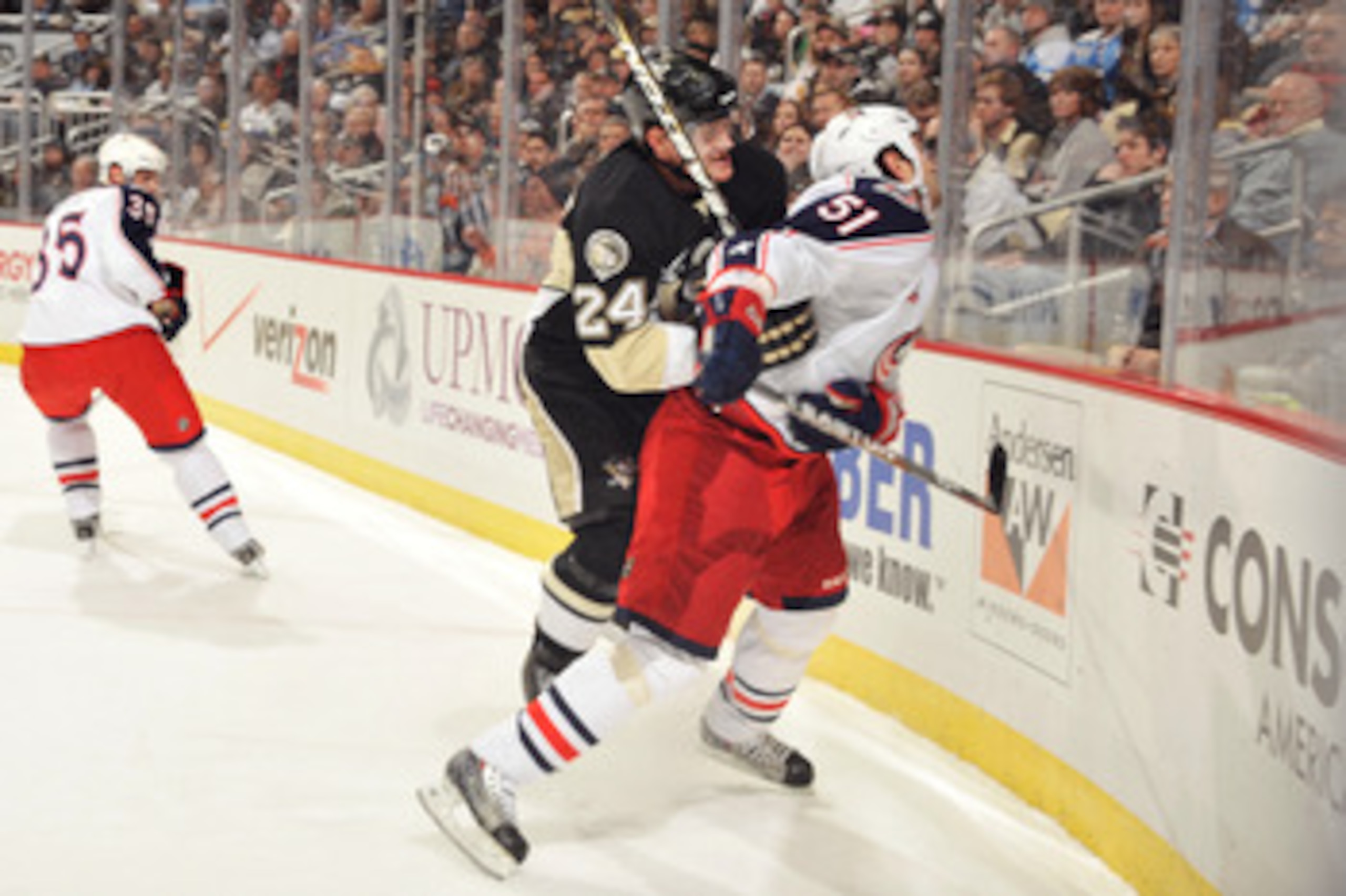
The Penguins employ Matt Cooke. Far from popular opinion, Cooke is a genuine hockey player.
He also makes some genuinely boneheaded decisions.
Cooke was not the only offender on a Penguins team that took an identity of relative softness and turned it into one of a pugilist.
Five Penguins players had more than 100 PIM in 2010-11, and four more had more than 50. Mike Rupp, Arron Asham and Eric Godard are reputable fighters, and Deryk Engelland carved out quite a place for himself among the league's best with a number of clean decisions against names like Colton Orr.
Pittsburgh led the league in minor penalties (374) and had the most hooking (69) and cross-checking (27) minors.
Matt Cooke, Chris Kunitz and Eric Godard also accounted for 29 games missed due to disciplinary suspension.
The Penguins ranked second in the NHL in PIM per game (16.93), total PIM (1388), major penalties (74), fighting majors (71) and game misconduct penalties (10).
In spite of the penalties, the Penguins managed to stay afloat because of their top-ranked penalty killing unit (86.1 percent).
The unit was excellent, led by assistant coach Tony Granato. Whether or not the unit remains as successful next season, they shouldn't be tested to such extent.
Bylsma's club has proven itself to be of the 50-grit variety. The challenge now is to balance the sandpaper play with some discipline.
What About the Third Defensive Pairing?
2 of 5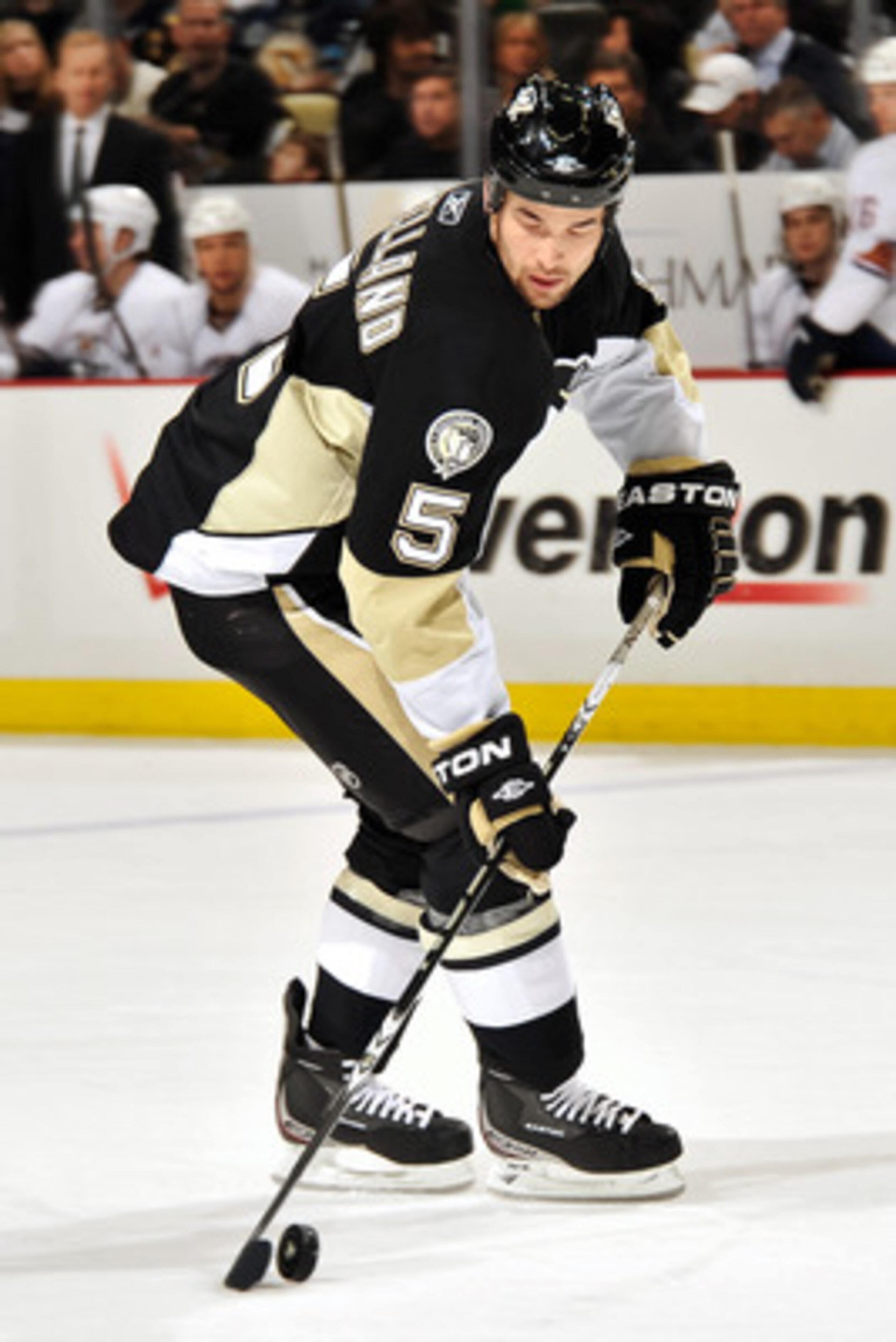
Pittsburgh may have the league's best defensive platoon from one to four.
Brooks Orpik and Kris Letang are the veterans on the team, both Penguins draft selections. Letang had a breakout season through the first two-thirds of 2010-11. Orpik, the longest tenured player on the team, has an influential voice inside the locker room and is a feared hitter on the ice.
Paul Martin and Zbynek Michalek were snapped up on July 1 of last year, two of the most prominent free-agent acquisitions of Ray Shero's tenure in Pittsburgh. After being dropped by Montreal in the 2010 Conference semifinal series because of a perforated defensive corps, nine years and $45 million were sunk into the big name defensemen.
Pittsburgh went from 20th in total defense to sixth in just one year—at one point as high as second in total defense before a string of injuries hit the team.
The team's defense also boosted goaltender Marc-Andre Fleury, who last year experienced his finest season as a professional.
Questions remain as their concerns lie in the third defensive pairing.
Rather than acquire an aging veteran defenseman, as the team had previously done with the likes of Daryl Sydor and Jay McKee, rookie defensemen Ben Lovejoy and Deryk Engelland made the team out of training camp.
The pairing represented themselves well during the regular season, even after the departure of offensive defenseman Alex Goligoski. Lovejoy and Engelland combined for 28 regular season points and a plus-six combined rating.
Matt Niskanen, acquired in the Goligoski trade, took Engelland's place during the playoffs. Lovejoy, a plus-11 during the regular season, had an even rating in seven playoff games, while Niskanen went minus-three with only one assist.
Lovejoy averaged 10:54 TOI during the postseason after averaging 15:00 TOI during the regular season.
It seemed like Bylsma lost faith in his last defensive pairing during the postseason series with Tampa Bay and perhaps, somewhat understandably, after the pair was torched by Martin St. Louis several times
For comparison, Orpik and Martin averaged over 24:00 TOI in those seven games, Letang more than 26:00 TOI and Michalek better than 27:00.
Many wondered why Engelland was not a participant in the last two games after Niskanen struggled in his own zone (Engelland is a stay-at-home defenseman), and it became a point of criticism following the 1-0 loss in Game 7.
Engelland and Lovejoy now have a full year of experience to their credits and each is signed for at least two more seasons. Cracks in their game may have been due to inexperience, and any shortcomings would certainly have been exposed by the highly skilled Tampa forwards.
It will be interesting to see how the pairing plays out next season. Lovejoy is the likely fifth starter, but the focus will be on how Byslma deploys the more defensive-minded Engelland and the more offensively-capable but defensively-unreliable Niskanen.
How to Handle the Pending Free Agent Class?
3 of 5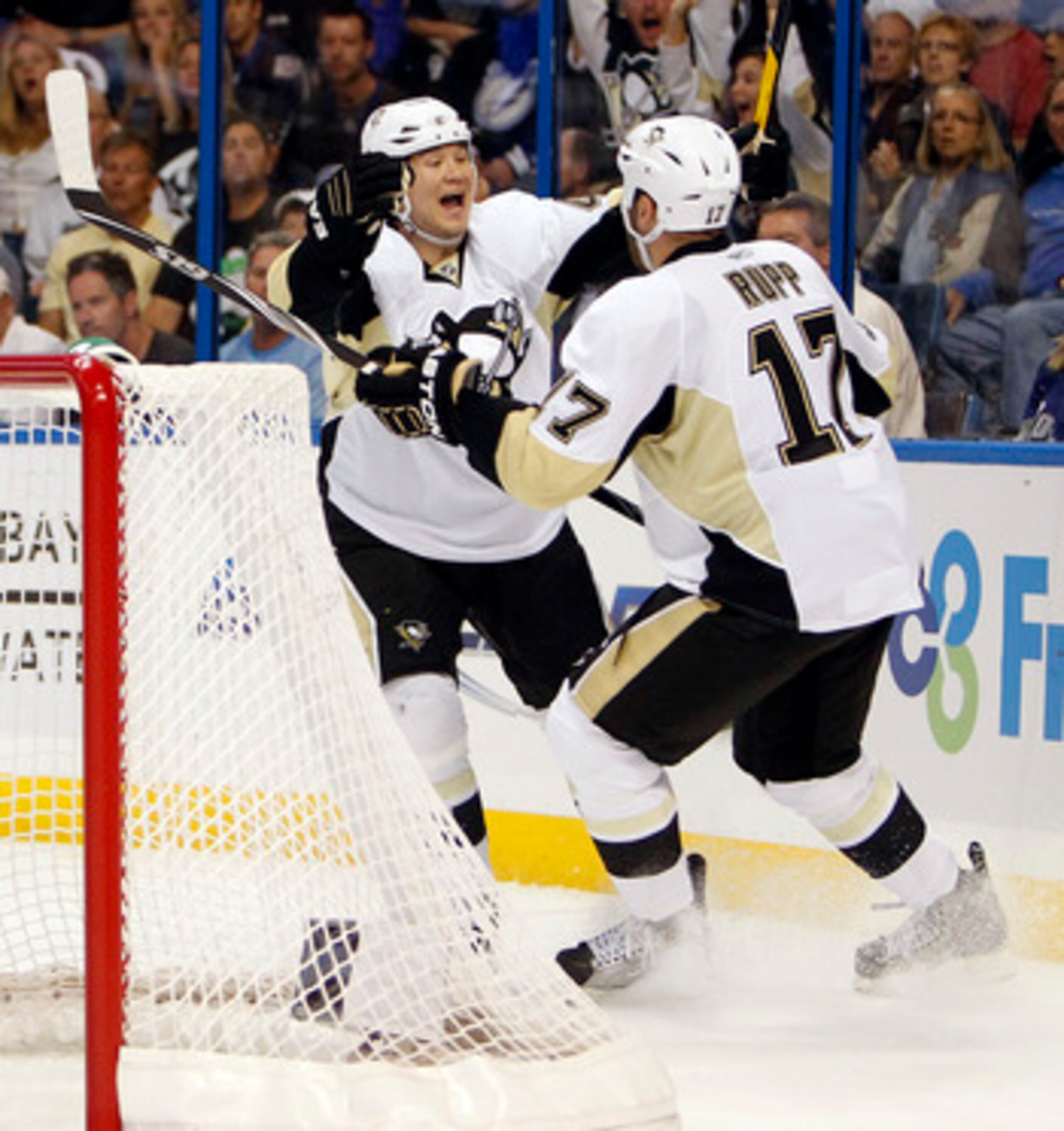
Tyler Kennedy, Pascal Dupuis and Max Talbot were addressed in the first part of the piece and all are obvious targets for their versatility, speed and work ethic.
They are only three of 12 restricted and unrestricted free agents on the current roster.
Alex Kovalev, Mike Rupp, Eric Godard, Craig Adams, Arron Asham, Chris Conner, Dustin Jeffrey, Mike Comrie and Nick Johnson are all without a contract for next season.
Only Jeffrey and Kennedy are restricted free agents.
Of those players, a few are sure bets not to return. Alex Kovalev, a low-risk acquisition (seventh-round pick), will almost certainly not return. Mike Comrie, whose season was cut short by a hip injury, also seems highly unlikely to return, as does popular enforcer Eric Godard.
Arron Asham dealt with injuries and inconsistency during the regular season but represented himself well with three playoff goals, as a member of the fourth line. Mike Rupp and Craig Adams, popular locker rooms guys and fellow fourth-liners, also played very well during the postseason.
Chris Conner may have miffed the Game 7 penalty shot but was electric as a part of the speedy third line which included Talbot and Dupuis.
The third and fourth line players were the best forwards throughout the Tampa series, but it would be an exercise in cap gymnastics to bring them all back.
Depending on the deal Tyler Kennedy does or does not receive, most of these players will likely depart.
The possibility of acquiring new free agents seems very unlikely. The Penguins have a host of role players who figure to fill the bottom two lines admirably, as well as a number of young guys who can fill the spots at a relative discount.
The team has released no information other than that they are having preliminary talks with Tyler Kennedy's camp.

How Many Centers Is Too Many?
4 of 5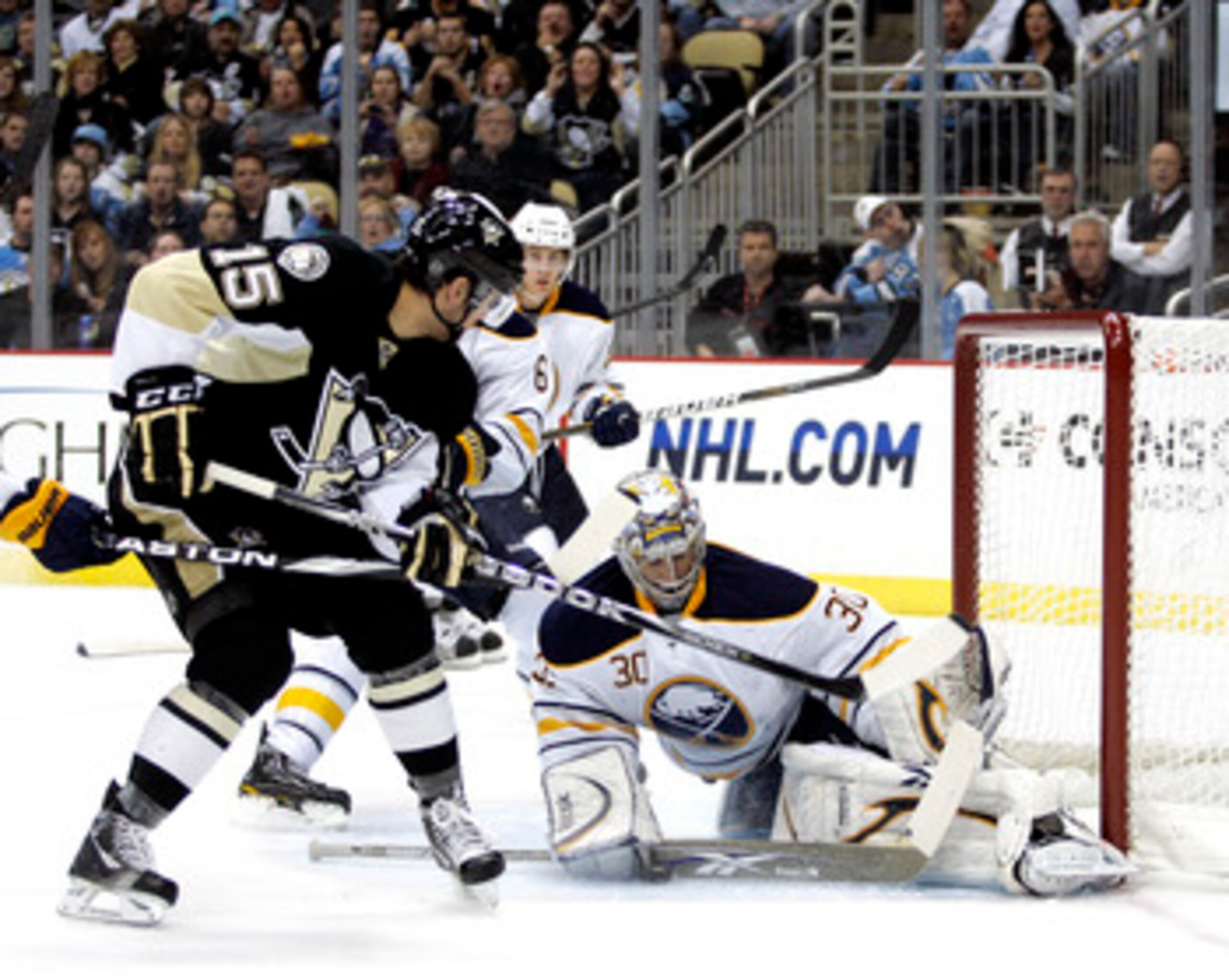
Injuries prevented the problem last season, but the Penguins will have to deal with a surplus of centers when training camp hits in September.
Sidney Crosby, Evgeni Malkin, Jordan Staal, Dustin Jeffrey and Mark Letestu are all natural centers, and Craig Adams and Max Talbot are also capable of playing the position. Crosby will fill the first center role. From there, the Penguins have options.
There was talk at the beginning of last year of putting Evgeni Malkin back on Jordan Staal's wing, where both players scored 29 or more goals as rookies. This could be a huge mistake, though, as Malkin has proven most comfortable at his natural position.
If Staal remains on the third line, only Talbot and Adams could really play the role of the prototypical fourth-line center—assuming either player is retained.
Of those centers, only four—Crosby, Malkin, Staal and Letestu—are signed into next season. Jeffrey is a restricted free agent, and Adams and Talbot are UFA's.
Assuming Malkin remains the second-line center, every center below the big three is capable of platooning at a wing position.
With so much turnover likely for this summer's free agency period, don't be surprised to see some of those centers—ones who have the versatility to step into any forward position—get first billing over the rest of the team's pending free agents.
How About That Power Play?
5 of 5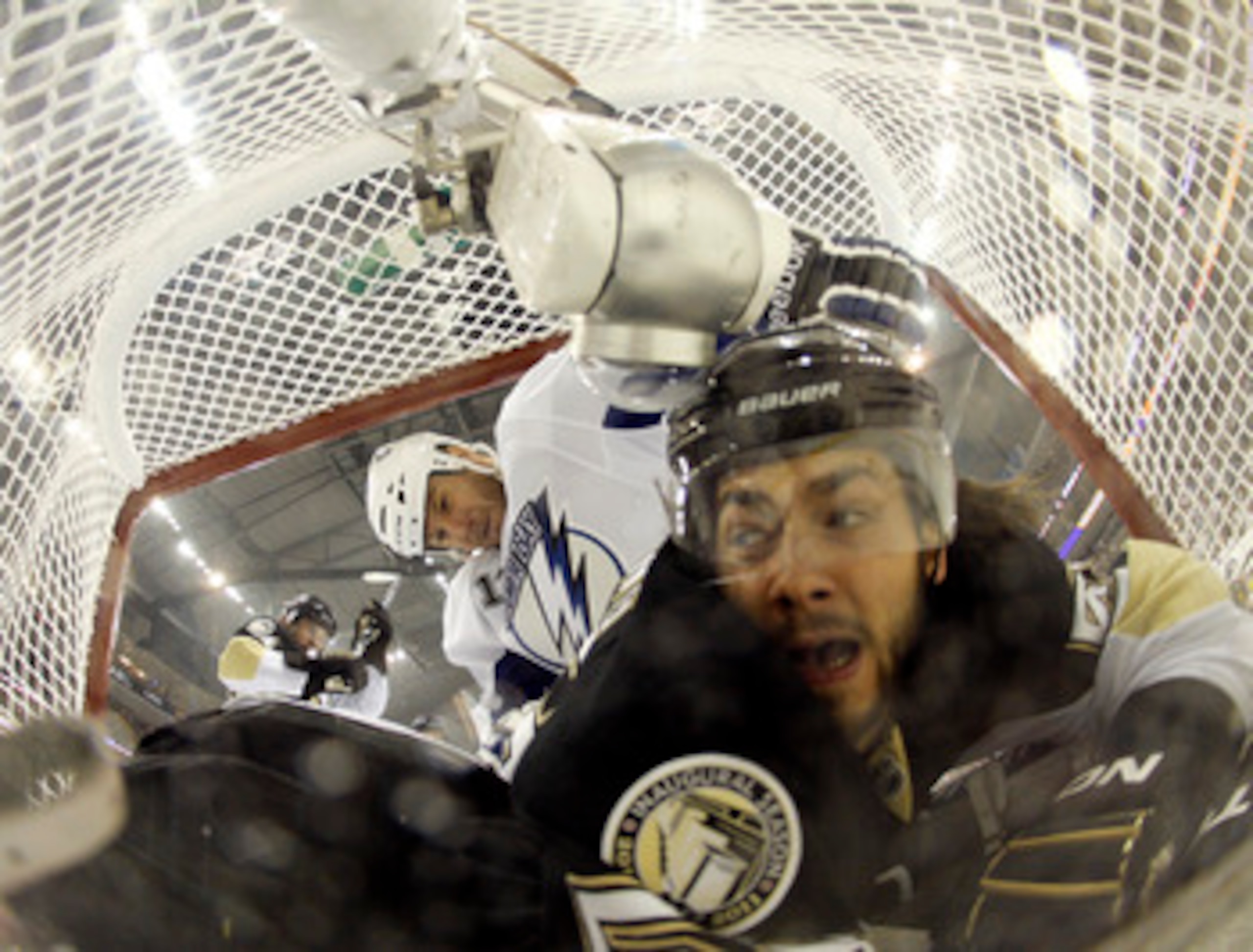
Sidney Crosby, Evgeni Malkin, James Neal, Kris Letang, Zbynek Michalek.
Chris Kunitz, Tyler Kennedy, Jordan Staal, Paul Martin, Ben Lovejoy.
This isn't an exercise is SEO. These are the potential power-play units for next year's club, and there are zero excuses for a third straight season of power play impotence.
The Penguins haven't had a power play unit finish better than 20th in the league for two straight seasons, parts of which have also included time from specialists Sergei Gonchar and Alex Goligoski.
The unit finished 25th in the league in 2010-11, with a meager 15.8 percent effective rate. The postseason was even more damning. The unit scored just once—once—despite having 35 chances on the man-advantage (25 of which were at home).
Personnel is no excuse for converting on 2.9 percent of one's power play chances.
The Penguins badly, badly need to figure out how to make the unit work in 2011-12.
Paul Coffey, a former Penguin and one of the most prolific power play scorers in league history, has expressed interest in coming to the team in a strictly advisory role, working only with the power play unit.
At this point, all options should be on the table.
.jpg?w=2560 "NHL Trade Grades Connor Hellebuyck")


.jpg?w=2560 "Latest Peyton-Colts Rumors")


.jpg?w=2560 "Landing Spots for Trade Candidates 📍")
.jpg?w=2560 "Ugly Jets Scoring Stat 😳")