Featured Video
Falcons May Have Figured It Out 🗣️

NCAA v NBA: Basketball Is Basketball
Kyle Slavin
You turn the corner tothe arena, and you can already hear the crowd screaming.
The thump of the musicseems to make the blood boil in your veins. It’s rattling you through the rafters, and you have yet to even reachyour seat. I mean, the fans are goingCRAZY. They’re all wearing the samecolor, and their frenzied cheers ripple through the arena like seismicshocks. The energy is palpable, alive onthe face of everyone you pass. And yes,it’s on your face too.
This is the game thatthe whole city has been talking about – hell, the whole country – and every fanhere knows they are in for something special. And maybe, just maybe, their cheer can transfer to the court, to inspiretheir team, to somehow make a difference in the outcome of the game.
TOP NEWS
Buzz: Knicks' KAT Offer Revealed

Buzz: Bron Chopper Part of Deal 🚁

MJ Makes Record-Setting Donation 🙌
Then, the lightscut. The screams become manic. And thegame begins.
Much has been made of the “rivalry” that NCAA basketball andthe NBA have with each other, and Spring is usually the time rears itshead. With March Madness and the playoffpush battling for air time, coupled with the absence of any baseball andfootball to cloud the public attention, this is the time when the most eyes areon the roundball.
And, as sports nuts are known to go a little bonkers withtheir debates and opinions, the topic of “which is better” invariably pops up,like the daisies, each and every Spring.
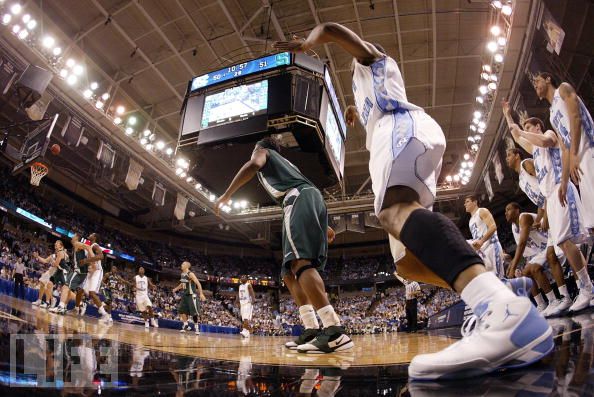 The argument is always convoluted and myopic. It usually concludes nothing, and gets thetwo sides nowhere. If you favored NCAAbasketball, would you really be swayed by anything the NBA-backer had tosay? You enjoy the crowd energy, theyouthful exuberance of the players, and the win-or-go-home anxiety of thetournament. It’s better basketball, yousay.
 But as an NBA fan, you tire of the argument that the collegekids “play harder”. You want to watchthe best athletes battle each other, and the pros just do things the college kidscan’t. These players have perfected thegame. They fly higher, they dunk harder,and when they collide you can feel it in your bones. It’s better basketball, you say.
Each and every Spring. Like the daisies.
The players quietlysit in front of their lockers. A couplehave their heads down, nodding to the beat of their go-to pump-up jam. The family, the friends, and all the everydaydistractions are slowly eased from their minds.
No one speaks. But they can feel the low rumble through thewalls, resonating like an oncoming tornado.
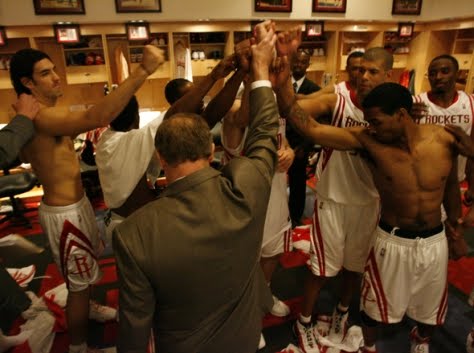 Every minute, everypep talk from the season has been geared towards this game. The team has already been through so muchtogether. Of course no one wants it toend. They know their game plan, and theirlimitations. If they are going to win,they had better execute perfectly. Andevery external force is geared to prevent that from happening.
The coaches comein. They take one last look around attheir team.
“Fellas…let’s go. It’s time.”
It’s true, the college game and the pros are two completelydifferent games. (That’s beforediscussing their different motivations, contracts, and pending shoedeals.) To say that you favor onebecause you are a “true basketball fan” really doesn’t lend credence to yourargument.
The goal for each team is to win basketball games. End of story. They just have a drastically different approach to accomplishing thatgoal.
Because of the great dilution of talent in collegebasketball, most teams don’t have a true
“first scoring option”. Obviously, ifyou have a Hakeem Olajuwon, you’re going to keep going to him, but there are347 D-1 teams, and there’s only been one Hakeem…ever.
“first scoring option”. Obviously, ifyou have a Hakeem Olajuwon, you’re going to keep going to him, but there are347 D-1 teams, and there’s only been one Hakeem…ever.
 This leads to a much greater emphasis on the coach, and hisset systems. Oftentimes, the winningteam has the most complete understanding of their coach’s system and how theirteammates behave within it. As a styleof play, it’s a bit more methodical. Swing the ball, observe. Swingback. Kick to the post, and kickout. Then a cut is made to where thedefense seems weak, and from there the defense’s reactions dictate theplay.
 I said methodical, mind you. Not tedious. Methodical.
Likewise, in the NBA, there is such a specialized set oftalents on each team that much of the game involves tossing the ball to yourstar player and either making it easier for them to operate, or getting out ofthe way completely. In most cases, theoffensive system is created to fit the players, and not the other way around.
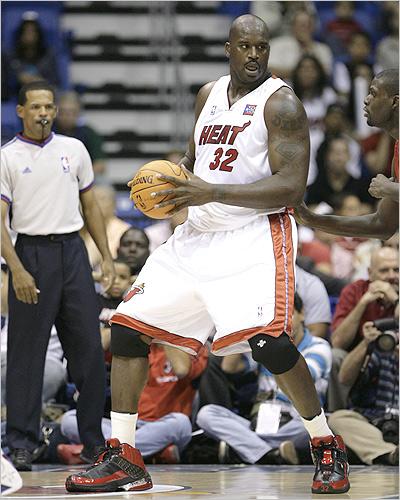 Dump the ball to Shaq, and let him do his thang. Put Michael, or , or AI on the free throw line extendedand, yes, let him do his thang. It’s abit more predictable, but “his thang” is usually more productive and reliablethan an X’s and O’s play. Besides, withthe 24-second shot clock in the NBA, there’s really not much time for a secondoption.
 You see more “unstoppable moves” in the NBA, which leads togreater creativity in trying to prevent them from happening. But you see more overall team involvement inthe NCAA, which comes across as more fundamentally sound.
But that is the great thing about basketball. No matter what your game plan entails, anyteam can beat you on any given night. Even the best players can have a bad outing, and even the worst playerscan randomly catch fire. And that istrue for the NBA and NCAA alike.
Besides, if we just gave teams the victories, where would wego for hot dogs and beer?
The two teams havebeen absolutely killing it the entire night.
Every shot has beenmatched, every big play countered. Playersare literally flying around the court, chasing loose balls into the stands, andlooking for any edge they can gain against their opponents. Just when the visitors seemed like they wouldpull away, the home team gets a big defensive stop. The point guard gets the ball, puts his handup, and walks the ball into the front court for a pivotal offensive set.
The entire stadiumknows the weight of this possession, and as the point guard crosses the halfcourt line, their frenzied but weary game-long cheering slowly, yet pointedly,reaches a crescendo.
One by one, every fanrises from their seat, and screams as loud as they humanly can.
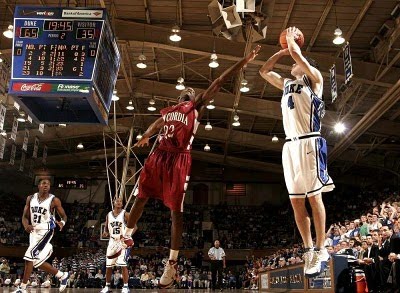 The play sets up. The shooting guard makes a quick cut alongthe baseline, and gets the ball on the wing. A big man comes up to set him a screen, but as he goes around it, hepulls both defenders, and looks trapped. There is dangerously little left onthe clock. The player hesitates, then risesup and fires a quick pass to the cutting high post, who swings a pass to theopen small forward in the far corner.
 He catches the ball,and sizes up the three-pointer. Therecovering defender is running, full-speed, directly at him. With no time remaining and no other options,the small forward elevates, hangs, and lets the ball go.
It clears theadvancing defender’s fingertips by inches.
And that’s the point. It’s basketball.
You can’t argue if one style of basketball is better thananother. You just can’t. In the ebbs and flow of a given ball game,and the countless attacks and adjustments that occur on any given play, we arereally arguing the same thing.
If you’re a multi-millionaire or a college kid with AdvancedBio in the morning, your goal is the same. You are there to make that shot. You are there to complete that play. It’s your only job, whether you get paid for it or not.
To hell with systems. You are there to win the game.
And how you plan to accomplish that has been set inmotion long ago.
Falcons May Have Figured It Out 🗣️



.jpg?w=2560 "Love's Body Already 'Tired'")

.jpg?w=2560 "Tyreek Deal May Come Soon")
.jpg?w=2560 "Mahomes' Wife Trolls Kubiak 💀")